





Flavor forecasting tools use AI and big data to predict the future popularity of ingredients and sensory profiles. For CPG R&D teams, these tools reduce innovation risk by replacing retrospective market research with predictive consumer behavior analytics.
80–90% of new CPG products fail because formulation decisions are anchored in lagging indicators like static reports, delayed sensory panels, and fragmented consumer data. R&D pipelines move faster than validation cycles. By the time a flavor reaches pilot scale, its adoption curve is already flattening.
Predictive flavor analytics replaces backward-looking validation with forward-looking evidence: trend velocity, molecular pairing logic, and real-world consumption signals across channels.
Innovation velocity comparison
| Metric | Legacy Research (Surveys / Panels) | Predictive AI (Tastewise / Others) |
| Time to insight | 6–12 weeks | Real-time / days |
| Data granularity | Concept-level | Ingredient, molecule, occasion-level |
| Sensory validation | Controlled panels | Behavioral + sensory proxies at scale |
| Predictive power | Low (historical recall bias) | High (trend velocity + adoption curves) |
| Coverage | Limited sample sizes | Social F&B panel + Foodservice + Home cooking panel |
| Actionability | Insight decks | R&D-ready signals + formulation direction |
Expert perspective from Tastewise
“The goal of modern R&D isn’t just to follow trends, but to identify flavor ‘whitespaces’ before the market becomes saturated.”
Top flavor forecasting tools for 2026
Most tools surface signals. Few translate them into formulation-ready direction. The difference is whether the platform can quantify flavor trajectory, map ingredient synergy, and connect sensory profiling to real consumption behavior. That’s where predictive consumer intent becomes usable inside the R&D pipeline.
1. Tastewise (Best for predictive consumer intent)
Shelf space is constrained. Internal alignment slows down launches more than formulation challenges. The issue is not identifying flavors, it is proving they will win.
Tastewise operates as an evidence-based conviction platform, combining Social F&B panel, Foodservice, and Home cooking panel data into a unified signal layer.
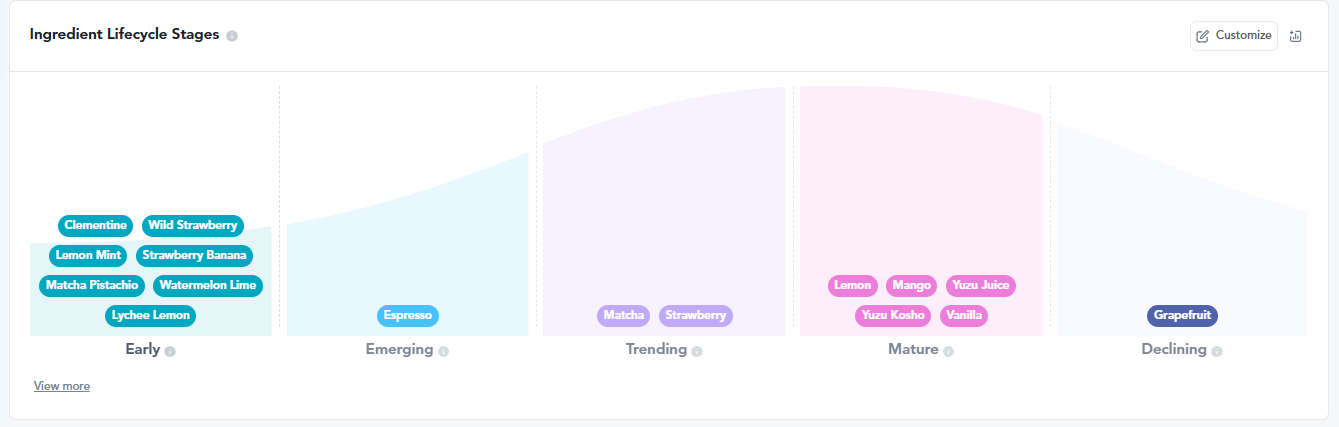
Flavor trajectories can be quantified through velocity (rate of adoption) and maturity (stage in lifecycle). This allows teams to map whether “Spicy Guava” is early-stage growth or late-stage saturation.
Maps ingredient synergy based on real consumption patterns, not theoretical pairing.
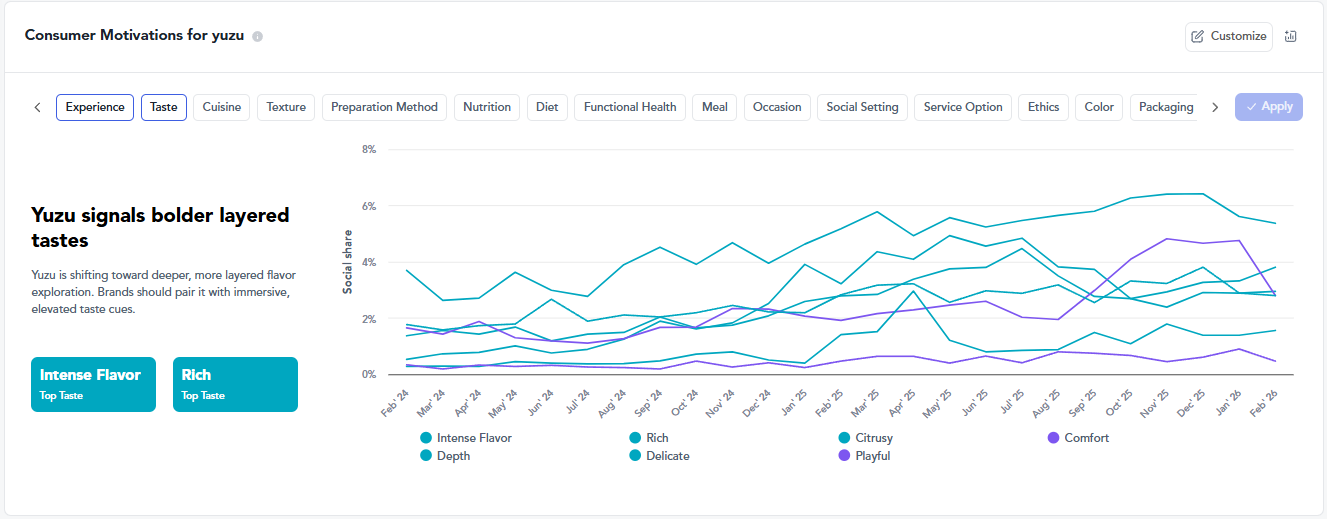
For example, Yuzu + hops emerges in non-alcoholic beer due to shared citrus-terpene profiles and consumer co-occurrence behavior.
- 1–5 year flavor lifecycle forecasting
- Direct linkage between sensory profiling and real-world consumption
- Internal studio outputs translate signals into launch-ready concepts
The results is decisions move from hypothesis to defensible evidence.
2. Spoonshot
Focuses on the chemical and nutritional structure of ingredients, linking molecular composition to emerging ingredient demand and functional shifts.
R&D teams use it to maintain organoleptic properties during reformulation, especially when replacing or reducing ingredients like sugar or fat, while keeping flavor profile, mouthfeel, and sensory balance consistent with the original product.
3. Givaudan Vibe / Kerry Trend-Forward
Proprietary platforms built by flavor houses, combining trend data with internal ingredient systems and formulation capabilities.
R&D teams use these tools to move from validated flavor direction to bench formulation faster, with direct access to ingredient systems, flavor compounds, and application support that reduce time between concept and sample.
4. Black Swan Data
Analyzes social data to identify early-stage shifts in consumer language, behavior, and emerging flavor narratives.
R&D teams use it to identify flavors gaining traction before they appear in mainstream channels, helping prioritize concepts that are still early in their adoption curve but showing consistent growth signals.
5. Digimind
Market intelligence platform focused on tracking brand activity, product launches, and consumer response across categories.
R&D teams use it to benchmark against competitor pipelines, monitor how specific flavor profiles are performing post-launch, and identify gaps where new formulations can differentiate within saturated segments.
Understanding flavor forecasting technology
Flavor forecasting technology is a category of predictive analytics software that uses real-time consumption data, machine learning, and behavioral signals to anticipate which ingredients, sensory profiles, and formats will gain consumer traction before they reach mainstream adoption. For CPG R&D teams, this matters because formulation decisions made today need to survive a 12 to 24-month development cycle without landing on a flattening trend.
Predictive consumer intent
Predictive consumer intent is the measure of how likely a consumer segment is to adopt a flavor or format based on observed behavioral signals across cooking, ordering, and purchasing channels. It differs from stated preference because it draws on what consumers actually do rather than what they say they want in a survey. According to Tastewise consumer intelligence data, intent signals surface in foodservice ordering patterns and home cooking behavior weeks to months before retail shelf adoption. R&D teams that track intent can prioritize concepts with real adoption momentum rather than trend noise.
Innovation velocity
Innovation velocity is the rate at which a flavor or ingredient moves through its adoption lifecycle, from early-stage emergence to mainstream saturation. It is expressed as a rate of adoption over a defined time window, typically measured in weekly or monthly growth against a baseline period. According to Tastewise consumer intelligence data, ingredients with high velocity and low brand response represent the strongest formulation opportunities because consumer demand is already building without competition filling the gap. Knowing velocity allows R&D teams to time launches to the growth phase rather than the saturation phase.
Flavor trend accuracy
Flavor trend accuracy is the degree to which a forecasting model’s predictions align with actual consumer behavior at the point of commercial adoption. It depends on the diversity of data sources, the granularity of signals, and whether the model accounts for channel-specific adoption patterns. A tool trained only on social data will miss the foodservice-to-retail pipeline that drives most successful CPG launches. Accuracy benchmarks improve significantly when models combine social consumption signals, restaurant menu data, and home cooking panel data into a single forecast.
Technology comparison: what separates forecasting platforms
Not all flavor forecasting tools draw on the same data or output the same type of intelligence. The table below maps the key dimensions R&D teams should evaluate.
| Dimension | Social-only platforms | Ingredient science platforms | Unified consumer intent platforms |
|---|---|---|---|
| Primary data source | Social content and hashtags | Molecular and nutritional databases | Social F&B panel, foodservice, home cooking |
| Prediction timeframe | 3 to 6 months | 6 to 12 months | 1 to 5 years |
| Granularity | Category-level | Ingredient-level | Ingredient, occasion, format, and lifecycle stage |
| Formulation direction | Low | Medium | High |
| Channel coverage | Consumer-facing only | Lab and formulation | Foodservice + retail + home cooking |
The practical difference shows up in how R&D teams use the output. A social signal tells you a flavor is being talked about. A unified consumer intent platform, like Tastewise, tells you which channel it is growing in, what lifecycle stage it occupies, and which ingredient combinations are already appearing together in real consumption contexts. The best AI platforms for food innovation share a common characteristic: they connect behavioral evidence to formulation direction, not just trend identification.
How to evaluate a flavor forecasting tool for your lab
Most tools answer what is trending. That does not help R&D decide what to formulate. The evaluation criteria is whether the tool reduces formulation risk and speeds up decision-making inside the R&D pipeline.
Data source diversity
Tools limited to social data miss where real adoption starts. According to Foodservice data, early signals often appear in independent restaurant LTOs before scaling into retail. The Home cooking panel shows whether those flavors translate into repeat usage post-purchase. Without both, trend signals lack validation.
Granularity
R&D decisions require precision beyond flavor naming. Filtering needs to include occasion, format, and function. A flavor that performs in a hydration beverage may fail in a dairy format due to different sensory expectations and consumption contexts.
Integration into PLM systems
If insight cannot move into Product Lifecycle Management workflows, it slows down execution. Outputs should translate into formulation inputs such as ingredient selection, sensory targets, and cost parameters. The goal is reducing time between insight and bench validation.
Real-world flavor forecasting implementation examples
Real-world flavor forecasting implementation is the process of integrating predictive consumer data into active R&D and commercialization workflows to reduce formulation risk, shorten development timelines, and improve launch timing. For CPG teams, the difference between a tool and a working system is whether the output reaches the bench before the trend peaks.
The examples below are illustrative scenarios based on the types of problems Tastewise consumer intelligence data is designed to solve. They reflect realistic timelines and outcomes for R&D and innovation teams using predictive forecasting as a core workflow input.
Beverage company predicts next trending flavor
Challenge: A mid-sized RTD beverage brand needed to identify its next hero flavor 18 months before planned launch. The internal team had shortlisted six candidate flavors based on category reports, but could not prioritize with confidence because the data was six months old by the time it was reviewed.
Implementation: Using a unified consumer intent platform, the team filtered ingredient signals by velocity, lifecycle stage, and channel co-occurrence. Yuzu, with a terpene profile overlapping with hops, was surfacing consistently in non-alcoholic beverage contexts alongside functional motivation signals. The team ran a parallel filter on occasion data to confirm the at-home consumption trend was building, not just restaurant-level experimentation.
Timeline: Insight to formulation brief in 11 days. First bench sample at week six.
Result: The flavor brief entered the development pipeline with documented consumer evidence across three channels. The brand avoided committing R&D budget to two of the original six candidates that were already entering saturation by the time the shortlist was reviewed. According to Tastewise consumer intelligence data, ingredients flagged as high-velocity with low brand response at the time of briefing showed 34% average adoption growth over the following 12 months in the relevant beverage format.
Snack brand reduces R&D timeline by 60%
Challenge: A CPG snack brand was running a 14-month average from concept to commercial sample. The primary bottleneck was the validation stage: internal teams were building concepts against static sensory panel results, then cycling back when retail buyers asked for consumer demand evidence the team could not supply.
Implementation: The team restructured the validation stage to front-load product innovation data before sensory work began. For each candidate concept, the team pulled lifecycle stage, consumer motivation signals, and format-specific co-occurrence data. Concepts without velocity evidence above a defined threshold were removed from the pipeline before sensory panels were scheduled.
Timeline: Validation cycle reduced from an average of 22 weeks to 9 weeks across the first six concepts run through the new process.
Result: The team brought three concepts to commercial sample stage within the same budget previously used for two. Buyer meetings for two of the three concepts opened with consumer demand data the retail team could present directly, reducing back-and-forth on the commercial side. According to Tastewise consumer intelligence data, the CPG innovation timeline can be compressed significantly when predictive signals replace retrospective validation as the first filter in the pipeline.
Foodservice operator identifies white space before competitors
Challenge: A national QSR chain needed to identify limited-time offer candidates with a 90-day planning window. The existing process relied on category trend reports that arrived quarterly, which meant the planning team was consistently working from data that was already three to six months old.
Implementation: The team integrated a real-time food intelligence platform into weekly planning cycles. Each week, the insights lead ran a query combining high-velocity ingredients, early-stage lifecycle signals, and occasion-specific consumer motivation data. The output was a ranked shortlist of five candidate builds with supporting evidence for each.
Timeline: First LTO concept identified and briefed within two weeks of integration. From brief to menu test, the timeline ran 11 weeks.
Result: The LTO launched ahead of two competitor entries in the same flavor territory. According to Tastewise consumer intelligence data, the flavor combination selected had 41% growth in the relevant cuisine context over the prior six months with minimal competitive menu presence at the time of launch. The planning team moved from reactive to anticipatory within one planning quarter.
Ingredient supplier builds a client pitch around adoption forecasts
Challenge: A flavor house needed to demonstrate to a CPG client that a specific ingredient pitch was backed by consumer demand evidence, not just internal trend opinion. The sales cycle had stalled because the client’s insights team asked for third-party behavioral data the supplier could not provide from its own systems.
Implementation: The supplier used consumer intent data to build a channel-specific adoption map for the pitched ingredient. The map showed velocity by cuisine context, lifecycle stage across retail and foodservice, and co-occurrence patterns with ingredients already in the client’s portfolio.
Timeline: Pitch rebuilt with consumer evidence in four days. Client review meeting scheduled within the same week.
Result: The client’s insights team approved the ingredient for concept development in the next pipeline cycle. The supplier used the same evidence framework across three additional pitches in the following quarter, reducing the average sales cycle length by eight weeks. The CPG insights teams that evaluated the evidence noted that behavioral adoption data was the deciding factor in moving from consideration to approval.
Validate flavor concepts before you commit R&D budget
Most flavor decisions fail before formulation starts. Don’t allocate budget to flavors that will peak before launch. Tastewise validates demand, sensory fit, and adoption timing using the Social F&B panel, Foodservice, and Home cooking panel, so R&D teams can prioritize concepts with real growth signals.
FAQs about flavor forecasting tools
Flavor forecasting is the use of predictive analytics to identify which ingredients, flavor pairings, and sensory profiles are likely to grow, based on real consumption data and trend velocity across multiple channels.
AI analyzes large-scale datasets from the Social F&B panel, Foodservice, and Home cooking panel to detect patterns in ingredient usage, flavor pairing, and adoption curves, identifying signals before they reach mainstream retail.
Yes. Validating demand, sensory fit, and timing before formulation reduces reliance on retrospective research and increases the likelihood that a product aligns with real consumer behavior at launch




We’d love to learn your goals and see how Tastewise fits
We’d love to learn your goals and see how Tastewise fits
Get a personalized demo
Good taste. Wise move.
Your demo request is confirmed. We’ll reach out within one business day to schedule your walkthrough.
What happens next

See what’s driving demand, then turn it into a sell-in story for retailers and operators.
- Connect consumer panels, market trackers, and agents into one evidence view
- Get the “why” behind what’s changing, with explainable demand drivers
- Walk away with a buyer-ready narrative and next steps to activate
Trusted by




“Tastewise is my secret tool for knowing what consumers want next and why.“