





A focus group tells you what twelve people remembered about a drink last month. A survey report lands on your desk six weeks after fieldwork closed. In that window a flavor can move from a handful of cafe menus to almost 390,000 menu items, which is exactly what matcha did in the US. Using ai for market research closes that gap by reading what people already ordered, cooked and bought, then reporting it while you can still act. Tastewise turns that unstructured behavior into demand signals your innovation and insights teams can take into a launch meeting.
Key takeaways
- AI market research reads live behavioral data from menus, retail listings, recipes and social conversation, so a signal reaches you in the same month it moves rather than a quarter later.
- Consumer conversation moves before operators commit. US social mentions of matcha grew 32.3% over the past year while its operator menu share grew 13.4% to 7.9%.
- The earliest signals sit at tiny volume. Sudachi is up 293.7% and strawberry hibiscus 247.4% in US beverage conversation, both still under 0.02% social share.
- Menu depth reveals conviction. US operators carrying matcha now run 5.7 matcha items each, up 69.3%, while the average price held at $7.93.
- Format is where margin hides on shelf. Functional drink powders average $11.57 across 58 US products against $7.78 for the 481 bottled products.
- The insights industry itself has passed $150 billion, and agentic AI has already settled into analysis, reporting and data preparation work inside research teams.
What is AI market research and why is it vital for F&B growth?
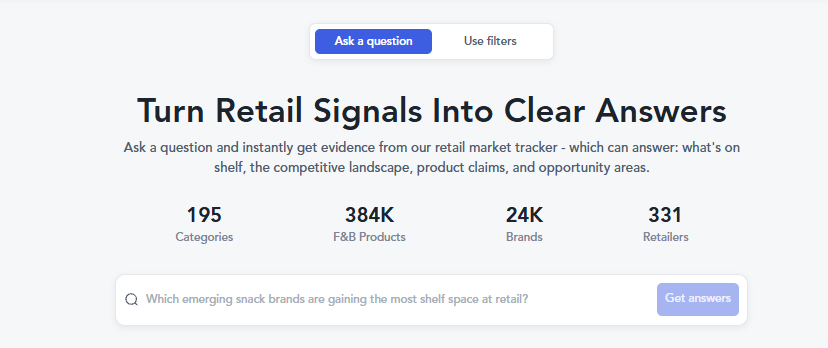
AI market research is the application of machine learning and natural language processing to aggregate, analyze and interpret real-time consumer behavior data at scale. Deploying ai for market research lets food and beverage teams detect emerging flavor trends, evaluate dietary shifts and forecast purchasing intent months before any of it reaches a sales report.
The distinction that matters for your category is source material. Traditional food market research asks people to describe intent. An ai powered market research platform reads the choices they already made, which arrive continuously and in volume.
The cost of fragmented research methods
Most insights teams run three or four disconnected inputs. A syndicated report frames the category, a scanner feed shows what sold last quarter, a social listening tool reports spikes in chatter, and a survey vendor validates a concept after the brief is already written. Each one answers a different question on a different clock.
Combining ai and market research into one continuous read removes the stitching work. It also removes a specific blind spot. When menu data, retail listings and consumer conversation sit in separate tools, nobody sees the moment a flavor crosses from conversation into commitment. That crossing is the buy signal, and it is usually the thing an innovation pipeline is waiting for.
The practical cost of the gap is timing. An ai tool for market research that refreshes monthly will surface a rising ingredient while the formulation window is still open. A quarterly report surfaces it once three competitors have already launched.
Market growth and adoption trends
The research sector is funding this shift with real money. ESOMAR data reported in Research World puts the global insights industry past US$150 billion as of 2024, with research software the largest sector inside it. That is the spend behind rising interest in ai market research automation market size and in ai market research platform market size 2026 as search terms.
Adoption is further along than most category teams assume. Greenbook’s 2026 GRIT Insights Practice Report finds the industry has converged on three tasks where agentic AI is already embedded, namely analyzing data, updating reports, and preparing and integrating data. The same report puts recognition of insights operations at 80% among both brand-side researchers and analytics professionals.
For a food and beverage brand the implication is narrow. Generative ai market research is now table stakes for processing speed. The differentiator is whether the underlying data is built for your category or borrowed from a general-purpose corpus.
How modern analytics transform real-time demand signals into brand strategy
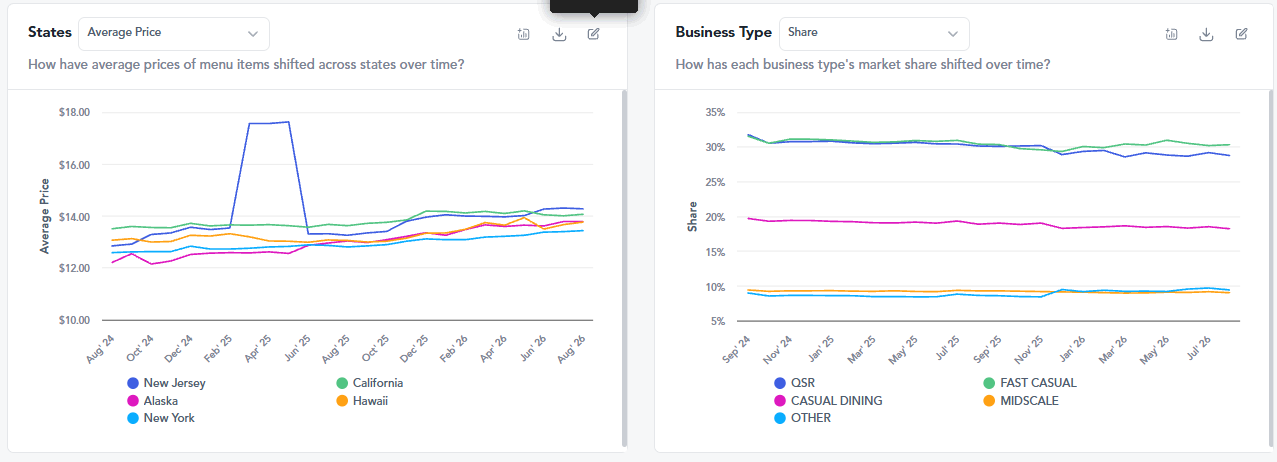
Tastewise reads unstructured behavior that never enters a survey. Recipe uploads, restaurant menu updates and retail product listings all arrive as raw text. So do consumer posts. The platform then classifies that text into ingredients, dishes, claims and occasions, which is what makes a flavor countable.
Evaluating platform capabilities
When you evaluate the best ai tool for market research for a food and beverage team, the qualifying questions are narrower than the generic vendor checklist suggests. Ask whether the platform covers more than one channel, because a signal confirmed in only one place is noise. Ask whether it reports share and growth rather than raw mention counts, since volume alone will always favor whatever is already mainstream. Ask how it handles a term that has almost no volume yet, because that is where the opportunity sits.
Teams comparing the best ai market research tools should also test the exit. Insight that cannot leave the platform and enter a buyer deck or a formulation brief is decoration. This is where agentic AI has changed the work, because an agent can run the pull, structure the answer and hand it to the person who needs it.
A worked example in functional beverages
Here is what using ai in market research looks like on a live US category, pulled over the twelve months to July 2026.
Start with the consumer layer. Matcha holds 1.03% of US beverage conversation and grew 16.6%, which puts it in the trending lifecycle stage. Hibiscus sits at 0.13% and grew 7.25%. Acai, at 0.04% and 4.17%, reads as mature. Those three tell you what is safe.
The interesting rows are the ones a survey would never surface. Sudachi, a Japanese citrus, grew 293.7%. Strawberry hibiscus grew 247.4%. Both sit at or below 0.01% social share, which means no survey sample would return them and no scanner data would show them. They are classified as emerging, and that is the window.
Now validate against operators, because conversation alone does not justify a SKU. US social mentions of matcha grew 32.3% over the past year to 1.11% share. Operator menu share grew 13.4% to 7.9%. Total matcha menu items reached roughly 390,000, up 117.7%. Items per operator carrying matcha reached 5.7, up 69.3%. Average price held flat at $7.93, moving 0.5% down over the year.
Read those five figures together and you get a formulation decision. Consumers are moving faster than menus, operators are deepening their matcha lineups rather than testing a single item, and none of that depth has forced price down. The category is expanding on volume rather than discounting, which supports a premium launch instead of a value one.
The named builds show you the flavor direction. Caribou Coffee runs a Lavender Matcha Tea Latte at $6.47 and a Frozen Matcha with Bubbles at $7.55. The Cheesecake Factory added a Matcha Latte at $6.95. Wawa carries Matcha Cream and Mint Matcha Iced Tea in convenience. Beignets & Brew has run Pumpkin Biscoff Crumble Matcha and Tiramisu Matcha as limited time offers at $8.45. SunLife Organics prices a Yuzu Matcha at $14.00, and Jamba’s Gotcha Matcha with Sweet Cloud Whip has reached college dining. Rita’s Italian Ice added a Frozen Matcha at $7.99.
That list is the actual brief. Matcha is pairing with botanicals, citrus and dessert formats, it is moving into frozen and convenience, and the ceiling on price is higher than the category average. Sudachi is a citrus. Strawberry hibiscus is a botanical and fruit pairing. The emerging rows and the operator builds point the same direction, which is the cross-source confirmation that makes a concept defensible in a stage gate.
How category leaders optimize omnichannel performance using AI
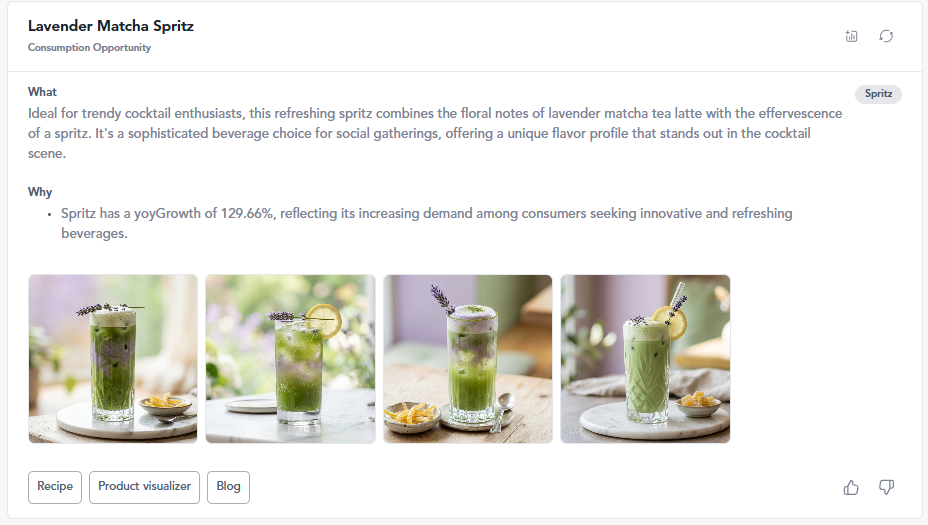
A single channel gives you a partial answer. Social conversation shows interest, menus show operator commitment, and retail listings show what a shopper can actually put in a basket. The brands getting this right read all three against each other, which is the working definition of AI in the food industry as it is practiced now.
Next-gen AI engines vs legacy research
Legacy panels recruit a sample, ask it questions and report back. The method is sound and the output is slow, bounded by the size of the panel and the date fieldwork closed. Continuous ai-driven market research services read the whole observable market instead.
Take the retail shelf for US plant-based and functional drinks. Bottled products dominate on count at 481 SKUs with an average price of $7.78, and they carried 15 of the recent launches. Powder sits at 58 products with an average price of $11.57 and no recent launches. Sachets number three, at an average of $16.62. Bags come in at 107 products and $5.28.
A panel study would have told you consumers like functional drinks. The shelf tells you the powder and sachet formats carry a meaningful price premium with almost nothing launching into them. That is a format gap you can brief, and it is the kind of read that supports a retail sell-in conversation with a buyer who wants evidence rather than a category thesis. For a broader view of the vendor landscape, our guide to CPG market research companies covers how these inputs fit together.
Synchronizing innovation with consumer demand
The value of ai in market research shows up when three functions read the same number in the same week. Here is how that lands across a team.
R&D takes the emerging rows. Sudachi and strawberry hibiscus are the formulation shortlist for the next sampling round, because they have growth and no crowding.
Product marketing takes the pairing data. Lavender, yuzu and dessert cues are already carrying matcha through cafe and convenience menus. Those are the flavor stories with proven consumer pull behind them.
Retail and foodservice teams take the format and price data. Powder and sachet formats support a higher price point on shelf, and the flat $7.93 menu average means an operator pitch should lead with menu depth rather than a discount. The product innovation workflow keeps those three views on one dataset, and an AI trend prediction agent refreshes them without a new research request each time.
Set a cadence and the alignment holds. Monthly is enough for most beverage categories. Weekly matters during an LTO window, when a flavor can gain or lose a season in six weeks.
Frequently asked questions about AI for market research
AI market research is the use of machine learning and natural language processing to collect and interpret real-time consumer behavior data at scale. In food and beverage it reads menus, retail listings, recipes and social conversation, which is how a signal like sudachi at 293.7% growth becomes visible while it still sits under 0.01% social share.
A survey records what people say when asked. AI market research records what they already did. Both matter, and the difference is timing and scale. US matcha menu items grew 117.7% over the past year to roughly 390,000, a movement no panel of a few thousand respondents would have captured at that resolution.
Look for multi-channel coverage and for share and growth reporting rather than raw counts. Check that low-volume emerging terms are covered, and that there is an export path into the documents your team actually uses. A platform that reports matcha at 7.9% operator menu share and 1.11% social share in the same view is doing the work a single-source tool cannot.
It supports them with observed prices rather than stated willingness to pay. US matcha menu items averaged $7.93 over the past year and held that level while item counts more than doubled, which argues against discounting into the trend.
Insights, R&D and commercial teams, in that order of first contact. Insights runs the pull, R&D takes the emerging ingredient list into formulation, and sales teams take the channel and price evidence into retailer or operator meetings. You can request a custom report if you want to see your own category cut before committing to a platform.
How often should we refresh the data?


We’d love to learn your goals and see how Tastewise fits
We’d love to learn your goals and see how Tastewise fits
Get a personalized demo
Good taste. Wise move.
Your demo request is confirmed. We’ll reach out within one business day to schedule your walkthrough.
What happens next

See what’s driving demand, then turn it into a sell-in story for retailers and operators.
- Connect consumer panels, market trackers, and agents into one evidence view
- Get the “why” behind what’s changing, with explainable demand drivers
- Walk away with a buyer-ready narrative and next steps to activate
Trusted by




“Tastewise is my secret tool for knowing what consumers want next and why.“