





A food market research company or agency provides CPG brands with data on consumer behavior, retail sales, and flavor trends. A modern insights stack typically combines real-time AI consumer intelligence, historical retail scanner data, and traditional syndicated reports.
- AI predictive intelligence: Tastewise
- Retail scanner data: NielsenIQ
- Syndicated research: Mintel
CPG teams evaluating CPG market research companies are no longer choosing a single vendor. The requirement is a combined stack: predictive analytics for future demand, POS data for validation, and syndicated research for macro context.
AI-powered market intelligence & predictive solutions
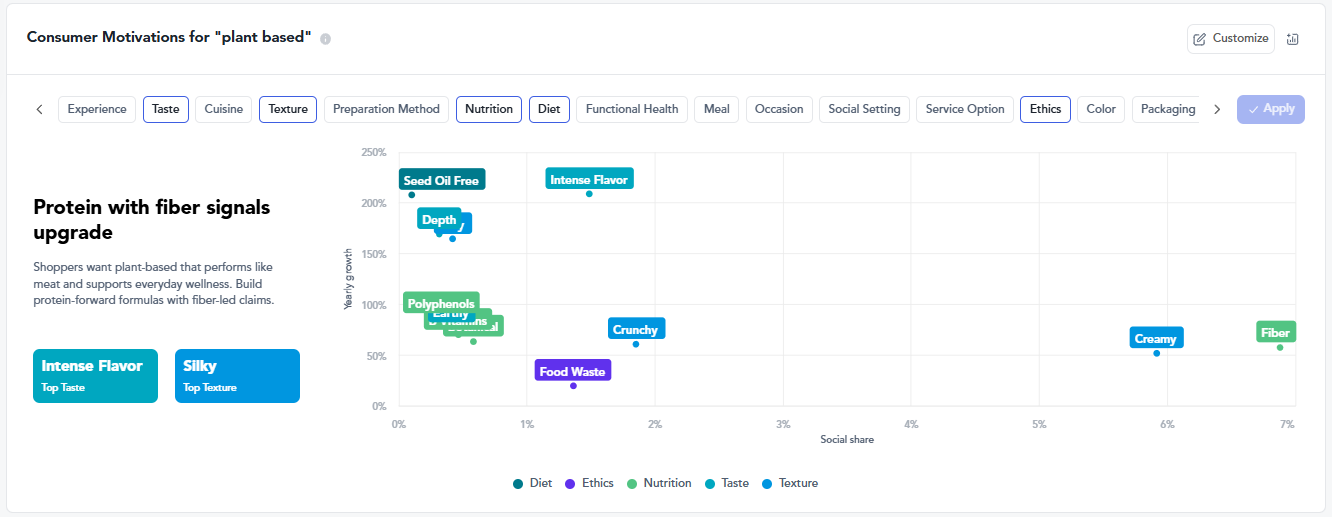
AI platforms are now a required layer within the CPG market research companies, focused on predicting behavior using unstructured data.
1. Tastewise
Best for: Predictive flavor innovation and real-time consumption signals
Tastewise is a GenAI consumer intelligence platform built for food and beverage. It analyzes real-time consumption data across social, menus, and home cooking to help teams validate concepts, identify emerging demand, and move from signal to execution with explainable evidence.
2. Black Swan Data
Best for: Early cultural signal detection and predictive trend modeling
Black Swan Data analyzes large-scale online conversations to identify emerging behaviors and forecast trend trajectories, often used as a macro radar for early-stage opportunity identification.
3. Trend Hunter
Best for: Cross-industry trend discovery and inspiration
Trend Hunter provides broad trend reports and consumer insights across industries, used for ideation and directional thinking rather than category-specific validation.
4. AI Palette
Best for: Concept generation and early-stage idea screening
AI Palette focuses on turning trend signals into product concepts and ranking them based on predicted consumer appeal, supporting faster innovation cycles within CPG teams.
5. Meltwater
Best for: Brand sentiment tracking and media intelligence
Meltwater aggregates social, news, and digital media data to monitor brand perception, campaign performance, and consumer sentiment at scale.
Retail scanner data & POS analytics companies
As you compare food intelligence platforms side by side, legacy retail and POS systems stand out for providing verified sales data and market share within CPG market research.
6. NielsenIQ (NIQ)
Best for: Global retail sales tracking and market share analysis
NielsenIQ provides barcode-level POS data, enabling teams to track shelf velocity, pricing, and distribution across retailers worldwide.
7. Circana (IRI & NPD)
Best for: Integrated retail and foodservice performance data
Circana combines retail scanner data with consumer panel and foodservice insights to provide a full view of purchasing behavior across channels.
8. SPINS
Best for: Natural and wellness category tracking
PINS specializes in health-focused and natural product categories, offering detailed insights into emerging brands and attributes within these segments.
9. Numerator
Best for: Omnichannel purchase behavior via consumer panels
Numerator uses receipt-scanning panels to track consumer purchases across retail, e-commerce, and foodservice, providing household-level insights.
10. Kantar
Best for: Global consumer panel data and Worldpanel tracking
Kantar delivers longitudinal consumer panel data to understand brand penetration, loyalty, and purchasing behavior across international markets.
Traditional food market research agencies & syndicated reports
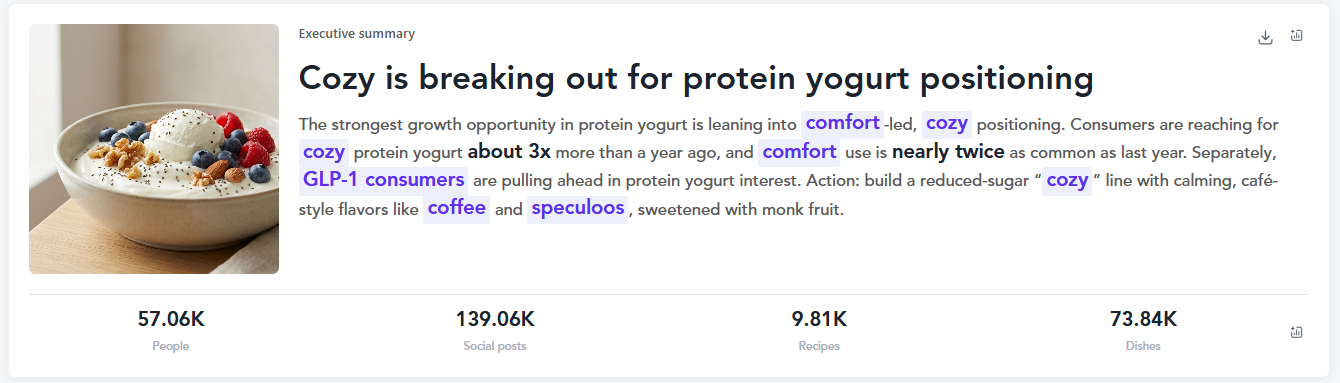
Syndicated research firms are a foundational layer within CPG market research companies, used for category sizing and strategic validation.
11. Mintel
Best for: Consumer research, product tracking, and market reports
Looking at Tastewise compared with Mintel, Mintel serves as a foundation for structured research, GNPD product launch tracking, and strategic benchmarking, while Tastewise complements this with real-time consumption signals and AI-generated workflows.
12. Datassential
Best for: Foodservice menu tracking and operator insights
Datassential focuses on restaurant menus, operator behavior, and foodservice trends, helping brands understand what is appearing and scaling on menus.
13. Euromonitor International
Best for: Global market sizing and economic analysis
Euromonitor delivers macro-level data on industries, economies, and consumer markets, supporting long-term strategic planning.
14. Innova Market Insights
Best for: Ingredient and packaging trend tracking
Innova tracks product launches and ingredient claims, helping teams monitor innovation patterns and positioning strategies.
15. Technomic
Best for: Foodservice consulting and operator research
Technomic provides insights into restaurant performance, operator strategies, and menu trends, often used for foodservice-focused decision-making.
Comparison of food market research vendor types
| Vendor Type | Core Data Source | Primary Use Case | Time Horizon |
| AI predictive platforms | Unstructured data (social, menus, recipes) | Predict future demand, validate concepts | Forward-looking |
| Retail scanner data | POS and transaction data | Track sales, market share, shelf velocity | Historical |
| Syndicated research | Reports, surveys, expert analysis | Understand macro trends and category context | Mixed |
How CPG teams use these market research tools in practice
The scenarios below are illustrative, not case studies of named clients. Each one shows how the three vendor types cover different parts of the same decision.
Validating a new flavor before launch
The challenge: a mid-size beverage team is weighing yuzu for its RTD line and needs to know whether the flavor is early, peaking, or already crowded before it commits budget.
The approach: an AI platform reads real-time consumption signals across social, menus, and home cooking to show the shape of the interest curve and which consumer groups are driving it. Syndicated reports place that inside the wider citrus picture and the competitive set. Scanner data shows whether adjacent yuzu SKUs are moving in specialty retail.
The outcome: the team enters concept development with direction, category context, and current performance in one view, instead of debating whether the trend is real.
Tracking emerging competition before it reaches scanner data
The challenge: a category manager at a snack manufacturer wants to know whether a set of better-for-you challenger brands is picking up genuine consumer traction, ahead of the next quarterly scanner read.
The approach: cultural conversation tracking shows how quickly those brands and their claims are being discussed. An AI consumer intelligence layer shows which health attributes, high protein and gut health among them, are gaining consumption signal in the same category. Natural channel data shows whether any of that interest is converting to sales in specialty retail.
The outcome: the team sees the movement in conversation and demand signal first, and the sales confirmation second. That sequencing is what creates room to respond on formulation and distribution rather than after a share loss.
Building the business case for a new line
The challenge: a product development director has to take a functional food concept to the executive team and needs forward-looking demand evidence alongside category-level sizing.
The approach: an AI platform supplies the demand signal and the consumer language behind it. A syndicated firm supplies market sizing for the functional segment. A retail and foodservice tracker supplies channel-level performance on how functional products are selling now.
The outcome: the proposal answers the three questions leadership always asks. How big is this, what is happening today, and where is it heading. Each answer comes from a different source, which is harder to argue with than a single-vendor deck.
How to conduct food market research effectively in 2026
Most teams evaluating the CPG market research companies are solving for speed, validation, and alignment across functions.
Step 1: Predict the future
Use AI consumer intelligence platforms to identify emerging demand signals and validate concepts before launch.
Step 2: Track the past
Use POS scanner data to understand what is currently selling, where, and at what velocity.
Step 3: Understand the macro context
Use syndicated research to frame category growth, competitive landscape, and long-term drivers.
A single-source approach creates gaps. A combined system allows teams to defend decisions with data across time horizons.
Add real-time predictive AI to your insights stack
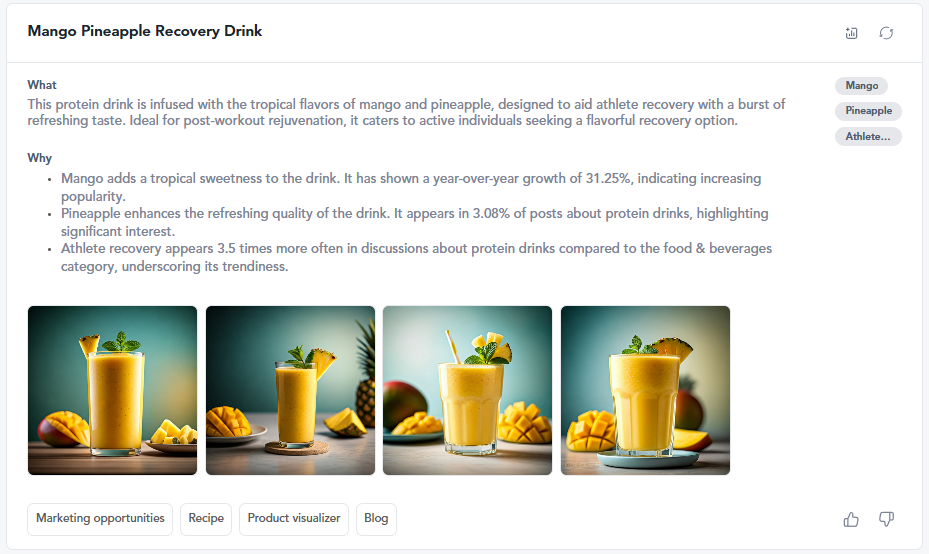
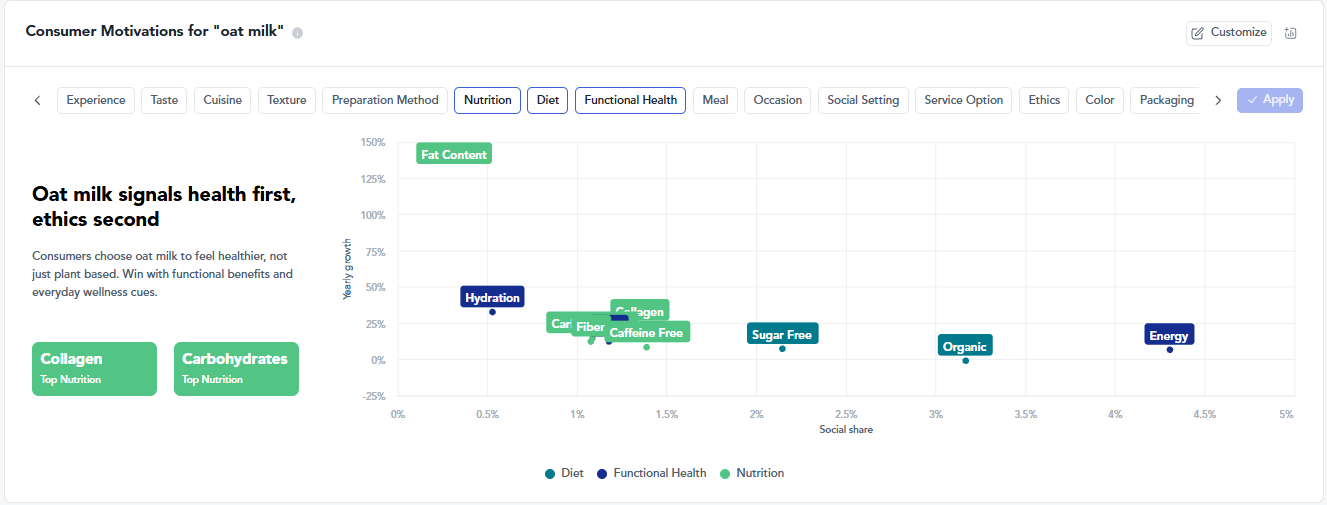
Legacy reports and scanner data explain historical performance. Predictive AI platforms provide visibility into emerging demand and concept viability.
Tastewise is a GenAI consumer intelligence platform built for food and beverage teams. It analyzes real-time consumption signals across multiple sources to help brands identify whitespace, validate concepts, and move from insight to execution with repeatable workflows.
FAQs about food market research
A food market research company provides data and analysis on consumer behavior, product trends, and market performance to support decision-making in the food and beverage industry.
The right vendor depends on the use case: predictive platforms for future demand, POS providers for sales tracking, and syndicated firms for macro insights.
Costs vary from subscription-based platforms to custom research projects, typically ranging from a few thousand dollars to enterprise-level annual agreements.
AI predictive platforms like Tastewise read unstructured, real-time data such as social posts, restaurant menus, and recipe searches to identify emerging consumer demand before it appears in sales data. Syndicated research firms like Mintel publish structured reports built on surveys, expert analysis, and historical data, which gives you macro category context. Most CPG teams use both: the AI layer to see what is coming, the syndicated layer to validate strategic direction.
NielsenIQ supplies barcode-level point-of-sale data, so you can see what is selling now, where, and at what velocity. Tastewise reads unstructured consumption signals across social, menus, and home cooking, so you can see where demand is building before it reaches the shelf. Used together, NielsenIQ confirms current retail performance and Tastewise points to the direction of travel, which gives innovation and category teams evidence across two time horizons.
These platforms are used by product innovation teams, brand and category managers, and insights leads at food and beverage manufacturers, restaurant chains, ingredient suppliers, and retail buyers. The common thread is the decision rather than the company size: validating a concept, defending a range review, or tracking how preference is shifting inside a category.
No. AI consumer intelligence is strongest at identifying emerging signals and reading where demand is heading. Traditional research is strongest at structured validation, category sizing, and long-run trend context. The stacks that hold up combine all three layers: AI predictive intelligence for the future, POS scanner data for the present, and syndicated research for the macro picture.
It depends on the decision in front of you. Teams working on innovation and trend prediction lean on AI platforms. Teams managing shelf performance and distribution lean on POS providers such as NielsenIQ or Circana. Teams building strategic or investor-facing cases lean on syndicated firms such as Mintel or Euromonitor. Larger organizations often run more than one of these in parallel, because each category answers a different time horizon.



We’d love to learn your goals and see how Tastewise fits
We’d love to learn your goals and see how Tastewise fits
Get a personalized demo
Good taste. Wise move.
Your demo request is confirmed. We’ll reach out within one business day to schedule your walkthrough.
What happens next

See what’s driving demand, then turn it into a sell-in story for retailers and operators.
- Connect consumer panels, market trackers, and agents into one evidence view
- Get the “why” behind what’s changing, with explainable demand drivers
- Walk away with a buyer-ready narrative and next steps to activate
Trusted by




“Tastewise is my secret tool for knowing what consumers want next and why.“