





Sprite slipped to fifth among US soda brands by sales volume in 2025 after a 3% volume drop, according to Beverage Digest figures reported by the Atlanta Journal-Constitution. Coca-Cola has since given Sprite a new brand image and won back a major NBA sponsorship. Over the same period, 7UP drew new consumer interest faster than its bigger rival. For beverage R&D, marketing and sales teams, the 7UP vs Sprite comparison is a useful read on where lemon-lime demand is heading in 2026.
This guide compares the two sodas on taste, ingredients, sugar and sodium. It then uses Tastewise shelf, menu and consumer data to show how each brand reaches US shoppers and diners, and what that means for your next launch.
Key takeaways
- Both sodas carry 140 calories and 38 g of sugar per 12 oz can. 7UP has 40 mg of sodium against 65 mg in Sprite.
- Sprite fills 265 products across 19 sales categories on the US online shelf. 7UP has 179 products but reaches more of the retailers Tastewise tracks, 18 against 14.
- Sprite appears on nearly 3 in 10 US restaurant menus. 7UP appears on fewer than 1 in 100.
- Sprite holds about 7 times the consumer interest of 7UP among US beverage consumers, but interest in 7UP grew 47% in the past year against 13% for Sprite.
- Dirty soda over-indexes 10 times among US lemon-lime soda consumers and grew 138% on last year.
- Sugar free motivates 2.1% of US lemon-lime soda consumers, up 23% on last year.
What is the difference between 7UP and Sprite?
7UP and Sprite are both caffeine-free lemon-lime sodas with identical calories and sugar per can. The main difference is the salt behind the citrus: 7UP uses potassium citrate and carries less sodium, while Sprite uses sodium citrate and sodium benzoate.
Ownership differs too. Sprite belongs to The Coca-Cola Company. In the US, 7UP is made by Keurig Dr Pepper through its Dr Pepper/Seven Up unit. PepsiCo owns the brand in most other markets. Any 7UP vs Sprite comparison in this article refers to the US versions.
Flavor profile & sensory experience
The sprite vs 7up taste difference is subtle, and taste is personal. Both brands sell a crisp lemon-lime soda made with natural flavors. Neither brand publishes its carbonation level, so any claim that one is fizzier comes down to personal opinion.
What you can compare is the formula. Both build their sharpness on citric acid. Sprite softens that acidity with sodium citrate, and 7UP does the same job with potassium citrate. 7UP’s retail listings say it delivers more of the natural lemon-lime flavor, while Sprite leans on its crisp, cold image.
The flavor range around each brand tells you more than the core taste. On the US online shelf, cherry appears on 29 Sprite products and 33 7UP products, per Tastewise shelf data. 7UP also carries Shirley Temple flavors on 10 products and pomegranate on 9. Neither flavor appears among Sprite’s top shelf flavors, which gives 7UP a mocktail-friendly range Sprite has left open.
The people behind each brand differ as well. Across the Tastewise US consumer panel, vegetarian and GLP-1 consumers lead interest in Sprite. Male consumers and on-the-go snackers lead interest in 7UP. For a sprite vs 7up comparison that goes past the sip test, that audience split matters more than the citrate.
Nutritional profiles, sugar & ingredients
Here is the 7up vs sprite ingredients breakdown for a standard 12 oz can, taken from current US labels.
| Per 12 oz can | Sprite | 7UP | Sprite Zero Sugar | 7UP Zero Sugar |
|---|---|---|---|---|
| Calories | 140 | 140 | 0 | 0 |
| Total sugar | 38 g | 38 g | 0 g | 0 g |
| Sodium | 65 mg | 40 mg | 35 mg | 45 mg |
| Sweetener | High fructose corn syrup | High fructose corn syrup | Aspartame, acesulfame potassium | Aspartame, acesulfame potassium |
| Acidity regulator | Sodium citrate | Potassium citrate | Potassium citrate | Potassium citrate |
| Preservative | Sodium benzoate | Calcium disodium EDTA | Potassium benzoate | Potassium benzoate, calcium disodium EDTA |
| Caffeine | None | None | None | None |
On sprite vs 7up sugar, the result is a tie. Each can holds 38 g of added sugar, which is 76% of the daily value. The 7up vs sprite sugar question only splits once you move to the zero-sugar versions, where both brands use the same aspartame and acesulfame potassium pairing.
Sodium is the real structural sprite vs 7up difference. 7UP carries 40 mg per can against 65 mg in Sprite, and both qualify as low sodium. The order flips in the zero-sugar cans, where Sprite Zero Sugar has 35 mg and 7UP Zero Sugar has 45 mg.
On sprite zero vs diet 7up, note that the zero-calorie 7UP on US shelves today is 7UP Zero Sugar. Both zero-sugar cans carry a phenylalanine warning because of the aspartame. Across both brands, Tastewise shelf data counts a sugar free claim on 72 products and on 7 recent launches, and a natural claim on 100 products.
Formulations, carbonation & beverage variations
The 7up vs sprite difference in manufacturing comes down to formula and route to market. Both start with carbonated water, and 7UP specifies filtered carbonated water on its label. The carbonation itself works the same way in both: dissolved carbon dioxide forms carbonic acid, which adds bite on top of the citric acid.
Fountain availability is where the two brands split hardest. Sprite pours at nearly 3 in 10 US restaurants in Tastewise menu data, so many diners meet it from a fountain. 7UP shows up on fewer than 1 in 100 restaurant menus and reaches most consumers through cans and bottles.
The variation strategy differs as well. Sprite builds around Sprite Zero Sugar and cherry. 7UP pairs its zero-sugar line with cherry, pomegranate and Shirley Temple flavors that read as ready-made mocktail bases.
How Tastewise.io uses data-driven insights to predict soft drink trends

Tastewise reads consumer, menu and retail shelf signals together, so you can track sprite vs 7up market share shifts month by month, ahead of quarterly sales reports. Tastewise is the proactive AI food and beverage intelligence system that delivers before you ask. It resolves social, menu and shelf sources into one connected dataset across 72 markets, refreshed daily.
Sales and market volume demand
Sales figures tell you what sold last year. Consumer, shelf and menu signals show where the next year is heading, and that is where the 7UP vs Sprite story gets interesting.
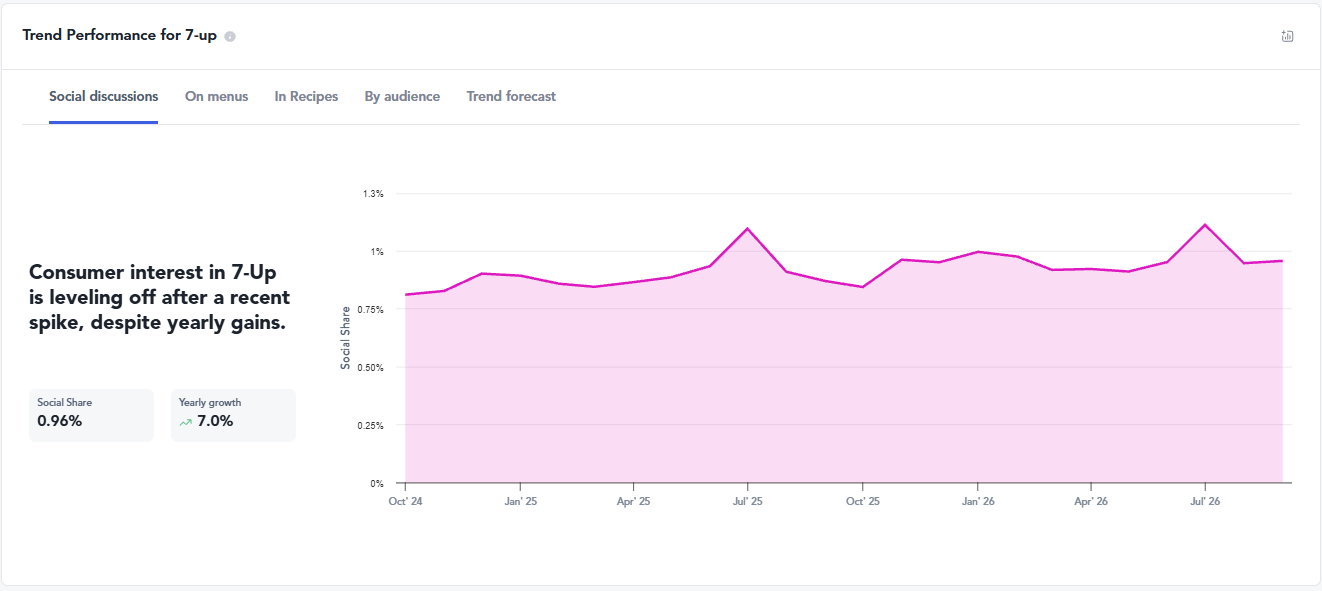
Across the Tastewise US consumer panel, Sprite holds about 7 times the consumer interest of 7UP among US beverage consumers. 7UP is gaining new interest faster, up 47% over the past year against 13% for Sprite, with most of that gain in the last six months. Tastewise forecasts interest in Sprite to keep climbing through 2027, while interest in 7UP holds steady at its new level.
The shelf points the same way. 7UP launched 9 new products against 8 for Sprite despite a smaller range. Its average listed price online is $8.72 against $7.19 for Sprite. For a brand heading into a line review, that gap is the start of a retail buyer story about which lemon-lime shopper pays more and why.
Foodservice and menu innovation
On menus, Sprite’s reach is built on quick service and fast casual. Each segment accounts for nearly 3 in 10 of the US restaurant locations serving Sprite (31% each). Sprite’s presence on menus grew 3% over the past year, with fine dining the fastest riser at 21% from a small base.
7UP’s smaller menu footprint is spread more evenly. Fast casual holds nearly 3 in 10 of its restaurant locations (28%), quick service nearly 1 in 5 (20%) and midscale nearly 1 in 5 (18%). Midscale is losing ground for 7UP, down 10%, while operators outside the main segments are up 26%. Overall, 7UP’s menu presence grew 5%, a faster rate than Sprite’s 3%.
Mocktails and mixed sodas explain much of that movement. Alcohol free motivates 4.2% of US lemon-lime soda consumers and over-indexes 1.5 times against all beverage consumers. Dirty soda, the cream and syrup soda format that started in Utah soda shops, over-indexes 10 times among lemon-lime soda consumers and grew 138% on last year. Limeade grew 40% and refreshers grew 334% in the same group.
For teams selling to foodservice operators, that is a menu opening. A lemon-lime base, a fruit syrup and a cream topper is a low-cost LTO for any fast casual chain with a fountain.
Real-world success: driving CPG beverage growth through AI analytics
Beverage brands and CPG manufacturers use Tastewise to test citrus flavor ideas, choose which zero-sugar claims to lead with and build the retail story before launch. Customers generate retailer-ready narratives 10x faster, cut research costs by 65% and see 30% higher win rates.
Take a beverage brand planning a lemon-lime sparkling drink for 2027. It needs to decide three things before it commits to a formula: the flavor, the claim and the channel. Here is how the 7UP vs Sprite data answers each one.
Start with flavor. Cherry is the shared extension on both shelves, so it offers little room to stand out. The faster signals sit in mixed formats, with dirty soda up 138% and limeade up 40% among US lemon-lime soda consumers. A creamy citrus or limeade-style profile is the stronger test for new concept validation.
Next, pick the claim. Sugar free motivates 2.1% of US lemon-lime soda consumers and grew 23%, while natural grew 27%. Energy is larger at 4.6% and grew 97%, with caffeine up 59%. Sprite and 7UP are both caffeine free, so a lightly caffeinated lemon-lime option sits outside both core lines. A zero-sugar, natural-flavor base with an energy variant covers the steady claim and the fast-growing one.
Then choose the channel. Sprite owns the fountain, so a new brand has a clearer path on the shelf. 7UP’s $8.72 average listed price shows that lemon-lime shoppers accept a premium online. Pricing near 7UP, with a pack built for mocktails, fits the gap. You can then match the pitch to the consumer segments leading interest, such as GLP-1 consumers for a zero-sugar line.
Tastewise agents can watch these signals on your category every week and hand your team the new item one-pager and the retailer deck when a shift appears. That is how CPG insights turn into a launch decision with evidence behind it.
The 7UP vs Sprite contest is lopsided on reach and close on the label. Sprite owns the fountain and the bigger shelf. 7UP is winning new interest faster and leaning into mocktail flavors. If your team is planning in this category, the signals that matter are already moving in the data.
FAQs about 7UP vs Sprite
7UP and Sprite have the same calories and sugar, but 7UP has 40 mg of sodium per 12 oz can against 65 mg in Sprite. 7UP uses potassium citrate, while Sprite uses sodium citrate and sodium benzoate.
Sprite is a Coca-Cola brand. In the US, 7UP belongs to Keurig Dr Pepper.
Neither. Both contain 38 g of added sugar per 12 oz can, which is 76% of the daily value.
Both zero-sugar versions contain 0 g of sugar and use aspartame and acesulfame potassium.
The zero-calorie 7UP sold in the US today is 7UP Zero Sugar. It has 45 mg of sodium per can against 35 mg in Sprite Zero Sugar, and both use the same sweetener pair.
Sprite sells more. It ranked fifth among all US soda brands by 2025 sales volume, according to Beverage Digest figures.
On the US online shelf, Tastewise counts 265 Sprite products against 179 for 7UP.
Sprite. It appears on nearly 3 in 10 US restaurant menus, while 7UP appears on fewer than 1 in 100.
7UP’s menu presence is growing slightly faster, up 5% over the past year against 3% for Sprite.
7UP. Consumer interest in 7UP grew 47% over the past year, against 13% for Sprite.
Sprite still holds about 7 times the consumer interest of 7UP among US beverage consumers.



We’d love to learn your goals and see how Tastewise fits
We’d love to learn your goals and see how Tastewise fits
Get a personalized demo
Good taste. Wise move.
Your demo request is confirmed. We’ll reach out within one business day to schedule your walkthrough.
What happens next

See what’s driving demand, then turn it into a sell-in story for retailers and operators.
- Connect consumer panels, market trackers, and agents into one evidence view
- Get the “why” behind what’s changing, with explainable demand drivers
- Walk away with a buyer-ready narrative and next steps to activate
Trusted by


“Tastewise is my secret tool for knowing what consumers want next and why.“