





Gaming is one of the largest everyday occasions food and beverage brands can plan around. The Entertainment Software Association’s 2026 Essential Facts report counts 212.3 million Americans who play video games every week. That is 2 in 3 Americans (67%), and they eat and drink on the rhythm of the session.
Loyalty comes from knowing which formats, flavors and functional benefits fit the way people play. This guide uses gamer consumer insights from the Tastewise US consumer panel and the online shelf to show what gamers reach for.
Key takeaways
- Energy is the leading functional need. Nearly 1 in 10 US consumers in gaming food and drink moments (11%) look for energy, up 31% on last year.
- Savory snacks reach nearly 1 in 20 consumers in gaming snack moments (6%), and they are growing 27% while sweet snacks slip 3%.
- Popcorn is the breakout dish, up 79% in gaming snack moments, while cake is down 19%.
- Gen Z consumers are 2.3x more likely than the average US consumer to show up in gaming food and drink moments.
- Weekends anchor the occasion for nearly 1 in 5 consumers in gaming moments (18%), and evening sessions are up 45%.
- On the US shelf, Monster led energy drink launches over the past 12 months with 17 new products, ahead of Alani Nu with 10.
Who are modern gamers and what are their food and drink preferences?
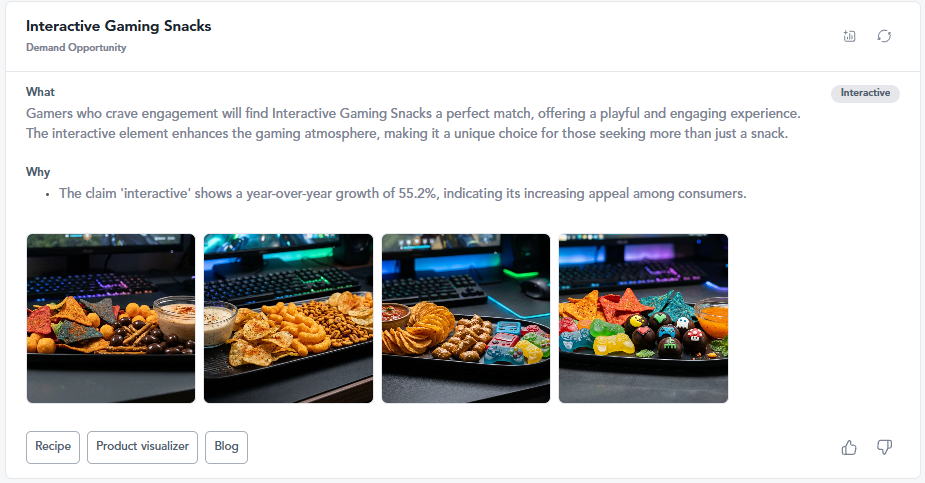
Modern gamers are a multi-generational audience that wants convenience, steady energy and snacks that work with one free hand. For food and beverage brands, the opportunity sits in distinct snacking occasions across mobile, console and PC play.
How do gamer demographics shift across PC, console, and mobile platforms?
The same ESA report puts the average US player at 37, with half of all players aged 35 or older. More than 80% of Gen Z play, alongside 71% of Millennials, 56% of Gen X and 50% of Boomers. Mobile is the widest entry point, used by 80% of players aged 8 and up.
Play is also social. Three in four American parents play video games every week, and 81% of those parents play with their kids.
Across the Tastewise US consumer panel, Gen Z consumers are 2.3x more likely than the average consumer to show up in gaming food and drink moments. Beer lovers are 2.4x more likely, which points to an adult, social side of play that brands often overlook. If you are building consumer segments for gaming, start with these two groups and the occasions they share.
What snack and beverage attributes drive gameplay consumption?
Sweet snacks lead the gaming snack basket. Nearly 1 in 7 consumers in gaming snack moments (16%) reach for sweet snacks, and cookies and bars over-index 5.5x against the average snack occasion.
Savory snacks are where the movement is. They reach nearly 1 in 20 consumers in gaming snack moments (6%), and they over-index 9.2x against the average snack occasion. Popcorn reaches 5.5% of consumers in gaming snack moments and grew 79% on last year. Cereal is up 54% and ice cream is up 61%, while cake fell 19%. Fork-and-plate desserts are losing ground to formats you can eat from a bowl or a bag.
Drinks split between staying alert and settling in. Nearly 1 in 10 consumers in gaming drink moments choose beer or cider (9%), and the same share choose coffee (9%). Carbonated drinks reach 6% of consumers in gaming drink moments, but they over-index 9.2x against the average drink occasion.
What are gamer attitudes toward food and beverage branding in 2026?
Gamers favor brands that support the community, fit into play without interrupting it, and give a functional reason to buy. Packaging styled for gamers works best when a real product benefit sits behind it.
How do gamers evaluate popular beverage brands versus functional alternatives?
The energy aisle shows the tension clearly. Over the past 12 months, Monster led US energy drink launches with 17 new products across 676 listings, at an average listed price of $7.55. Red Bull added 9 launches across 642 listings at $10.86. Newer wellness-positioned brands are launching just as actively at higher prices. Alani Nu added 10 products at $11.74, and Bloom Nutrition added 6 at $12.03.
Format is moving too. Seven new energy launches came in gummy form, a no-spill option that suits a desk covered in controllers and keyboards.
Tastewise reads this competition by connecting consumer demand in gaming moments with restaurant menus and the online shelf. Demand shows energy rising while coffee in gaming drink moments dipped 7% on last year. Alcohol-free choices reach 1% of consumers in gaming moments and grew 25%. That evidence can become a retail buyer story for clean energy and lighter options.
Why is authenticity critical for building brand loyalty among gamers?
Brand loyalty among gamers comes from showing up consistently in the places and moments where people already play. Timing matters as much as message. Weekends lead the occasion, reaching nearly 1 in 5 consumers in gaming moments (18%), up 27% on last year. Evening play is smaller at 3.7% of consumers in gaming moments, but it grew 45%. Halloween gaming moments grew 40%, which makes October a natural window for limited editions.
Where people buy matters too. Wawa shoppers are 3.9x more likely than the average consumer to show up in gaming food and drink moments, and Circle K shoppers are 3.0x more likely.
For food and beverage brands, authenticity means matching that real routine. Sponsor the weekend tournament, stock the store on the way home and co-create flavors with the creators the community already trusts. That is what strong food branding looks like here.
How can food and beverage brands successfully market to gamers?

Brands win by matching product formats to specific gaming occasions, partnering with mid-tier streamers for contextual integration, and using live consumer data to shape messaging.
How do product developers tailor formulations for long gaming sessions?
Take a snack brand planning a gaming-occasion launch that must choose between a sweet and a savory format. Savory snacks are reaching new consumers in gaming moments faster than sweet snacks, growing 27% while sweet snacks slip 3%. Popcorn’s 79% growth makes it the clearest single format to test. A single-serve popcorn in a resealable bag fits the one-handed, long session.
A beverage team weighing a focus drink faces a similar choice. Energy is the growing need, and fitness reaches nearly 1 in 10 consumers in gaming moments (9%) with a 3.4x over-index. Fruit flavors are early but moving fast in gaming drink moments, with apple up 89% and raspberry up 88%, though each reaches under 1% today. A lightly caffeinated raspberry RTD or an energy gummy fits that profile. Product innovation teams can validate concepts like these before a production run.
How do marketing teams execute contextual activations on Twitch and Discord?
Plan around the weekend evening session, which is where gaming moments are growing most. Schedule drops, codes and watch-party offers for Friday and Saturday nights.
On Twitch, work with mid-tier streamers who already eat and drink on camera, and let them shape the product moment. On Discord, give community servers early access codes, flavor votes or exclusive bundles redeemable at nearby convenience stores. These food marketing strategies keep the brand inside the session.
5 key strategies for engaging gamers
- Lead with energy and focus claims on drinks, and test lighter caffeine levels for long sessions.
- Launch savory, one-handed formats such as single-serve popcorn, and keep packs resealable.
- Time drops, codes and limited editions to weekend evenings and Halloween.
- Build convenience store bundles that pair a snack with a drink for one session.
- Co-create flavors with mid-tier creators and let community votes pick the next release.
Turning gamer consumer insights into growth
Gaming is a weekly, multi-generational occasion with clear needs: steady energy, easy snacks and products that fit the session. Tastewise, the proactive AI food and beverage intelligence system, brings your team the signals that matter and the finished work that turns them into a decision. Its AI agents watch your categories and hand your team the campaign, concept or buyer story when demand moves. For food and beverage brands courting gamers, that means planning launches around what this audience already reaches for.
FAQs about food and beverage brands
Gamers favor brands that offer a functional benefit and fit into play. Energy is the leading need, reaching nearly 1 in 10 US consumers in gaming food and drink moments (11%).
Beverage brands can engage gamers through creator partnerships, weekend activations and convenience store bundles. Circle K shoppers are 3.0x more likely than the average consumer to show up in gaming food and drink moments, which makes c-stores a strong channel.
Occasion-led timing works best. Weekend play reaches nearly 1 in 5 consumers in gaming moments (18%), and Halloween gaming moments grew 40% on last year.
Gamers span every generation, and half of US players are 35 or older. In Tastewise data, value shoppers are 1.7x more likely than average to show up in gaming food and drink moments.
Gaming market analytics show which formats and flavors are gaining. In gaming snack moments, cereal grew 54% and ice cream grew 61% on last year, while cake declined 19%.




We’d love to learn your goals and see how Tastewise fits
We’d love to learn your goals and see how Tastewise fits
Get a personalized demo
Good taste. Wise move.
Your demo request is confirmed. We’ll reach out within one business day to schedule your walkthrough.
What happens next

See what’s driving demand, then turn it into a sell-in story for retailers and operators.
- Connect consumer panels, market trackers, and agents into one evidence view
- Get the “why” behind what’s changing, with explainable demand drivers
- Walk away with a buyer-ready narrative and next steps to activate
Trusted by


“Tastewise is my secret tool for knowing what consumers want next and why.“