





The matcha vs green tea question stopped being a tea question this year. Matcha has moved out of the specialty tea occasion and into the daily slot coffee used to own, and your consumers now choose between the two on how each one feels. Tastewise US data shows matcha adding menu placements around four times faster than steeped green tea over the past 12 months. It also shows the health language most packs were built around losing ground fast. If your team is briefing an RTD, a café LTO or a powder line, that split matters more than the search volume suggests.
Key takeaways
- Matcha carries 11.5% menu presence in the US against 4.4% for steeped green tea in the same pull. Brief your innovation team with matcha as the incumbent format.
- Matcha dish placements grew 15.8% since last year while green tea grew 3.8%, roughly four times slower. The menu window is open now and it is closing at café speed.
- Antioxidant claims fell 48.8% and weight management language fell 72.8% in the past year. Lead with calm and ritual instead, because both are rising.
- Green tea still appears across about 113,000 US restaurants against matcha’s 74,000. Treat foodservice sell-in as a format upgrade conversation rather than a new listing.
Matcha vs green tea in the US market right now
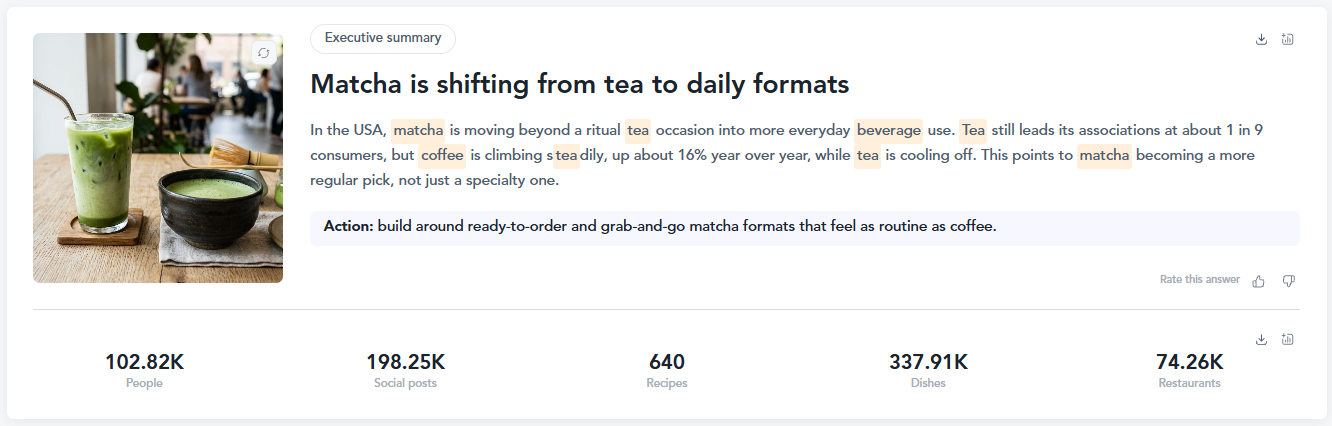
Both drinks come from the same plant and often the same farms, so what changed is the occasion. Matcha has moved from a ritual tea moment into everyday beverage use, and the US read on Tastewise shows tea still anchoring the occasion for about 1 in 9 consumers while coffee climbs about 16% up on last year. Consumers typing matcha vs green tea into a search bar are picking a daily drink. That is a formulation brief, and it points straight at ready-to-order and grab-and-go formats.
The signals name the movement precisely. Matcha’s hero builds are cooling, with matcha latte down 29.0% and iced matcha latte down 44.9%. The edges are growing instead: matcha cloud up 76.5%, banana matcha up 37.9%, matchatini up 19.2% and hojicha up 15.4%. On the green tea side the growth sits with flavor rather than format, as jasmine tea rises 20.3% and yuzu 22.2%. The center of each format has gone soft and the flanks are carrying demand.
That gap is the opportunity. Matcha’s operator whitespace list is led by Tim Hortons, Auntie Anne’s and The Cheesecake Factory, three chains with enough traffic to normalize the format in a single LTO cycle. Green tea’s whitespace sits at Subway, Taco Bell and Burger King, a different job at a different price ceiling. Sizing that gap before your next planning cycle is what the 2026 trend forecast was built for.
What is the difference between matcha and green tea?
Both come from Camellia sinensis. Steeped green tea is an infusion, where dried leaves give up part of their content to hot water and are then thrown away. Matcha is the whole leaf, shade-grown for several weeks to build chlorophyll and L-theanine, then stone-ground into powder and whisked into the water you drink. That single processing choice drives every matcha vs green tea difference downstream, from caffeine to color to cost.
Caffeine content and energy delivery
Matcha vs green tea caffeine content is a dose question more than a potency question. A 2023 catechin analysis of commercial teas measured ceremonial matcha near 31 mg of caffeine per gram of dry tea against about 23 mg for bagged green tea, a real but modest gap. The per-cup difference is wider because a matcha serving is around 2 grams of leaf consumed whole, which lands most cups at 60 to 80 mg against 25 to 40 mg for a steeped cup. L-theanine slows how that caffeine arrives, which is why the same milligrams read as steady rather than sharp.
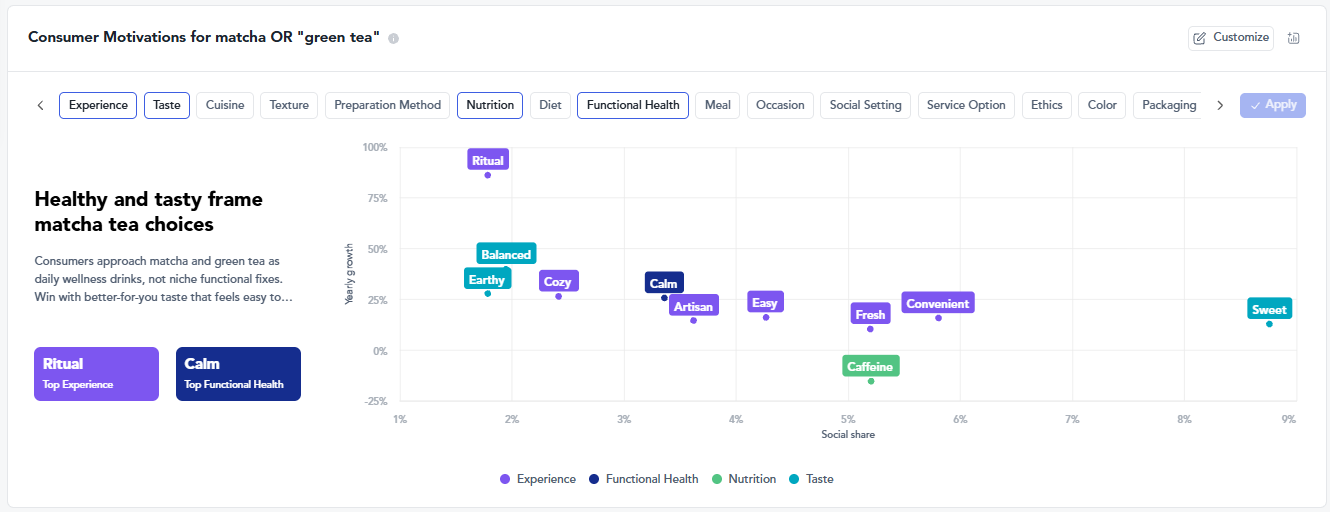
Consumers are asking for better-feeling caffeine, not more of it. Caffeine claims sit at 3.44% share in the matcha set and fell 26.1% in the past 12 months, while calm claims rose 12.2%. Route the positioning through your consumer marketing team, because this is a message problem before it is a formulation problem.
Antioxidant density and health benefits
The 137 times more antioxidants line is where matcha vs green tea health benefits comparisons usually go wrong. In that same analysis, bagged and gunpowder green teas measured higher total phenolic content per gram than either matcha grade, and culinary matcha outperformed the ceremonial grade your pack probably wants to name. Matcha still delivers more catechins per cup, because drinking the leaf beats discarding it. Delivery is the version of the matcha vs green tea antioxidants claim that survives a lab check.
The commercial half of the story is just as clear. Antioxidant claims in the matcha set fell 48.8% in the past year and polyphenol language fell at a similar rate, so consumers moved on ahead of the category. Anchor the pack on taste and feel, then let the whole-leaf story carry the nutrition point in supporting copy. Green tea extract vs matcha is a real formulation choice, and it belongs on cost and sensory grounds.
Weight loss, metabolism and metabolic performance
Matcha vs green tea for weight loss is the fastest-declining claim in the set. Weight management language fell 72.8% since last year, metabolism fell 54.9% and intermittent fasting fell 88.7%. Thermogenic framing lost that argument to prescription weight management, and consumers stopped asking tea to do the job. Neither format carries evidence strong enough to support a fat-oxidation claim, so a daily-habit position is both the honest route and the safer one. If your pipeline still holds a metabolism SKU, re-brief it through product innovation before it reaches artwork.
Sensory profiles and formulations
Matcha vs green tea taste is where the two separate for real. Matcha reads umami and vegetal, and its rising descriptors say consumers have learned to enjoy exactly that, with umami up 16.9%, earthy up 16.1% and astringent up 11.5% than last year. Steeped green tea reads lighter with a drier finish, and its growth comes from pairing rather than from body, as jasmine, green apple and mint carry the volume.
Format follows taste. A green tea latte vs matcha latte comparison barely exists on US menus, since matcha latte holds 11.5% menu presence and the green tea version registers as a rounding error. Real pricing shows the headroom: Starbucks lists a matcha latte at $5.65, Gregorys Coffee charges $7.05 and Toastique sells a dirty matcha at $10. Ready-to-drink language is still small at 0.02% claim share, though it grew 45.5%, and MatchaBar, Aiya and Pure Leaf already hold the powder shelf.
How Tastewise data tracks matcha vs green tea demand
Tastewise reads consumer signals, home recipes and restaurant menus in one view, which is how a shift like this surfaces months before a quarterly report catches it. The green tea vs matcha picture only holds up when the consumer side and the operator side sit together.
Start with jitter-free energy and nootropic demand. The nootropic framing is fading, with nootropic claims down 58.2% and brain function down 57.3%. What replaced it is softer and more habitual, as ritual rose 69.8%, slow living 84.3%, intentional 180.7% and calm 12.2%. That is a positioning instruction. A matcha RTD should sound like a morning routine, and the cognitive claim belongs in supporting copy at most.
The trend line adds timing. Combined interest in matcha and green tea peaked in July 2025 and has settled since, sitting about two points above where it was two years earlier. A cooling peak on a rising baseline reads as a maturing format. The operator data supports that, with matcha now appearing across 4,379 US chains and more than 82,000 restaurants. Launch on the flanks rather than on the hero build.
Then read café culture and menu innovation. Chains are already moving: Dunkin’ lists a frozen matcha latte at $6.11, Blue Bottle runs a cherry blossom latte at $8.95 and Boba Guys sells a mango matcha latte at $7.75. Strawberry matcha holds 5.51% share in the matcha set while cold foam is up 11.3%, so the builds that win pair matcha with fruit and texture. Teams working the same signals should read the menu planning guide alongside the foodservice forecast for operator timing.
Turning matcha vs green tea data into a product decision
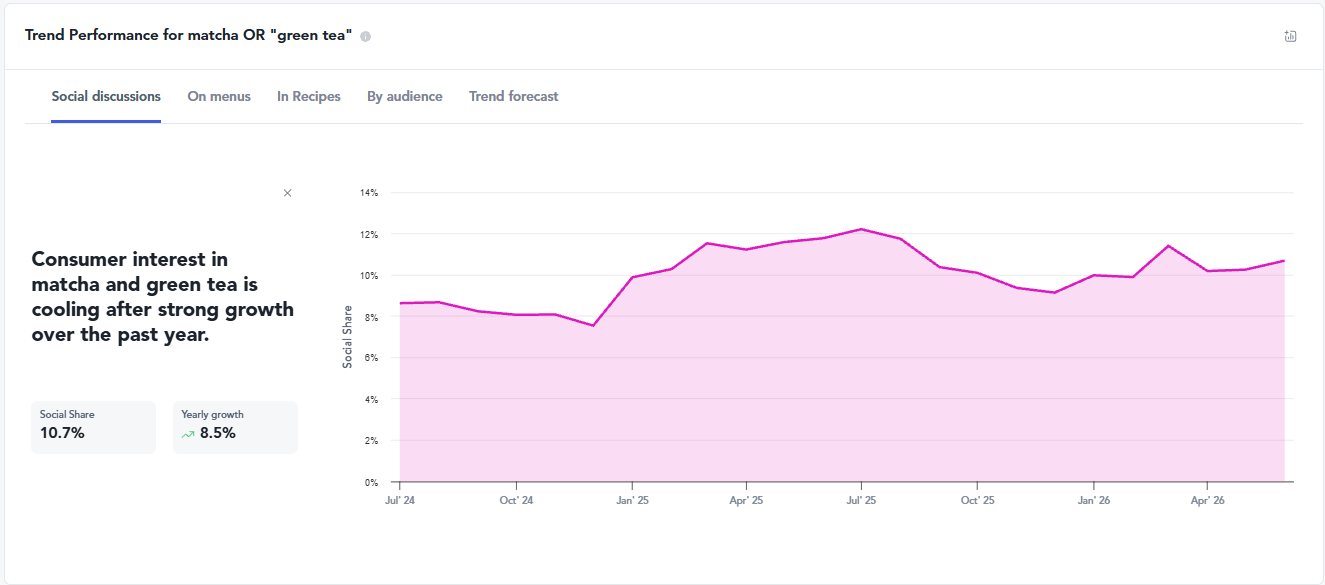
Here is how a US beverage team would work the choice between matcha powder vs green tea and green tea extract vs matcha for a new ready-to-drink line. The walkthrough below is an illustrative scenario built from the US data in this piece, not a named client account.
Step one is picking the base on reach and velocity together. Matcha owns velocity and consumer pull, while green tea owns distribution at 112,874 restaurants in the operator set. For an RTD aimed at retail, matcha powder is the base with demand behind it, and green tea extract is the cost line you blend against to hold a shelf price.
Step two is cutting the claims that are falling. Metabolism and antioxidant superiority come out of the brief, and balanced language at 44.2% growth goes in alongside calm. Each one gets checked against the segment you are actually selling to through custom audiences rather than against the category average.
Step three is choosing the flavor system from the flanks. Strawberry matcha, banana matcha and hojicha all grew this year while the plain latte cooled, so a strawberry matcha RTD carries more evidence than another unsweetened green tea. Step four is pricing against the shelf rather than the café. Ceremonial powder runs up to $52 for 80 grams while culinary grade sits nearer $18 to $32, and a ceremonial claim adds cost the RTD aisle has not learned to pay for.
Step five is taking the operator list into sell-in. Tim Hortons and The Cheesecake Factory both sit inside matcha’s whitespace, which gives your team a named first call instead of a category pitch. That is where the retail sell-in story gets built.
Frequently asked questions about matcha vs green tea
Per cup, matcha delivers more catechins, because you drink the whole leaf instead of discarding it. Per gram the picture flips, as a 2023 analysis of commercial teas measured higher total phenolic content in bagged and gunpowder green teas than in either matcha grade. Consumer demand has shifted with that reality, and antioxidant claims in the US matcha set fell 48.8% in the past 12 months.
Yes, and dose explains most of it. Ceremonial matcha measured around 31 mg of caffeine per gram against about 23 mg for bagged green tea. A matcha serving also uses more leaf, which puts most cups at 60 to 80 mg against 25 to 40 mg for a steeped cup. Caffeine claims are falling 26.1%, so the commercial story sits with how that energy feels.
Matcha powder is milled whole leaf, so it carries color, texture and the full flavor profile into a formulation. Green tea extract is a concentrated fraction used for functional dosing at lower cost, and it will miss the visual and sensory cues consumers now expect from matcha. Menu evidence backs the powder route, with matcha latte at 11.5% menu presence against 4.4% for steeped green tea.


We’d love to learn your goals and see how Tastewise fits
We’d love to learn your goals and see how Tastewise fits
Get a personalized demo
Good taste. Wise move.
Your demo request is confirmed. We’ll reach out within one business day to schedule your walkthrough.
What happens next

See what’s driving demand, then turn it into a sell-in story for retailers and operators.
- Connect consumer panels, market trackers, and agents into one evidence view
- Get the “why” behind what’s changing, with explainable demand drivers
- Walk away with a buyer-ready narrative and next steps to activate
Trusted by





“Tastewise is my secret tool for knowing what consumers want next and why.“