







That split matters because the two seeds are recruited for different jobs. Chia is a finished format that consumers order by name. Flax is a functional input that mostly arrives without a headline. This guide covers the nutrition comparison, the consumer motivations behind each seed, and where each one is actually showing up in restaurants and on retail shelves.
Key overview
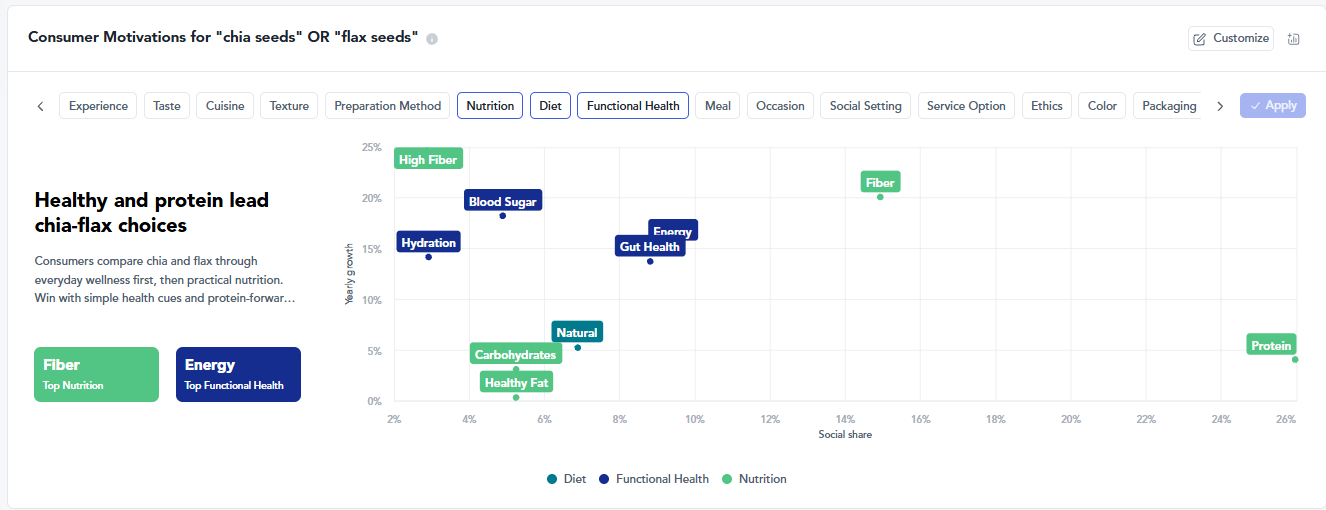
- Chia reaches about 2.5 times more US consumers than flax, but flax has the momentum, with flax dishes up 10.5% year over year against 2.9% for chia.
- Chia also carries the wider operator footprint, appearing at roughly 27,000 US restaurants and 1,475 chains versus about 17,000 restaurants and 666 chains for flax.
- Chia holds the fiber advantage at about 10 grams per ounce against 8 grams for flax, and fiber is growing faster as a stated reason for chia too, up 22.3% against 16.4%.
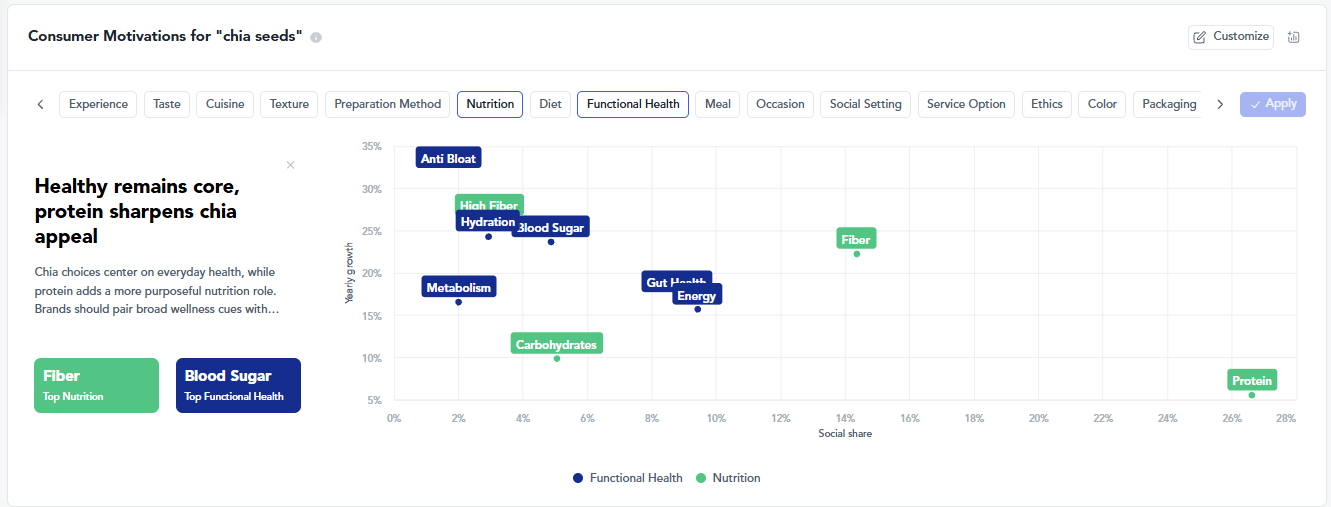
- Omega-3 is fading as a purchase driver for both seeds, down 20.5% for chia and 26.7% for flax, while blood sugar climbed 23.7% and 16.0%.
- Flax owns the hormonal use case, with hormone balance reaching about 1 in 20 flax consumers compared with 2% of chia consumers, close to three times the index.
Chia seeds vs flax seeds, the core difference
Both seeds are dense sources of alpha-linolenic acid and dietary fiber. Chia is a whole hydrophilic seed that gels in liquid and carries all nine essential amino acids. Flax needs grinding before the body can reach most of its nutrients and its lignans, which is why it usually appears as meal, milled seed or oil rather than a whole seed.
Nutritional profile and macro comparison
Any chia seeds vs flax seeds nutrition comparison should start with fiber. On a per 100 gram basis, USDA FoodData Central puts chia at 34.4 grams of dietary fiber against 27.3 grams for flaxseed. Per one ounce serving that lands at roughly 10 grams for chia and 8 grams for flax, with protein close to 5 grams for both. Flax carries more alpha-linolenic acid per ounce, so the two seeds trade wins rather than one sweeping the card.
On chia seeds vs flax seeds nutrition the fiber types differ more than the totals. Flax skews toward soluble fiber, which is the fraction linked to cholesterol binding. Chia is mostly insoluble by weight, with a smaller soluble mucilage layer that does the gelling work. That mucilage is why chia thickens a pudding and flax thickens a batter.
| Measure (per 1 oz, 28g) | Chia seeds | Flax seeds |
|---|---|---|
| Dietary fiber | About 10 g | About 8 g |
| Protein | About 5 g | About 5 g |
| Calories | About 138 | About 150 |
| Alpha-linolenic acid | High | Higher |
| Complete protein | Yes, nine essential amino acids | No |
| Lignans | Low | High |
| Needs grinding | No | Yes for full absorption |
| Culinary function | Gels and suspends | Binds and adds nutty depth |
Figures are drawn from USDA FoodData Central. Treat them as formulation inputs rather than health claims, because the regulatory language you can put on pack is narrower than the nutrition profile.
Weight loss and gut health applications
Search demand for chia seeds vs flax seeds for weight loss and flax seeds vs chia seeds for weight loss is steady, but consumer motivation has moved somewhere more specific. Weight management as a stated driver fell about a third over the past year for both seeds, down 33.4% among chia consumers and 33.6% among flax consumers. The demand did not disappear. It changed vocabulary.
What replaced it is glycemic and digestive language. Blood sugar climbed 23.7% among chia consumers and 16.0% among flax consumers. Anti-bloat rose 34.3% for chia and 26.0% for flax. Gut health reaches about 1 in 8 flax consumers (13%) and nearly 1 in 10 chia consumers (8.8%), and it is rising for both. Among flax consumers, references tied to weight loss drugs grew 53.2%, which suggests the satiety conversation is now shaped by medication rather than dieting.
For a formulation team the practical read is that a satiety product sells better on blood sugar steadiness and digestive comfort than on pounds lost. Chia earns that claim through gel volume. Flax earns it through soluble fiber density.
Functional health and wellness advantages
The clearest difference in chia seeds vs flax seeds benefits sits in hormonal health, and it lines up with the lignan story. Anyone weighing chia vs flax seeds benefits or flax seeds vs chia seeds benefits will find the split right here. Hormone balance reaches about 1 in 20 flax consumers (5.6%) compared with 2% of chia consumers. Women’s health follows the same shape at 5.5% for flax and 2.1% for chia, and menopause runs at 1.5% for flax against 0.5% for chia. Flax is nearly three times more likely to be chosen for a hormonal reason.
Chia owns a different set. Hydration rose 24.3% among chia consumers while slipping 4.8% among flax consumers, which is the gel doing visible work in drinks. High fiber climbed 26.2% for chia and 13.9% for flax. Heart health moved the other way for both seeds, down 19.6% for chia and 18.2% for flax, and omega-3 as a stated reason fell 20.5% and 26.7%. The nutrient that built both categories is fading as a front-of-pack hook, which is worth checking against your own consumer segments before you brief a pack refresh.
Consumer demand signals for chia vs flax seeds
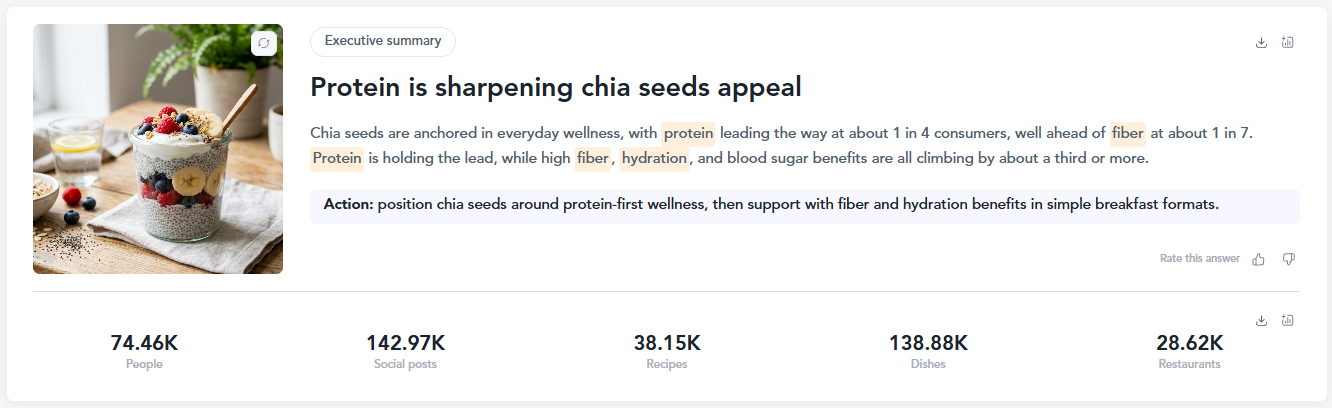
Protein is where flax vs chia seeds separate most sharply. Among flax consumers it is the largest nutrition driver at nearly 1 in 3 (31%), but it lost 2.0% over the past year. Among chia consumers protein reaches nearly 1 in 4 (27%) and gained 5.5%. Flax holds the bigger protein franchise and chia is the one building it.
Fiber is rising on both sides, up 22.3% for chia and 16.4% for flax, and it now reaches about 1 in 7 chia consumers (14%) and about 1 in 5 flax consumers (22%). Energy climbed 15.7% and 16.7%. The pattern is a category shifting from broad wellness cues toward specific, checkable nutrition.
Daypart tells you where to put each seed, and flax seeds vs chia splits cleanly here. Breakfast reaches about 1 in 5 chia consumers (20%) and held flat, while among flax consumers it sits at about 1 in 6 (17%) and fell 4.9%. Convenience reaches nearly 1 in 6 chia consumers (18%) and rose 10.3%. Chia is winning the morning and the grab-and-go moment.
Menu and shelf adoption across channels
Chia appears on menus at roughly 27,000 US restaurants and about 1,475 chains. Flax appears at roughly 17,000 restaurants and 666 chains. Chia has about 1.6 times the restaurant footprint and 2.2 times the chain footprint, so the seed with more consumer reach also has more operator distribution.
The named items show why. Chia is ordered as itself. Tropical Smoothie Cafe runs acai bowls from $12.49 and First Watch sells an AM Superfoods Bowl. Bluestone Lane lists an almond butter chia pudding at $8.00 and Life Alive Organic Cafe sells mango chia pudding at $7.70. Cafe June prices a strawberry chia power smoothie at $12.69, and Playa Bowls, Smoothie King and Jamba carry chia across their bowl lines.
Flax works the opposite way. Its biggest operator accounts are Chick-fil-A, IHOP and Denny’s, and it reaches diners inside the Cool Wrap, the Hearty Grain Pancake Slam at $14.79 and bakery items like the Fresh Baguette Organic Superseed loaf. Flax meal and flax egg carry menu shares near 48% and 52% within the flax set, which marks them as working ingredients rather than menu headlines. If you sell into foodservice operators, chia is a merchandising story and flax is a spec sheet story.
Retail follows the same logic. Flax dominates the shelf as milled seed and oil, through products like Manitoba Milling ground flaxseed and lignan flaxseed oil softgels. Chia shows up most often inside blends, including BetterBody Foods Super Seeds with chia, flax and hemp, and Simple Mills Almond Flour Snack Bars built on chia and flax together. The retail answer to chia versus flax is frequently both.
Texture is the constraint that decides the format. Chia mucilage sets a pudding in 15 to 30 minutes and keeps particles suspended in a drink, which suits ready-to-drink and overnight oats. Ground flax adds a nutty note and binds, which suits pancakes, crackers and bars. Texture as a stated motivation rose 21.9% among flax consumers and 11.4% among chia consumers, so sensory language is becoming a selling point rather than a technical footnote.
How CPG teams de-risk a seed formulation decision
Take a real scenario. A snack manufacturer is building a functional bar line and has to choose a seed before it commits to a co-manufacturer. The tempting move is to pick the seed with the better nutrition panel. The better move is to check which claim the seed can carry with a live audience, which is where AI for CPG work earns its keep.
On this data the bar would use both. Milled flax carries the fiber load and the hormone balance audience, and it supports a blood sugar claim that is growing faster than the weight management claim it would replace. Chia delivers the visible seed cue and the hydration and protein momentum, and it gives the breakfast daypart a format consumers already order. Simple Mills and BetterBody Foods already sell that combination, which lowers the argument you have to make to a buyer.
Three specific decisions follow. Lead the pack claim on fiber and blood sugar rather than omega-3, because omega-3 fell more than 20% as a stated reason for both seeds. Target the perimenopause and women’s health audience with the flax-forward variant, since flax indexes near three times higher there. Launch a chia pudding or overnight oats format in the breakfast window, where chia held its share while flax slipped.
Whitespace tells you who to call. Smoothie King, Paris Baguette and True Food Kitchen top the chia opportunity list, while Tropical Smoothie Cafe and Saladworks lead on flax. Those are the accounts where the format exists and the seed does not, and they are the shortest route to a pilot. Teams running agentic AI workflows track that list continuously instead of refreshing it once a quarter, and the same signals feed retail sell-in conversations with buyers.
Frequently asked questions about chia seeds vs flax seeds
Chia is a whole seed that gels in liquid and provides complete protein, while flax must be ground to release its nutrients and lignans. USDA data puts chia at 34.4 grams of fiber per 100 grams against 27.3 grams for flaxseed.
In practice that difference shows up as format. Chia becomes puddings and drinks, flax becomes meal, oil and baked goods.
Neither seed causes weight loss, and consumer interest has moved toward blood sugar and digestive comfort instead. Weight management as a stated motivation fell about a third for both seeds over the past year, while blood sugar rose 23.7% for chia and 16.0% for flax.
Chia supports satiety through gel volume and flax through soluble fiber density. Both work best as part of a wider diet.
Chia has more total fiber, at about 10 grams per ounce compared with about 8 grams for flax. The fiber claim is also growing faster for chia, up 22.3% against 16.4% for flax.
Flax needs grinding for full nutrient absorption because the whole seed passes through largely intact. Chia does not require grinding, though soaking it improves texture and slows glucose absorption.
Chia has the larger base, reaching about 2.5 times more US consumers than flax, but flax formats are expanding faster with flax dishes up 10.5% against 2.9% for chia. Chia also carries the wider operator footprint at roughly 27,000 restaurants versus 17,000 for flax.
The two seeds are best read as a portfolio rather than a choice. Chia leads on visibility and flax leads on momentum and hormonal positioning.
The chia seeds vs flax seeds question used to be settled on a nutrition label. In 2026 it is settled on a shelf and a menu, and the two seeds are moving in different directions. Across the Tastewise US consumer panel, chia reaches about 2.5 times more consumers than flax over the past 12 months. Flax is the one gaining ground on formats, with flax dishes up 10.5% against last year while chia dishes rose 2.9%. If you are choosing between them for a new product concept, reach and momentum point at different seeds.




We’d love to learn your goals and see how Tastewise fits
We’d love to learn your goals and see how Tastewise fits
Get a personalized demo
Good taste. Wise move.
Your demo request is confirmed. We’ll reach out within one business day to schedule your walkthrough.
What happens next

See what’s driving demand, then turn it into a sell-in story for retailers and operators.
- Connect consumer panels, market trackers, and agents into one evidence view
- Get the “why” behind what’s changing, with explainable demand drivers
- Walk away with a buyer-ready narrative and next steps to activate
Trusted by





“Tastewise is my secret tool for knowing what consumers want next and why.“