






Your marketing team does not need another dashboard. It needs an AI marketing agent. The gap between insight and execution has always been where food and beverage marketing stalls. Your team spends days pulling consumer signals, building briefs, aligning on claims, and by the time a campaign asset is ready, the trend window has already moved.
An AI marketing agent changes that equation entirely. It does not just surface what consumers want. It moves from signal to finished campaign output, at the speed the category actually demands. If you work in marketing, insights, or brand strategy at a large food and beverage company, this shift is already happening around you.
Key takeaways
- Marketing teams that rely on dashboards alone are operating on a lag. Consumer demand shifts faster than weekly reporting cycles, and the brands winning shelf space and menu placement are acting on signals in days, not months.
- An AI marketing agent covers the full workflow: audience analysis, content hooks, claims generation, activation assets, and campaign narratives. That means fewer handoffs, less briefing time, and faster time to market.
- The agentic AI layer sitting on top of food intelligence data is what separates a report your team reads from a campaign your team launches. The data does not change. What changes is how fast it becomes something you can use.
- Brands that build always-on intelligence into their marketing workflow are not just faster. They are more defensible in buyer meetings, because every claim traces back to live consumer behavior, not last quarter’s research.
What an AI marketing agent actually does in food and beverage
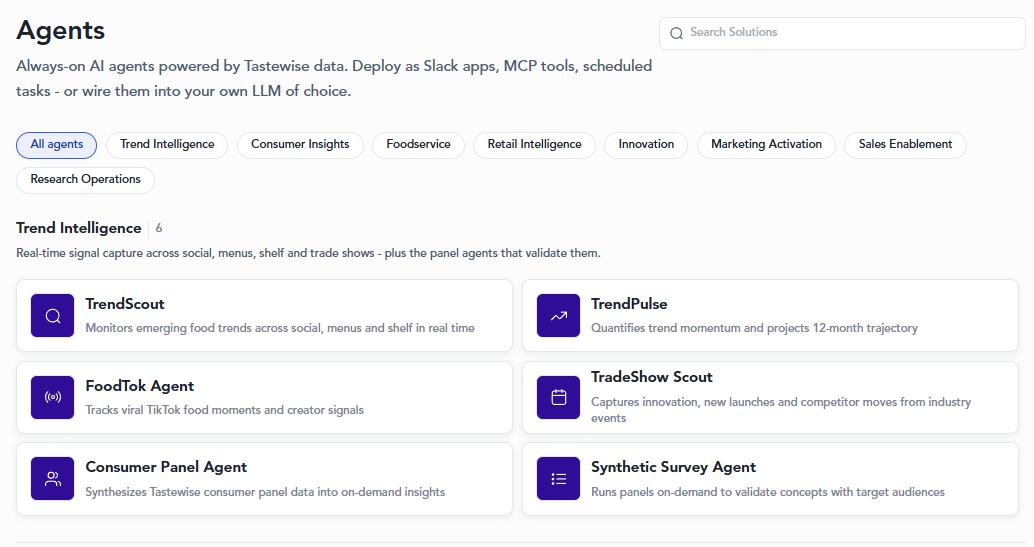
Most food and beverage marketing teams are not short on data. They are short on the time and infrastructure to turn data into campaigns that move. Consumer behavior in the category shifts constantly: ingredients rise, occasions evolve, and the flavor profile that lands in January may be crowded by March. A marketing AI agent is designed to operate inside that pace. It monitors signals continuously, identifies what is building momentum, and produces the marketing layer on top of it without waiting for a human to manually connect those steps.
Tastewise tracks consumer demand across menus, retail shelves, and social content to build a live picture of what is moving and why. The agentic AI layer translates that picture into outputs your team can use directly: audience briefs, content hooks built around real motivations, claims your legal team can defend, and assets ready for activation. The gap between what the data says and what your campaign says closes significantly.
This matters most in the moments where speed is the competitive advantage. A new ingredient trend, a seasonal occasion opening, a competitor moving into your white space. Those are not situations where a static report serves you. They are situations where an agent that runs while you sleep gives you a real edge. The 2026 food and beverage trend forecast is a useful starting point for understanding which of those moments are already approaching.
What an AI marketing agent covers that your current stack does not
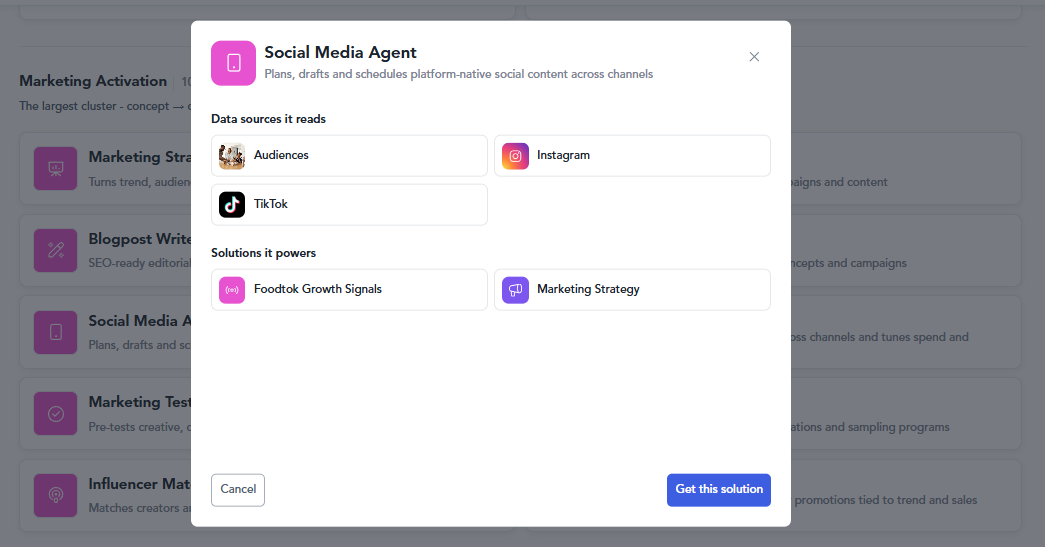
The standard marketing stack in food and beverage was built for a slower world. Research in one tool, briefing in another, creative in a third. An AI marketing agent sits across all of that and connects the steps. It handles five distinct jobs that currently live in different parts of your team’s workflow.
Content hooks are the first output. Instead of briefing a writer to interpret a trend, the agent reads what consumers are actually saying and what emotional territory the trend lives in. It identifies the angle that will resonate for your specific audience before anyone opens a blank document.
Audience analysis is the second. Not segment descriptions written once a year, but a live read of which consumer groups are driving demand for a specific ingredient, occasion, or flavor. Consumer marketing strategy built on live signals is the difference between a brief grounded in assumption and one grounded in what real people are doing right now.
Claims generation is where the agent earns its place most visibly. A trend signal becomes a claim. A growth figure becomes a hook. The output is not just a data point. It is a sentence your team can put on pack, in a pitch, or in a campaign headline. That step used to take days of internal alignment. With a marketing agent, it is part of the same workflow as the initial signal pull.
Activation assets and campaign narratives complete the loop. The agent does not stop at strategy. It produces the assets and the story structure your team needs to go to market. For brands running limited-time offers or launching into new retail channels, that matters enormously. The briefing-to-asset timeline compresses from weeks to days.
How agent marketing differs from what AI tools offered before
The distinction matters and it is worth being precise about it. Generative AI tools that produce content on demand are useful. They are not the same as an agent marketing system. The difference is in what triggers the output and what it connects to.
A standard AI writing tool responds to a prompt. A marketing AI agent responds to a signal. It is watching the category continuously, identifying when something is worth acting on, and initiating the workflow without waiting to be asked. That is not a feature difference. It is an architectural one. The agentic AI examples in food and beverage show what that looks like in practice, and the contrast with conventional AI tooling is instructive.
Agentic AI versus generative AI is a comparison worth understanding before your team builds or buys. The short version is this: generative AI helps you execute faster once you have decided what to do. Agentic AI helps you decide and execute, because it is doing the monitoring and the triggering as well as the output generation. For marketing teams in food and beverage specifically, the agentic model fits the category’s pace far better than a tool you have to prompt manually every time.
The use of agentic AI in food and beverage is still early enough that moving now gives your team a meaningful advantage. The infrastructure investment is lower than most assume. The speed gain is immediate.
What this means for your next campaign brief
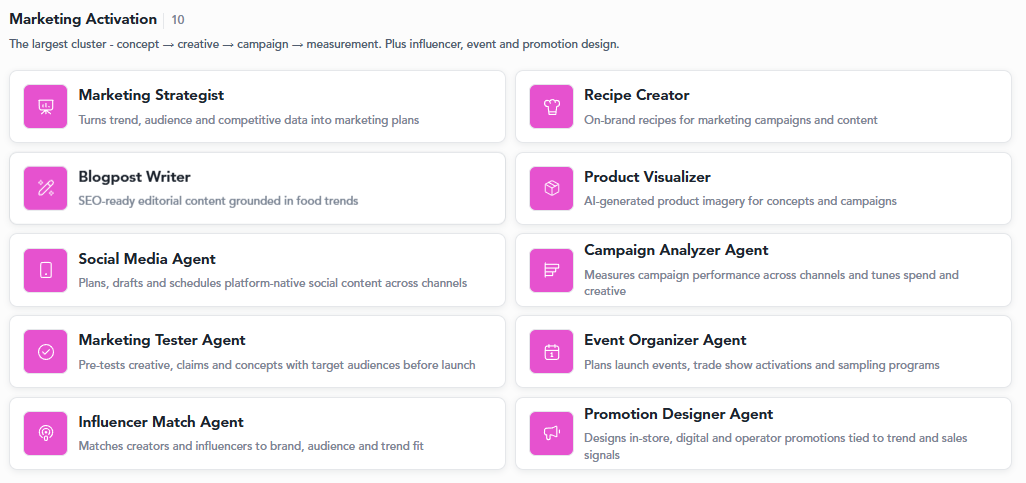
The practical implication for your team is straightforward. The next time you build a campaign brief, the question is not whether you have the data. It is whether your workflow gets the data to the right place fast enough to matter. A brief built manually on last month’s platform exports will always lag. A brief built by an agent working from live signals will not.
For food and beverage brands specifically, the most immediate application is in trend-led campaigns: seasonal occasions, ingredient-forward LTOs, and category expansion plays where consumer behavior is moving faster than your internal planning cycle. An AI marketing agent gives your team the ability to move at the speed the category actually demands, with the consumer evidence to back every claim.
FAQs about AI marketing agents
An AI marketing agent is a system that monitors signals continuously and initiates marketing outputs without waiting for a manual prompt. A standard AI tool responds when you ask it something. A marketing AI agent watches your category, identifies when a signal is worth acting on, and moves through the workflow from audience analysis to campaign asset automatically. In food and beverage, the distinction matters because trend windows are short and the brands that respond fastest tend to win the placement.
The outputs cover the full pre-launch marketing workflow: consumer audience analysis, content hooks tied to real motivations, defensible claims built from live data, activation assets, and campaign narratives. The result is a brief that arrives already populated, a creative direction that traces back to consumer behavior, and assets your team can take to market without three rounds of internal alignment first.
Yes, and the applications differ usefully between them. For retail teams, the agent produces sell-in narratives grounded in consumer demand signals your buyer can verify. For foodservice teams, it builds LTO concepts and operator stories from real menu movement data. Both channels benefit from the same underlying advantage: speed from signal to campaign without losing the evidentiary chain that makes the story defensible.


We’d love to learn your goals and see how Tastewise fits
We’d love to learn your goals and see how Tastewise fits
Get a personalized demo
Good taste. Wise move.
Your demo request is confirmed. We’ll reach out within one business day to schedule your walkthrough.
What happens next

See what’s driving demand, then turn it into a sell-in story for retailers and operators.
- Connect consumer panels, market trackers, and agents into one evidence view
- Get the “why” behind what’s changing, with explainable demand drivers
- Walk away with a buyer-ready narrative and next steps to activate
Trusted by




“Tastewise is my secret tool for knowing what consumers want next and why.“