Most retail food trend reports tell you what’s getting attention. Very few tell you what’s actually selling. The gap between those two things is where category teams lose pitches, miss launches, and over-invest in viral moments that never reach the shelf. If you work in brand management or category strategy at a CPG company, you have almost certainly seen this gap in action. This piece is about closing it with a single, repeatable test you can run on any trend report before you bring it to a buyer. For a broader view of where category-level signals sit right now, the retail category overview is the right starting point.
Key takeaways
- Retail food trends that spike on social often fail on shelf. The Dubai chocolate moment of 2024 generated massive creator-driven traffic and brief retail listings, then stalled on repeat purchase. Your category team needs a filter for this before the buyer meeting, not after.
- Trend reports that rely on a single data source, especially social-only ones, over-index on creator amplification. Cross-source reports covering menu, social, retail, and recipe data are the floor for any category decision worth defending internally.
- The cottage cheese resurgence passed almost every analyst unnoticed until it was already winning at shelf. It had been climbing in Circana scanner data for nearly three years before mainstream trend coverage caught up. Demand without obvious trend is the pattern most brands are slowest to act on.
- The 5-question framework in this piece turns any trend report into a pass/fail test. A trend that fails any of the five questions is a hypothesis, not a green light for a buyer pitch.
What retail food trends actually measure and what they miss
Retail food trends measure attention. Consumer demand measures behavior. These two things correlate sometimes. They are not the same thing, and they fail in different directions.
A retail food trend is observed attention: searches, social mentions, menu appearances, recipe saves, creator posts. Real consumer demand is observed behavior: repeat purchases, basket growth, sustained category velocity at shelf. Both can point in the same direction. Often, though, they diverge. And when they diverge, brands that did not notice tend to find out the hard way. Overstock, a missed window, or a buyer conversation that did not go the way the trend deck suggested it would.
Two patterns from the 2023 to 2025 window illustrate this clearly. The viral TikTok pasta chip moment of 2024 produced high view counts, brief retail listings, and genuine interest from some distributors. It had no sustained velocity. The signal was creator-driven amplification without underlying repeat purchase behavior. The outcome was predictable in hindsight. The problem is that most trend reports would have flagged it as a green light.
The cottage cheese resurgence ran the opposite pattern. It did not appear in mainstream food trend reports until 2024. By that point, it had been building in Circana scanner data for close to three years. Quiet on social, steady on shelf, driven by ordinary shoppers repeating a behavior without an influencer prompt. The brands that moved early had a multi-year head start. The brands that waited for trend coverage to catch up were buying into a category that had already been won.
The fix is not to stop reading trend reports. It is to read them with a better filter. That filter is five questions.
The 5-question framework for stress-testing any food trend report
Before you bring a trend to a buyer or an innovation review, run the report through five questions. A trend that fails any of these is a hypothesis, not a green light.
1. Who measured it, and across how many signal types?
Single-source trend reports, especially social-only ones, over-index on creator amplification. Cross-source reports covering menu data, social, retail scanner data, and recipe signals are the floor for category decisions. If the report cannot tell you where the data came from, treat it as incomplete.
2. Over what window?
A trend that emerged six weeks ago is a spike. A trend that has been climbing for six quarters is a trajectory. Reports that do not show their time horizon are hiding it. Ask before you build a pitch around the finding.
3. At what regional and retailer cut?
A “national trend” rarely lands the same way in Kroger Texas as in Whole Foods NYC. If the report cannot show you the same trend filtered by region and retail channel, it cannot tell you whether your buyer’s specific customer base is already in it or still catching up.
4. Is it still rising when creator-driven traffic is filtered out?
Most viral food trends are creator-driven at their peak. The signal your category team actually wants is post-creator: ordinary consumers adopting the behavior without an influencer prompt. Reports that do not separate these two sources are conflating two completely different markets with different shelf implications.
5. Does it appear in purchase behavior, not just intent?
Search interest, recipe saves, and social engagement are intent signals. Repeat basket additions and category velocity at shelf are behavior signals. Trends that score high on intent and flat on behavior are the most common and most expensive category mistakes in CPG. Understanding how AI food trend analysis tools handle this distinction is worth your team’s time before the next planning cycle.
How do you validate a food trend before pitching it to a retail buyer?
Validate a food trend by running it through the five questions above: source diversity, time window, regional cut, creator-filter, and behavior signal. A trend that passes all five is buyer-ready. A trend that passes three is a hypothesis worth pressure-testing internally. A trend that passes one or two is a pitch you do not want to make.
Your team can build buyer-ready retail sell-in stories backed by real consumer demand signals.
Two case studies the framework would have caught
The 2023 to 2025 window produced clean examples of both failure modes: attention that did not convert, and demand that did not trend until it was already won.
Case 1: Dubai chocolate (attention without demand)
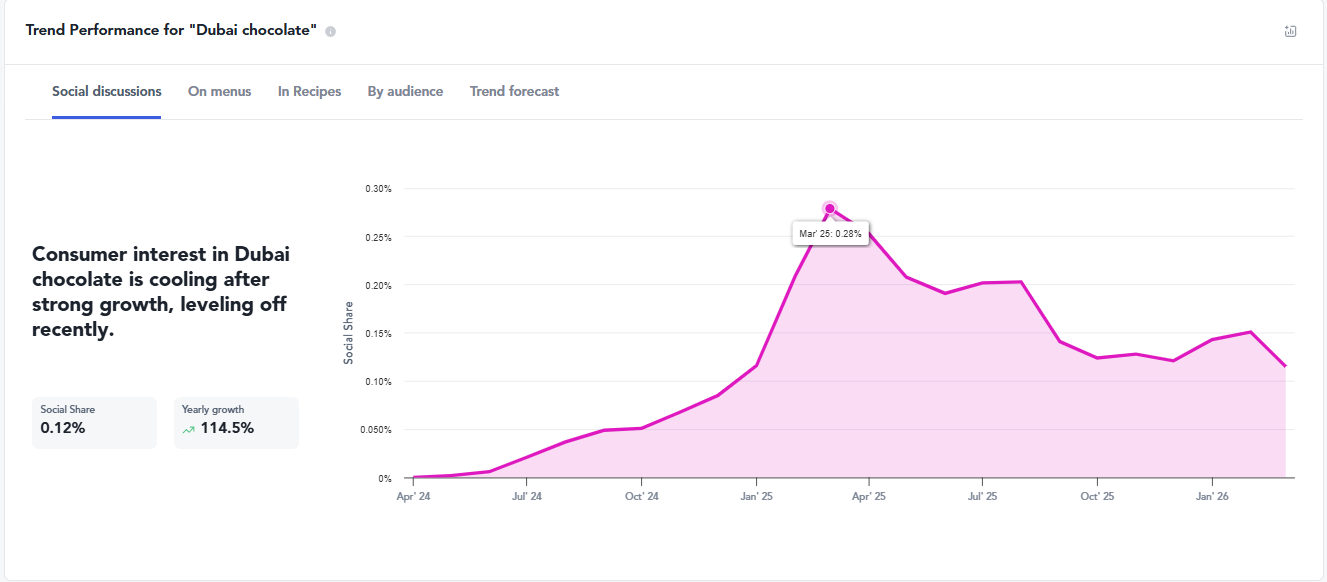
Dubai chocolate generated more than 97,000 posts in the past year across social, recipe, and menu platforms, with dish mentions growing over 1,900% in that window. The social signal looked extraordinary. It passed questions one and two in most trend reports: broad multi-source coverage and a trend window of several months. It failed questions four and five hard. The top consumer need driving all that engagement was “trendy,” and that claim is now down 65% since its peak. Pistachio and knafeh, the two signature ingredients behind the format, are both in declining lifecycle stage on Tastewise. The recipe signal told the same story: most of the growth came from creator-amplified tutorials, not from ordinary consumers repeating a purchase. Retail shelf velocity never matched the social volume, and brands that chased it faced overstock pressure by mid-2025. The trend was real. The sustained demand was not.
Case 2: High-protein cottage cheese (demand without obvious trend)
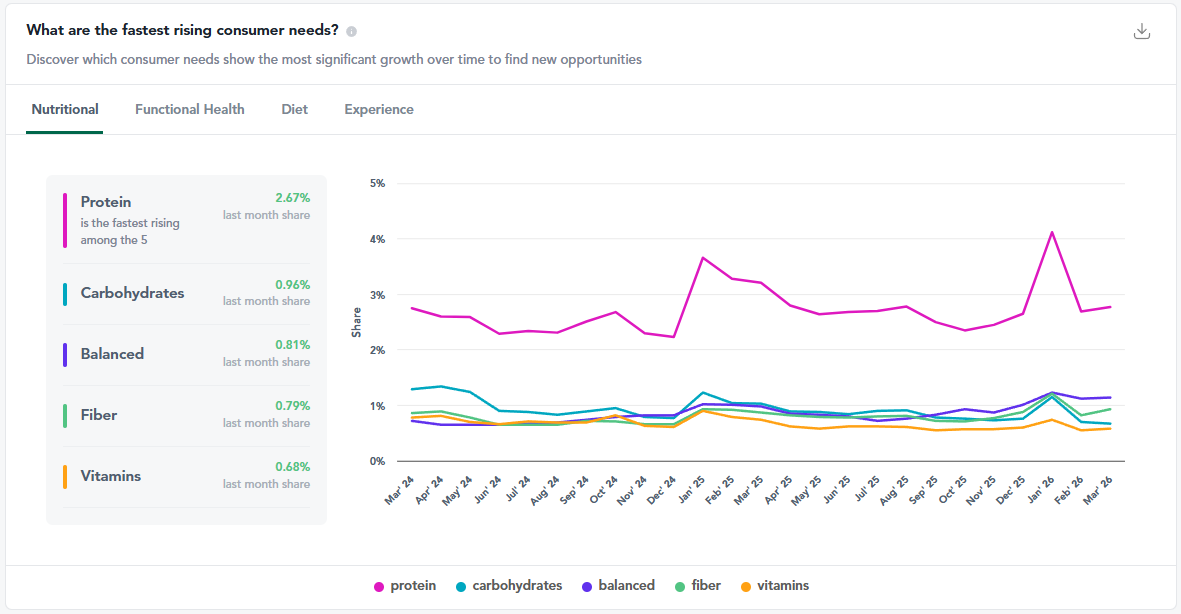
High-protein cottage cheese tells the opposite story. The “high protein” consumer need currently sits at 89% share in the cottage cheese conversation on Tastewise, with the lifecycle firmly mature and holding. The signal was not creator-driven. It built through recipe index growth first, food-at-home behavior second, and social attention last. Comfort as a driver is up 179% in that category in the past 12 months. “Recurring favorite” is up 36%. Those are repeat-behavior signals, not trial signals. The consumer motivation, protein as an everyday priority rather than a sports-nutrition occasion, was visible in the data well before mainstream trend coverage caught up. Brands that acted on the framework early built shelf presence and format equity before the category became crowded. Brands that waited for the trend deck are buying in late.
Both cases come back to the same principle. CPG insights that help your team win are the ones that separate the signal from the noise before the decision is made, not after the fact.
What to use instead of single-source trend reports
The fix is not a better trend report. It is the replacement of trend reports, as a category, with stacked consumer demand signals read together in real time.
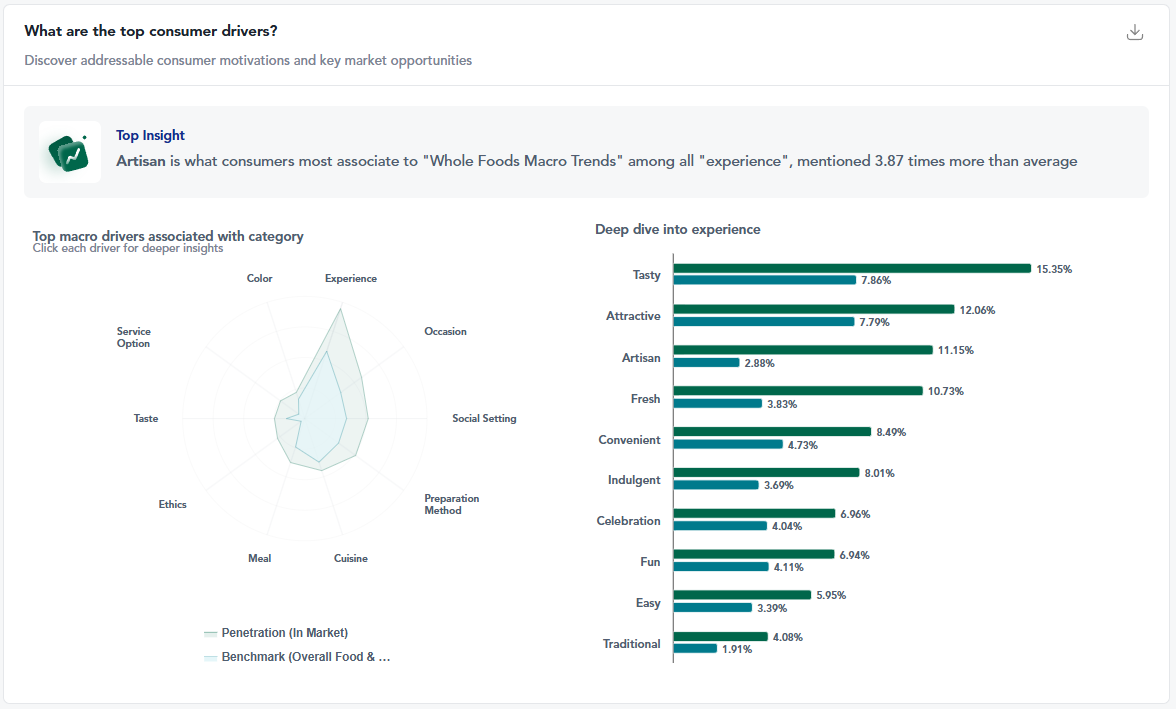
Tastewise is an AI-powered consumer intelligence platform that tracks real consumer demand for food and beverage by triangulating menu, social, retail, and recipe data in real time. The output is not another list of trending items. It is a cross-source picture of whether a signal is building or fading, where it is strongest by region and channel, and whether behavior is following intent.
What data sources are most reliable for tracking retail food trends?
The most reliable approach is a stack, not a source. Syndicated retail data (Circana, NIQ) for what is selling; menu data for foodservice leading indicators; social filtered for non-creator audiences; recipe and eRetail signals for emerging intent. Each source has blind spots. Together, they converge on real demand, which is what buyers care about.
For the full picture of where category signals are heading into the second half of 2025, the 2026 food and beverage trend forecast applies exactly this stacked approach across the categories most CPG teams are prioritizing right now.
See how the 5-question test runs on your category.
FAQs about retail food trends
A food trend is a measure of observed attention: social mentions, creator posts, search volume, menu appearances. Real consumer demand is a measure of observed behavior: repeat purchases, basket growth, sustained shelf velocity. The two often move in the same direction early. They diverge when a trend is primarily creator-driven and does not translate into ordinary consumers repeating a purchase behavior. The five-question framework in this piece is designed to identify that gap before it becomes a costly category mistake.
Most trend reports are built on single-source data, often social-only, because that data is fast and abundant. Social data captures attention efficiently. It is a poor predictor of sustained retail velocity because it conflates creator-driven amplification with genuine consumer adoption. Reports that lack a time window, a regional cut, and a behavior signal are showing you what people are talking about. They are not showing you what people are buying repeatedly.
Apply it before any buyer meeting or innovation review that involves an externally sourced trend. Take the trend claim, find the underlying data source, and run it through the five questions. If you cannot answer questions three, four, and five with confidence, the trend needs more validation before it becomes a pitch. Most teams find that two or three questions they had not previously asked, regional cut and creator-filter in particular, change the recommendation significantly.