Argentina food trends in USA are not a future story. They are a right-now story that most food and beverage brands have not yet caught up with. Empanadas are reaching consumers at the same rate as sandwiches. Chimichurri is outpacing almost every other sauce in consumer engagement. Dulce de leche reaches roughly 3 in 10 US consumers. The demand is established. The branded product response is not. If your team is still treating Argentine cuisine as a niche or emerging category, the Tastewise food intelligence platform suggests it is time to reconsider.
Key takeaways
- Empanadas reach about 1 in 2 consumers in the Tastewise US panel, with a social index of 246, comparable to steak and sandwiches. This is a mainstream format your team can build around today, not a trend to monitor for next year.
- Chimichurri is up +13% in the past year and indexes at 343 against the general food landscape. The ingredient is proven at scale, but shelf-stable and QSR-ready formats remain largely unclaimed.
- “Argentinian” as a cuisine identity registers at a social index of nearly 51, roughly 51 times more concentrated in this consumer context than average. Consumer appetite exists. The product pipeline has not kept pace.
- Milanesa is growing +12% in the past year at nearly 5% consumer reach, and emerging formats like morcilla (+20%) and humita (+18%) are building behind it. The next wave of Argentine-origin formats is already in motion.
What is driving Argentina food trends in the USA
Argentine cuisine is one of the few global food traditions that sits at the intersection of everything US consumers are reaching for right now: grilled proteins, intense flavors, indulgent sweets, and food with a credible origin story. It is not positioned as health food, and it does not need to be. The motivational data shows that consumers engaging with Argentina food trends in the USA are driven by grilled (+7x social index vs. benchmark), crispy (+29% growth), rich (+31% growth), and intense flavor (+134% growth) signals. Authentic (+9%) and traditional (+18%) are both growing too, which points to a consumer who wants the real thing, not a generic Latin American approximation.
The Tastewise US consumer panel shows that this is not a small or niche audience. Empanada alone reaches 42.6% of consumers in this dataset, putting it in the same tier as sandwiches (7.26%) and steak (8.68%) when indexed against the broader food landscape. Chimichurri reaches 23.3% and dulce de leche 29.5%, both carrying social index scores above 340. These are not discovery signals. They are proof of an already-formed consumer base that is waiting for the market to catch up.
The convenient motivation is up +22% in this context, which opens the door for ready-to-eat formats, grab-and-go packaging, and QSR menu integration. Your team does not need to educate the US consumer about Argentine food. The education has already happened. The gap now is in accessible, scalable, branded formats built around ingredients and dishes the consumer already knows.
See where your category sits in the 2026 food and beverage trend forecast.
The ingredient opportunity: chimichurri and dulce de leche are underbuilt
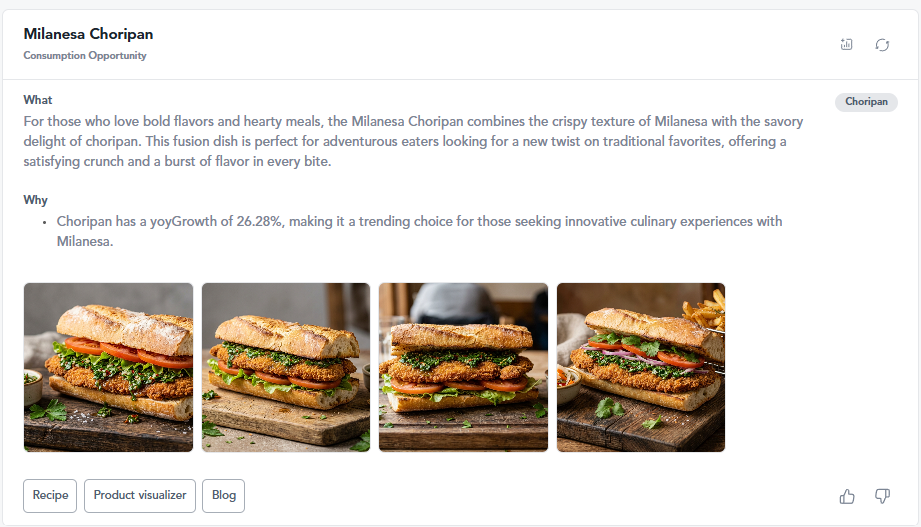
The two most commercially significant Argentina food trends in the USA right now are not dishes. They are ingredients with proven consumer reach and a significant gap in branded product response.
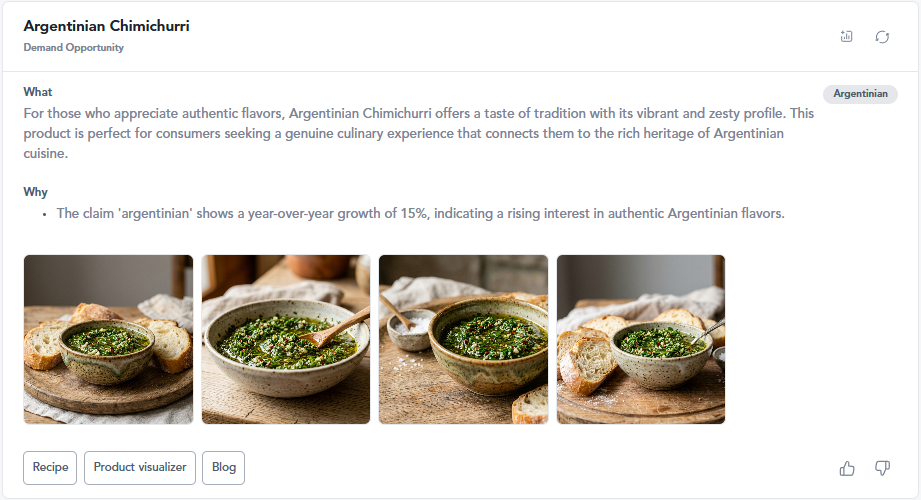
Chimichurri reaches about 1 in 4 US consumers in the Tastewise panel and has grown +13% in the past year. Its social index of 343 puts it among the highest-indexed ingredients in this dataset, well above comparable Latin American sauces. It is firmly in the mature lifecycle, which means consumer familiarity is not the obstacle. The obstacle is format. The Tastewise product innovation solution tracks where ingredient reach has outrun product development, and chimichurri is a clear example. Garlic (+14% growth), olive oil (+13%), and parsley (+6%) are all moving alongside it, meaning the full chimichurri ingredient stack is gaining momentum together. This is a retail sauce, a foodservice condiment, a marinade, and a pizza base waiting for a brand to lead.
Dulce de leche tells a similar story on the sweet side. At 29.5% consumer reach and a social index of 343, it is one of the most recognized South American-origin ingredients in the US. Growth in the past year is +3% at a mature stage, which signals a defend-and-extend dynamic: the consumer base is large and stable, and the format expansion opportunity sits in adjacent categories. Ice cream inclusions, bakery fillings, coffee-shop beverages, snack coatings, and dessert spreads are all underdeveloped relative to the consumer pull.
Picanha is the ingredient to watch on the savory side. It is in the emerging lifecycle, up +19% in the past year, and gaining independent consumer recognition in the US as a premium beef cut. This is a retail butcher and foodservice menu story that is only beginning.
The dish signals: what the Argentina food trends data says about format
Milanesa (4.94% consumer reach, +12% in the past year) is the fastest-growing Argentine dish with meaningful base size in the Tastewise US dataset. Its social index of 245.9 confirms it is strongly associated with Argentine food identity in the US consumer mind, not just as a generic breaded cutlet. The growth rate at this reach level is one of the most commercially interesting signals in this pull.
Choripan is up +8% and sits at a mature lifecycle stage with a social index near 246. It is an underrepresented format in US foodservice menus given its consumer recognition, and it presents a direct opportunity for QSR and fast casual operators building Latin American-inspired or globally-flavored menus.
Alfajores (5.15% consumer reach) are stable at mature stage and carry a social index of 245.9. This is the Argentine confectionery format with the most developed US consumer awareness. Branded retail versions remain sparse relative to the consumer base that already knows and wants the product.
Emerging formats tell the next chapter. Morcilla is up +20% in the emerging lifecycle. Humita is up +18% in the emerging lifecycle. Mandioca frita (cassava fries) is up +23% in the emerging lifecycle. These are Argentine and broader South American formats that are building consumer familiarity ahead of any significant branded or foodservice response. Your R&D team has a narrow window to move before these cross into the trending stage and the competition catches up.
One signal worth noting: parrillada as a broad Argentine grill format is declining (-14%). The consumer is not looking for a generic Argentine grill concept. The consumer is looking for specific dishes and ingredients from that tradition. Lead with the dish or the ingredient, not the category frame.
What this means for your innovation pipeline
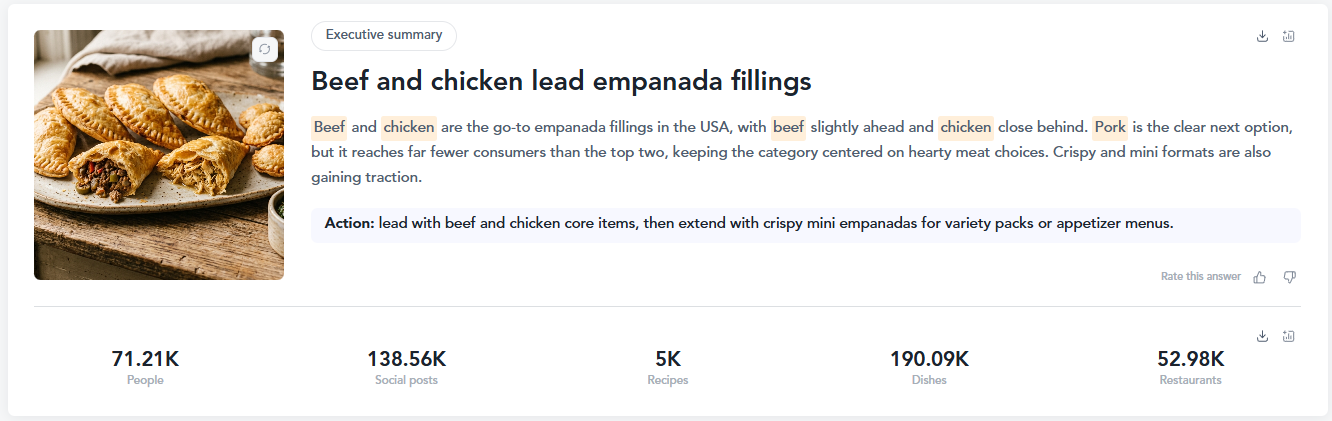
The core finding from this data is straightforward. Argentina food trends in the USA have crossed into mainstream consumer reach, but the branded product landscape has not caught up. The empanada is as reachable as the sandwich. Chimichurri indexes higher than almost any other sauce in this dataset. Dulce de leche reaches nearly 1 in 3 US consumers. And “Argentinian” as a cuisine identity is 51 times more concentrated in this consumer context than average.
The opportunity your team is looking at is not awareness-building. It is format development. The consumer already knows what these dishes and ingredients are. The question is whether your brand will be the one to build the accessible, scalable, retail-ready or menu-ready version before a competitor does.
The convenient motivation is up +22% in this context. Intense flavor is up +134%. Rich is up +31%. These are signals that point directly at premium convenience formats: a chimichurri sauce that lives next to hot honey on the condiment shelf, a dulce de leche filling inside a snack bar, an empanada format built for QSR throughput, a picanha cut positioned as an affordable premium on a steakhouse menu.
The Tastewise foodservice sales enablement solution is built for exactly this kind of gap analysis, translating consumer pull into operator-ready sell-in narratives.
FAQs about Argentina food trends in the USA
No. The consumer data shows that chimichurri, dulce de leche, and empanada-style formats are registering across mainstream food contexts in the US, not just in Latin American or Argentine-specific restaurants. Chimichurri is appearing alongside grilled proteins in American casual dining, and dulce de leche is showing up in coffee shops, bakeries, and ice cream formats well outside of Argentine cuisine contexts. The broader application opportunity is significant.
The data points to chimichurri and dulce de leche as the two highest-priority retail plays. Both have large, proven consumer bases, mature lifecycle stages, and significant format gaps. Chimichurri in particular is growing +13% in the past year at nearly 1 in 4 consumer reach, and the shelf-stable sauce category for this ingredient is underdeveloped relative to demand.
Not at the sub-format level. While the broad empanada category is in a mature lifecycle, beef and chicken empanada sub-formats are showing slight softening, which signals that the undifferentiated format is reaching saturation while the opportunity sits in innovation: new fillings, baked vs. fried positioning, LTO-ready formats, and premium ingredient combinations. The consumer base is large. The product differentiation is not.