






The latest food trends Australia are moving fast, and the brands tracking them in real time are pulling ahead. Across Tastewise consumer data, three signals are converging in 2026: a sustained shift toward functional health, a matcha-led premiumisation of everyday beverages, and a quiet but decisive surge in convenience-first eating. These are not seasonal blips. They are structural changes in how Australian consumers choose, buy, and talk about food.
Key takeaways
- Matcha is up 53% in the past year on the Australian consumer panel and now appears on menus at major QSR chains including McDonald’s and Krispy Kreme. Your innovation team can act on a trend that already has mass-market proof.
- The “convenient” consumer need is up 55% in Australia, growing faster than any other occasion signal. Portable, single-serve, and on-the-go formats are where the next shelf win is hiding.
- Gut health, anti-inflammatory, and hormone balance claims are each growing at double-digit rates, led heavily by at-home food formats. Any portfolio that lacks a functional positioning is leaving a lane open for competitors.
- Waffle is up 72%, tacos up 33%, and cinnamon bun up 108% on the Australian consumer panel. These are not niche curiosities. They are early-stage ingredients with room to run before the market saturates.
Australia food trends 2026: an overview
Australian consumers in 2026 are making food decisions that sit at the intersection of pleasure and purpose. The traditional separation between indulgence and health has largely dissolved. Consumers want food that tastes great, delivers a functional benefit, and fits into a lifestyle that does not slow them down. This shift is showing up across the home kitchen, the cafe menu, and the supermarket shelf simultaneously.
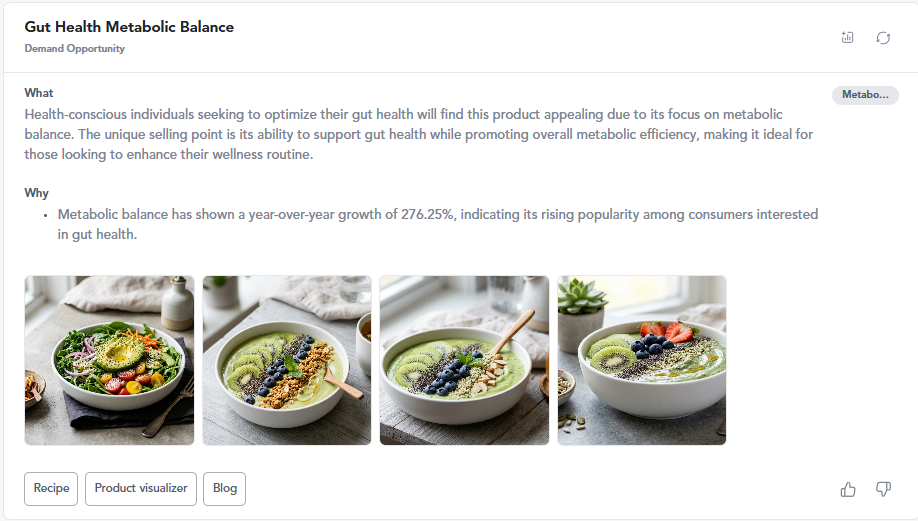
The Tastewise Australian consumer panel shows matcha at +53% in the past year, yogurt at +37%, and smoothies at +28%. The “gut health” consumer need is held by over 90% of the signal in certain functional health searches. Anti-inflammatory claims are up +292%, and the “convenient” occasion signal is up +55%. These are not separate trend stories. They are the same story told from different angles: Australian consumers are buying into a lifestyle, and food is the daily expression of it.
For your brand, that convergence creates a specific kind of portfolio opportunity. Ingredients that deliver on both taste and function, presented in formats that respect a time-poor consumer, are where Australia’s growth is concentrated. The 2026 food and beverage trend forecast maps out which of those pockets are still early enough to own.
How matcha became a mainstream signal in Australia food trends
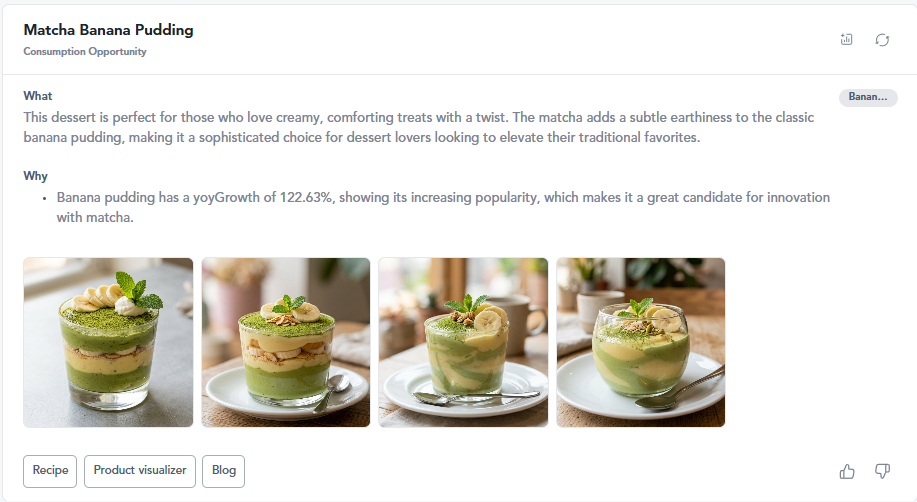
Matcha’s rise in Australia is no longer a specialty story. Tastewise data shows the ingredient at 3.58% social share on the Australian consumer panel, up 53% in the past year, with a lifecycle stage of “emerging.” That growth is confirmed at the operator level: iced matcha lattes now appear on menus at McDonald’s, Krispy Kreme, Starbucks, Rashays, and Chatime, with price points ranging from $6.30 to $18.95 across Sydney, Melbourne, and Brisbane outlets. Menu variants already include strawberry matcha, pistachio matcha, coconut matcha, and banana matcha, with banana matcha up +235% on the consumer panel. The full trajectory of this ingredient is covered in the matcha trends analysis across global markets.
What drives the growth is not novelty. Matcha resonates in Australia because it sits at the exact centre of the consumer values matrix: it is energising, it carries an antioxidant story, it photographs well, and it works across dayparts. The “calm” consumer need associated with matcha has grown +87% in the past year. “Therapy” is up +34%. Consumers are not just buying a drink. They are buying a mood.
The commercial implication is that matcha has crossed the line from trend to expectation in the premium cafe segment, but the grocery and retail channel has barely responded. Matcha-flavoured yogurts, snacks, and baking ingredients exist in isolated SKUs, but a coherent matcha portfolio at retail has not materialised. That whitespace is closing. The brands that move now, while the ingredient is still emerging rather than mature, have a genuine first-mover window in Australia’s grocery aisle. Your product innovation pipeline should be asking whether matcha is a flavour play or a platform.
The functional health shift driving Australia food trends in 2026
Australia’s food and beverage market is quietly becoming one of the most health-literate consumer environments in the world. The Tastewise data tells a specific story: anti-inflammatory claims are up +292% in the past year, gut health holds a dominant share of functional health signals, and hormone balance claims have grown +319%. These are not niche concerns held by a health-food subset. They are mainstream motivations held by the consumer who also buys convenience snacks and watches food content on social media.
The ingredient-level evidence backs this up. Greek yogurt is up +64%, chia is at +39% growth, bone broth has grown +237%, and magnesium as an ingredient is up +155% on the consumer panel. The “gut health” consumer need is by far the dominant functional signal, growing steadily and holding high reach. According to the Australian Bureau of Statistics, health conditions including digestive disorders affect nearly half of all Australians, which partly explains why gut health messaging resonates so consistently across the consumer panel.
For your R&D and brand teams, this creates a tractable brief. Australian consumers respond to functional claims that are specific and ingredient-led, not generic wellness language. “Contains live cultures” outperforms “supports health.” An anti-inflammatory positioning attached to a specific ingredient like turmeric or olive oil (up +41% in Australia) is more legible than a brand-level health promise. The CPG insights from comparable markets show that specificity converts at shelf where vagueness does not.
Convenience and occasion: the third pillar of Australian food trends
The “convenient” occasion signal in Australia is up +55% in the past year. “Easy” is up +54%, and “snack” is up +24%. These three signals are moving together, and they are telling the same story: Australian consumers want food that integrates into life rather than requiring life to pause for it. The implication for your range goes beyond format. It touches flavour, packaging, portion, and shelf placement simultaneously. Even in the beverage category, where cocktail trends show Australians shifting toward lower-alcohol and occasion-flexible formats, convenience is a consistent thread.
The ingredient signals confirm this. Loaded fries are up +69%, rice bowl is up +22%, and tacos are up +33% on the Australian consumer panel. These are not home-cooking signals. They are shorthand for the “assembled rather than cooked” meal moment that Australians are increasingly reaching for across lunch, late night, and the after-work daypart. The “late night” occasion claim is up +74%, and “on the go” is up +49%. Australian foodservice operators and QSR networks are already responding, with major metros showing strong signals for fast-casual protein bowls and grab-and-go breakfast items.
For portfolio and sales teams building a retail sell-in narrative, convenience in Australia is not a single SKU or pack-size story. It is a positioning decision. The brands winning shelf space in 2026 are those that can show a retailer exactly which consumption moment their product owns, with consumer data to prove it. Buyer conversations in Australia’s major grocery chains reward specificity over category claims.
Emerging ingredients in Australia food trends: where the whitespace sits
A set of ingredients on the Australian consumer panel are in the early-to-emerging lifecycle stage, growing rapidly but not yet captured by major CPG brands at retail. These are the places where a first-to-market advantage is still available.
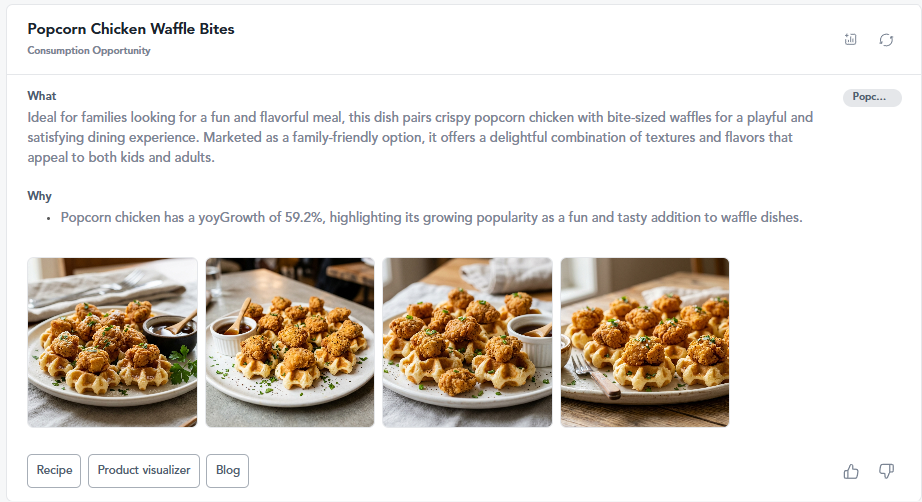
Waffle is up +72% and waffle formats are appearing across breakfast and dessert menus in major cities. Cinnamon bun is up +108% and is crossing from cafe into retail-packaged formats in other markets but has minimal brand presence in Australia. Ube is up +103% and has significant menu presence (5% menu share in the sushi category) but almost no branded retail expression. Pho is up +44% and tracking alongside broader Vietnamese influence in Melbourne and Sydney foodservice. Chai tea is up +26% and green tea is up +29%, both positioned at the intersection of the convenience and functional health trends.
Each of these represents a different risk profile. Waffle is broad enough to attach to multiple dayparts and channels. Ube is more specific and culturally anchored, but its growth trajectory in Australia mirrors its trajectory in the US and UK two years ago, markets where it subsequently crossed into grocery. The food marketing strategies that worked in those markets started with foodservice proof, moved to limited retail editions, and built from there. Australia is at the foodservice proof stage now.
How food trends in Australia play out across channels
The Australian consumer panel and operator data tell two complementary stories about how these trends are manifesting. At home, Australian consumers are experimenting with functional ingredients in cooking contexts: bone broth is up +237%, chia pudding up +51%, and smoothie formats up +28%. The at-home signal is richer in health motivations and led by younger consumers who are more likely to shop specialty or health channels.
In foodservice, the story is about speed and aesthetics. Matcha variants are proliferating across QSR and cafe menus in Sydney, Melbourne, and Brisbane at price points between $6 and $18. Korean-influenced formats, including loaded fries, crispy rice, and bao buns, are holding strong menu share. The “trendy” consumer need holds the highest share of any claim on the Australian panel at 30%, growing +6% in the past year. This tells you that visual and social appeal is still a primary driver of Australian restaurant choice. The social media food trends driving Australian engagement mirror the operator signals: visual-first formats with a health or heritage story attached.
The gap between the two channels is where the innovation opportunity sits. Ingredients that are well established in Australian foodservice but absent from grocery are the clearest brief. Matcha, ube, and Vietnamese flavour profiles all fit that description. A brand that closes that gap between menu and shelf is not creating a new category. It is following a consumer who already exists.
FAQs about food trends Australia
The three dominant signals in 2026 are matcha-led beverage premiumisation, functional health claims (particularly gut health and anti-inflammatory positioning), and convenience-first formats. Matcha is up 53% on the Australian consumer panel, with operator presence confirmed across McDonald’s, Krispy Kreme, and major cafe chains. Gut health holds the highest share of any functional claim, and the “convenient” occasion need is up 55%. These three trends are reinforcing each other rather than competing.
Ingredients in the early-to-emerging lifecycle stage with strong growth signals include waffle (+72%), ube (+103%), cinnamon bun (+108%), tacos (+33%), matcha (+53%), and yogurt (+37%). These sit in a growth window where consumer demand exists ahead of significant brand response, particularly in the grocery and retail channel. They are already established in Australian foodservice, which is typically the leading indicator for retail crossover.
Anti-inflammatory claims are up +292% on the Australian consumer panel, gut health dominates the functional needs layer, and hormone balance claims have grown +319%. At the ingredient level, Greek yogurt is up +64%, bone broth is up +237%, and magnesium is up +155%. These are at-home signals predominantly, meaning consumers are translating functional health intent into their grocery shop rather than purely seeking it at restaurants.




We’d love to learn your goals and see how Tastewise fits
We’d love to learn your goals and see how Tastewise fits
Get a personalized demo
Good taste. Wise move.
Your demo request is confirmed. We’ll reach out within one business day to schedule your walkthrough.
What happens next

See what’s driving demand, then turn it into a sell-in story for retailers and operators.
- Connect consumer panels, market trackers, and agents into one evidence view
- Get the “why” behind what’s changing, with explainable demand drivers
- Walk away with a buyer-ready narrative and next steps to activate
Trusted by





“Tastewise is my secret tool for knowing what consumers want next and why.“