





The CPG industry challenges facing brand teams today look different from the ones that shaped the last decade. Margin pressure has become a standing condition rather than a passing squeeze. Media costs keep climbing. Consumer attention moves faster than most innovation pipelines can answer.
This guide covers the challenges in the CPG industry that carry the most weight right now, across cost, marketing, ecommerce, supply chain and innovation. It also covers what three brands did about them, using the results they reported.
You get a clear view of where the pressure comes from, what current demand signals show, and which moves teams are making in response.
Key takeaways
- Cost pressure is now the baseline. The USDA Food Price Outlook forecasts all food prices up 3.1 percent in 2026, with grocery at 2.7 percent and restaurant at 3.5 percent.
- Identity claims are losing conversational ground. Mentions of vegetarian fell 24.9 percent and dairy free fell 18.6 percent across US food conversation over the past year.
- Function is where the attention went. Conversation around fiber grew 40.9 percent, gut health 12.1 percent and protein 9.8 percent in the same period.
- Validation speed separates the winners. Givaudan reported pitching 10 times faster and answering three times more customer briefs.
- Proof beats opinion in category conversations. Waitrose brought its Japanese Menyu range to market in nine months and cut launch time by 25 percent.
Core CPG industry challenges facing brands today
The pressures below rarely arrive one at a time. A formulation problem becomes a cost problem, which becomes a shelf problem. Reading them together is what separates a plan from a reaction.
Formulation and innovation risk
Getting a product to taste right and hold its nutritional promise remains one of the hardest parts of the job. The gap between a concept that tests well and a product that repeats is where most budgets disappear. Teams that treat product innovation as a validation problem rather than a creative one tend to waste less.
The data supports narrowing early. Tempeh conversation grew 8.6 percent over the past year and lentil grew 4.1 percent, while almond milk conversation fell 22.9 percent and vegan cheese fell 39.9 percent. Those are signals about where interest is heading, not sales figures, and they are useful for deciding what to test first.
Cost pressure and margin compression
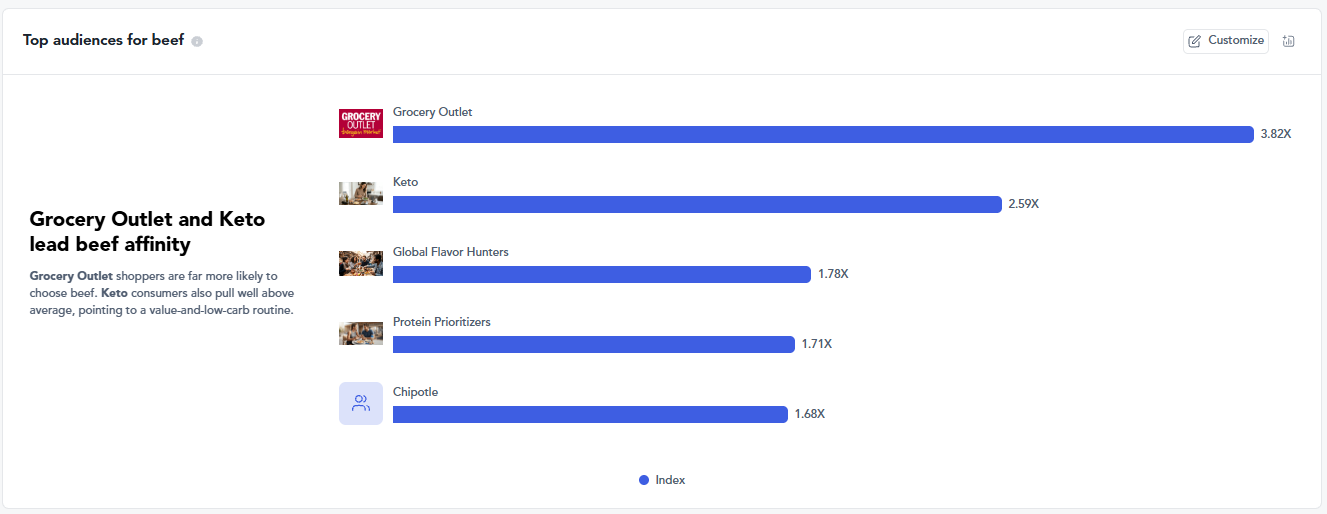
Input costs move faster than pricing decisions. Beef remains the sharpest pressure point as cattle inventories sit at multi decade lows, and sugar and sweets are running ahead of the wider grocery basket. Passing that through to shelf price risks the volume that funds the brand.
The practical response has been mix. Brands are protecting margin by shifting weight toward formats and claims that carry a price premium without a proportional cost increase, rather than by repricing the core line.
Consumer perception and claim fatigue
Identity based claims are doing less work than they did. Vegan still holds the largest share of conversation in the plant based space at 97.2 percent of relevant posts, but that conversation contracted 2.1 percent over the past year. Vegetarian fell 24.9 percent and dairy free fell 18.6 percent.
Functional benefit claims moved the other way. Fiber conversation grew 40.9 percent, gut health 12.1 percent, protein 9.8 percent and high protein 8.6 percent. Comfort grew 44.6 percent and satisfying grew 29.9 percent, which points at a consumer who wants the benefit and the eating experience together.
For most portfolios the read is straightforward. Lead with what the product does for the body and how it eats, then let the diet credential sit in support. That shift usually needs a rework of the CPG marketing message before it needs a rework of the product.
Market saturation and shelf competition
Category shelves are crowded and buyers have less room to gamble. New entrants struggle to earn a first listing and incumbents struggle to defend facings. Winning either conversation depends on category evidence, which is why retail sell-in has moved from a sales craft to an evidence exercise.
Menu share offers one grounded read on where a category already has behavioral traction. Within plant based dishes, burger sits at 2.2 percent menu penetration, nut butter at 2.3 percent and almond at 2.1 percent. Tofu, despite carrying the single largest share of conversation in the space, appears on just 0.2 percent of menus.
Technology adoption and internal speed
Most teams are not short of data. They are short of time to turn it into a decision a buyer will accept. The move toward agentic AI reflects that, with tools now expected to produce the argument rather than the spreadsheet behind it.
Adoption stalls when the output cannot be traced. Insights teams will not put a number in front of a retailer unless they can explain where it came from and what it measures.
CPG marketing challenges in a fragmented media landscape
Reach costs more and converts less than it did. Retail media has absorbed a growing share of trade budgets, and the same creative now has to work across a retailer network, a social feed and a search result that may never produce a click.
The harder problem is relevance. A single brand message aimed at a broad category audience tends to underperform against several messages aimed at specific motivations. Conversation around convenient grew 9.3 percent and easy grew 10.4 percent over the past year, while healthy fell 12.4 percent. Those are different buyers responding to different promises.
Teams working with defined consumer segments tend to get more from the same spend, because the claim, the occasion and the format are chosen together rather than in sequence.
Attribution stays difficult. Where sales lift cannot be cleanly traced, the strongest available proof is that the demand signal moved before the campaign ran and the category responded after it.
CPG ecommerce challenges on the digital shelf
The digital shelf rewards different things than the physical one. Pack design matters less than the first three words of a product title. Ranking depends on review velocity and search relevance, both of which decay without attention.
Assortment fragmentation compounds it. The same product may appear across a retailer site, a marketplace, a delivery app and a convenience aggregator, each with its own content rules and its own competitor set. Keeping the claim consistent across all of them is an operational task, not a creative one.
Basket economics are the third constraint. Delivery and fulfilment costs fall hardest on low ticket items, which pushes brands toward multipacks and bundles that hold margin. Choosing which formats to bundle works better when it follows how people actually describe eating the product. Conversation around meal prep grew 11.0 percent over the past year and frozen held steady, both of which favor multi serve formats.
Managing critical CPG supply chain challenges and risks
Supply chain now shapes what a brand can credibly promise. A claim that depends on a single origin ingredient carries a different risk profile than one that does not, and that risk shows up in fill rates long before it shows up in a P&L.
Logistics and inventory bottlenecks
Ingredient volatility is the most immediate pressure. When a commodity moves sharply, the cost of a formulation can change faster than a pricing cycle allows, and reformulating mid year carries its own risk to taste and to labeling.
Transport and labor friction add a timing problem on top of a cost problem. A delayed shipment that would once have meant a late delivery can now mean a lost promotion window, because retailer calendars have less slack in them than they used to.
Forecasting is where these meet. Demand for a product rarely moves in a straight line across retail and digital channels at the same time, and a forecast built on last year’s split will over serve one and starve the other. Getting that wrong is expensive in both directions, through markdowns on one side and lost listings on the other.
Addressing operational constraints
The constraint most brands run into is lead time on decisions rather than lead time on goods. Sourcing choices get locked months before the demand picture is clear, so the quality of the early signal determines how much flexibility remains later.
This is where demand data earns its place in a supply conversation. Watching how interest in an ingredient moves, and how far it has traveled into menus and retail assortments, gives a planning team an earlier read than shipment history alone. Tempeh conversation growing 8.6 percent while almond conversation fell 23.1 percent is the kind of divergence worth catching before a contract renews.
Menu share is the steadier of the two measures, because it reflects what operators have already committed to buy. Reading conversation for direction and menu penetration for commitment gives sourcing and foodservice sell-in teams a shared basis for planning, instead of two forecasts that disagree.
None of this removes volatility. It shortens the gap between a market moving and a team knowing, which is usually the difference between adjusting a plan and rebuilding one.
How three brands worked through these challenges
The pressures above are easier to read against real cases. Each of these teams faced a version of the same problem, which is that the market moved faster than their research cycle could answer.
Givaudan, answering client briefs before the trend cooled
The challenge: the Marketing and Consumer Insights teams at Givaudan had to answer client briefs on flavor direction while consumer preferences kept shifting underneath them. Their research methods were slower than the questions coming in, which meant briefs went unanswered and competitors reached the trend first.
What changed: the teams moved to real time trend validation, using live consumer signals to check an idea before committing to it. Social insight became a standard input rather than a supplementary one, feeding into every second research project.
The result: Givaudan reported pitching 10 times faster, answering three times more client briefs, and a rise in project inflow and new wins.
Waitrose, taking a new range to shelf in nine months
The challenge: the innovation team at Waitrose was working through menus, recipe sites and social by hand to spot culinary movement. That process could describe a trend but struggled to size it, so building a business case for a new range took longer than the window the trend allowed.
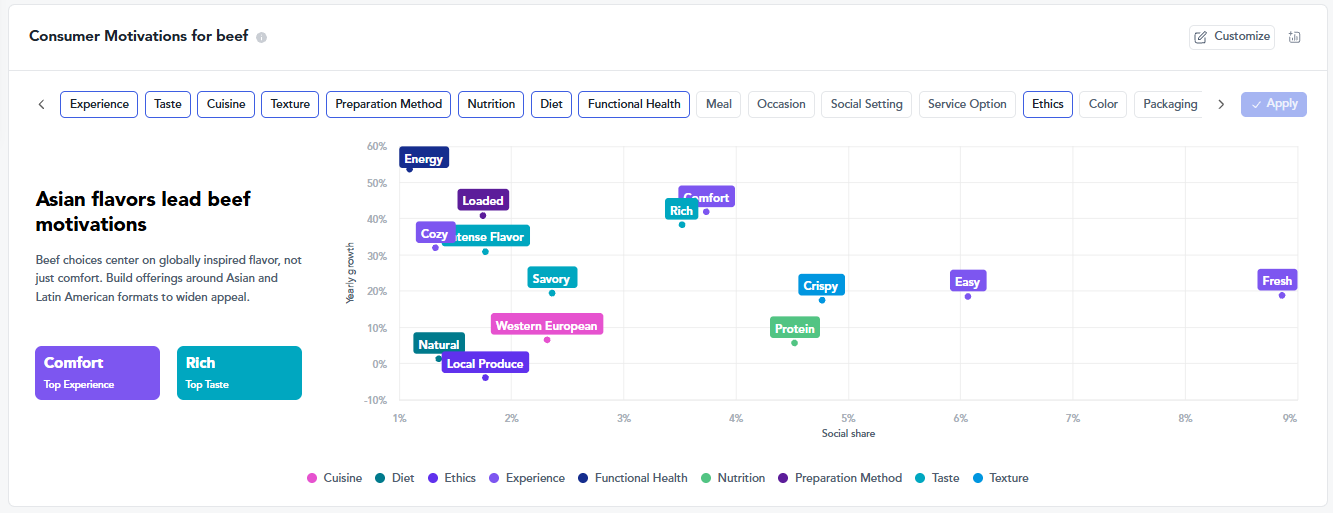
What changed: the team used consumer demand data to quantify the opportunity in Asian meals and to build the internal proposal for a Japanese range on evidence rather than instinct.
The result: the Japanese Menyu range launched in nine months across a complex cross category line, with launch time cut by 25 percent. It became the top performer in chilled meals and drew younger customers who spent an average of five pounds more per basket.
Butterball, moving from regional listings into national chains
The challenge: growing beyond an established regional base means convincing national operators, and those buyers want category evidence rather than a supplier’s confidence. Butterball needed to show where its products fit on menus that were already full.
The result: the team expanded into national chains and reported 20 percent menu growth.
The common thread across all three is timing. None of them found a trend nobody else could see. They confirmed it early enough to act while the opportunity was still open.
Where the opportunities sit for CPG companies
Every pressure described above has a corresponding opening, usually for whoever reads the signal first.
Reformulating around function rather than identity
The claim shift is the clearest near term opportunity. A product that already qualifies on a diet credential can often be repositioned on fiber, protein or gut health without a formulation change, which is a marketing cost rather than an R&D one.
Winning category conversations with evidence
Retail buyers are making fewer, more defensible decisions. A brand that arrives with category level demand data and a clear read on the shopper tends to get further than one arriving with a product story. That is a change in what CPG market research is for, moving it from a validation step at the end to a sell-in asset at the front.
Shortening the innovation cycle
The teams above all compressed the same stage, which is the distance between an idea and enough confidence to fund it. Removing months there changes how many concepts a team can afford to try, and CPG growth tends to follow the number of quality attempts more closely than the size of any single bet.
Turning CPG industry challenges into a plan
The challenges in the CPG industry are not going to resolve into a calmer market. Costs will keep moving, shelves will stay crowded, and the claims that work this year will tire. What changes is how quickly a team can tell the difference between a shift that matters and one that does not.
That is a question of evidence and timing. Givaudan, Waitrose and Butterball each solved the same underlying problem, which was seeing the movement early enough to do something useful with it.




We’d love to learn your goals and see how Tastewise fits
We’d love to learn your goals and see how Tastewise fits
Get a personalized demo
Good taste. Wise move.
Your demo request is confirmed. We’ll reach out within one business day to schedule your walkthrough.
What happens next

See what’s driving demand, then turn it into a sell-in story for retailers and operators.
- Connect consumer panels, market trackers, and agents into one evidence view
- Get the “why” behind what’s changing, with explainable demand drivers
- Walk away with a buyer-ready narrative and next steps to activate
Trusted by





“Tastewise is my secret tool for knowing what consumers want next and why.“