





The 2026 food trends USA picture is moving faster than most product pipelines can absorb. Consumer demand for functional, clean-label, and convenient formats is no longer a segment story. It is showing up in the mainstream data: gut health claims are up 44% in the past year, anti-inflammatory positioning has grown 70% since last year, and metabolism-related motivations have surged 61% across the US market. If your team is briefing a new SKU or format for 2026, the signals are already in the data. The question is whether your pipeline is moving at the speed the consumer is.
Key takeaways
- Gut health is the fastest-growing functional claim in the US, up 44% in the past year. Consumers are actively seeking fermented formats, probiotics, and anti-bloat positioning across both food and beverage. Your next innovation brief should include at least one gut-health angle if it does not already.
- Anti-inflammatory positioning has grown 70% in the past 12 months and is now appearing across food and restaurant channels at a 31/69 split. That restaurant-led growth is the early signal. Retail brands that move now have a first-mover window before shelf competition catches up.
- Metabolism support has surged 61% since last year, and hormone balance motivations are up 73%. Consumers are not just choosing healthy food. They are choosing food that does something specific for their body. Generic wellness claims are losing ground to function-first positioning.
- Convenience is growing 44% and is skewing 77% toward food formats rather than restaurants. That tells you the at-home and retail occasion is where consumers are making active functional choices. Your packaging and format strategy should meet them there.
- Vitamin D mentions have grown 142% in the past year and vitamin B12 is up 99%. Micronutrient fortification is moving from pharmacy to food aisle in the consumer mind. Brands that can credibly own a specific micronutrient benefit have a clear brief to build.
2026 food trends USA overview: what is driving the shift
American consumers are not eating less. They are eating with more intention. The dominant behavioral signal across the 2026 food trends USA landscape is a move toward foods that do something: regulate, recover, support, sustain. This is being driven by a population that has normalised daily nutritional self-management, and the data from Tastewise’s food intelligence platform reflects it clearly. Clean-label claims, functional health motivations, and convenient formats are all growing together because they reflect the same underlying shift in how Americans think about food’s role in their daily routine.
Three signals define the current landscape. First, gut health is the breakout functional category, with 44% growth and strong presence across both food and out-of-home channels. Second, metabolism and hormone balance motivations are surging, driven by a consumer cohort that is actively tracking and optimising their nutritional intake. Third, convenience is accelerating, but specifically in food formats rather than restaurant occasions, meaning retail and CPG brands are positioned to capture the largest share of this demand if they move with the right formats and claims.
The opportunity is concentrated where functional claims meet everyday formats. The whitespace is not in creating a new category. It is in taking high-familiarity ingredients and repositioning them around the specific functional outcomes consumers are already expressing. The 2026 food and beverage trend forecast maps the full signal landscape for teams who want the complete data picture before briefing their next launch.
Consumer behavior signals shaping 2026 food trends USA
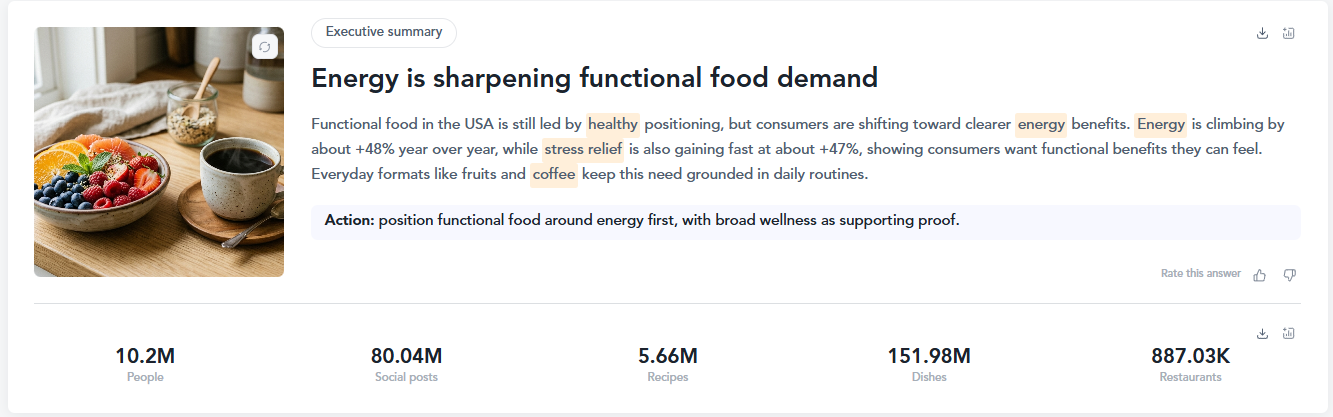
Tastewise data shows that the top consumer motivations in the US functional food space are health (96.6% share), energy (60.3%, up 10% in the past year), and gut health (52.1%, up 44%). These three signals sitting at the top of the motivation stack together tell you that consumers have moved past the idea of food as neutral sustenance. They are choosing what they eat because of what they expect it to do. That expectation is most acute in the morning occasion, where breakfast-related motivations have grown 75% in the past 12 months, and in the convenience window, where easy-to-prepare formats are up 55%.
Specific micronutrient motivations are registering at growth rates that were not visible in this data two years ago. Vitamin D is up 142% in the past year. Vitamin C is up 66%. Potassium is up 72%. These are no longer niche health-seeker interests. They are moving into mainstream purchase decisions, anchored by a generation of consumers who track their nutrition daily and expect food brands to speak their language. Anti-inflammatory claims at 70% growth and anti-bloat positioning at 98% growth confirm that the specificity of the functional claim matters. Broad wellness language is underperforming. Precise functional language is winning.
For your team, this creates a clear brief logic: start with the function the consumer is expressing, then build the ingredient and format story around it. Coconut water is growing 38% and sits alongside electrolytes (up 12%) and magnesium (up 62%) as ingredients that carry both functional credibility and mainstream familiarity. Fermented formats, with probiotics up 69% and fermentation mentions up 95%, offer a gut-health proof point that consumers already understand. These are not new ingredients. They are proven ingredients that have not yet been fully claimed in the functional positioning space. See how Tastewise supports product innovation
The core finding: where the 2026 food trends USA whitespace sits
The gap in the 2026 food trends USA data is not in consumer demand. That exists at scale. The gap is in execution. Consumers are expressing clear, specific functional preferences, and the brand response across most retail categories has not caught up. Anti-inflammatory positioning has grown 70% but is showing up primarily in restaurant contexts rather than retail. Metabolic balance mentions have surged 151% in the past year. Adaptogens are up 82%. These are not fringe signals. They are mainstream motivations that most retail shelves are not yet answering.
The specific whitespace sits at the intersection of three things the data confirms: a functional claim that consumers understand and are actively seeking, a high-familiarity ingredient that does not require consumer education, and a convenient format that fits the occasions where this consumer is making purchase decisions. Gut health plus fermented ingredients plus a single-serve or on-the-go format is one version of that brief. Anti-inflammatory plus ginger or turmeric plus a clean-label ready-to-drink format is another. The data does not prescribe one answer. It shows your team where the demand is concentrated so you can build the right version for your portfolio and channel.
The risk of waiting is not abstract. Retail brands that sit on this signal for another 12 months are watching foodservice operators build consumer habit around functional formats in the out-of-home channel. Those habits carry into retail purchase decisions. The team that lands the right functional brief first owns the consumer reference point on shelf.
Ready to build a data-backed brief?
Key ingredients driving 2026 food trends USA
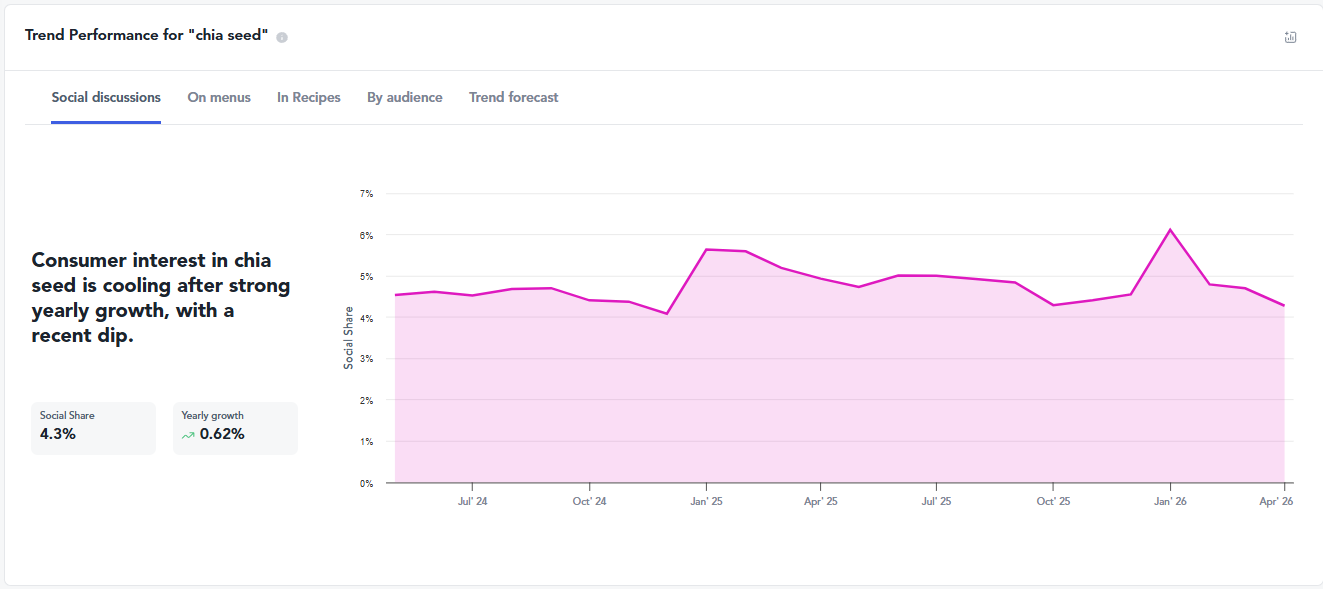
These ingredients are recording the strongest combined growth in the Tastewise US dataset and carry the highest alignment with the functional motivations consumers are expressing most actively.
- Chia seed: +73% social growth. High alignment with fiber (+25%), omega-3 (+12%), and gut health motivations. Versatile across both sweet and savory formats with strong familiarity in the health-conscious consumer segment.
- Lemon: +79% social growth. Growing as a functional flavor carrier, not just a taste ingredient. Aligns with vitamin C (+66%), detox (+99%), and anti-bloat (+98%) motivations. Strong cross-format potential across beverages, dressings, and snack coatings.
- Coconut water: +38% social growth. The natural electrolytes signal in ingredient form. Tracking alongside potassium (+72%) and magnesium (+62%) motivations. Strong positioning for functional hydration formats targeting the fitness and morning occasions.
- Ginger: +38% social growth. Top ingredient in the anti-inflammatory and gut health brief. Pairs with turmeric in the spice-led wellness positioning that is outperforming generic ‘clean’ claims across both food and beverage.
- Olive oil: +47% social growth. Gaining momentum as a healthy-fat and heart-health ingredient. Up alongside heart health motivations (+40%) and anti-inflammatory claims. Strongest in premium and Mediterranean-positioned formats.
- Greek yogurt: +39% social growth. The gut health and protein bridge ingredient. Aligns with probiotics (+69%), high protein (+18%), and morning occasion growth (+75%). Strong in snacking, breakfast, and blended formats across retail.
How 2026 food trends USA play across channels
At-home and retail
The at-home data is clear: convenience is up 44%, skewing 77% toward food formats rather than restaurant occasions. Consumers are making active functional choices in the grocery and home-prep context, and they are choosing formats that do not require effort. Meal prep motivations are up 22%, and quick-preparation claims are up 35%. The retail brief that lands in this context combines a credible functional claim with a format that removes friction. Protein-forward, single-serve, and clean-label configurations are outperforming in this occasion.
Out-of-home and foodservice
In foodservice, the signal is arriving through the morning and midday dayparts. Breakfast-related motivations are up 75% in the past 12 months, and the foodservice operators building around this are centering on protein, gut health, and clean-label positioning rather than indulgence. The Tastewise operator data shows breakfast tacos, grilled chicken formats, and charcuterie-led concepts among the top menu ingredients for operators tracking functional consumer demand. QSR and fast-casual are the channels where the consumer is already training the behavior. Retail brands that can mirror the format language from foodservice have a ready-made sell-in story with buyers.
Social and digital
The social signal is running ahead of both retail shelf presence and restaurant menus for most of the high-growth functional claims. Anti-bloat positioning is up 98% in social data. Adaptogens are up 82%. Vitamin D is up 142%. These are signals that have not yet been fully claimed in the commercial space. Your marketing team can use the social-to-shelf gap as the proof point in a buyer meeting: here is what consumers are already asking for, here is how much menu and retail presence actually exists, and here is the window before a competitor closes it.
Strategic recommendations for R&D, marketing, and sales teams
R&D
- Build your next brief around one of the three highest-growth functional motivation clusters: gut health (+44%), metabolism support (+61%), or anti-inflammatory (+70%). Each has an ingredient stack that is already growing in the Tastewise data and does not require consumer education to land.
- Prioritise single-serve and convenient formats. Convenience is up 44%, skewing 77% toward food. If your current format brief starts with multi-serve or full-meal formats, the data suggests the higher-demand occasion is the on-the-go or quick-prep window.
- Consider micronutrient fortification as a differentiation angle. Vitamin D is up 142%, vitamin C up 66%, potassium up 72%. Consumers are tracking these specifically, and the retail shelf has not caught up with the demand signal yet.
Marketing
- Audit your current claim language against the 2026 data. Broad wellness is underperforming. Specific functional claims, particularly anti-inflammatory, gut health, hormone balance, and metabolism support, are growing at 2x to 3x the rate of generic health positioning. Reframe your copy around the specific outcome, not the general benefit.
- Brief your agency on the morning occasion. Breakfast-related motivations are up 75% in the past year. This is the highest-growth daypart in the functional food space, and most brand campaign calendars are not reflecting that shift yet.
Sales
- Use the social-to-shelf gap as your buyer story. For gut health, anti-inflammatory, and micronutrient claims, consumer demand in social data is outpacing retail shelf presence by a significant margin. That gap is the sell-in. Show your buyer where the consumer is already heading and what the shelf response looks like today.
- The foodservice sales enablement data is your best source for the out-of-home proof points that back up a retail pitch. Operators are building the consumer habit that retail needs to capture.
About this data
The insights in this report are powered by Tastewise’s AI, which analyses billions of real-life consumer data points across social media, restaurant menus, and retail product signals to provide a real-time view of food and beverage trends across the USA. The platform tracks 22.3 billion social interactions, 5 million-plus restaurant menus, and millions of retail SKUs with real-time daily updates.
Your next move
The consumer evidence for 2026 food trends USA is already in the data. Gut health is up 44%. Anti-inflammatory claims are up 70%. Vitamin D mentions have grown 142% in the past year. The brands that act on these signals now will have 12 months of distribution and buyer confidence before the market catches up.
FAQs about food trends USA
The three functional motivation clusters with the strongest and most consistent growth in the Tastewise US dataset are gut health (up 44% in the past year), metabolism support (up 61%), and anti-inflammatory positioning (up 70%). Each is reinforced across social, menu, and retail signals, meaning the consumer demand case is already built. Vitamin D is up 142% and vitamin B12 is up 99%, pointing to micronutrient fortification as a high-growth brief angle that most retail categories have not yet fully addressed.
The 2026 healthy food trends USA signal is additive rather than subtractive. Previous wellness cycles were defined by removing ingredients: less sugar, less fat, fewer carbs. The 2026 data shows consumers choosing food for what it provides: gut support, metabolic function, anti-inflammatory benefit, hormone balance. Anti-bloat claims are up 98% in the past year, adaptogens up 82%, and hormone balance motivations up 73%. Brands that frame their positioning around what the product gives the consumer, not what it takes away, are aligned with where this consumer is headed.
The Tastewise data shows that the morning and midday dayparts are the highest-growth windows in US foodservice right now. Breakfast-related motivations are up 75% in the past year, and the operator data shows that protein-forward and gut-health-positioned formats are the fastest-growing menu additions in this window. For operators building or refreshing their delivery menu, the functional breakfast and midday snack occasions represent the clearest growth opportunity, particularly in formats that can hold quality through the delivery window.
The Tastewise consumer needs data shows that energy claims (up 10%) and gut health claims (up 44%) have the broadest cross-demographic resonance, appearing in both food and restaurant channel data. Hormone balance motivations (up 73%) and womens health signals (up 22%) are skewing toward food formats rather than out-of-home consumption, which points toward retail and CPG as the primary channel for these audiences. Anti-inflammatory positioning is showing up more strongly in restaurant contexts (69% restaurant vs 31% food), which means the foodservice channel is currently leading consumer education on this claim.





We’d love to learn your goals and see how Tastewise fits
We’d love to learn your goals and see how Tastewise fits
Get a personalized demo
Good taste. Wise move.
Your demo request is confirmed. We’ll reach out within one business day to schedule your walkthrough.
What happens next

See what’s driving demand, then turn it into a sell-in story for retailers and operators.
- Connect consumer panels, market trackers, and agents into one evidence view
- Get the “why” behind what’s changing, with explainable demand drivers
- Walk away with a buyer-ready narrative and next steps to activate
Trusted by





“Tastewise is my secret tool for knowing what consumers want next and why.“