






Consumer insights tools are used to understand what people want, why they want it, and how that translates into demand. The gap is not access to data. It is the ability to explain it, defend it internally, and act on it quickly.
Most consumer intelligence software still operates as dashboards or static reports. That creates friction across marketing, R&D, and commercial teams. Insight exists, but conviction does not.
Tastewise represents the upgrade: an evidence-based conviction platform built to turn real consumer signals into decisions teams can align on and sell.
- Tastewise: best for decision-ready insights and sell-in narratives
- NielsenIQ: best for retail measurement and category tracking
- Mintel: best for macro trends and structured research
- GWI: best for audience profiling and segmentation
- Sprinklr / Brandwatch: best for social listening and conversation tracking
The 5 best consumer insights tools and platforms
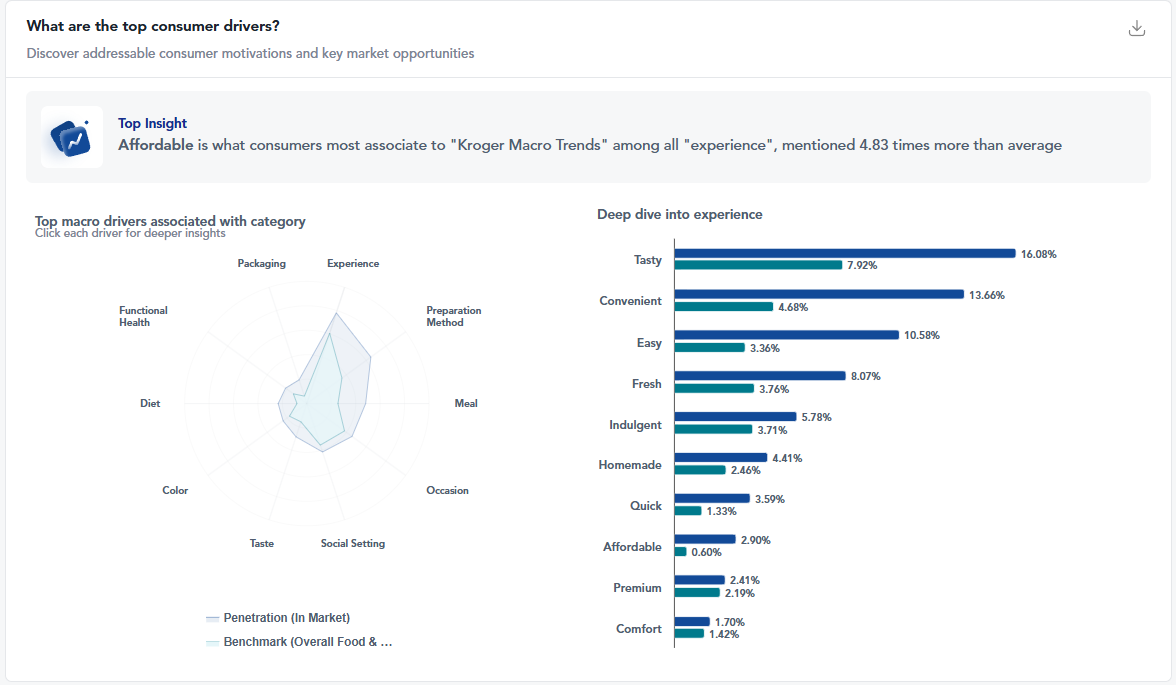
Food and beverage teams operate differently from general market research workflows. Demand signals shift faster, and decisions need to translate directly into products, menus, and shelf strategies.
Generic consumer insights platforms provide broad visibility, but F&B teams require category-specific intelligence tied to real consumption behavior. This is where platforms built for food and beverage create an advantage.
Tastewise
Best for: CPG innovation, sell-in narratives, cross-functional alignment
Tastewise brings together Social F&B panel, Foodservice, and Home cooking panel data into a single system. Outputs are structured for immediate use: product concepts, claims, pricing logic, and buyer-ready narratives.
Internal studio outputs support activation by turning insights into materials that can be used across teams without additional translation.
NielsenIQ
Best for: Retail measurement, category tracking, historical benchmarking
NielsenIQ provides structured visibility into sales, distribution, and category performance. It is widely used for tracking performance over time and benchmarking against competitors.
Mintel
Best for: Long-form reports, macro consumer trends, category overviews
Mintel delivers analyst-led research reports that support strategic planning and category understanding. These reports are often used to inform early-stage thinking and stakeholder discussions.
GWI (GlobalWebIndex)
Best for: Audience profiling, consumer segmentation, attitudinal insights
GWI provides survey-based insights into consumer behaviors, preferences, and attitudes. It is commonly used to define target audiences and build segmentation strategies.
Sprinklr / Brandwatch
Best for: Social listening, brand monitoring, sentiment tracking
These platforms track conversations across social channels, enabling teams to monitor brand perception, campaign performance, and emerging topics.
How to evaluate consumer insights platforms
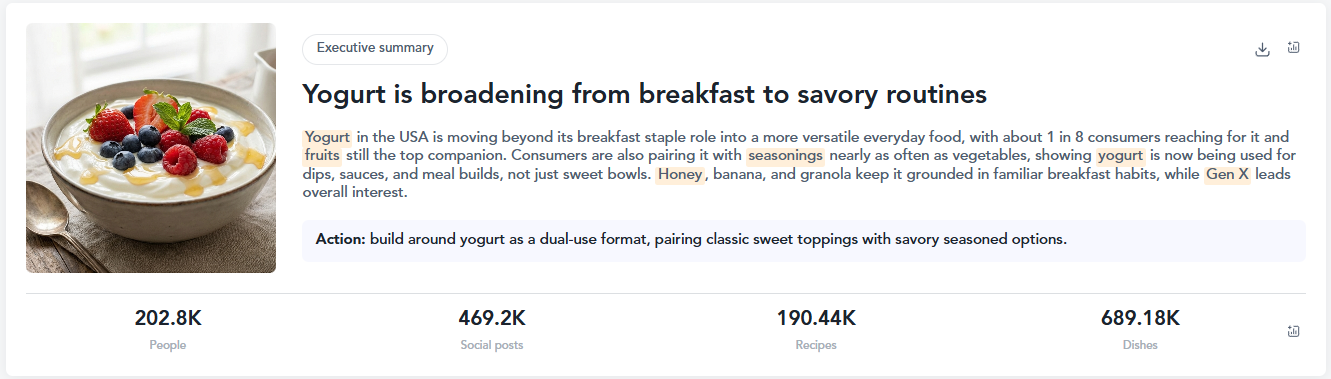
Speed
Faster access to insights enables quicker response to changing demand and shorter innovation cycles.
Explainability
Insights need to be clearly understood and communicated across teams to support decision-making.
Real data vs claimed data
Behavioral data reflects what consumers do. Survey data reflects what consumers say. Combining both improves confidence in decisions.
Actionability
Insights should translate into clear next steps across product, marketing, and commercial teams.
Why these tools matter for commercial teams
The impact of consumer insights depends on how easily they can be used across teams.
- R&D evaluates product viability
- Marketing defines positioning and messaging
- Commercial teams build retailer narratives
Teams move faster when evidence is easy to explain, validate, and apply in real decisions.
- Foodservice data shows increased demand for high-protein breakfast options
- Social F&B panel shows growing engagement with protein-led snacking
- Action: develop a high-protein breakfast product with clear functional positioning and defined price architecture
The value comes from connecting signals to a clear decision path.
How consumer insights tools work in practice
Consumer insights for CPG and foodservice teams prove their value in specific decisions, not in dashboards. The scenarios below are illustrative, not case studies of named clients. Each one follows the same path: the business problem, the tool-driven process and the outcome.
Scenario 1: CPG brand validating a new snack concept
A mid-sized CPG brand is preparing for a spring retail sell-in and wants to know whether a turmeric-ginger protein bar has enough consumer pull to justify a national launch. The innovation team checks demand signals for turmeric, ginger and high-protein snacking across the Social F&B panel, then cross-references foodservice data to see whether the pairing already appears on menus. From there, the team shapes the concept, drafts claim variants and sets a price architecture, with each choice tied to behavioral data rather than survey assumptions. The result is a retail sell-in narrative where every claim points back to a consumer signal the buyer can question and check.
What made this possible: behavioral data from several sources in one view, so product concept validation and the buyer story came from the same evidence.
Scenario 2: Restaurant chain refreshing a breakfast menu
A regional quick-service chain wants to refresh its breakfast menu ahead of a competitive relaunch, without waiting on a commissioned study. The team needs to know which functional ingredients are gaining ground in its markets. Using chain and menu data, it checks whether adaptogen drinks such as ashwagandha lattes are appearing on more independent café menus than in the previous quarter, and how those items are priced and described. If the signal holds, the chain can pilot a limited-time adaptogen latte and use the same data to explain the decision internally and to franchisees.
What made this possible: speed. Menu data answered a specific question inside the chain’s planning window.
Scenario 3: Beverage brand repositioning an existing product
A beverage brand with a declining sparkling water SKU wants to reposition the line without reformulating it. The marketing team uses GWI to profile audiences and Tastewise to read behavioral demand signals, and looks for a wellness-minded segment that responds to hydration language more than flavor-led messaging. Once the signal is clear, the team updates packaging claims, moves consumer marketing campaigns toward functional language and tracks performance against the previous creative. The pivot needs no new product development budget, because the change sits in positioning, not in the product.
What made this possible: explainability. The insight was clear enough for brand, marketing and sales to align on one message before creative work started.
Across all three scenarios, AI-powered consumer intelligence does the same job for food and beverage innovation. It turns a specific question into evidence your team can defend and act on.
Consumer insights for CPG needs to be fast
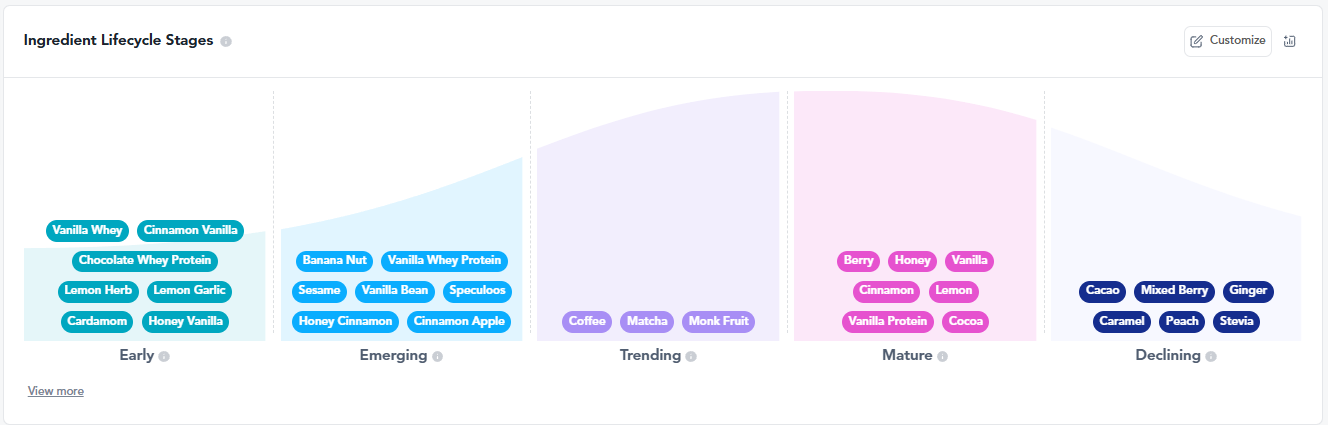
Speed determines whether insight gets used or ignored. For CPG teams, consumer insights need to be fast because decisions are tied to launch cycles, retail windows, and competitive timing:
Faster workflows support:
- quicker concept validation
- faster internal alignment
- stronger retailer conversations
Tastewise is designed to reduce the time between signal detection and decision-making.
Should you adopt AI-powered consumer intelligence platforms?
Different tools serve different roles.
Dashboards and research platforms provide structured visibility. AI-powered platforms extend that by translating data into decisions.
Tastewise is built specifically for food and beverage teams, combining multiple datasets with outputs designed for innovation and commercial use .
Teams evaluating platforms should consider how easily insights can be:
- understood
- shared internally
- used in external conversations
Consumer intelligence solutions built for product innovation
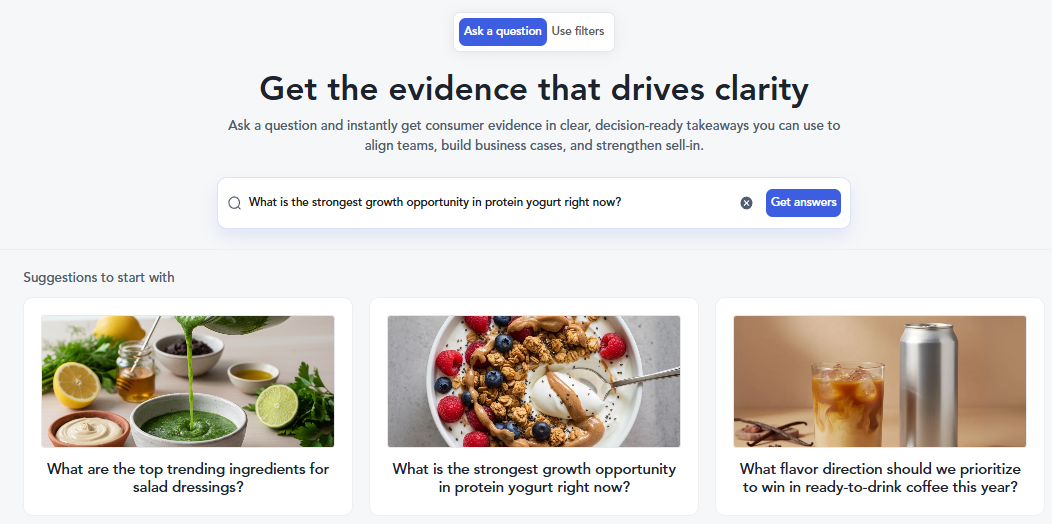
Consumer intelligence supports product innovation when demand signals translate directly into execution. That includes validating concepts against real behavior, defining positioning and claims that align with consumer expectations, and building shopper-facing narratives that hold up in retail conversations. Insight only works if it can be used.
FAQs about consumer insights tools and platforms
Consumer insights tools help businesses analyze consumer behavior, preferences, and demand patterns using data from multiple sources such as sales, social media, and surveys.
Consumer insights platforms are used to support product development, marketing strategy, pricing decisions, and retail sell-in by turning data into structured insights.
Consumer intelligence software connects different data sources to provide a unified view of consumer behavior, enabling teams to make faster and more informed decisions.
The best consumer intelligence tools combine real consumer data, fast access to insights, clear outputs, and the ability to support decision-making across teams.
Consumer insights tools help CPG companies identify demand shifts, validate product ideas, optimize positioning, and build stronger retailer narratives.
Consumer insights tools focus on analyzing data, while consumer intelligence platforms connect that analysis to actions such as product innovation, marketing, and commercial strategy.
AI-powered platforms improve speed, scale, and consistency by analyzing large datasets and translating them into outputs that teams can use directly in decision-making.
Start with the decision your team makes most often: product development, marketing strategy or retail sell-in. Then shortlist tools whose data matches that decision, since platforms built for food and beverage usually get F&B teams to an answer with less setup. A scoped pilot on one live business question is the most reliable way to test fit before you commit to a full contract.
Consumer insights platforms draw on sources such as social media, point-of-sale data, foodservice menus, consumer panels, e-commerce reviews and surveys. The strongest platforms combine behavioral data, which shows what consumers do, with attitudinal data, which shows what they say they prefer. Tastewise, for example, brings together Social F&B panel, Foodservice and Home cooking panel data in one system. Check which sources a platform uses, and how it labels each one, before you rely on its outputs.
It depends on setup, data access and how clearly you frame the question. AI-powered platforms are built to return answers to a scoped question on demand, while analyst-led research and commissioned studies usually run on longer reporting cycles. If speed matters to your team, test time to a usable answer during the evaluation, not after signing.
Many consumer intelligence platforms offer exports, API access or connections to tools your team already uses. Insights that reach people inside their existing workflow are easier to act on than insights locked in a separate dashboard. Tastewise, for example, supports workflow integrations and connects to AI assistants such as Claude and Gemini through MCP. Make integration depth part of your platform selection criteria.
Behavioral data captures what consumers do, such as the purchases they make, the menu items they order and the recipes they search. Survey data captures what consumers say they prefer or plan to do, which does not always match what they actually do. Combining both gives you more reliable insights, because you can check stated preferences against real-world behavior.
Traditional market research relies on scoped studies, analyst interpretation and reporting cycles that can run for weeks or months. AI-powered platforms analyze large, continuously updated datasets and surface patterns as they emerge. The main differences are speed and breadth. Traditional research answers a defined question for a defined sample, while AI-powered platforms can track many signals across sources at once.
Food and beverage companies get the most from platforms with category-specific data, such as foodservice menu tracking, social food content and home cooking behavior. Broader tools like GWI offer audience context across categories, and Mintel provides analyst-led category reports. Tastewise is built specifically for food and beverage teams and combines several F&B data sources in a single consumer insights platform.
Retail buyers want evidence that consumer demand exists and that a product fits where the category is heading. Consumer intelligence platforms supply that evidence through demand trend data, consumer segment profiles and competitive context. Platforms that produce buyer-ready narratives cut the time it takes to prepare pitch materials and give commercial teams firmer ground in the buyer meeting.

Read more from Kelia Losa Reinoso


We’d love to learn your goals and see how Tastewise fits
We’d love to learn your goals and see how Tastewise fits
Get a personalized demo
Good taste. Wise move.
Your demo request is confirmed. We’ll reach out within one business day to schedule your walkthrough.
What happens next

See what’s driving demand, then turn it into a sell-in story for retailers and operators.
- Connect consumer panels, market trackers, and agents into one evidence view
- Get the “why” behind what’s changing, with explainable demand drivers
- Walk away with a buyer-ready narrative and next steps to activate
Trusted by


“Tastewise is my secret tool for knowing what consumers want next and why.“