





Butterscotch is in a declining stage overall, but that’s the wrong frame. In coffee, breakfast pastries, and savory crossovers, it’s surging. Your team needs to know where the growth is hiding before competitors do.

Butterscotch trends in 2026 are best understood through real-time consumer signals, menu penetration data, and whitespace maps. These are the three lenses that show R&D and innovation teams at F&B brands not just where the flavor has been, but exactly where the opportunity is now.
Key takeaways
- Butterscotch lattes are growing +31% in the past year. Specialty coffee is the single fastest channel for this flavor and the clearest entry point for Foodservice innovation now.
- Breakfast pastry formats are surging: butterscotch croissants are up +64% and coffee cake up +75%. So, retail bakery is the next high-velocity whitespace.
- “Cozy” as a consumer motivation is up +68% in the past year. This is not a passing mood. Comfort-driven indulgence is structurally reshaping how Social audiences respond to butterscotch content.
- Butterscotch + pork is trending up +16% in Foodservice. Chefs are already experimenting with savory crossovers that mainstream Retail brands haven’t touched yet.
- Baklava is the fastest-emerging pairing at +153%. It shows that that consumers want butterscotch as a vehicle for layered, multi-textural dessert experiences, not just simple sweetness.
- Despite Social buzz declining 13% overall, menu presence holds steady at nearly 2% of dishes. This is a flavor with proven operator confidence, not a trend in freefall.
Butterscotch trends overview
The resurgence of butterscotch is driven by a powerful shift toward “Nostalgia Remix” , a consumer craving for emotional comfort and heritage flavors reimagined for a premium, modern era. As diners look for justifiable indulgence, butterscotch has transitioned from a dated candy-dish staple to a sophisticated flavor tool that signals artisanal quality and complex, multi-sensory depth. The same “nostalgia remix” dynamic powering butterscotch’s coffee revival is driving the explosive rise of Dubai chocolate, a format built entirely on layered texture and heritage flavor reimagined for a modern, premium audience.
The overall social conversation is quieter than a year ago. But within that quieter room, a very specific consumer is speaking loudly: the one ordering a butterscotch sea-salt latte, pinning a butterscotch croissant recipe, or asking their barista about the seasonal special. That consumer is valuable, and right now, very few brands are listening.
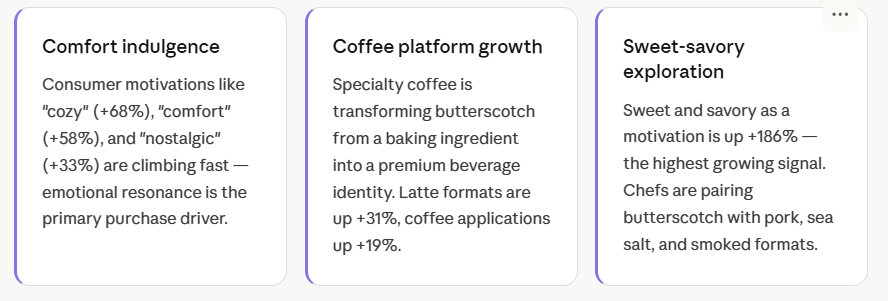
So what? These shifts represent whitespace for brands to use a high-familiarity flavor profile to de-risk bold new product innovation in 2026. Butterscotch is the heritage anchor your team can build around without starting from scratch on consumer trust.
How a leading snack brand can find its entry point with Butterscotch trends
The challenge
An innovation manager at a mid-size CPG snack brand knew butterscotch had nostalgic equity, but internal data showed declining candy sales. The team needed to know whether butterscotch was genuinely dying, or just shifting channels, before committing R&D budget to a new SKU.
The solution
By analyzing billions of social signals and 66K+ butterscotch dish mentions, the team identified a clear whitespace: premium, sea-salt-infused butterscotch inclusions within functional snacking. Coffee cake (+75%) and croissant formats (+64%) confirmed consumers already wanted butterscotch in morning occasions, a category their competitors hadn’t entered.
Example: 60% reduction in R&D validation time. The team reached top-category performance within 4 months of launch by leading with the coffee-occasion positioning Tastewise data surfaced.
Consumer behavior signals: what the data shows
Butterscotch is moving from candy-dish nostalgia into a daily ritual anchor. The consumer driving this shift is not reaching for hard candy. Instead, they’re ordering a latte, baking a muffin, or discovering a butterscotch croissant at their neighborhood specialty café. These are high-frequency, high-satisfaction moments that build brand loyalty.
In home kitchens, butterscotch functions as a “creative-comfort” ingredient. It is a familiar base that consumers feel confident riffing on. The 40% surge in DIY recipe searches reflects a consumer who already trusts the flavor and is ready to explore it. Brown butter pairings (+13%), maple syrup crossovers (+15%), and oatmeal applications (+12%) all point to butterscotch as a versatile baking staple for home-craft moments.
In grab-and-go Retail and premium QSR, butterscotch is becoming a multi-sensory reward signal. Consumers associate it with “rich” (+29%), “layered” (+30%), and “buttery” (15.3 social index). Theser are descriptors that justify a higher price point and differentiate shelf presence in a crowded confectionery aisle.

See the full consumer motivation breakdown for your category.
Market opportunity: where to win with butterscotch trends in 2026
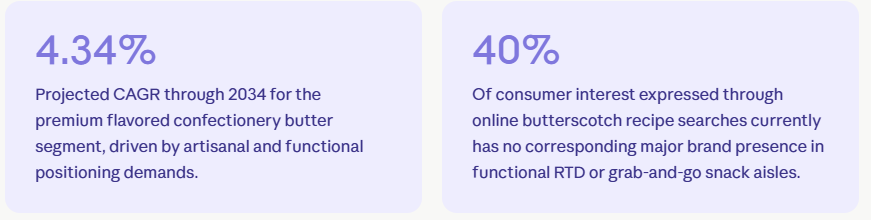
While social media is saturated with “Nostalgia Remix” content, sea-salt butterscotch recipes, baklava-inspired confections, DIY latte recreations. Retail shelves still primarily offer traditional high-sugar hard candies and basic baking extracts. The gap between what consumers are already making at home and what brands are offering in store is wide open.
Butterscotch’s surge in morning pastry formats mirrors the broader shift toward comfort-driven snack innovation reshaping how consumers choose between indulgence and function at shelf.
Brands that fail to integrate “Modern Indulgence” claims into butterscotch formats risk losing the 2026 breakfast-occasion consumer to emerging D2C challengers already successfully pairing this flavor with functional benefits. The coffee channel alone represents a meaningful first-mover window: butterscotch lattes are growing +31% in the past year with no major CPG brand owning the format yet.
Strategic recommendation
Pivot from traditional hard-candy formats to “Inside-Out” premiumization. Incorporate butterscotch as a textured inclusion or layered swirl in high-growth, health-conscious categories: plant-based desserts, functional morning bars, and specialty coffee formats. This is where the uncontested shelf space is.
Butterscotch trends across channels: at-home, out-of-home, and social
The same flavor plays three very different roles depending on where your consumer encounters it. Your channel strategy should reflect that.

Key ingredients and flavor pairings defining butterscotch in 2026
The modern butterscotch palette has moved well beyond brown sugar and butter. These are the pairings your R&D team should be building around.

Strategic recommendations: what your team should do now
The butterscotch opportunity is channel-specific and time-sensitive. Here is where each team should focus.
R&D-Prototype around coffee and breakfast formats
Lead with butterscotch sea-salt latte concentrates, croissant fillings, and high-protein morning bars. These are the highest-velocity growth areas with the least competitive response right now.
Marketing- Own the “cozy ritual” narrative
Consumer motivations for “cozy” (+68%) and “ritual” (+81%) are outpacing the flavor trend itself. Build campaign stories around morning routines and seasonal comfort moments, instead of candy nostalgia.
Sales- Lead with the coffee-channel proof story
Butterscotch latte growth (+31%) and the 5M-cup performance from one Indonesian coffee chain is a buyer-ready story. Use menu-penetration data to show retail buyers the unmet demand that operator success already validates.
As heritage flavors reclaim their place in premium formats, the playbook that made Oreo a crossover innovation benchmark, familiar base, unexpected format, is exactly the model butterscotch brands should be studying right now.
About this data
The insights in this report are powered by Tastewise’s AI, which analyzes billions of real-life consumer data points across social media platforms, restaurant menus, and recipe databases to provide a real-time view of flavor and category trends.
- 22.3B social interactions analyzed across F&B platforms
- 5M+restaurant menus tracked in real time
- Daily real-time updates. Meaning no lagging data
By blending social consumer signals with menu intelligence and recipe data, Tastewise provides conviction-ready evidence for brands looking to make faster, smarter innovation decisions without 18-month research cycles.
FAQs about Butterscotch trends
The overall social conversation is down 13% in the past year, but menu presence holds steady at nearly 2% of dishes with a +3.3% uptick. The headline decline masks a channel story: butterscotch is surging in coffee (+19%), lattes (+31%), and breakfast pastries (+64% croissant, +75% coffee cake). Brands that look only at aggregate social share will miss where the real growth is happening.
Butterscotch coffee cake is up +75%, croissants +64%, and lattes +31% in the past year. These are all breakfast and café-occasion formats. This is a clear signal that the flavor’s strongest growth is happening in the morning daypart, not in confectionery or dessert aisles where it has traditionally lived.
According to Tastewise consumer intelligence data, “sweet and savory” is the fastest-growing motivation at +186% in the past year, followed by “ritual” (+81%), “cozy” (+68%), and “comfort” (+58%). This is not just nostalgia. Instead, consumers are looking for butterscotch as a multi-sensory, emotionally resonant experience that justifies a premium price point.
Baklava (+153%) and honey lemon (+158%) are the fastest-emerging new pairings, pointing toward layered, premium dessert formats. In more established territory, raisin (+29%), maple syrup (+15%), and brown butter (+13%) are all climbing, these create a strong heritage-premium positioning for retail bakery and snack applications.
Retail shelves still primarily feature traditional hard candies and basic baking extracts. The whitespace is in morning formats: functional snack bars, premium baking kits, and RTD coffee products featuring butterscotch as a named flavor. An estimated 40% of consumer interest expressed through online recipe searches currently has no corresponding major brand presence in functional grab-and-go aisles.
Beyond expected dessert applications, chefs are exploring butterscotch in savory contexts, like pork pairings that are trending up +16%, and sweet-smoky combinations are rising. Specialty coffee shops are driving the highest-growth applications, with butterscotch sea-salt lattes becoming signature menu items. QSR and fast casual represent the fastest-growing foodservice segment for butterscotch-based innovation.

Read more from Kelia Losa Reinoso

We’d love to learn your goals and see how Tastewise fits
We’d love to learn your goals and see how Tastewise fits
Get a personalized demo
Good taste. Wise move.
Your demo request is confirmed. We’ll reach out within one business day to schedule your walkthrough.
What happens next

See what’s driving demand, then turn it into a sell-in story for retailers and operators.
- Connect consumer panels, market trackers, and agents into one evidence view
- Get the “why” behind what’s changing, with explainable demand drivers
- Walk away with a buyer-ready narrative and next steps to activate
Trusted by





“Tastewise is my secret tool for knowing what consumers want next and why.“