






The agave vs honey question used to be a pantry preference. It is now a formulation decision with retail consequences. Americans had 123.5 pounds of caloric sweetener availability per person in 2023, down from a 1999 peak of 153.6 pounds, and the shortfall is being filled by liquid alternatives that carry a health story. Static market reports tell you that shift happened. Tastewise reads home cooking recipes, retail shelves and restaurant menus as they move, so you can see which sweetener consumers are actually reaching for this quarter.
Key overview: agave vs honey in 2026
- Honey reaches nearly 1 in 3 US sweetener consumers (35%) across the Tastewise US consumer panel against 3.4% for agave. That is roughly ten times more people in the same category.
- Both sweeteners are contracting, and agave is contracting nearly twice as fast, down 15.7% in the past year against 8.2% for honey.
- Blood sugar is the claim consumers use, holding about 1 in 15 of sweetener category claims (6.5%) and rising 20.2%, while the industry term low glycemic sits at 0.16% and fell 20.7%.
- Honey’s growth is coming from savory heat rather than sweetening, with hot honey at about 1 in 12 honey occasions (8.1%) and up 9.6%, and the sweet and spicy claim up 73%.
- Agave’s operator base is narrow, appearing on roughly 13 times fewer US restaurant menus than honey and across nine times fewer chains, which concentrates its volume in juice bars and bakery cafes.
Sweetener choice is now a claim strategy, and the claim data moves faster than the reformulation cycle. The five signals shaping the rest of 2026 are mapped in the Q3 2026 food trends report.
What is the difference between agave and honey?
Both are liquid sweeteners with a natural halo, but they behave differently in the body and on the line. Honey is an animal product made by bees, it carries enzyme activity and trace antioxidants, and it thickens as it cools. Agave is a vegan plant syrup pressed from succulent sap, it runs about 80% fructose, and it stays pourable at fridge temperature.
Glycemic index, fructose content and diabetic use
Agave’s low glycemic index is a direct result of that fructose load, because fructose bypasses the fast glucose response that honey triggers. This is the core of the agave vs honey for diabetics debate, and the trade is real. A lower blood sugar spike comes with a higher fructose burden that the liver has to process.
The consumer language here has already moved. Among agave consumers, the low glycemic claim covers 0.14% of occasions and fell 32.5% in the past year, while the blood sugar claim held flat at 0.69%. Honey shows the same pattern at 0.53% for blood sugar and 0.02% for low glycemic. Consumers are asking what a sweetener does to their blood sugar. They are not asking for its glycemic index, and packs that lead with the index answer a question nobody is posing.
Functional health benefits and medicinal uses
Honey owns the medicinal territory in memory, and the data shows that territory going quiet. Across honey occasions, medicinal claims cover 0.70% and slipped 4.2%, antioxidants sit at 1.08% and fell 11.8%, and immune system claims fell 9.9%. The behavior survives even where the claim does not. Honey pairs with lemon in 7.9% of its occasions and with tea in 5.8%, which is the agave vs honey for cough use case showing up as a routine rather than a label.
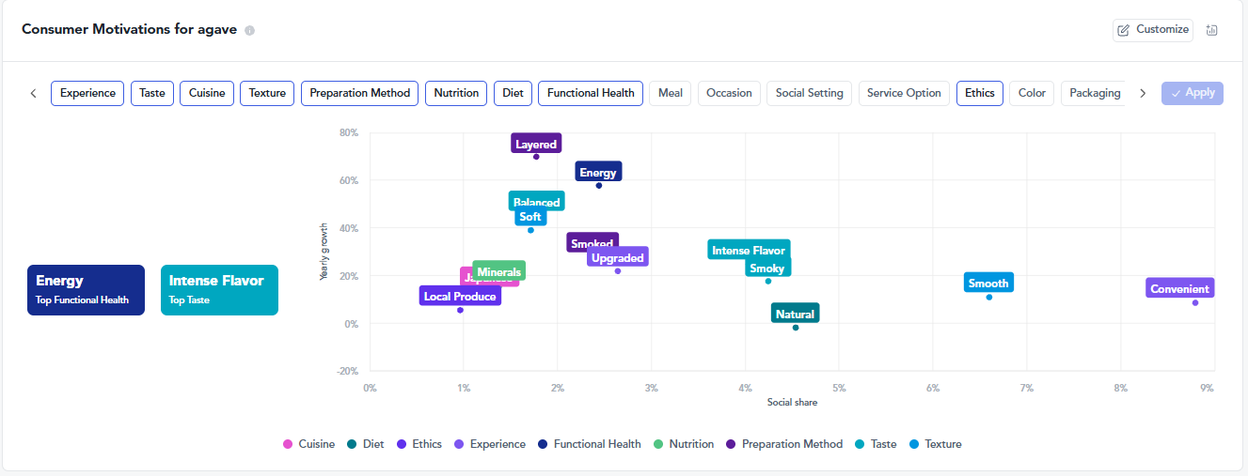
Agave’s functional story is being rebuilt around something else. Energy claims on agave rose 57.3% and minerals rose 15.9%, both from a small base. Agave benefits vs honey is therefore not a fair fight on antimicrobial ground, because agave is being pulled toward pre-workout and daily fuel occasions instead.
Sensory profile and culinary applications
Agave vs honey taste splits along viscosity. Honey brings floral complexity and body, so it holds on a biscuit or a wing. Agave is neutral and thin, which is why the smooth claim on agave rose 10.9% and the intense flavor claim rose 24.5% as formulators use it to carry other flavors rather than supply its own. The layered claim on agave jumped 69.8%, pointing at drinks built in visible strata.
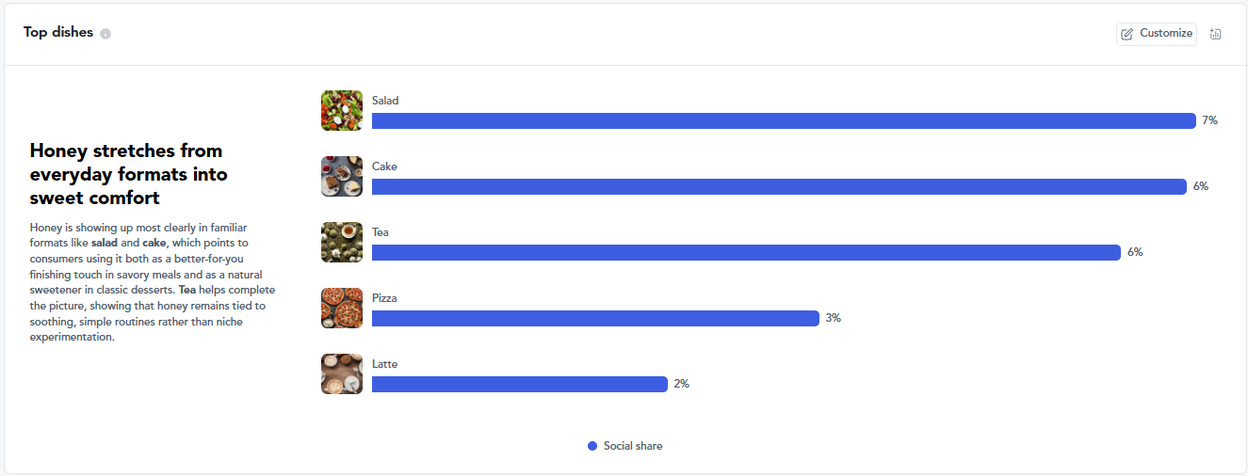
Honey’s format spread is wider than its dessert reputation. It shows up in salad occasions at 6.6%, cake at 6.3%, chicken at 11.4% and garlic at 8.1%, and the drizzled claim rose 9%. When you compare blue agave syrup vs honey for a bake, honey adds moisture retention and browning. For cold beverages, honey vs agave syrup favors agave, because it dissolves without a warm-up step.
Sweetener demand tracking: honey vs blue agave in real time
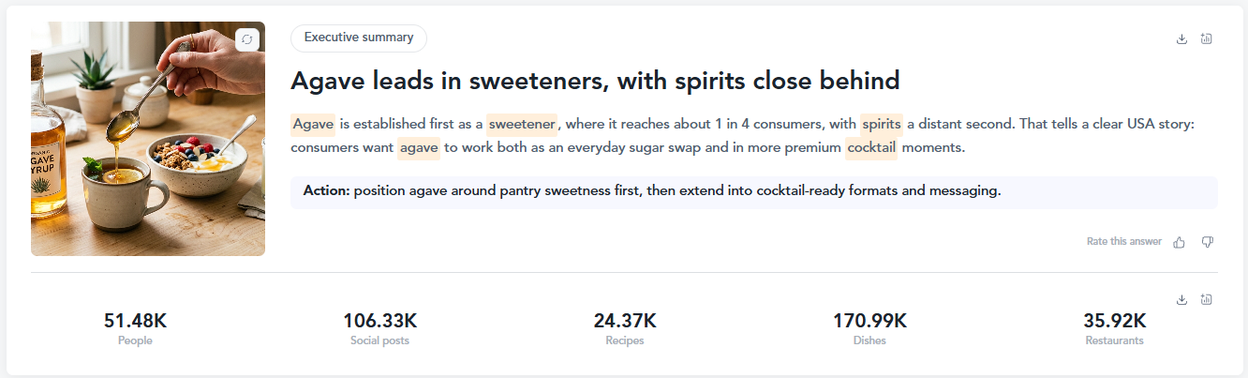
Tastewise reads three live surfaces at once, which is how the honey vs blue agave picture resolves faster than a quarterly report. Home cooking recipes show intent, retail shelves show what buyers stocked, and restaurant menus show what operators committed to printing. When the three disagree, that gap is the opportunity. The same method underpins the wider 2026 food trends USA picture.
Vegan and plant-based momentum
The vegan case for agave holds up in relative terms and falls apart in absolute ones. Agave carries the vegan claim on 5% of its occasions against 1.7% for honey, so agave does index about three times higher. Both figures are shrinking, with vegan down 21.8% on agave and down 28.3% on honey, and the claim is down 24.3% across the whole sweetener category.
That means a blue agave vs honey pack story built on vegan credentials is arriving late. Plant based fell 20.9% in the category over the same window. The claims worth the front of pack are blood sugar, up 20.2%, and energy, up 28.6%. Teams working the same problem in carbonated formats will recognize the pattern from the prebiotic soda sell-in guide.
Beverage and mixology innovation
Agave syrup vs honey on menus is decided in juice bars, not cocktail bars. Panera lists an agave lemonade at $3.89 and a gallon version at $12.09. Agave’s top operators are Starbucks and Panera, followed by Jamba, First Watch and Playa Bowls. Its cocktail associations are heading the other way, with margarita occasions down 14.3% and paloma down 19.7% inside the agave set.
Honey’s operator list looks nothing like that. It runs through Subway and McDonald’s before it reaches Starbucks, Dunkin’ and Taco Bell. That is what thirteen times the menu footprint buys you. Agave’s whitespace sits at Taco Bell, Crisp & Green and Tropical Smoothie Cafe, three chains whose menus already carry the flavor logic but not the ingredient. On shelf the organic blue agave nectar space belongs to Madhava, Monin and Health Garden. A 46 oz bottle lands near $10.73.
Formulation strategy: honey vs agave nectar in a low-glycemic RTD line
Take a beverage team building a low-glycemic ready-to-drink line and choosing between honey vs agave nectar. The reflex is to pick agave for the glycemic number and put low glycemic on the front label. The data argues for splitting that decision in two.
Agave is the right functional pick for a cold-fill RTD, because it dissolves without heat and stays neutral behind fruit and botanicals. Blue agave nectar vs honey also wins on batch consistency, since honey’s floral variation shifts with the season and the source. Keep agave as the sweetener and drop low glycemic from the label, given that the term fell 32.5% among the exact consumers you are targeting.
Lead the pack with blood sugar language and pair it with energy, which rose 28.6% in the category and is agave’s fastest-moving functional claim at 57.3% growth. Add gut health, holding 3.6% and still rising, as the secondary benefit. Avoid stevia and monk fruit as co-sweeteners for this line, because stevia fell 24.1% and monk fruit fell 9.2%, while allulose rose 4.1% and date syrup rose 1.5% from smaller bases. A validated concept beats a reformulation, which is what product innovation testing is for before a line commits.
For a honey line, the move is the opposite direction entirely. Put honey where the heat is, because hot honey grew 9.6% and sweet and spicy grew 73%, and build a savory drizzle SKU for chicken and pizza rather than a third sweetener for coffee. Brands watching claim panels for the ultra-processed foods backlash will find honey’s raw and local produce claims useful on that shelf. The category has run this play before, and the same claim logic drove the sugar-free gum reformulation wave.
Two operational notes for the sell-in deck. Match the claim to the shopper using defined consumer segments rather than a general population read, because the vegan collapse looks very different by audience. Then keep the tracker running, since AI agents will flag the claim inflection before the next planning cycle rather than after it.
Frequently asked questions about agave vs honey
Neither one is a health food, and the honest answer depends on which risk you are managing. Agave produces a smaller blood sugar spike because it is roughly 80% fructose, while honey carries trace antioxidants whose claim presence fell 11.8% in the past year.
Agave has the lower glycemic index of the two, which is why it appears more often in diabetic-friendly recipes. Consumer language has shifted to blood sugar, a claim that grew 20.2% in the sweetener category, while low glycemic fell 20.7%.
Agave tastes sweeter by volume because of its fructose content, so you can use less of it. Honey delivers more flavor character, which is why it holds in savory formats like chicken, present in 11.4% of honey occasions.
Blue agave refers to the specific plant variety, and agave nectar describes the finished syrup, so most blue agave nectar on shelf is both. Organic blue agave dominates the retail set from brands including Madhava and Health Garden.
Agave works as a one-to-one liquid swap in most bakes, though it browns faster and holds less structure. Honey remains the stronger baking choice, appearing in 6.3% of honey occasions tied to cake.
Neither is growing. Honey fell 8.2% in the past year and agave fell 15.7%, while maple syrup held up better at a 4.5% decline and hot honey grew 9.6%.



We’d love to learn your goals and see how Tastewise fits
We’d love to learn your goals and see how Tastewise fits
Get a personalized demo
Good taste. Wise move.
Your demo request is confirmed. We’ll reach out within one business day to schedule your walkthrough.
What happens next

See what’s driving demand, then turn it into a sell-in story for retailers and operators.
- Connect consumer panels, market trackers, and agents into one evidence view
- Get the “why” behind what’s changing, with explainable demand drivers
- Walk away with a buyer-ready narrative and next steps to activate
Trusted by





“Tastewise is my secret tool for knowing what consumers want next and why.“