





The food beverage retail industry trends 2026 that are actually reshaping the shelf are not the ones most brand teams are tracking. Consumer demand has shifted faster than quarterly scan cycles can capture, and the brands gaining shelf space are the ones reading real-time behavioral signals rather than waiting for syndicated reports to confirm what has already moved. Tastewise pulls live consumer demand, ingredient velocity, and claims data across the US market so your team can build category stories from what consumers are reaching for now, not six months ago.
Key takeaways
- Functional beverages are the fastest-moving segment in the category. Collagen in beverages is up 81% in the past year across the Tastewise US consumer panel. Mushroom coffee has a menu share index of 183.5, signaling that operators are well ahead of retail in this space.
- Gut health and blood sugar management are the two claims with the strongest structural momentum. Gut health reaches nearly as many consumers as the energy claim in the functional beverage set. Blood sugar management is up 7% in the past 12 months, with the hormone balance claim growing 63% over the same period.
- High-protein snacks are reaching more consumers than any other functional food segment. Consumer volume for the protein snack space reached 14,500 consumers in the Tastewise US panel, up nearly 4% in the past year, with egg bites up 40% and salmon up 18% as emerging ingredient signals within the set.
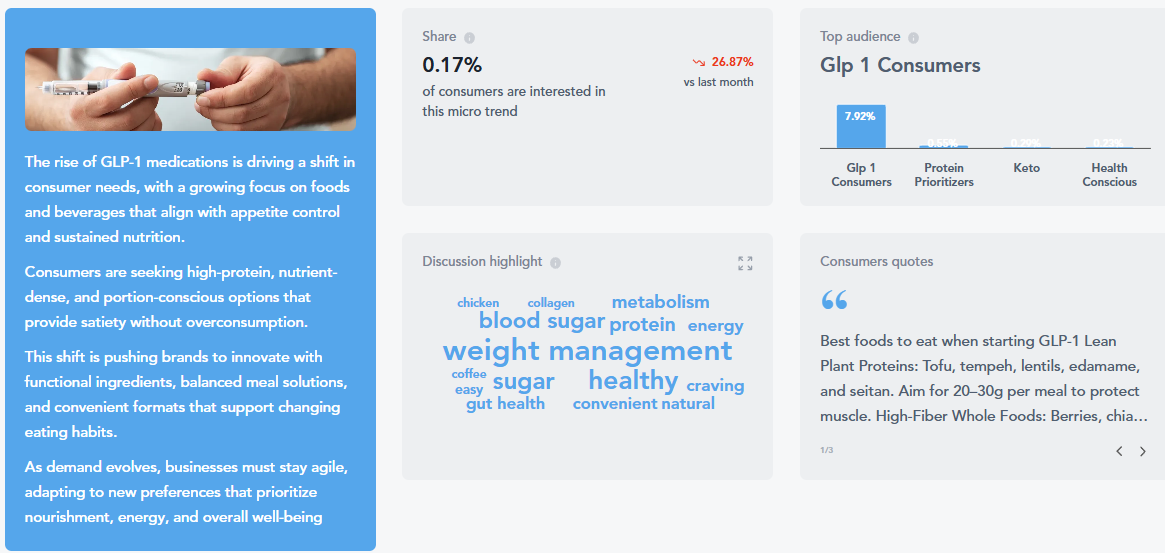
- The GLP-1 adjacency is the whitespace most retail teams have not yet mapped. Blood sugar, metabolism, and fiber claims are all growing simultaneously in the GLP-1 context, pointing to a consumer need state that spans multiple aisles and has limited brand ownership today.
What food and beverage retail industry trends 2026 actually look like
The headline shift in US food and beverage retail in 2026 is the acceleration of functional need states. Consumers are not simply choosing products. They are choosing products that do something specific: support their gut, stabilize their energy, manage their weight, or address a hormone or metabolic need they are actively tracking. This is a structural change, not a trend cycle.
Across the Tastewise US consumer panel, the energy claim reaches the highest share of consumers in the functional beverage set at 46.9% of the panel, up 11% in the past year. Gut health follows at 44.9% share, up 8%. The mushroom coffee ingredient has a menu share index of 183.5, meaning operators have embedded it into menus at nearly twice the rate the consumer panel would predict, a leading indicator that retail demand is still building. Coffee itself is growing 46% in the past year across the functional beverage space. Collagen is up 81% in the same period. These are not early signals. They are mid-cycle signals that retail teams have limited time to act on before the shelf response catches up.
For product innovation teams and brand managers, the 2026 opportunity is not in identifying trends. It is in mapping which of these signals correspond to unmet need states in your current category set and building the consumer evidence to support a shelf expansion story before a competitor does.
Key terms in food and beverage retail trend analysis
Menu share index. A menu share index measures how often an ingredient appears on operator menus relative to what consumer demand alone would predict. A score above 100 means operators have adopted it faster than consumer panel reach suggests. Mushroom coffee sits at 183.5 on the Tastewise US operator panel, so it appears on menus at nearly twice the predicted rate, a leading indicator that retail demand is still building rather than a measure of how much has already sold.
Operator-ahead, retail-behind dynamic. This is a market condition where foodservice operators have already built an ingredient or format into their menus, but retail shelves have not yet responded with equivalent products. Because consumers meet the ingredient through restaurants and cafés first, demand builds ahead of the shelf, which creates a time-limited whitespace for the brand that ranges it early.
GLP-1 adjacency. GLP-1 adjacency is the consumer need state tied to GLP-1 medications used for weight and blood sugar management. These consumers actively seek foods that support the same goals, high protein to preserve muscle, fiber for satiety, and low-sugar formats for glycemic control. In the Tastewise US panel, protein in this set is up 58%, fiber up 30%, and metabolism up 28%, and no single brand owns the journey across aisles today.
Functional need state. A functional need state is a specific health or performance outcome a consumer is actively trying to achieve through what they eat or drink, such as gut health, steady energy, blood sugar management, or hormone balance. The consumer is choosing the product to accomplish something measurable, not only for taste or occasion, and the sharp rise in these need states is the structural shift behind the 2026 trends.
Lifecycle stage. Lifecycle stage describes where an ingredient sits on the adoption curve. Emerging means early but growing adoption with peak retail penetration still ahead. Mid-cycle means adoption is accelerating and the window to act before the shelf catches up is narrowing. Declining means interest is softening. Lion’s mane and cordyceps are both emerging in 2026, so their retail penetration is well below their eventual ceiling.
Whitespace. Whitespace is a consumer need state with documented, growing demand that the current retail shelf does not adequately serve. You identify it by layering three signals: high consumer demand growth, strong operator menu adoption, and low current retail SKU density. Hormone health is a live example, demand is growing across several claims while conventional grocery has no dedicated set for it.
Claim velocity. Claim velocity is the rate at which a specific health or benefit claim is growing in consumer demand data. A high-velocity claim such as hormone balance, up 63% in the past year, is growing faster than the category average, which signals that consumers are actively seeking products that carry it. Innovation and brand teams use claim velocity to decide which benefit to lead with on new products and packaging.
Sell-in narrative. A sell-in narrative is the evidence-backed story a brand brings to a retail buyer to justify ranging a product or expanding a set. The strongest ones in 2026 combine three layers: consumer motivation growth, operator menu adoption as market validation, and a shelf gap analysis showing unmet demand. That sequence tends to move a listing decision faster than scan data alone.
The 2026 consumer mindset: food and beverage retail industry trends are moving faster than legacy metrics
The quarterly research cycle was built for a category that moved quarterly. US food and beverage retail in 2026 does not move quarterly. Flavor signals emerge on operator menus in weeks. Consumer motivation shifts show up in the Tastewise panel before they appear in point-of-sale data. By the time a syndicated report confirms a trend, the consumer has already moved past the early adoption phase and the shelf whitespace has narrowed.
The structural problem for most brand teams is that their planning inputs are timed to different cycles. The category review is quarterly or annual. The food intelligence signal that would justify a new SKU or claim refresh is available weekly. The teams closing this gap are the ones treating consumer demand monitoring as a standing operational rhythm rather than a project-by-project research event.
The practical shift is moving the question from ‘what sold last quarter’ to ‘what are consumers already reaching for that has no brand response yet.’ The former tells you how to defend your current position. The latter tells you where your next listing comes from.
Top 7 food and beverage retail industry trends dominating 2026
1. Functional beverages led by mushroom and collagen
Mushroom-based beverages are the clearest example of an operator-ahead, retail-behind dynamic in 2026. The mushroom coffee ingredient carries a menu share index of 183.5 on the Tastewise US operator panel, meaning it is embedded in menus at a rate that outpaces consumer panel reach. The retail shelf has not responded at the same rate.
Collagen is growing 81% in the past year across the US functional beverage consumer panel, and lion’s mane is up 36% while cordyceps is up 16%. Both ingredients are in the emerging lifecycle stage, meaning peak retail penetration is still ahead. Consumer motivation data shows energy (up 11%), gut health (up 8%), and hormone balance (up 63%) as the dominant claims in this space.
Buyer’s take: A buyer who sees documented operator adoption ahead of retail velocity has a clear argument for ranging a category-building SKU, not a me-too product.
2. High-protein snacks moving beyond bars and powders
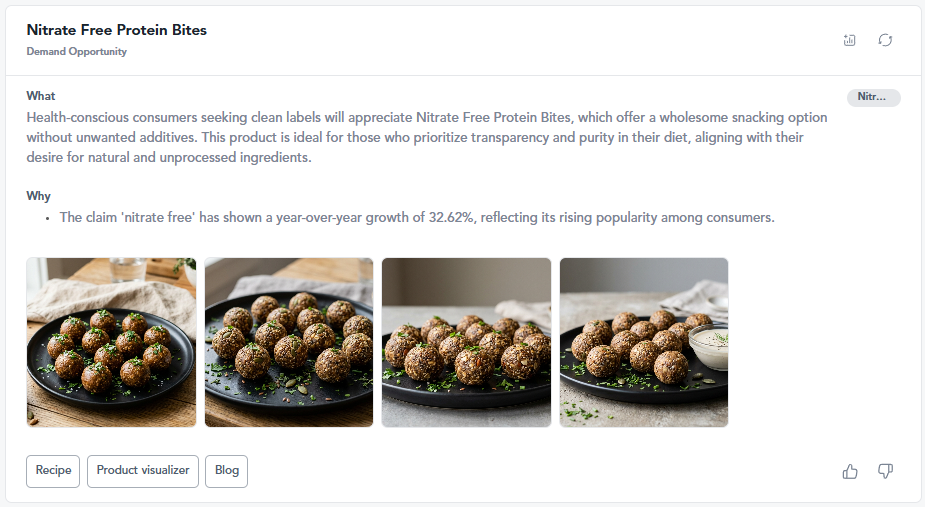
The protein snack consumer set in the Tastewise US panel reached 14,500 consumers with volume growing 4% in the past year. The signal inside that growth is more interesting than the headline: egg bites are up 40% with a menu share of 66.4, skyr is up 41%, and meat sticks are up 29%. These are formats driving protein consumption outside the traditional bar and powder formats.
Salmon as a protein snack ingredient is up 18%, emerging on the lifecycle stage. The fiber claim in the high-protein context is up 8%, and the blood sugar claim is up 29%, signaling that consumers are not just seeking protein quantity but protein paired with glycemic management. For retail sell-in teams, this pairing is a claim story that goes beyond the macro count on the front of pack.
Buyer’s take: Egg bites and skyr showing concurrent growth in operator menus and the consumer panel is a format confirmation signal. A buyer can range against documented demand, not just a brand’s innovation hypothesis.
3. Gut health expanding into a full-meal occasion
Gut health has moved from a supplement claim to a meal occasion. The Tastewise US functional beverage panel shows gut health reaching 44.9% of consumers in that set, up 8% in the past 12 months. Across the broader food panel, the anti-bloat claim is up 108% in the past year in the protein snack context. Prebiotic and probiotic claims remain high reach but are declining, while postbiotics are growing from a smaller base.
The consumer who is buying for gut health in 2026 is not buying a supplement. They are building a daily eating pattern around digestive support, spanning breakfast formats, snack occasions, and functional beverages. The whitespace for retail is in products that address gut health as a meal occasion rather than a functional add-on.
Buyer’s take: A category that spans three dayparts creates a range expansion argument. A buyer who sees gut health present in breakfast, snack, and beverage data has a category map, not a single slot to fill.
4. GLP-1 adjacency: the unbranded need state
The GLP-1 consumer segment is one of the largest unbranded need states in US food and beverage retail in 2026. Across the Tastewise GLP-1 adjacent consumer panel, blood sugar management is the highest-growth claim at +7% in the past year, with metabolism up 28% and fiber up 30%. Protein in this context is up 58%. Hormone balance is growing 59% in the same set.
The consumer here is not shopping the GLP-1 aisle. They are making choices across multiple categories simultaneously: high-protein snacks to maintain muscle mass, fiber-forward foods to support satiety, low-sugar beverages for glycemic management. No brand currently owns this consumer journey end-to-end. The consumer marketing team that builds a cross-category claim architecture around this need state owns the conversation.
Buyer’s take: A buyer managing multiple categories who sees the GLP-1 consumer present across their entire store has a business case for a cross-category brand that none of their current vendors have brought them.
5. Hormone health: the fastest-growing functional claim segment
Hormone balance is growing 63% in the past year in the Tastewise US functional beverage consumer panel. In the GLP-1 adjacent food context, it is up 59%. Women’s health claims are present across both datasets, with perimenopause and menopause claims both active and growing in the broader food and beverage space.
This is not a niche audience. It is a need state that spans a large demographic and currently has limited dedicated retail shelf space. The consumer is buying across multiple categories to address it, which is the textbook signal for a dedicated category rather than a scattered product set. Teams that map this need state specifically and build a range around it will have a category development story that most buyers have not seen yet.
Buyer’s take: A dedicated hormone health section is emerging in progressive natural channel retail. Brands that arrive with consumer demand data and a coherent range have a first-mover advantage in conventional grocery.
6. Clean energy: moving beyond caffeine
The clean energy claim in the Tastewise US functional beverage panel is growing 76% in the past year. Coffee is up 46%, but the growth pattern inside coffee is also shifting: mushroom coffee, cold brew, and functional coffee formats are all growing while standard instant coffee is growing at a slower rate. The consumer is not leaving caffeine. They are looking for caffeine delivered in a format that does not produce a crash.
L-theanine, lion’s mane, and adaptogen claims are all active in this consumer set. The AI analytics for CPG signal here points to a formulation opportunity: clean energy products that pair caffeine with cognitive support ingredients are reaching a consumer who is choosing between a coffee and a functional beverage. The brand that owns both use cases in one SKU has a strong differentiation argument.
Buyer’s take: A clean energy claim supported by functional ingredient data gives a buyer a story that separates your product from the energy drink set, which is under increasing regulatory and consumer scrutiny.
7. Collagen and beauty-from-within entering mainstream retail
Collagen is growing 81% in the functional beverage consumer panel in the past year. The hair and skin claim is present across both the beverage and protein snack sets. Anti-aging is up 20% in the beverage context. These signals triangulate a consumer who is buying edible beauty products as part of their daily routine, not as an occasional supplement.
The retail opportunity is in everyday formats: beverages, snack bars, and yogurt-adjacent products that carry a collagen claim without positioning primarily as a beauty supplement. The food marketing strategies shift here is from supplement aisle to grocery aisle, with the claim presented as a nutritional benefit rather than a cosmetic one.
Buyer’s take: Collagen positioned as a nutritional ingredient in a food format rather than a powder supplement opens the door to grocery ranging that the supplement buyer would not ordinarily approve.
Identifying consumer whitespace in food and beverage retail industry trends
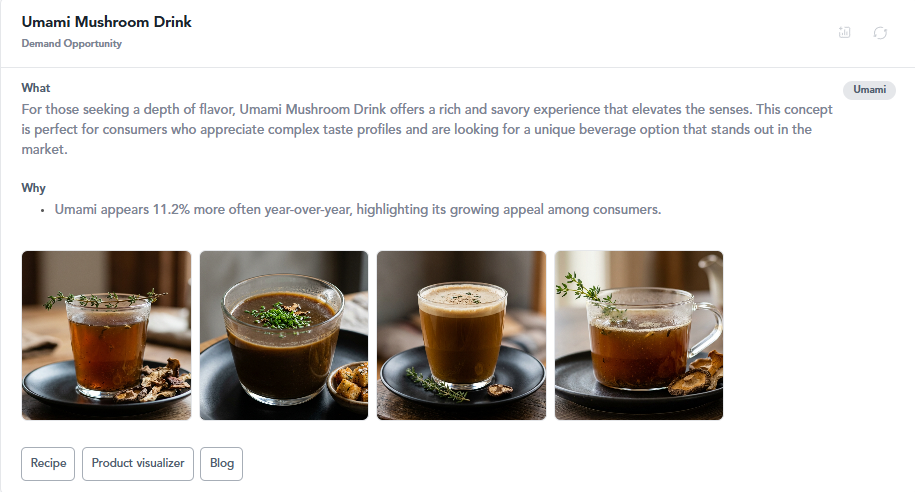
Whitespace in retail is most visible at the intersection of two conditions: consumer demand is growing and the shelf has not responded. The Tastewise data for 2026 shows several such intersections. Mushroom coffee has a menu index of 183.5 and growing consumer panel reach, but the retail shelf in most conventional grocery accounts has one or two SKUs at most. Hormone health has clear consumer demand across multiple claims but no dedicated retail set in conventional grocery.
The process for identifying whitespace systematically is to layer three data sets: consumer demand growth for the need state, operator menu penetration as a leading indicator, and current shelf density for the SKU format. Where all three align (high consumer growth, high operator adoption, low retail density), the whitespace is both real and timely. This is what CPG insights teams using Tastewise are running every two to four weeks rather than once per planning cycle.
The other whitespace signal worth tracking is ingredient pairing. When two ingredients are growing simultaneously and no retail product currently combines them, that is a formulation whitespace. Collagen and lion’s mane, for example, are both growing in the functional beverage space and currently appear in separate product formats. A product that combines both with a cognitive and beauty claim would address two growing need states with one SKU.
What the 2026 trends look like in practice: illustrative scenarios
The scenarios below are illustrative, not case studies of named clients. Each shows how a team could act on the signals in this article, following a situation, problem, data signal, action, and outcome arc.
A functional beverage brand building a category review pitch. A mid-size brand with a collagen beverage line is heading into a grocery category review with steady but unremarkable internal velocity. The problem is that its own sales data does not make a strong ranging case on its own. Reading the panel, the team sees collagen in beverages up 81% in the past year and mushroom coffee at a 183.5 menu share index, evidence that operators have already validated consumer acceptance. It builds the pitch around the operator adoption curve rather than its own SKU velocity, framing the product as the retail response to a need state foodservice has already proven. The outcome is a category-building argument a buyer can act on rather than a me-too velocity story.
A large CPG team mapping the GLP-1 whitespace. A brand strategy team is asked to find the next functional whitespace. The problem is that blood sugar, fiber, and protein claims are all rising in their shopper data, but no current product connects them in one narrative. Tastewise data shows protein up 58% in the GLP-1 adjacent set, fiber up 30%, and metabolism up 28%. The team uses that cross-claim picture to brief R&D and consumer marketing on a unified product architecture spanning snacks, breakfast, and beverages. The outcome is a cross-aisle strategy built around a single consumer journey, the kind of story a multi-category buyer has not seen from current vendors.
A brand proposing a hormone health set. A natural channel buyer carries several small brands with perimenopause and menopause claims but no coherent set, and no major brand has brought a category story. The problem for an incoming brand is standing out with more than a single SKU. Tastewise data shows hormone balance up 63% in the functional beverage set and women’s health claims active across food and beverage panels. The team approaches the buyer with a category development proposal backed by demand data for that specific market, using audience data to show the need state is present in the buyer’s own region. The outcome is a category conversation rather than a single-SKU pitch, and first-mover positioning in a set competitors have not mapped.
Building the innovation business case from food and beverage retail industry trends
The gap between an interesting trend and a funded innovation brief is almost always an evidence gap. The innovation team sees the signal. The commercial team asks for proof that the consumer is actually spending money on it. The retail team asks for proof that a buyer will range it. Each question requires a different layer of data, and most trend reports only deliver the first layer.
The strongest innovation business cases in 2026 combine three evidence types: consumer demand signals with growth trajectory and reach, operator menu adoption as proof that the market has validated the concept, and shelf gap analysis showing that current retail SKUs do not address the full need state. When you present this sequence to an executive stakeholder, you are not asking them to believe in a trend. You are showing them a documented gap with a consumer base that is already spending.
For foodservice teams and retail teams working in parallel, the shared language is the consumer motivation. Whether the channel is a grocery shelf or an operator menu, the underlying consumer demand data is the same. Building the brief from that shared foundation means both teams are arguing from the same evidence base, which is what makes the business case internally defensible.
Regional relevance in 2026 food and beverage retail industry trends
A national consumer demand signal is a starting point, not a deployment plan. The mushroom coffee signal in the Tastewise US panel is real and growing nationally, but its depth varies significantly by market. Urban coastal markets are earlier on the adoption curve. Mid-market regional accounts may be 12 to 18 months behind. Acting on the national average in both contexts produces the wrong ranging decision in at least one of them.
The practical layer your team needs is demand by DMA before finalizing any distribution recommendation. For retail sell-in conversations with regionally concentrated buyers, the regional data is not a nice-to-have. It is the difference between a buyer who sees their specific consumer base reflected in your data and a buyer who sees a national average that may or may not apply to their stores.
The hormone health signal, for example, shows different adoption patterns by geography. The GLP-1 adjacency need state is stronger in markets with higher prescription penetration. Clean energy skews toward urban commuter demographics. Each of these differences represents a ranging and timing decision that a national rollup cannot surface.
What 2026 food and beverage retail industry trends mean for CPG brands
- For consumer intelligence leads: Quarterly syndicated reports describe a category that has already moved. Running a Tastewise demand pull every two to four weeks gives your pipeline the lead time to respond before the shelf catches up.
- For brand strategists: Consumers in the functional health space are combining claims that your current portfolio addresses separately. Hormone balance, blood sugar, and gut health are all active in the same consumer set. A cross-claim brand narrative built from this data is a differentiation argument that most competitors are not making.
- For R&D and product developers: The ingredient signals showing the widest gap between operator adoption and retail penetration (mushroom coffee, collagen, lion’s mane) are the formulation opportunities with the most validated consumer demand and the least retail competition.
- For innovation teams: The GLP-1 adjacent consumer is buying across your category, your competitor’s category, and the supplement aisle simultaneously. The brand that maps this consumer journey and builds a cohesive range around it controls a need state that spans the store.
- For retail sales teams: Buyers in 2026 have access to their own shopper loyalty data. You need to arrive with consumer demand evidence they cannot pull from their own systems: motivation-level data, ingredient velocity, and a shelf gap analysis built from a national consumer panel.
The future of food and beverage retail industry trends: 2027 outlook
The structural direction for 2027 is toward more frequent, more granular shelf allocation decisions. Retailers with loyalty data are already piloting store-cluster planogram adjustments on shorter cycles than the traditional semi-annual reset. The brands that benefit from this shift are the ones whose consumer data matches the resolution of the buyer’s planning model. Agentic AI workflows are already compressing the time between a consumer signal and a buyer-ready category narrative from weeks to hours.
The trend lifecycle compression is also accelerating. The mushroom coffee signal that appeared on operator menus in 2023 and 2024 is now mid-cycle on retail shelves in 2026. By 2027, teams that are not monitoring ingredient and motivation signals in near-real time will consistently be responding to trends that are already peaking rather than building ahead of demand. The planning cadence will need to match the signal cadence.
The brands that will lead category management through 2027 are the ones treating consumer intelligence as an operational system rather than a research project. That means standing signal reviews, AI-assisted category narrative generation, and the organizational structure to move from signal to brief to buyer pitch in weeks, not quarters. The 2026 food and beverage trend forecast is the reference point for where the category sits today. The question for your team is how quickly you can build from it.
Build your 2026 category story
The food and beverage retail industry trends 2026 that are reshaping the shelf are already visible in consumer demand data. The brands acting on them now are the ones who will have the category stories and the listings. Your product innovation and retail sales teams do not need to wait for the next research cycle to build from this data.
FAQs about food and beverage retail industry trends
The five signals with the strongest consumer demand evidence in 2026 are: functional beverages led by mushroom and collagen, high-protein snacks in non-bar formats, gut health expanding into a meal occasion, GLP-1 adjacent products addressing blood sugar and metabolism, and hormone health as an emerging mainstream claim. Across the Tastewise US consumer panel, gut health reaches 45% of functional beverage consumers and protein snacks are growing 4% in consumer volume with several key formats up 30 to 40% in the past year. Each of these signals has documented consumer demand with limited retail brand response, which is the definition of actionable whitespace.
The strongest sell-in narrative combines three evidence layers: consumer motivation growth (what consumers are reaching for and why), operator menu adoption (which validates the concept through commercial behavior), and shelf gap analysis (which shows the buyer what is currently missing from their set). Retail sell-in teams using this sequence consistently report faster listing decisions and more durable shelf placements than those presenting syndicated data alone.
The brands gaining category share in 2026 are running consumer demand reviews every two to four weeks. For high-velocity categories or in the six weeks before a major shelf reset, a weekly monitoring cadence is worth the operational investment. The goal is to detect a consumer motivation shift before a competitor acts on it, not after. Functional health trends in particular are moving on a faster cycle than traditional categories, which means a quarterly research review is likely to be reviewing yesterday’s category landscape.
A menu share index measures how often an ingredient appears on operator menus relative to what consumer demand alone would predict. A score above 100 means operators have adopted it faster than consumer panel reach suggests. Mushroom coffee sits at 183.5 on the Tastewise US operator panel, appearing on menus at nearly twice the predicted rate, which is a leading indicator that retail demand is still building rather than a measure of what has already sold.
GLP-1 adjacency is the consumer need state tied to GLP-1 medications used for weight and blood sugar management. These consumers seek foods that support the same goals, high protein to preserve muscle, fiber for satiety, and low-sugar formats for glycemic control. In the Tastewise US panel, protein in this set is up 58%, fiber up 30%, and metabolism up 28%, and no single brand currently owns the journey across aisles.



We’d love to learn your goals and see how Tastewise fits
We’d love to learn your goals and see how Tastewise fits
Get a personalized demo
Good taste. Wise move.
Your demo request is confirmed. We’ll reach out within one business day to schedule your walkthrough.
What happens next

See what’s driving demand, then turn it into a sell-in story for retailers and operators.
- Connect consumer panels, market trackers, and agents into one evidence view
- Get the “why” behind what’s changing, with explainable demand drivers
- Walk away with a buyer-ready narrative and next steps to activate
Trusted by





“Tastewise is my secret tool for knowing what consumers want next and why.“