





Knowing what sold last quarter is available in any dashboard. Explaining why a consumer chose it, and whether that behavior will repeat, is where most teams stall.
CPG Consumer insights platforms now split into three distinct capabilities: behavioral intelligence, agile validation, and audience profiling. Each answers a different part of the decision chain: what’s happening, why it’s happening, and whether it will convert.
Consumer insights are explainable patterns in consumer behavior, preferences, and decision drivers derived from qualitative and quantitative data. Key consumer insights translate these patterns into decisions across product positioning, innovation, and commercialization. So what are the best consumer insights platforms for CPG brands this year?
- Behavioral intelligence (F&B-specific): Tastewise
- Agile survey validation: Suzy
- Enterprise survey system: Qualtrics CoreXM
- Global panel research: Toluna
- Audience profiling (psychographics): GWI
- Value-based segmentation: Resonate
AI-powered behavioral intelligence (best for F&B innovation)
Platforms in this category analyze unprompted, unstructured data: social content, menus, recipes, and consumption signals. The advantage is behavioral truth rather than stated intent.
1. Tastewise
Best for: the best AI platform for food trend analysis and consumer insights
Tastewise operates as a purpose-built consumer insights dashboard for food and beverage. Instead of relying on prompted surveys, it analyzes billions of real-world consumption signals across the Social F&B panel, Foodservice, and Home cooking panel.
This enables:
- Concept testing grounded in actual eating behavior
- Flavor profile validation based on observed demand
- Identification of consumption moments (e.g., late-night functional drinks vs. morning energy)
Consumption signals combine both qualitative (visuals, language) and quantitative (frequency, growth) inputs, allowing teams to validate product concepts before R&D spend.
The operational advantage is speed:
- Map trend lifecycle (emerging → scaling → saturated)
- Translate directly into product positioning strategy
- Build buyer-ready narratives using repeatable evidence
The constraint most teams face is not lack of insight, but inability to articulate and defend decisions internally and externally. Platforms that combine explainable, bespoke, and repeatable evidence solve for that gap
Agile survey & panel platforms
These tools answer specific validation questions through prompted responses. They are effective for narrowing decisions, not discovering them.
2. Suzy
Best for: fast, continuous quantitative consumer surveying
Suzy provides direct access to a proprietary panel for rapid polling.
Typical use cases:
- Packaging A/B testing
- Price sensitivity checks
- Message clarity validation
Speed is the advantage; response bias is the trade-off.
3. Qualtrics CoreXM
Best for: enterprise-grade experience management
Qualtrics supports:
- Advanced survey logic
- Brand tracking over time
- Deep statistical modeling
Best suited for organizations managing longitudinal consumer insight programs rather than rapid concept validation.
4. Toluna
Best for: global community panels
Toluna offers:
- Large-scale, cross-market quantitative research
- Access to diverse, opted-in consumer panels
Useful for geographic expansion decisions and comparative market analysis.
Audience profiling & psychographic intelligence
These platforms focus on who the consumer is: values, motivations, and behaviors across categories.
5. GWI (GlobalWebIndex)
Best for: deep audience psychographics
GWI builds detailed profiles of:
- Dietary preferences
- Media consumption habits
- Lifestyle signals
Useful for defining target segments and aligning positioning strategy.
6. Resonate
Best for: value-based segmentation
Resonate analyzes:
- Motivational drivers behind purchase decisions
- Belief systems influencing brand choice
This supports messaging strategy rather than product formulation.
CPG consumer insights platforms by team role
Each platform category above maps to a different team. The workflows below show where behavioral data, agile panels and audience profiling fit into the daily work of four CPG functions.
R&D and product innovation teams
Your R&D team has to commit formulation budget before a flavor direction is proven. A concept that scores well in a survey can still miss on shelf, because stated interest and real eating behavior often diverge.
Start your product innovation workflow with unprompted behavior. Behavioral intelligence shows which flavor profiles are scaling across social content, restaurant menus and home cooking. It also shows which consumption moments keep repeating. Take the two or three directions with sustained momentum into concept testing. Then use an agile panel to check execution details like pack format or claim wording.
You reach prototype with a shortlist grounded in observed demand. Survey spend goes toward refining a concept you already have evidence for.
Brand and marketing strategy teams
Brand teams need positioning that matches why consumers actually choose a product. Survey answers tend to capture what people say they value. That can steer messaging toward claims that sound right but do not drive choice.
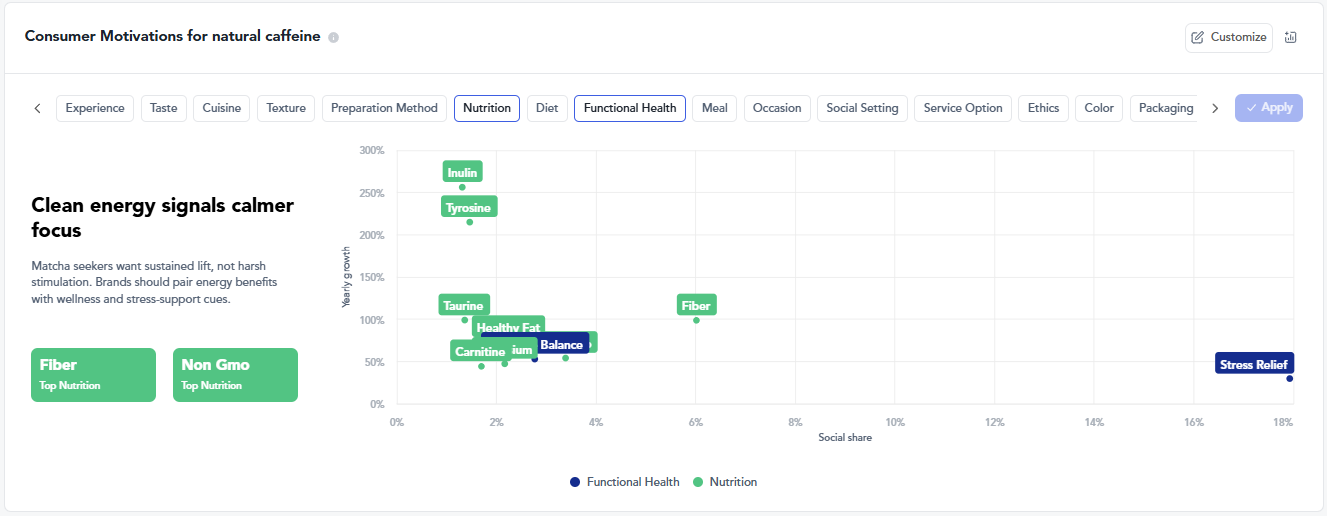
Pair behavioral data with a psychographic tool like GWI or Resonate. Behavioral data shows which benefits consumers attach to a product in their own words. Psychographic profiling shows who those consumers are and what they value. The beverage example below follows this path. Matcha is tied to natural caffeine and stress relief in the Social F&B panel, so the message moves from low sugar to calm, functional energy.
Your trend-led campaign messaging reflects observed behavior. Your target segment is defined by values your creative team can build around.
Insights and analytics teams
Insights teams are asked for analysis that is fast and defensible at the same time. One-off studies are hard to update, and stakeholders push back when they cannot see where a number came from.
Use a consumer insights platform built on behavioral data as your repeatable base layer. Map each trend on the lifecycle of emerging, scaling and saturated, so every request starts from the same framework. Track the same signals over time instead of rebuilding a study for each question. Bring in Qualtrics or Toluna when a decision needs a longitudinal tracker or a cross-market read.
Research resources go to trends at the emerging and scaling stages. Stakeholders get evidence they can trace and repeat.
Sales and category management teams
Category managers often walk into retailer meetings with internal sell-through data the buyer has already seen. Buyers want to know why demand is building and whether it will last.
Build the pitch on external demand evidence. Show how a flavor or ingredient is gaining momentum across restaurant menus, social content and home cooking. Show where it sits on the trend lifecycle. Menu data adds a proof point buyers recognize, since it shows operators putting an ingredient in front of paying guests.
You arrive with a retail sell-in narrative grounded in consumer momentum, which supports a shelf expansion conversation.
How to find consumer insights for food launches
Most teams start with surveys. That introduces bias before the opportunity is even defined. A more reliable approach sequences behavior, validation, and execution.
Step 1: Analyze unprompted behavior
Use AI platforms to track real consumption across social, menus, and recipes. Focus on what consumers actually eat, which flavor profiles are scaling, and which consumption moments are repeating.
Step 2: Validate the concept
Test whether the product idea holds under scrutiny. Confirm that the flavor, ingredient, or functional benefit shows sustained demand and aligns with a defined audience segment.
Step 3: Test execution
Use agile survey panels to refine packaging and messaging. Validate that the positioning is clear, differentiated, and commercially viable before launch.
F&B consumer insights example
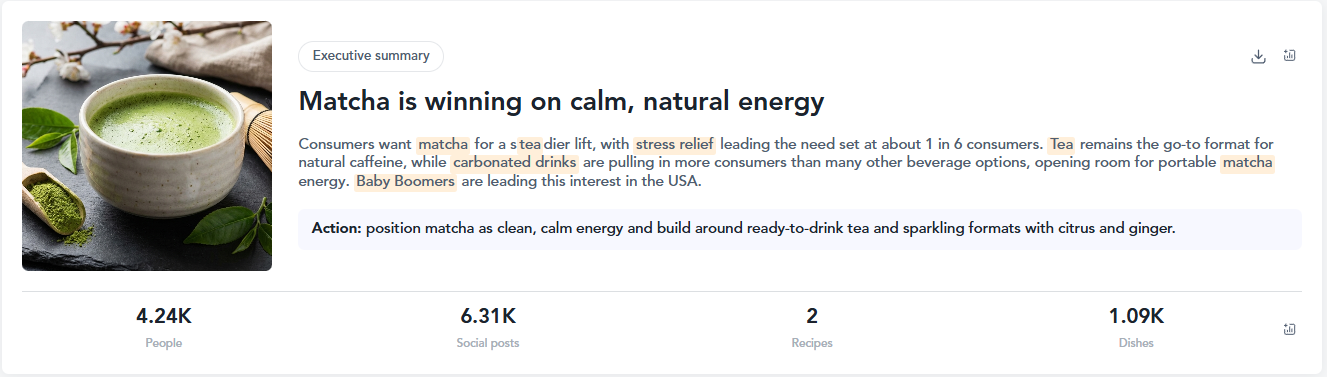
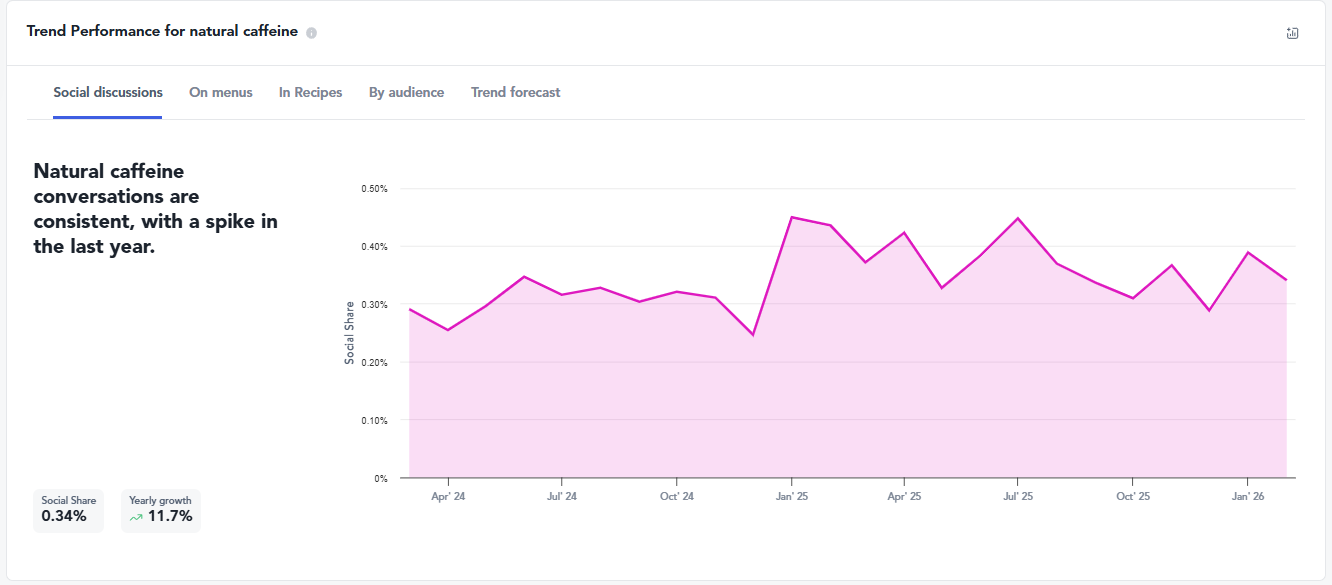
A beverage brand focused on “low sugar” energy. Behavioral data showed demand for something else. According to the Social F&B panel, matcha is tied to “natural caffeine” and “stress relief,” with consistent growth across consumption signals. The insight shifted from sugar reduction to functional, calm energy. The brand repositioned around matcha-based energy, aligning product, messaging, and format with observed behavior rather than stated preference.
Agile panels vs. AI behavioral data: which do you need?
| Criteria | Agile panels | AI behavioral data |
| Methodology | Prompted questions and surveys | Unprompted observation of organic behavior |
| Primary risk | Higher survey and response bias | Requires strong NLP to filter noise |
| Best use case | A/B testing a logo, claim, or price point | Finding whitespace flavors and real consumption moments |
Most CPG teams need both. Agile panels help validate a specific decision. AI behavioral platforms help identify the shifts, claims, and occasions worth testing in the first place.
Move beyond surveys with Tastewise AI
Asking consumers what they want often leads to survey bias. Observing what they actually eat leads to stronger product decisions.
Tastewise is the GenAI consumer intelligence platform built exclusively for the food and beverage industry. By analyzing billions of unprompted eating moments across social media, restaurant menus, and home cooking, the platform gives CPG brands the behavioral data they need to validate concepts and build stronger positioning strategies.
Frequently asked questions about the best consumer insights platfroms
Consumer insights are data-driven explanations of why consumers behave the way they do, combining qualitative and quantitative inputs to inform product, positioning, and commercial decisions.
They include flavor preferences, dietary needs, functional benefits, and consumption moments, along with the motivations behind them, such as health, convenience, or indulgence.
By combining behavioral data (to identify real demand), agile surveys (to validate decisions), and audience profiling (to define target segments and positioning).
Behavioral consumer insights come from unprompted data: what people eat, cook, order and share across social content, restaurant menus and recipes. Survey-based insights come from prompted questions, so they capture what people say they would do. Behavioral data is stronger for discovering demand and spotting whitespace, while surveys are stronger for validating a specific decision like a price point or a claim. Survey answers carry response bias, and behavioral data needs strong NLP to filter noise. Most CPG teams use both in sequence.
AI-powered trend prediction analyzes consumption signals across social content, restaurant menus and home cooking to find which flavors, ingredients and consumption moments are gaining momentum. Each trend is mapped on a lifecycle of emerging, scaling and saturated. Brands act on trends at the emerging and scaling stages, when there is still room to launch ahead of the category. The signals measure momentum in consumer behavior and conversation, so teams still validate the concept and test execution before launch.
A consumption signal is a real-world data point that shows how people eat, cook or talk about food, drawn from social content, restaurant menus and recipes. Signals combine qualitative inputs, such as visuals and language, with quantitative inputs, such as frequency and growth. In CPG market research, teams use them to validate product concepts, check flavor demand and identify consumption moments before committing R&D spend. A consumption signal measures momentum. It is a different measure from sales volume or household penetration.
Use agile survey panels when you already have a specific decision to make, such as A/B testing a logo, claim, price point or pack design. Panels like Suzy return fast answers to prompted questions, which suits narrowing a choice. Use AI behavioral data earlier, to find whitespace flavors, real consumption moments and the claims worth testing. In a typical launch sequence, behavioral data comes first and panels refine execution before launch.
CPG teams reduce R&D risk by confirming demand before formulation budget is committed. Behavioral intelligence shows whether a flavor, ingredient or functional benefit has sustained momentum and fits a defined audience segment. Concept testing grounded in eating behavior then filters weak ideas early. Agile panels check packaging and messaging last, so survey spend focuses on refining a concept with evidence behind it.
Tastewise is a behavioral intelligence platform built for food and beverage. It analyzes unprompted consumption signals across social content, restaurant menus and home cooking to show what consumers actually eat and which trends are scaling. Suzy is an agile survey platform for fast polling on packaging, price and messaging. Qualtrics CoreXM is an enterprise survey system for advanced survey logic, brand tracking and statistical modeling. The tools answer different questions, and many CPG teams use a behavioral platform to find opportunities and a survey tool to validate them.





We’d love to learn your goals and see how Tastewise fits
We’d love to learn your goals and see how Tastewise fits
Get a personalized demo
Good taste. Wise move.
Your demo request is confirmed. We’ll reach out within one business day to schedule your walkthrough.
What happens next

See what’s driving demand, then turn it into a sell-in story for retailers and operators.
- Connect consumer panels, market trackers, and agents into one evidence view
- Get the “why” behind what’s changing, with explainable demand drivers
- Walk away with a buyer-ready narrative and next steps to activate
Trusted by





“Tastewise is my secret tool for knowing what consumers want next and why.“