Business
Snack Trends 2026: Driving Confectionery & Snack Innovation


Snack trends 2026 are shaped by daily routine. Snacks now stand in for meals, carry functional claims and pick up bolder flavors, and each shift shows up across consumers, retail shelves and restaurant menus. Below, you get the consumer data behind each shift, the confectionery and savory flavors on the rise, and the shelf and menu moves that follow.
Key takeaways
- Two in 3 US adults snack every day, and snacks now sit on nearly 1 in 3 US restaurant menus (31%), up 5% in the past year.
- Protein is the top claim US consumers attach to snacks (3.7%). Energy is up 20% and calm is up 25%, while the broad healthy claim is down 24%.
- Nearly 1 in 2 US snack bar consumers (49%) choose bars for protein, and protein sits on 81 new US bar launches in the past 12 months, over five times the 15 that carry fibre.
- The average snack item on US restaurant menus now costs $8.10, up 12% on last year, and operators carry 4.7 snack items each.
- Salted honey (+88%), cookie butter (+58%) and toasted marshmallow (+41%) are climbing in US snacks, while Dubai chocolate (-41%) and freeze-dried candy (-44%) are cooling.
- Crunch Pak used celebration and family-bonding cues to build the Charfruiterie tray, a $10MM annual sales platform launched 6 to 8 months ahead of competitors.
Snack market performance
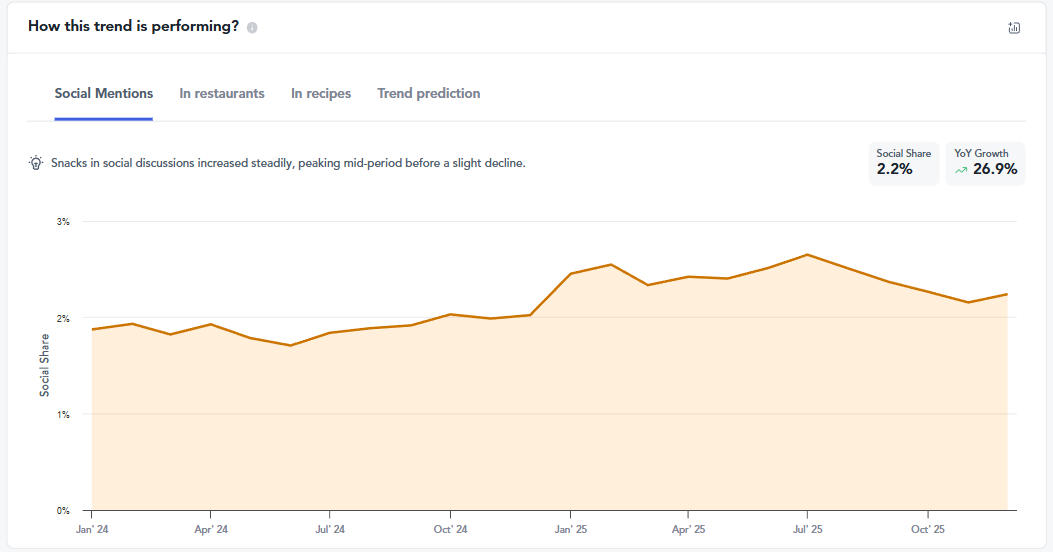
Snacking is now a daily habit for most US consumers. Two in 3 US adults snack every day, and 41% of US snack consumers eat snacks in place of a regular meal, according to Mondelez’s 2026 State of Snacking report.
Restaurants are following the same habit. Across the Tastewise US restaurant panel, snacks appear on nearly 1 in 3 US restaurant menus (31%), up 5% in the past year. Operators that already carry snacks are also adding more of them, which gives a new snack SKU or LTO more places to land.
Snack demand reaches you from three directions at once: what consumers cook at home, what they buy on shelf and what they order on menus. The sections below follow each one.
Analysing consumer snacking trends and market behaviour
Consumer snacking trends in 2026 follow the shape of the working day. The snack consumption statistic to plan around is frequency. Two in 3 US adults (66%) snack daily and 17% snack three or more times a day, according to the same Mondelez study. Most of the meal swaps happen in the morning or at midday, which is where a filling snack has the clearest role.
Across the Tastewise US consumer panel, consumer trends in snacking point to snacks with a specific job. 2.2% of US snack consumers choose snacks for energy, up 20% in the past year. Calm is smaller at 0.4% but up 25%. Weight management, the diet-era claim, is down 36%. People want a snack that carries them through a long afternoon or winds them down in the evening.
That changes how you formulate. Build the functional claim into the recipe and name its source on the pack, such as matcha for energy. A vague wellness line gives the shopper nothing to check. Protein still leads the claims consumers attach to snacks, so energy and calm work best layered on top of it.
It also changes how you pack. On the US online bar shelf, boxed multipacks average $11.90 and bags average $5.88. That gives you two formats for Snack Trends 2026: the pantry box for consumers who stock up, and the single bag for the grab-and-go moment. For product innovation teams, start each new SKU with the job the snack does, then size the pack to the occasion it serves.
What consumers want from snacks right now
Across the Tastewise US consumer panel, these are the claims consumers attach to snacks most often over the past 12 months:
- Protein (3.7%), up 2%
- Healthy (3.3%), down 24%
- Energy (2.2%), up 20%
- Fitness (2.0%), down 13%
- Fibre (0.7%), up 7%
Protein leads and is still growing. Consumers use snacks as fuel, especially when a snack replaces breakfast, bridges a long gap or follows a workout.
The broad claims are losing ground. Healthy is down 24% and fitness is down 13%, while fibre is up 7%. Consumers respond to a named benefit they can check on the label, so a snack that states its protein or fibre content gives them a clearer reason to buy than a general health message.
Formats winning on social
Snack formats spread fastest when they are visual, simple and easy to recreate at home.
Frozen snack builds lead, including strawberry matcha frozen clusters made with yogurt-style bases and coated in matcha-infused white chocolate. They are fast to prep, easy to store and naturally portioned.
Smoothies also dominate snack content. High-performing examples include raspberry smoothies with 25g of protein and no protein powder. That format matches the protein claim leading snack choice.
Freezer pops work because they are colourful, customisable and low-effort. Fruit-based pops also support lower-sugar positioning without heavy claims.
Nostalgia formats come back as homemade rebuilds. Choco Taco-style snacks show consumers pulling older snack ideas back into rotation with updated flavours and DIY shortcuts.
Snack trend formats showing up in recipes
Home recipes show where snacking goes when consumers make it themselves. Recipe activity points to functional, flexible formats:
- Turmeric and banana smoothies positioned as breakfast or snack
- Carrot hummus as a snack dip with layered flavour
- Air fryer corn ribs as a crispy snack or appetiser format
- Pistachio scones as a snackable baked good
- Royal milk tea as a drink tied to snack occasions
Snacks now reach well past chips and bars. The strongest recipe activity sits in drinks, dips, air fryer formats and bakery-style snacks sized for smaller eating moments.
Menu usage and pricing signals for snack trends
Operators package snack behaviour into defined items that travel well. Menu examples include:
- Snack wraps
- Snack sticks
- Bites and mini formats
- Packaged snack crossovers, including Flamin’ Hot Cheetos as a menu item
These items lean on familiar flavours and recognisable formats, and they sit on menus as planned purchases.
Pricing has moved with them. Across the Tastewise US restaurant panel, the average snack menu item costs $8.10, up 12% on last year. Operators that carry snacks now list 4.7 snack items each, up 22% in the past year. Consumers are paying more for snacks that do a meal’s job, and operators are giving them more choice.
Where snack trends demand is heading
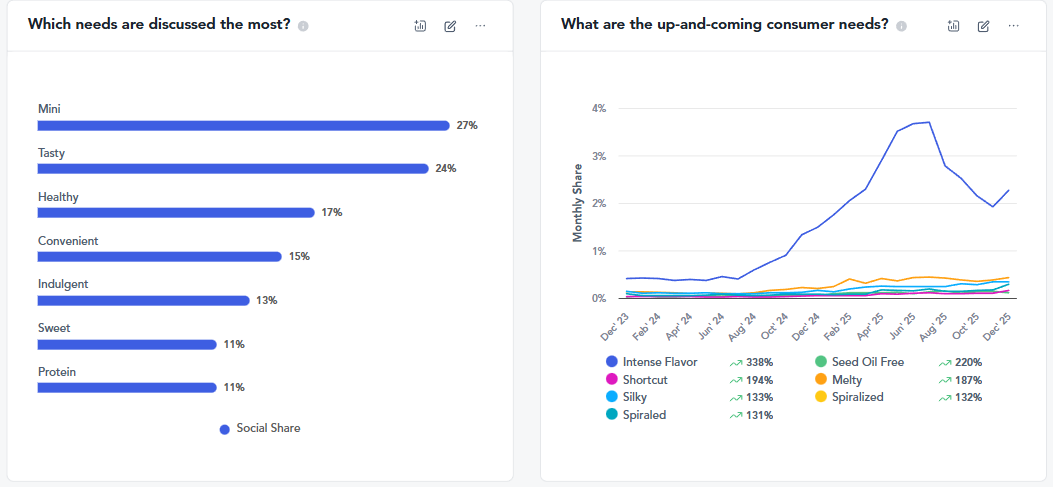
Based on consumer claims, flavour movement and menu data, snack trends 2026 will keep building around:
- Portioned formats that fit two or three snack occasions a day
- Protein-forward snacks in familiar formats like smoothies and yogurt-based builds
- Frozen and chilled snacks that store well and feel light
- Sweet snacks with a better-for-you framing, in line with pastry and baking trends, built on portion control and simple ingredients
- Operator-friendly snack items built for portability and speed
Real-world application of snack trends
Each of the three snack opportunities below pairs a consumer signal with a shelf or menu move you can take into your next range review.
Health-forward protein snacks
Across the Tastewise US consumer panel, nearly 1 in 2 US snack bar consumers (49%) choose bars for protein, up 2% in the past year. The shelf shows the same lead. Protein appears on 81 new US bar launches in the past 12 months, and protein bars average $9.12 online. Among snack bar consumers, the broad healthy claim is down 24%, so a stated protein amount now carries the message a general health claim used to.
Brands should:
- Put a stated protein amount on the front of core snack packs
- Pair protein with fibre, which sits on 15 new bar launches and has room to grow on shelf
- Test new protein claims with the AI Survey Agent before reformulating
- Build the retail sell-in story around protein’s lead in new bar launches
The gain comes from upgrading the claim and format on SKUs you already sell.
Convenient ready-to-eat formats
Nearly 1 in 3 US snack bar consumers (32%) choose bars for convenience, up 5% in the past year. Ease is climbing faster, with 16% choosing bars because they are easy, up 9%. Consumers want a snack they can open and eat with no prep, and menu items like snack wraps and snack sticks meet the same need away from home.
Brands should:
- Give sales teams retail and foodservice sell-in comparisons for each pitch
- Develop cross-category snack packs, such as protein with fruit or sweet with salty
- Price single-serve packs in impulse bands near the checkout
- Position new SKUs as basket additions next to the core range
Seasonal and indulgent snack occasions
Indulgence has its own timing. In the Mondelez study, 22% of US snackers name evenings as the time for an indulgent snack, ahead of afternoons at 17%. Across the Tastewise US consumer panel, the indulgent snack flavours climbing fastest are campfire and fairground cues: toasted marshmallow is up 41%, kettle corn is up 23% and caramel apple is up 17%.
Brands should:
- Build seasonal trays and multipacks around toasted marshmallow or caramel apple for autumn and holiday resets
- Target evening occasions with portioned indulgent packs
- Turn seasonal flavour data into campaign assets with the Marketing Agent
- Frame sell-in around basket growth during seasonal peaks
Case study: turning celebration cues into a $10MM snack platform

Crunch Pak identified a gap in adult snacking: seasonal fruit trays lacked cultural relevance and differentiation. According to the Social F&B panel, celebration-driven snacking conversations increased by 25% year-over-year, while Foodservice data shows charcuterie-style formats now appear on 1 in 5 shareable appetizer menus. The signal points to format migration: consumers are adopting curated, board-style snacking across multiple occasions, while traditional retail fruit trays have remained largely unchanged.
Crunch Pak reimagined the traditional fruit tray into the Charfruiterie format, a hybrid of health-forward fruit and charcuterie-style presentation.
The result:
- $10MM in annual sales
- Innovation launched 1/2 year ahead of mainstream retail competitors
- Stronger seasonal velocity driven by occasion-based positioning
Snack trends inform direction. Evidence-backed applications secure distribution and drive measurable growth.
Emerging snack flavour trends shaping global markets
Snack flavour trends in 2026 move fastest at the edges of familiar profiles. Across the Tastewise US consumer panel, the quickest climbers pair a known base with one unexpected note. Salted honey is up 88% in the past year, smoked cherry is up 74% and cookie butter is up 58%. Dragon fruit coconut has more than doubled (+122%) from a small base.
Global spice blends follow the same pattern. Maple chipotle is up 54%, Louisiana hot sauce is up 53% and chilli lime seasoning is up 26%, all still early in their lifecycle. Hot honey, now in its trending stage, is up 21%. These snack flavor trends give CPG brands a way to bring adventurous consumers in, while the familiar base gives them a reason to buy again.
Functional ingredients now travel with flavour. Matcha is the largest trending snack flavour (0.6%) and is up 23%, while banana matcha is emerging at +64%. Both suit snacks that promise steady energy as well as taste.
Some confectionery flavours are cooling. Dubai chocolate is down 41%, freeze-dried candy is down 44% and milk chocolate is down 11%. Texture-led novelty is fading with them, so pair crunch or chew with a flavour consumers already want.
The shelf is behind. New US salty snack launches in the past 12 months still lean on potato, tortilla and cheddar bases, while cheddar jalapeño is up 38% among consumers. Hickory shows how fast a flavor can move: it appeared on 7 new launches against just 25 products already on shelf.
FAQs about snack trends 2026
Daily routine is the main driver. Two in 3 US adults snack every day, and protein leads the claims US consumers attach to snacks (3.7%). Energy is up 20% in the past year, while the broad healthy claim is down 24%.
Frozen clusters, high-protein smoothies, freezer pops and homemade nostalgia-style snacks keep coming back in consumer snack content. Each is visual, naturally portioned and easy to recreate at home, and the smoothies tie directly to protein, the top snack claim.
Specific functional benefits are growing, while the general healthy claim is losing ground. Among US snack consumers, healthy is down 24% in the past year, while fibre is up 7% and calm is up 25%. Consumers want a snack that states one clear benefit.
Protein (3.7%) leads the claims US consumers attach to snacks, followed by healthy (3.3%), energy (2.2%), fitness (2.0%) and fibre (0.7%). Protein and energy are growing, while healthy and fitness are declining.
Yes. Tastewise resolves consumer, retail shelf and restaurant menu data into one dataset, so you can see the functional claims consumers attach to snacks next to the claims printed on new packaged launches. For functional snacks, that shows energy up 20% and calm up 25% among US snack consumers, with protein on 81 new US bar launches in the past 12 months. You can cut the data by audience, category or retailer.
Protein and convenience lead snack bar trends in 2026. Nearly 1 in 2 US snack bar consumers (49%) choose bars for protein, and nearly 1 in 3 (32%) choose them for convenience. Taste-led claims are fading, with tasty down 28% among snack bar consumers in the past year.
The biggest snacking trends in 2026 are snacks replacing meals, functional claims and bolder flavour pairings. 41% of US snack consumers now eat snacks in place of a regular meal, according to Mondelez. On flavour, salted honey (+88%) and maple chipotle (+54%) are among the fastest climbers in US snacks.
Sources cited in this article
- Mondelez’s 2026 State of Snacking report foodbusinessnews.net
Cite this article
Reinoso, K. L. (2026). Snack Trends 2026: Driving Confectionery & Snack Innovation. Tastewise. https://tastewise.io/blog/snack-trends. Updated 11 Nov 2026