






Building innovative FoodTech applications or planning a national QSR menu requires more than static ingredient lists; it requires dynamic context, clean data architecture, and the ability to ask questions of the food data set to unlock predictive consumer intelligence.
Recipe data APIs and menu intelligence platforms provide FoodTech companies, QSRs, and CPG brands with structured data on ingredients, nutrition, and consumer dining trends. A modern F&B intelligence stack moves beyond basic recipe scraping to include predictive AI, natural language processing (NLP), and real-time market trackers.
- Menu intelligence & predictive context: Tastewise
- Nutritional analysis & compliance: Edamam
- Recipe database for app population: Spoonacular
Enterprise menu intelligence & predictive AI
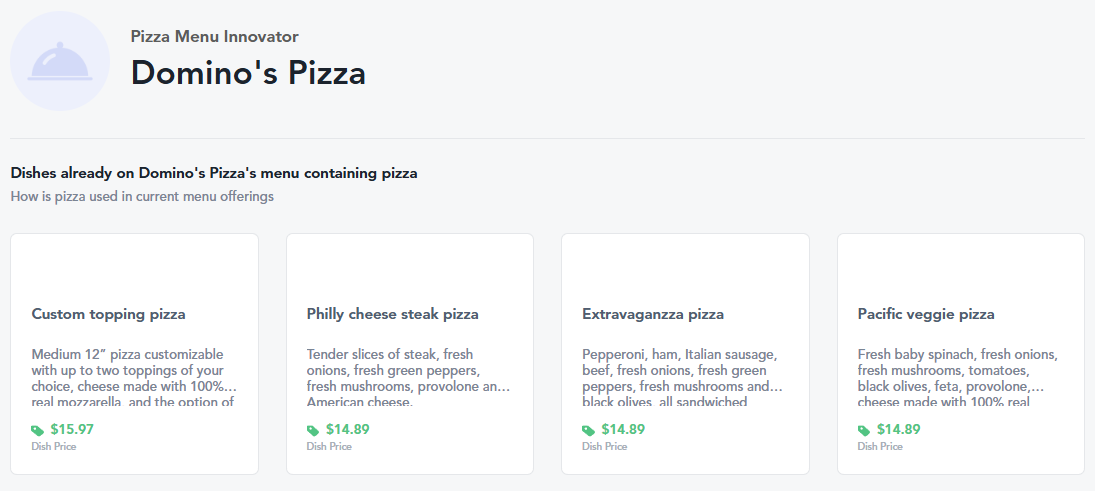
Software and APIs that provide contextual market trackers, consumer panel data, and predictive analytics for R&D and commercial strategy.
1. Tastewise
Best for: enterprise FoodTech, CPGs, and QSRs needing AI agents and predictive market trackers
Tastewise is not a basic recipe scraping tool; it is a menu intelligence software and food trends API for enterprise teams. F&B data teams use Tastewise API endpoints and dashboards to access billions of eating moments across social media, restaurant menus, and home cooking.
With natural language processing (NLP) models purpose-built for food, Tastewise understands contextual differences in ingredient usage and menu positioning. This allows teams to track Limited-Time Offers (LTOs), identify menu expansion opportunities, and build predictive analytics into R&D workflows.
Tastewise connects consumer panels and market trackers into a structured data layer, enabling teams to move from raw signals to decision-ready outputs that support internal alignment and external sell-in.
Nutritional analysis & diet compliance
APIs specifically built to calculate macros, allergens, and assign strict dietary labels (e.g., keto, paleo, halal) to ingredient strings.
2. Edamam
Best for: nutritional breakdown and diet-specific F&B applications
Edamam is a nutritional analysis API designed to process ingredient inputs and return structured nutritional data via JSON response. It provides accurate macronutrient breakdowns, allergen detection, and diet compliance tagging.
It is widely used in meal-prep applications, health platforms, and compliance workflows where accuracy and consistency are required.
3. Nutritionix
Best for: restaurant chain nutritional tracking and fitness app integrations
Nutritionix offers a large, verified database of grocery products and restaurant menu items. It is commonly integrated into POS systems and fitness applications to support calorie tracking and nutritional transparency.
Its strength lies in standardized data and broad coverage across branded food items.
B2C recipe databases & scraping APIs
Budget-friendly, high-volume databases used to populate consumer-facing applications with recipes and ingredient data.
4. Spoonacular
Best for: B2C meal planning apps and developer side-projects
Spoonacular is a recipe data API that provides access to large volumes of structured recipes, ingredient lists, and cooking instructions. It is suitable for developers building consumer-facing applications that require fast access to recipe content.
It serves as a practical alternative to web scraping, offering cleaner data delivery and API-based integration.
5. TheMealDB
Best for: open-source recipe data for basic coding projects
TheMealDB is a free, community-driven recipe database. It is commonly used for prototyping and early-stage development where cost constraints are a factor.
It does not provide enterprise-level SLA, data standardization, or security (ISO/GDPR) required for commercial deployment.
Retail CPG & barcode scanning
APIs used to identify packaged foods via UPC and barcode lookup.
6. Chomp
Best for: barcode scanning and basic grocery CPG data retrieval
Chomp provides an API that allows developers to retrieve packaged food data using barcode inputs. It returns structured product information, including ingredients and packaging details.
It is typically used in retail and grocery applications that require fast product identification.
Comparison: which API type to use
| Need | Use |
| Decide what to launch | Menu intelligence |
| Check nutrition & compliance | Nutrition API |
| Build app / recipes | Recipe API |
| Scan packaged products | Barcode API |
How to build a modern food data architecture
The Context (Tastewise)
Use a menu intelligence platform to track consumer demand across restaurant menus, social signals, and home cooking behavior. This layer identifies which ingredients, formats, and concepts are gaining traction.
The Formulation (Edamam)
Pass validated concepts into a nutritional analysis API to calculate macros, assign dietary labels, and ensure compliance with health or regulatory requirements.
The Consumer Endpoint (Spoonacular/Chomp)
Use recipe data APIs or barcode APIs to structure and deliver content into consumer-facing applications, POS systems, or digital platforms.
A database of recipes alone does not provide commercial value. Teams need both structured data and predictive context to build products that align with real consumer demand.
Power your F&B innovation with AI-Driven menu Intelligence
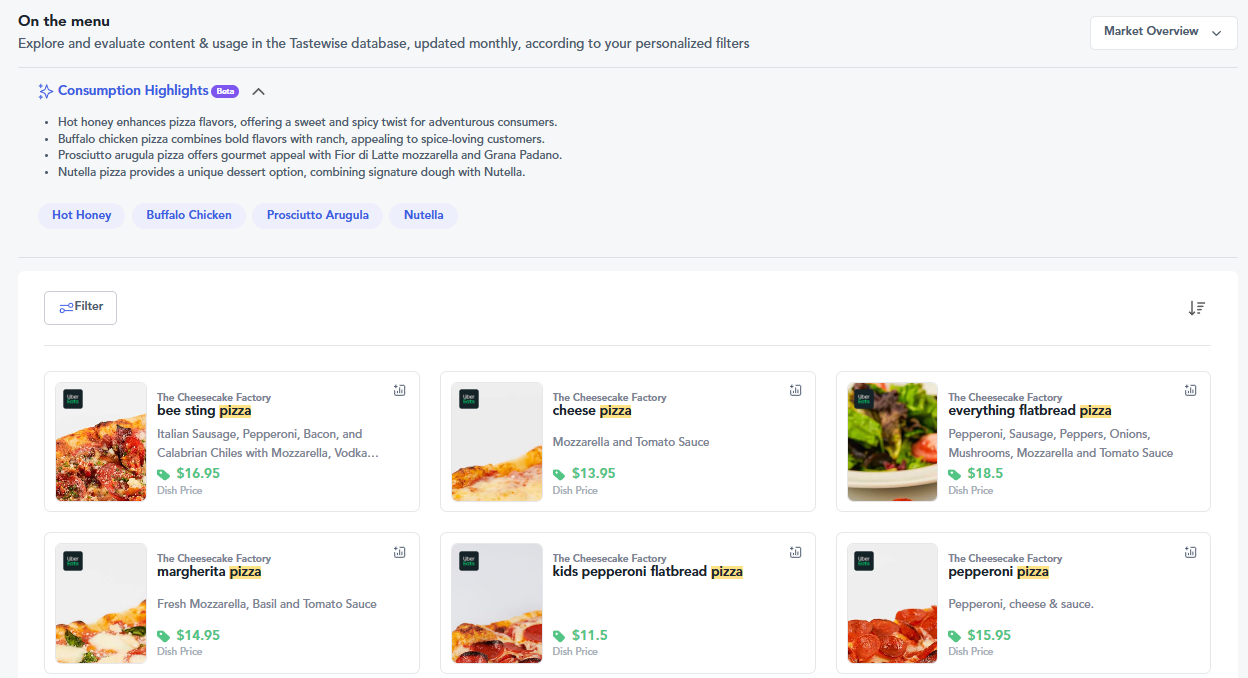
Raw data isn’t enough; you need context. FoodTech developers, QSRs, and CPGs need to know which ones are driving consumer demand. Tastewise provides the industry’s most advanced AI Agents and Market Trackers. By leveraging NLP purpose-built for food, we turn billions of fragmented recipes, menus, and consumer panels into structured, predictive data.
FAQ about recipe data API
A recipe data API provides structured access to recipes, ingredients, and nutritional data through API endpoints that return machine-readable responses such as JSON.
Recipe scraping extracts static data from websites. Menu intelligence software analyzes consumer panels, market trackers, and restaurant menu data to provide predictive insights.
They combine menu intelligence platforms, nutritional analysis APIs, and recipe databases to support product development, compliance, and digital execution.





We’d love to learn your goals and see how Tastewise fits
We’d love to learn your goals and see how Tastewise fits
Get a personalized demo
Good taste. Wise move.
Your demo request is confirmed. We’ll reach out within one business day to schedule your walkthrough.
What happens next

See what’s driving demand, then turn it into a sell-in story for retailers and operators.
- Connect consumer panels, market trackers, and agents into one evidence view
- Get the “why” behind what’s changing, with explainable demand drivers
- Walk away with a buyer-ready narrative and next steps to activate
Trusted by





“Tastewise is my secret tool for knowing what consumers want next and why.“