





How to sell to Gen Z has become a practical question for food and beverage teams, not a branding exercise. This generation already influences what gets listed, launched, reformulated, or removed. Their purchasing habits shape menus, shelves, and innovation pipelines faster than many teams expect.
5% of Gen Z have purchased food or beverages specifically to help reduce stress and younger consumers overall show greater interest in mood-related food functions than older groups.
For retailers, operators, and innovation leaders, selling to Gen Z starts with understanding how they actually consume food and beverages. Tastewise data shows clear behavioral patterns across formats, occasions, and product lifecycles. Those patterns are measurable, repeatable, and actionable.
What Gen Z food and beverage consumption looks like in practice

Gen Z approaches food with flexibility. Fixed meal moments matter less. Consumption happens in between work, study, commuting, and social plans. Tastewise data shows stronger engagement with:
- Portable meals that do not require cutlery or long prep
- Snack-sized or modular formats that can replace meals
- Beverages that deliver flavour plus function
- Products that feel filling without feeling heavy
This has direct implications for how products are developed and sold. Items designed for long sit-down occasions often underperform with Gen Z unless they offer strong convenience or delivery performance.
Price still matters, but not in isolation. Gen Z evaluates value through portion size, satiety, and repeat satisfaction. Smaller formats with a clear role often outperform larger options that feel unfocused.
About 33% of Gen Z say environmental sustainability significantly affects their food and beverage purchases, and almost three in four Gen Z agree their generation cares more about environmental impact than older generations.
Familiar foods still matter, just differently
Gen Z does not reject familiar food categories. Tastewise data shows strong demand for bowls, wraps, noodles, sandwiches, and comfort-driven formats. What changes is how these foods are presented.
Innovation that performs well tends to anchor itself in familiarity, then introduce one clear variation, a pattern that appears consistently across Gen Z food trends. That variation is usually flavour-led, ingredient-led, or format-led.
Overcomplicating the offer reduces trial. For innovation teams, this means pushing fewer concepts further rather than launching many lightly. For operators, it means menus that prioritise clarity over novelty volume.
How Gen Z approaches beverages
Beverages play a central role in Gen Z consumption, and gen z beverage trends reflect a higher frequency of beverage-led occasions compared to older demographics. Tastewise data shows that drinks are often used to replace meals, extend energy, or support daily routines.
Cold brew, flavoured waters, functional sodas, and hybrid drinks perform well when flavour and purpose are obvious. Ambiguous positioning performs poorly.
For foodservice operators, beverages offer speed, margin, and trial opportunities. For retailers, ready-to-drink products succeed when packaging communicates taste and function immediately.
Where Gen Z demand shows up most clearly
The table below summarises key Gen Z food and beverage behaviours observed in Tastewise consumption data and what they mean for F&B teams.
| Gen Z behaviour | What the data shows | What it means for F&B teams |
| Flexible eating occasions | Less reliance on traditional meal times | Design products for all-day consumption |
| Beverage-first decisions | Drinks replace meals more often | Invest in functional and flavour-led beverages |
| Faster trend turnover | Shorter product lifecycles | Test smaller, decide faster |
| High substitution rates | Quick switching when items are unavailable | Prioritise consistency and availability |
| Preference for clarity | Simple naming and formats perform better | Reduce overdescription and complexity |
This is where selling to Gen Z becomes operational rather than conceptual.
B2B marketing tactics for Gen Z-focused food brands
B2B marketing tactics for Gen Z should mirror how this audience behaves. Operators and retailers are not looking for abstract positioning. They want evidence that a product works in real environments.
What resonates most with decision-makers selling to Gen Z includes:
- Demonstrated repeat consumption, not just trial
- Clear use cases across dayparts
- Proof of velocity rather than hype
- Evidence that products fit into existing workflows
Overly polished narratives often create friction. Teams responsible for menus and assortments need confidence that a product will hold its place once listed.
Key execution principles for selling to Gen Z in food and beverage:
- Prioritise formats that travel and store well
- Keep flavour profiles focused and recognisable
- Design packaging and menus for fast scanning
- Test concepts in smaller batches
- Remove underperformers quickly
This approach aligns with how Gen Z actually consumes, not how brands want them to consume.
Gen z is driving the shift from “looks good” to “feels worth it”
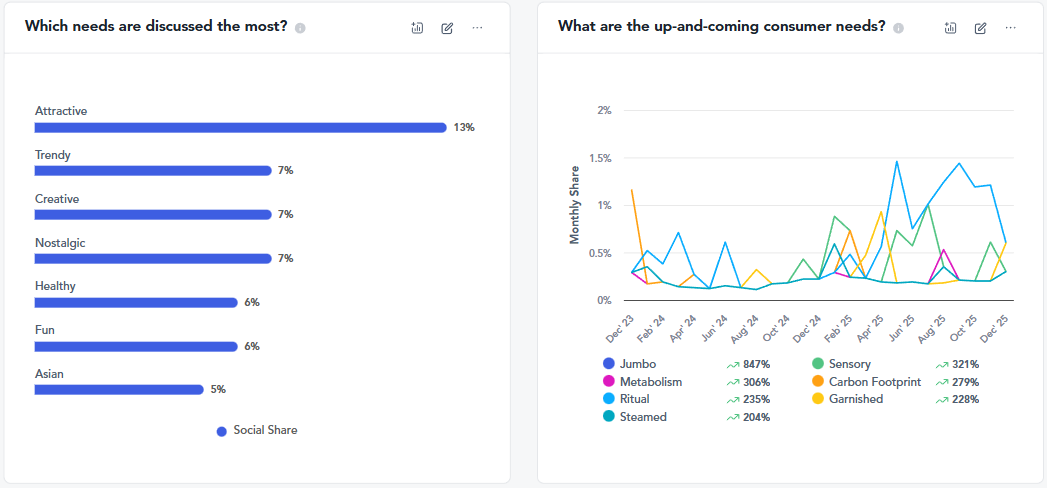
Consumer conversations are currently led by attractive food experiences (13% social share), showing how visual appeal still drives discovery and engagement.
Trendy, creative, and nostalgic needs (7% each) signal that consumers want familiar comfort, but with a fresh twist. Healthy and fun (6% each) remain steady motivators, while Asian flavors (5%) continue to influence exploration.
Looking ahead, momentum is rising for jumbo formats (+847%), plus needs tied to sensory satisfaction (+321%), metabolism (+306%), and sustainability like carbon footprint (+279%).
How to sell to Gen Z without overexplaining
Gen Z does not need long explanations. They prefer fast signals. Clear names, honest pricing, and visible ingredients perform better than dense copy.
Data-backed decisions reduce the need to persuade. When a product aligns with existing consumption behaviour, selling becomes easier for everyone involved.
Tastewise insights help teams identify which flavours, ingredients, and formats already resonate with Gen Z. This reduces reliance on assumptions and shortens decision cycles.
Selling to Gen Z is a day-to-day discipline
Selling to Gen Z is shaped by menu architecture, shelf layout, pricing logic, and speed of execution. Teams that succeed adjust often and observe closely.
Retailers that perform well simplify navigation. Operators streamline ordering and delivery. Innovation teams shorten feedback loops and move on quickly when something does not land. Gen Z does not wait for brands to refine their messaging. They respond to what fits their routines right now.
FAQs about how to sell to Gen Z
Gen Z decisions are driven by routine fit, flavour, and perceived value. They favour products that are easy to consume, clearly positioned, and consistent over time. Repeat experience matters more than novelty.
Gen Z tracks value closely, but price alone does not determine purchase. Portion size, satiety, and how often a product can be repurchased play a bigger role than headline pricing.
Portable meals, snack-sized formats, and beverage-led options perform strongly. Products that fit flexible schedules and support all-day consumption tend to see higher repeat rates.
Gen Z trends move faster than those driven by older demographics. Many concepts peak quickly, which makes smaller test launches and faster iteration more effective than long rollout cycles.
Gen Z switches quickly after poor repeat experiences. Inconsistent flavour, portioning, or availability leads to faster drop-off compared to older cohorts.
Yes. Tastewise tracks real consumer behaviour across menus, social conversations, and purchasing signals, allowing brands to see how Gen Z weighs affordability against ethical factors such as sustainability, sourcing, and transparency.
Tastewise helps identify which flavours, ingredients, and formats Gen Z prefers at dinner, including trending proteins, plant-based options, and comfort foods. This allows restaurants to design dinner menus that match real demand rather than assumptions.
Yes. Tastewise analyses how Gen Z talks about food in relation to emotions such as comfort, nostalgia, indulgence, and wellbeing, helping brands understand the emotional drivers behind menu choices.
Tastewise reveals gaps between what Gen Z shares online and what they actually eat or order. While social posts often highlight bold or aesthetic foods, real behaviour data shows consistent demand for familiar, affordable, and comforting options.
Yes. Tastewise offers US-specific insights into Gen Z food preferences, regional trends, and dining occasions, helping brands tailor menus and messaging to local consumer behaviour.
Tastewise tracks interest in sustainability-related attributes such as plant-based ingredients, ethical sourcing, and waste reduction, showing how these preferences influence Gen Z food choices across categories.
Tastewise identifies growing demand for functional ingredients like protein, adaptogens, probiotics, and low-sugar options, helping brands align beverage offerings with Gen Z wellness-focused behaviour.
Tastewise helps identify millennial-driven trends such as premium ingredients, global flavours, and balance between indulgence and health, enabling restaurants to design menus that resonate with millennial values and dining habits.




We’d love to learn your goals and see how Tastewise fits
We’d love to learn your goals and see how Tastewise fits
Get a personalized demo
Good taste. Wise move.
Your demo request is confirmed. We’ll reach out within one business day to schedule your walkthrough.
What happens next

See what’s driving demand, then turn it into a sell-in story for retailers and operators.
- Connect consumer panels, market trackers, and agents into one evidence view
- Get the “why” behind what’s changing, with explainable demand drivers
- Walk away with a buyer-ready narrative and next steps to activate
Trusted by





“Tastewise is my secret tool for knowing what consumers want next and why.“