






The healthy snacks market is growing because shoppers want snacks that do a job for their body and fit a day with less time for meals. IMARC Group values the global healthy snacks market at USD 95.8 billion in 2025 and expects it to reach USD 148.4 billion by 2034, a CAGR of 4.98%. Across the Tastewise US consumer panel, interest in the broad “healthy” label cooled over the past 12 months. Interest in specific claims kept climbing.
Healthy snack trend data tracks how consumers, menus and store shelves respond to better-for-you snacking over time. For brands, it shapes what to make, how to position it and which ingredients to source.
Key takeaways
- IMARC Group puts the global healthy snacks market CAGR at 4.98% through 2034.
- US consumer interest in seed oil free snacks grew 53% in 12 months as the generic “healthy” label cooled.
- Protein Prioritizers are nearly 7x more likely than the average US consumer to engage with healthy snacks.
- UK consumer interest in clean label snacks nearly tripled, up 198%.
- US restaurant menu items featuring protein bites rose 13% in a year, at an average price of $7.72.
- In India, consumer interest in monk fruit as a snack sweetener grew 176%.
What is driving global healthy snacks market growth in 2026?
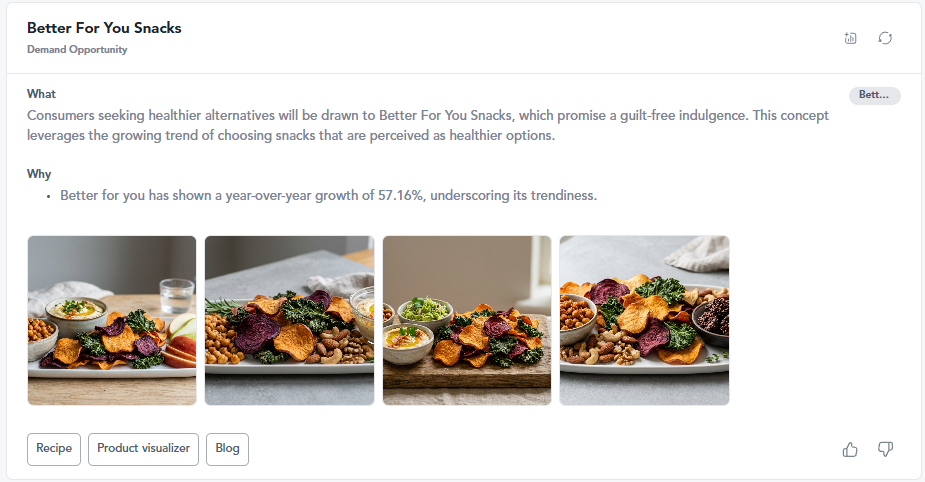
Global healthy snacks market growth in 2026 is driven by demand for functional nutrition, clean ingredient lists and portable formats. Real-time consumer data shows the growth moving from the generic “healthy” label toward specific, provable claims.
Estimates of the global healthy snacks market size differ by research firm. Global Market Insights sizes it at USD 107.3 billion in 2025, with North America holding 36.2%.
The shift from traditional snacking to functional better-for-you options
Across the Tastewise US consumer panel, the claims gaining ground in healthy snacks describe what a snack does or what it leaves out. Consumer interest in real fruit claims grew 77% over the past 12 months, and choline and seed oil free each grew 53%. Growth in the healthy fat free snacks market now follows claims like seed oil free that name the exact fat a shopper wants to avoid.
High-protein snacking carries the same logic. Protein Prioritizers, a Tastewise audience of consumers who build their eating around protein, are nearly 7x more likely than the average US consumer to engage with healthy snacks. You can size and target groups like this through custom consumer segments.
Deconstructing the on-the-go healthy snacks market
Across the Tastewise US consumer panel, On The Go Snackers are more than 5x more likely than the average consumer to engage with healthy snacks. Convenience Seekers over-index more than 3x.
Market estimates point the same way in Asia. IMARC Group values the India on-the-go healthy snacks market at USD 4.4 billion in 2025, growing at a 7.14% CAGR through 2034. Its Japan on-the-go estimate is USD 7.0 billion, rising to USD 12.9 billion by 2034. In both countries, the portable segment is forecast to grow faster than the total healthy snack category.
Niche category expansions: meat & plant-based protein
The healthy meat snacks market combines high protein, low sugar and a format that travels well. On US e-commerce shelves tracked by Tastewise, Jack Link’s and Slim Jim each list 17 jerky and meat snack products with a protein claim. Only two new SKUs with a nutrition claim launched in that aisle over the past 12 months, from Righteous Felon and The New Primal.
Plant protein is moving in the snack format too. Across the Tastewise US consumer panel, consumer interest in lupini beans as a healthy snack grew 50% over the past 12 months. Bean dip grew 82%, giving you a plant-based protein base for dips and crisps.
How do regional dynamics and geographic preferences shape the healthy snacks market?

The global healthy snacks market splits by local diet, retail structure and regulation. Western markets lean on protein and transparency, and Asian markets on fiber and traditional ingredients.
UK healthy snacks market: how consumer demand is shifting
The UK healthy snacks market is growing on demand for clean label, real fruit and gut-friendly snacks. Consumer interest in clean label healthy snacks rose 198% over the past 12 months across the Tastewise UK consumer panel.
IMARC Group values the UK healthy snacks market at USD 3.2 billion in 2025, with a 4.99% CAGR forecast through 2034. Regulation is the other driver. England already restricts multibuy promotions on high fat, salt and sugar (HFSS) foods, and Wales brought in matching rules on 26 March 2026. Snacks outside the HFSS rules keep access to multibuys and prime store space. On pack, UK consumer interest in real fruit grew 118%, seed oil free doubled and low FODMAP grew 80%.
US healthy snacks market: retail channels and growth statistics
The US healthy snacks market leads on functional protein, clean claims and broad retail distribution. Growth now depends on which claims a brand puts on pack and which banner carries it.
That North America share makes the U.S. healthy snacks market the anchor of global demand. Public forecasts for the US healthy snacks market CAGR vary widely with how each firm defines the category. Tastewise shelf data shows how crowded the claims already are. Among US e-commerce snack products, 1,322 carry a healthy claim, 690 carry a protein claim and 647 carry a gluten free claim.
Assortment varies sharply by banner. Walmart lists 600 healthy snack SKUs online at an average of $15.02, DoorDash lists 577 at $6.21 and Natural Grocers lists 145. If you are pitching healthy snacks at Whole Foods Market, Sprouts Farmers Market, Thrive Market or Market Basket, match your sell-in story to that banner’s price ceiling and claim mix.
India healthy snacks market: size, CAGR, and localized innovations
The India healthy snacks market is expanding through urban health awareness and modern retail, led by traditional ingredients and cleaner sweeteners.
IMARC Group sizes the India healthy snacks market at USD 3.13 billion in 2025, with an India healthy snacks market CAGR of 4.80% through 2034. That puts the market size of healthy snacks in India at USD 4.77 billion by 2034.
The healthy snacks available in the Indian market are shifting toward familiar wellness ingredients. Across the Tastewise India consumer panel, interest in roasted quinoa grew 347% over the past 12 months. Monk fruit grew 176%, moringa 59% and sattu, a roasted gram flour, 52%. For healthy snacks market India growth, the direction for R&D is to lead with recognizable regional ingredients and cut refined sugar.
Mexico healthy snacks market: on-the-go dynamics and CAGR
The Mexico healthy snacks market and the Mexico on-the-go healthy snacks market are growing as consumers look for portable snacks with gut and mood benefits. IMARC Group puts the Mexico healthy snacks market CAGR at 4.84%.
IMARC Group sizes the Mexico healthy snacks market at USD 1,438.2 million in 2025. Across the Tastewise Mexico consumer panel, consumer interest in calm (calma) as a healthy snack benefit grew 106% over the past 12 months. Prebiotics grew 78% and Mediterranean diet 79%.
Across Latin America, country-level forecasts point to similar growth. A Research and Markets report forecasts a 5.90% CAGR for the Peru healthy snacks market from 2025 to 2034. The Report Cubes projects 6.20% for the Chile healthy snacks market from 2026 to 2034.
Japan healthy snacks market: precision nutrition and functional formats
The Japan healthy snacks market leads on protein-dense, plant-based and seed-based snacks in small formats.
IMARC Group values the Japan healthy snacks market at USD 5.68 billion in 2025 and expects a 5.23% healthy snacks market Japan CAGR to 2034. Across the Tastewise Japan consumer panel, interest in edamame as a healthy snack grew 272% over the past 12 months. Pumpkin seed grew 163% and protein powder 113%.
Elsewhere in APAC, the Australia healthy snacks market is moving toward fiber. Across the Tastewise Australia consumer panel, interest in psyllium grew 102% over the past 12 months and chicory grew 207%. In the Australia on-the-go healthy snacks market, corn thins grew 96% and skyr grew 85%.
Europe & Americas regional comparison: Germany, France, and Canada
The Germany healthy snacks market, France healthy snacks market and Canada healthy snacks market share a focus on transparency and metabolic health.
Across the Tastewise Germany consumer panel, consumer interest in blood sugar claims grew 76% over the past 12 months, and metabolism grew 107%. In France, interest in polyphenols grew 141%, and interest in 100-calorie snacks grew 103%. In Canada, consumer interest in metabolic balance tripled, up 203%, while clean label grew 97% and seed oil free 87%.
How brands use healthy snack trend data

Healthy snack trend data turns consumer interest, menu adoption and shelf activity into product, positioning and sourcing decisions. The scenarios below show how teams use Tastewise consumer insights to answer real business questions.
For CPG product developers: identifying winning ingredient combinations
A healthy snack company needs to pick a base and a pairing for R&D before its next launch. Healthy snack trend analysis flags US pairings including peanut butter yogurt, chia yogurt, cinnamon yogurt and egg white protein. Apple chips are rising too, with consumer interest up 74% over the past 12 months. Tastewise, the proactive AI food and beverage intelligence system that delivers before you ask, ranks each pairing by lifecycle stage and growth. Your team can shortlist functional snack ingredients with evidence attached and move them into product innovation with a clear case for each one.
For restaurant chains: menu innovation grounded in consumer demand
A fast casual chain wants a better-for-you snack that lifts afternoon orders without adding prep. Menu development insights show protein bites already earning space. US menu items featuring protein bites rose 13% in a year, and their average price is $7.72, up 3.4%. Clean Juice sells six-count birthday cake and chocolate peanut butter protein bites from $6.59, and Fast Fit Foods ran pumpkin spice protein bites as a limited-time offer. A culinary team can price and time its own launch against that benchmark using restaurant chain growth data.
For brand marketers: aligning claims to what consumers actually want
A brand team needs to choose the front-of-pack claim for a reformulated bar. Consumer demand signals show where interest is rising faster than shelf supply. Consumer interest in better for you claims grew 43% over the past 12 months, creatine grew 37% and no artificial sweeteners grew 32%. None of these appears among the claims leading new US snack launches, which healthy and protein top. That gap tells a consumer marketing team where a claim can still stand out.
For retail buyers: forecasting category growth before it peaks
A category manager wants to add healthy snack SKUs before a trend saturates, using F&B trend forecasting and launch velocity. Walmart leads tracked banners in new healthy snack SKU launches, with 17. Snacks with a protein claim average $12.13 on shelf, against $10.28 for those with a healthy claim. A buyer can use these price tiers to plan the planogram, and a brand can use them to build a retailer-ready sell-in story.
Tastewise data forecasts overall consumer demand for healthy snacks to hold steady through next year. The growth sits inside the category, in specific claims, regional ingredients and portable formats. If you build products, menus or assortments in the healthy snacks market, the advantage goes to the team that sees those shifts first.
FAQs about healthy snacks market
Specific claims and portable protein lead. In the US, consumer interest in polyphenols grew 35% over the past 12 months, and air popped popcorn grew 11% as a light everyday format.
Lotus seed is among the fastest-rising healthy snack ingredients in the US, up 98% over the past 12 months, while Germany’s fastest risers include beta glucans, up 102%.
Healthy and protein lead the claims on new US snack launches in Tastewise shelf data. Pantry and convenient claims also appear widely, on 503 and 329 US e-commerce snack products.
Demand is moving from the generic healthy label to specific benefits. In Canada, interest in perimenopause support as a healthy snack benefit grew 67%.
Juice bars and bowl chains lead with protein bites, and Playa Bowls sells a vegan chocolate peanut butter version at $9.09.
A trend grows steadily across several sources and markets, while a fad spikes once and fades. Consumer interest in real fruit claims grew 76% in Canada over the past 12 months while also rising in the US and UK, which is how a trend behaves.
Start with the claims rising fastest among your target audience, then check them against shelf supply. In Japan, consumer interest in Medjool dates grew 170% over the past 12 months while the ingredient is still at an early stage.
Tastewise connects consumer, menu, recipe and retail shelf data into one dataset and breaks each signal down by audience and market. This article draws on Tastewise data from nine markets, from the US and UK to India and Australia.




We’d love to learn your goals and see how Tastewise fits
We’d love to learn your goals and see how Tastewise fits
Get a personalized demo
Good taste. Wise move.
Your demo request is confirmed. We’ll reach out within one business day to schedule your walkthrough.
What happens next

See what’s driving demand, then turn it into a sell-in story for retailers and operators.
- Connect consumer panels, market trackers, and agents into one evidence view
- Get the “why” behind what’s changing, with explainable demand drivers
- Walk away with a buyer-ready narrative and next steps to activate
Trusted by


“Tastewise is my secret tool for knowing what consumers want next and why.“