






Trends don’t fail because they’re “bad.” They fail because CPG brands treat them like a shortcut. If your 2026 plan is built on what’s going viral this week, you’re betting real budget on food trends leaving the conversation before they ever become repeat purchases.
Tracking real-time social discussion data makes it easy to spot trends losing momentum—including these five food trends that aren’t expected to survive 2026. This is a data-backed read on declining food trends and which formats are already becoming outdated food trends and worst food trends.
Key takeaways
- Declines above 15% in the past 12 months signal structural consumer rotation, not a temporary dip. Audit your portfolio exposure now.
- When adjacent formats decline together, the positioning is broken, not just the product. That is a portfolio call, not a copy fix.
- Every declining format has a rising replacement carrying the same consumer need. Finding it is your next innovation brief.
- The fastest-declining formats in 2026 still have 12 to 18 months of shelf presence. That runway closes faster than most planning cycles account for.
- Brands that act on decline signals early fund their transition from existing volume. Those that wait until exit have already lost the headroom.
1. Better-for-you alcohol formats are breaking
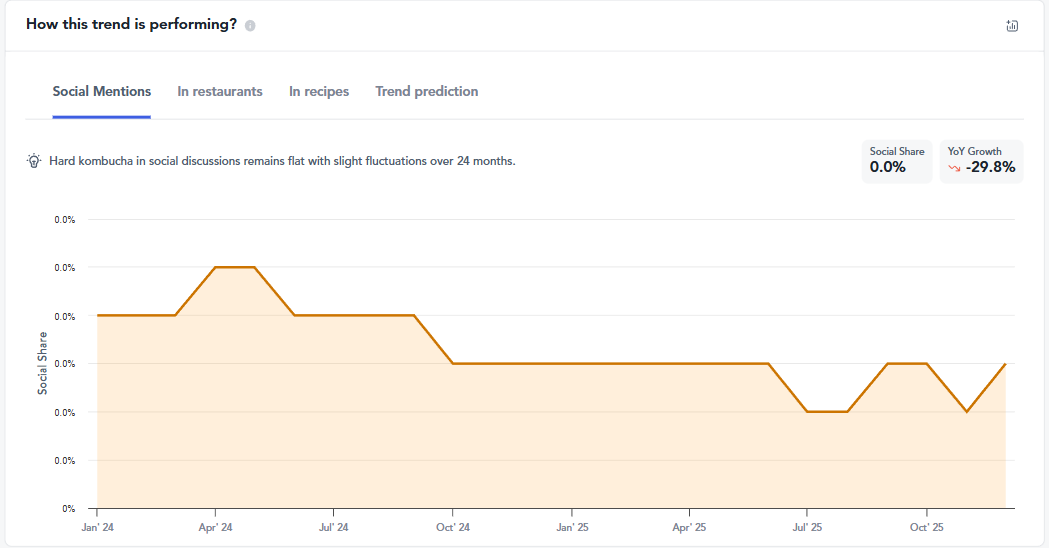
Once framed as lighter, functional, or lifestyle-aligned, several alcohol formats are now declining sharply in social discussion:
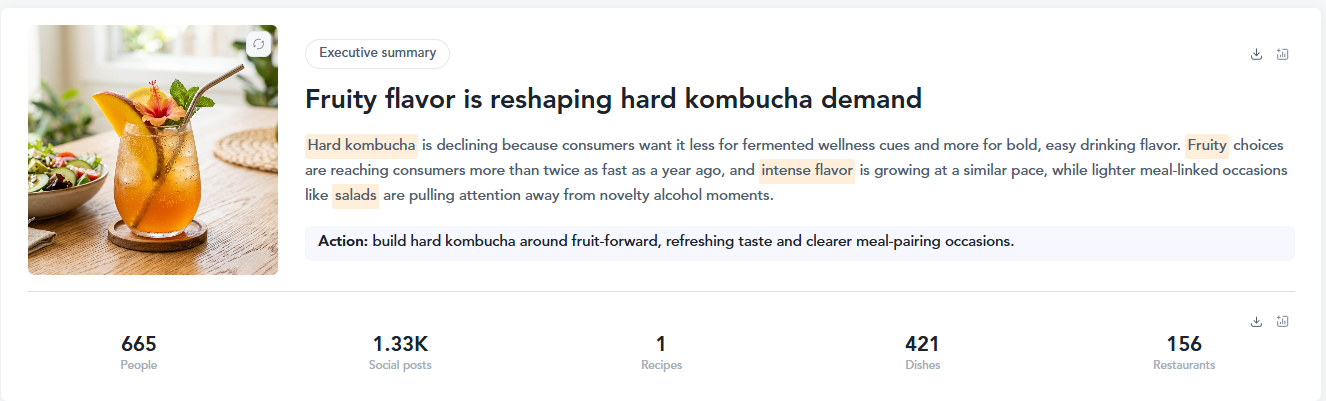
- Hard kombucha: 0% share, -29.8% YoY
- Hard tea: 0.01% share, -33.79% YoY
- Hard seltzer: 0.02% share, -33.67% YoY
Contraction shows up in adjacent alcohol culture signals as well:
- Craft beer: 0.84% share, -16.52% YoY
- IPA beer (generic): 0.38% share, -17.28% YoY
Products relying on a “better-for-you drinking” narrative are losing attention. If you’re building 2026 campaigns here, reduce reliance on pseudo-functional claims and tighten to clear occasions, clear flavour payoffs, and fewer sub-format variants. This is one of the clearest declining food trends signals in the beverage space.
2. Viral pastry hacks are collapsing fast
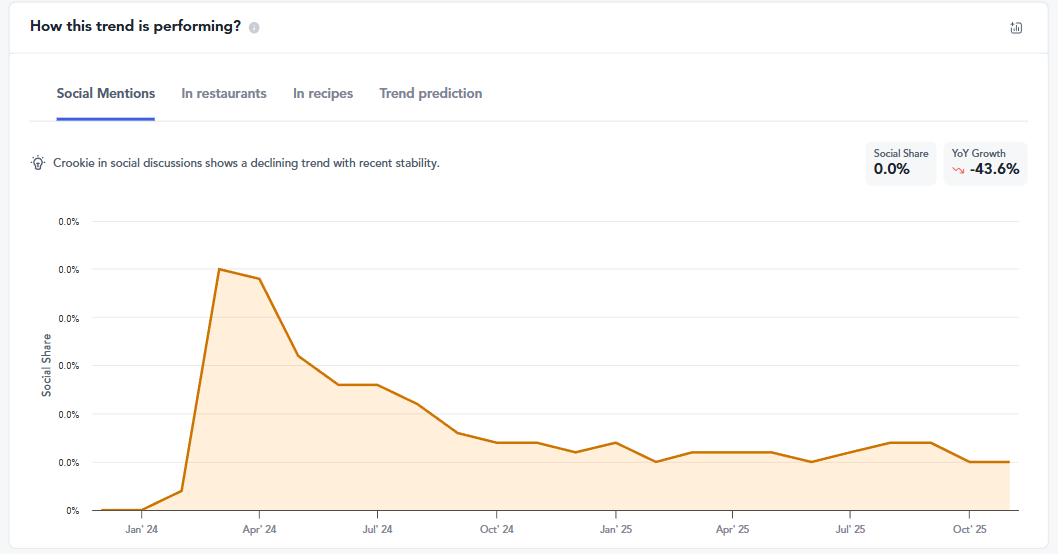
These are classic “peaked on social, failed to become a habit” formats. The decline is steep and broad across the cluster.
- Crookie: 0.01% share, -43.6% YoY
- Flat croissant: 0% share, -40.72% YoY
Related “internet snack” signals show the same pattern:
- Freeze-dried candy: 0.01% share, -51.38% YoY
Short-cycle novelty is aging out faster, especially when it requires extra steps, special ordering, or has no anchor beyond virality. If you want bakery innovation that lasts, prioritise repeatable formats with stable cues (portion, price logic, familiar base) rather than hybrid gimmicks.
In the data, these formats behave like outdated food trends because they peaked without converting into repeat behaviour. For many shoppers, they also start to register as the worst food trends once the novelty wears off.
3. Cannabis and CBD ingredients are in freefall
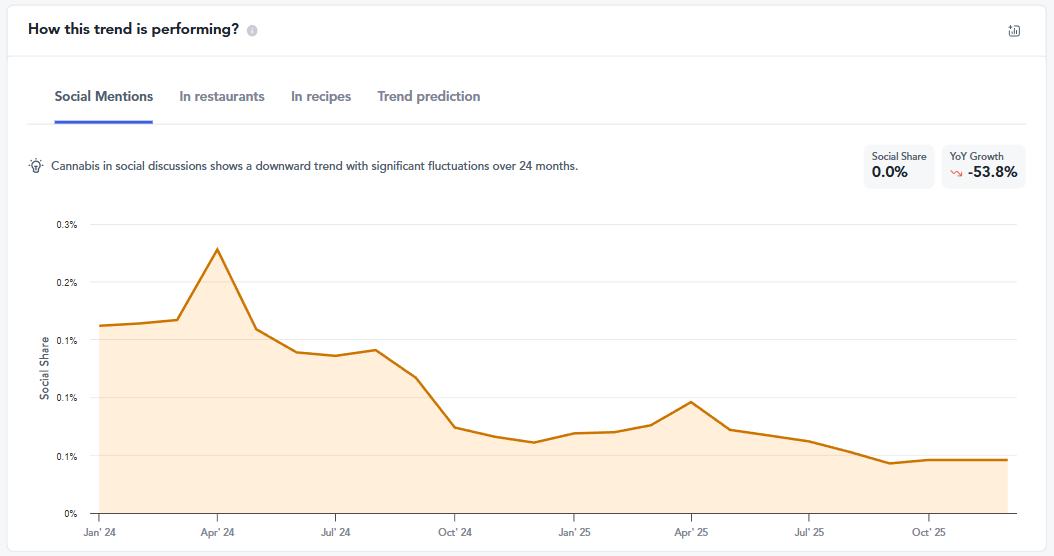
This is one of the cleanest decline stories in the data: sharp drops with limited remaining share.
- Cannabis: 0.12% share, -53.8% YoY
- CBD: 0.12% share, -49.23% YoY
- Terpenes: 0.01% share, -49.18% YoY
- THC: 0.03% share, -31.77% YoY
The “edible wellness add-on” era is losing relevance in mainstream conversation.
For 2026, treat cannabinoid callouts as a niche play, not a broad-based growth lever. If you’re keeping it in portfolio, test whether the benefit is legible and whether the format travels across channels without regulatory or shopper friction. This is one of the clearest food trends leaving mass relevance.
4. Process-coded wellness substitutions are losing oxygen
Several formerly “smart choice” formats are declining, especially those that read as engineered replacements rather than naturally functional.
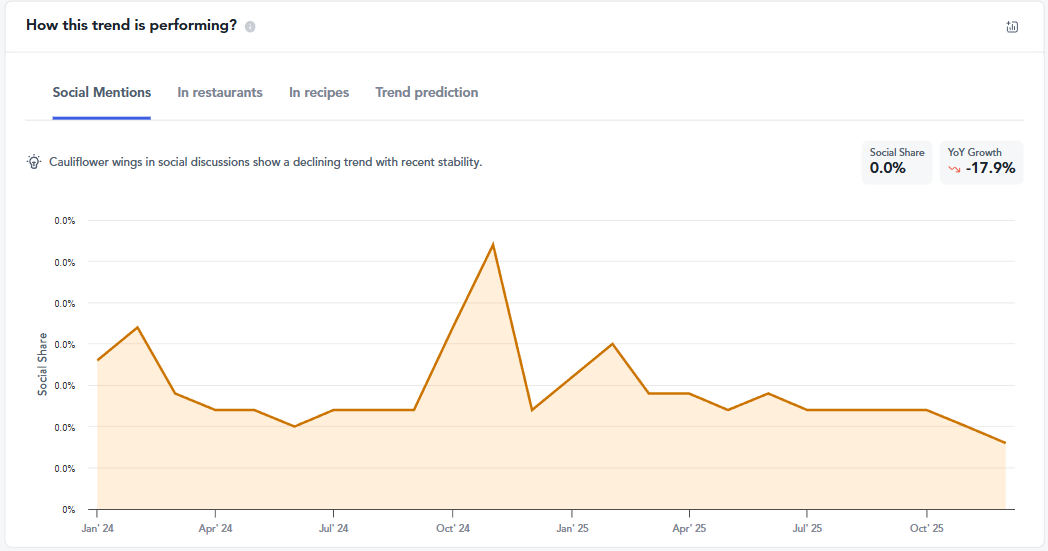
- Cauliflower wings: 0% share, 17.9% YoY
- Buddha bowl: 0.01% share, -30.95% YoY
- Vegan bowl: 0.01% share, -18.94% YoY
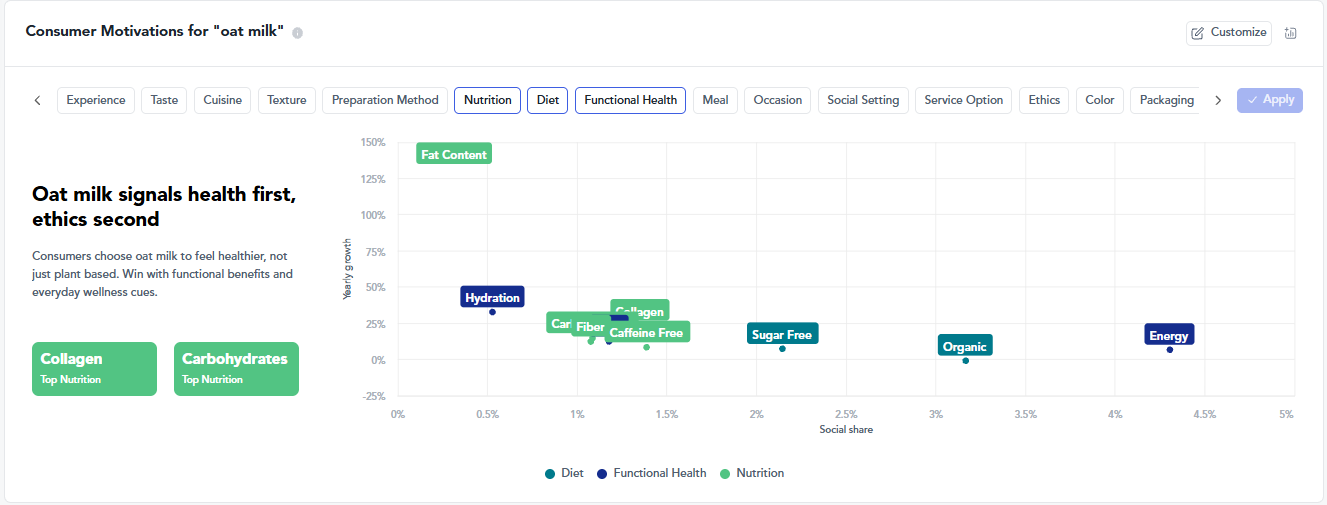
- Plant milk (ingredient): 0.14% share, -40.99% YoY
- Textured vegetable protein (ingredient): 0.01% share, -35.40% YoY
Consumers can still want health outcomes while rejecting “replacement eating” language. The sharper drops are where the format feels like a workaround.
In 2026, audit product copy, menu naming and planning, and hero ingredients for signals that read as engineered or compensatory. These patterns show up across multiple declining food trends tied to replacement positioning.
5. Oils and “industrial ingredient” narratives are weakening for mainstream options
Multiple widely used oils are declining in social discussion, suggesting resistance to industrial-coded inputs.
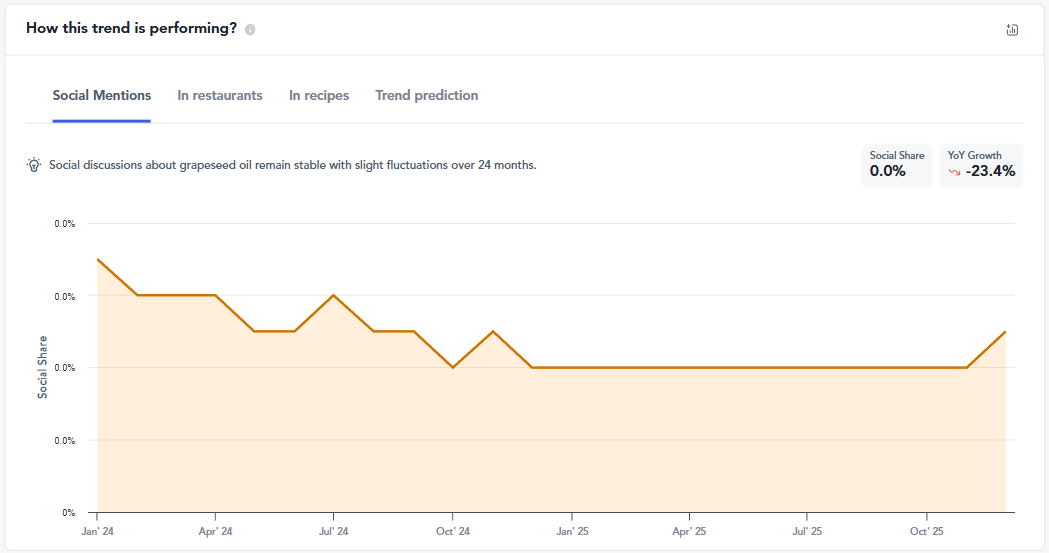
- Grapeseed oil: 0% share, -23.4% YoY
- Soybean oil: 0% share, -21.65% YoY
- Sunflower oil: 0.01% share, -18.75% YoY
Attention is moving toward cleaner-label signals, simpler ingredient lists, and fats that support premium or “real food” positioning.
This is less about removing oil everywhere and more about where oil choice is visible to the consumer and used as a quality cue. These changes often sit behind outdated food trends conversations as ingredient perception changes. They also show up in worst food trends lists when “industrial-coded” inputs become the headline.
Understanding food trend decline: definitions and framework
Understanding food trend decline is a structured method for categorising the rate at which consumer interest in a food or beverage format drops over time, and it matters because brands that misread the severity of that drop tend to over-invest in formats already past recovery.
Not all declines look alike. The difference between a temporary dip and category-wide obsolescence is measurable, and treating them the same way costs budget and launch windows. According to Tastewise consumer intelligence data, the formats covered in this article sit at the steeper end of the decline spectrum, but the framework below applies across any category signal you are tracking.
Decline severity glossary
The following definitions use annualised social discussion decline as the primary signal, cross-referenced against remaining share. Use these as decision thresholds, not hard rules.
- Temporary dip: less than 5% decline in the past 12 months. Usually tied to a seasonal cycle, a news event, or a single-format contraction within a healthy category. Hold your position and monitor.
- Fading trend: 5% to 15% decline in the past 12 months. Consumer interest is softening but the format still has share. Reduce investment in new development; protect existing SKUs with stronger occasion anchors.
- Declining trend: more than 15% decline in the past 12 months. Consumer attention is actively rotating away. Audit your portfolio exposure, tighten marketing to high-intent audiences, and redirect innovation budgets.
- Trend death: near-zero remaining share with steep annual decline. The format has left mainstream conversation. Exit or reposition entirely before the category association becomes a liability.
Hard kombucha (down 29.8% in the past 12 months), freeze-dried candy (down 51.38%), and CBD (down 49.23%) all sit in the declining or trend-death tier by this framework. That classification changes what your team does next.
The five-stage trend lifecycle
Most food formats follow a recognisable arc. Knowing where a format sits tells you whether you are catching a wave or paddling behind it.
- Emergence: early social signal growth, limited distribution, driven by indie operators and food-forward consumers. High risk, high potential.
- Growth: mainstream media coverage, retail ranging begins, category competitors entering. This is where the white space closes fastest.
- Peak: broadest distribution and discussion share. Innovation investment is highest here, but the window for differentiation is narrowing.
- Decline: social discussion falls, shelf resets reduce facing counts, promotional spend required to maintain velocity. New entrants stop launching.
- Obsolescence: format exits mainstream conversation. Remaining volume consolidates into private label or deep-discount positioning.
Hard seltzer is a clean example of a format moving from peak into decline: broad distribution is still in place, but According to Tastewise consumer intelligence data, social discussion is down 33.67% in the past 12 months, and adjacent craft beer signals are declining alongside it, which means the contraction is structural rather than format-specific.
Key decline indicators to track
Social discussion decline rate is the leading indicator, but it reads most clearly alongside three supporting signals.
First, engagement quality. A format can lose volume but retain a highly engaged niche. If the discussion that remains is conversion-oriented rather than curiosity-driven, the format may be contracting to a loyal core rather than dying outright. Second, retail placement data. When ranging decisions and facing counts start to follow the social signal down, the decline is confirmed at the shelf level. Third, search volume trends. Sustained drops in organic search interest confirm that consumer intent, not just content creation, is contracting. When all four indicators move together, you are looking at structural decline. When only one or two move, investigate before repositioning.
Rising versus declining food trends: a direct comparison
The clearest way to calibrate any declining signal is to set it next to a format that is growing in the same macro category.
| Declining format | Decline (past 12 months) | Rising format | Growth (past 12 months) |
|---|---|---|---|
| Hard seltzer | -33.67% | Functional soda | +27.74% |
| CBD | -49.23% | Refresher drinks | +47.59% |
| Plant milk | -40.99% | Chicken cutlet formats | +31.64% |
| Cauliflower wings | -17.9% | Chicken and waffles | +46.65% |
| Freeze-dried candy | -51.38% | Cola and nostalgic soda formats | +42.7% |
The pattern across every row is the same. Consumer appetite for the underlying need (refreshment, wellness, indulgence) has not disappeared. The format that used to carry that need has been displaced by a newer one. Your innovation pipeline should be tracking the right column, not defending the left one. Platforms built for food intelligence analysis surface this comparison automatically, which shortens the time between signal and decision.
Real-world applications: how food brands navigate declining trends
Real-world applications of decline data are the practical methods CPG brands, restaurant operators, and foodservice teams use to redirect budget, reformulate products, and reframe narratives before a declining format affects revenue targets.
Data on its own does not make a decision. What makes it useful is a repeatable process for translating a decline signal into a specific action at the right stage of the decline curve. The five-step framework below is built for that.
A five-step framework for exiting a declining trend
Step 1: Confirm the signal is structural, not situational.
Check whether adjacent formats are declining alongside the one you are tracking. If they are, the decline is category-wide and your response needs to be more significant than a copy refresh. Hard tea, hard seltzer, and hard kombucha are all declining together, which means the “better-for-you alcohol” positioning itself has weakened, not just one SKU. That is a portfolio-level call, not a product-level one.
Step 2: Map your current exposure.
Audit which products, campaigns, and retail narratives are anchored to the declining format. Quantify the revenue exposure and the marketing investment currently tied to it. This step often reveals that the risk is more concentrated than it looked from the outside. Brands using product innovation pipelines built on live consumer data can run this audit in hours rather than weeks.
Step 3: Identify the rising format in the same macro category.
Every declining format has a consumer need underneath it. Find the format that is now carrying that need more effectively. This is where the next innovation brief starts. Consumers who drove hard seltzer’s peak are not leaving the better-for-you beverage space. They are moving toward functional sodas, electrolyte formats, and prebiotic drinks. Your job is to find where they went and whether you have a credible right to play there.
Step 4: Decide what to do with the existing line.
There are four options, and they are not mutually exclusive. You can maintain and harvest (reduce investment, extend the lifecycle through price efficiency), reposition (shift the narrative to an occasion or audience where the format still has traction), reformulate (add a functional claim or ingredient that connects the existing format to a growing consumer motivation), or exit (wind down distribution and redirect SKU slots and marketing budget to the replacement format). The right option depends on your remaining share, your distribution depth, and the competitive intensity of the rising format you are targeting.
Step 5: Build the new brief before you exit the old one.
Timing matters more than most brand teams account for. The best moment to brief a replacement concept is while the declining format still has enough shelf presence to fund the transition. If you wait until volume has collapsed, you lose the commercial headroom to invest in the new direction. According to Tastewise consumer intelligence data, the formats declining fastest in 2026 (cannabis ingredients, viral pastry formats, process-coded wellness substitutes) still have 12 to 18 months of shelf presence before the exit window closes for most mainstream operators. That is your runway.
What a decline pivot looks like in practice
The framework is easiest to see when you follow a displaced need to where it resurfaces. Better-for-you alcohol is the cleanest case. Hard seltzer discussion has fallen 33.67% in the past 12 months, while functional soda has grown 27.74% across the same window. The refreshment-with-benefit need did not disappear. It relocated.
Brands that read that migration early briefed functional and prebiotic concepts while their seltzer lines still funded the work. Brands that held the format leaned on promotion to defend velocity, which protects volume for a quarter but rarely rebuilds the occasion. The difference is timing, and timing is a budget decision. A declining line absorbs more promotional support each cycle just to hold facings, so capping that spend early frees the resource to fund the replacement from existing volume rather than fresh investment.
Industry-specific considerations
The five steps above apply across channels, but the decision weight varies by sector.
For CPG brands, the highest-stakes decision is usually Step 4, because SKU exits carry distributor and retailer relationship costs that extend well beyond the product itself. Brands that have built their sell-in story on a format now in decline need to rebuild the narrative before the next range review. A strong consumer marketing brief built around the rising format, not the declining one, gives your retail buyer a reason to reallocate the facing rather than simply delist.
For restaurant operators and foodservice teams, the leverage point is usually in Steps 1 and 3. Menu items tied to declining ingredient narratives (plant milk, cauliflower-based proteins, CBD add-ons) can be quietly rotated off the menu without the same distributor complexity that CPG teams face. The risk is leaving them on too long and having the menu read as dated to a food-forward guest. According to Tastewise consumer intelligence data, the formats declining fastest in casual dining are the ones that arrived on menus via a wellness positioning that no longer resonates with the guest’s current frame. Replacing them with formats that carry the same health intent through a more current lens is a lower-risk move than it appears.
For retail buyers and category managers, the most useful application is the comparison table above. A format in structural decline is not just a volume risk on your shelf. It is a space allocation decision. The question is not whether to reduce the facing count on hard seltzer, but which growing format earns that space, and what consumer evidence supports the story you tell your supplier at the next category review.
How to act on declining trend data
The decline signals in this article are live. They are not predictions about what might happen in 2026. They are descriptions of what is already in motion. Your team does not need to act on all of them at once, but three immediate applications are worth prioritising.
First, run a portfolio audit against the declining formats above. If your brand has active SKUs or live campaigns anchored to any of the formats in this article, quantify the exposure now. Second, identify your replacement format candidates. For each declining format you are exposed to, name the rising format in the same macro category and confirm whether you have a right to play there. Third, brief the rising format before you brief the exit. The innovation brief for the replacement should be in development before the divestment conversation begins, not after.
Brands that use food intelligence tools to track these signals continuously have a structural advantage here. They see the decline early enough to act in Step 2 rather than Step 4. If your team is still relying on annual trend reports to make these calls, you are consistently arriving at the decision one planning cycle too late.
FAQs about declining food trends
Declining food trends are formats, ingredients, or concepts losing attention and relevance, typically seen as negative YoY change and shrinking share of conversation. They often remain available, but stop driving discovery and trial. This is where food trends, leaving the cultural script show up first.
The strongest decline clusters include cannabis/CBD add-ons (cannabis -53.8% YoY, CBD -49.23% YoY), viral pastry hacks (crookie -43.6% YoY), and better-for-you alcohol formats (hard kombucha -29.8% YoY). These are food trends that won’t survive 2026 if the trajectory holds.
Often, yes. Outdated food trends usually describe concepts that peaked through novelty, then lost repeat behavior. Worst food trends tend to be the consumer label once the novelty wears off. The data pattern is low share plus sharp decline, like freeze-dried candy (0.01% share, -51.38% YoY). These are the fastest food trends leaving the conversation.
Most fail to convert from “shareable” to “repeatable.” If a format depends on novelty, extra steps, or special ordering, it often peaks and then contracts. Pastry hacks and novelty snacks are a clean example of declining food trends driven by short-cycle attention.
Not across the board. The declines are concentrated in replacement-coded formats and engineered substitutes: cauliflower wings (-17.9% YoY), buddha bowl (-30.95% YoY), plant milk (-40.99% YoY), textured vegetable protein (-35.40% YoY). These read as outdated food trends because the positioning no longer holds attention.
Check two things: the trend’s trajectory (YoY direction + share) and whether adjacent signals support it. If the core term and its cluster are both declining, you’re looking at food trends that won’t survive rather than a temporary dip.
A declining food trend shows more than 15% drop in consumer interest over the past 12 months alongside shrinking remaining share. A temporary dip is usually under 5% and tied to a seasonal cycle or isolated event rather than structural consumer rotation. The clearest confirmation of structural decline is when adjacent formats in the same macro category also contract, which rules out a one-term blip.
The signal to act is when social interest decline is confirmed by at least two supporting indicators: retail placement reduction, search volume contraction, or a declining engagement rate on existing content. According to Tastewise consumer intelligence data, brands that wait for all four indicators to align consistently miss the transition window and begin the pivot in Step 4 rather than Step 2 of the decision cycle.
The primary indicator is an annualised decline in consumer discussion of more than 15% with a share below 0.5%. Supporting indicators include reduced retail facings, lower organic search volume, and contraction in adjacent format signals. When hard seltzer, hard kombucha, and craft beer all decline together, the indicator is not one format’s underperformance but a category-level consumer rotation away from the positioning that united them.
Start by confirming the decline is structural, which means checking whether adjacent formats in the same macro category are contracting alongside it. If they are, the response is a portfolio decision, not a copy refresh: audit revenue exposure, name the rising format carrying the same consumer need, and brief the replacement while the declining line still has shelf presence to fund it. According to Tastewise consumer intelligence data, the fastest-declining 2026 formats still hold 12 to 18 months of runway, which is the window to move.
A fading trend is declining 5% to 15% in the past 12 months and still holds meaningful share, so the move is to reduce new development while protecting existing lines with stronger occasion anchors. An obsolete trend has fallen close to zero remaining share and has left mainstream conversation, so the move is to exit or reposition before the association becomes a liability. Freeze-dried candy, down 51.38% with 0.01% share, sits at the obsolete end. Craft beer, down 16.52% with 0.84% share, is fading rather than gone.




We’d love to learn your goals and see how Tastewise fits
We’d love to learn your goals and see how Tastewise fits
Get a personalized demo
Good taste. Wise move.
Your demo request is confirmed. We’ll reach out within one business day to schedule your walkthrough.
What happens next

See what’s driving demand, then turn it into a sell-in story for retailers and operators.
- Connect consumer panels, market trackers, and agents into one evidence view
- Get the “why” behind what’s changing, with explainable demand drivers
- Walk away with a buyer-ready narrative and next steps to activate
Trusted by





“Tastewise is my secret tool for knowing what consumers want next and why.“