
Business
Navigating Consumer Flavor Trends in Latin America for 2026


US eaters are getting specific about Latin American food. Consumer flavor trends in Latin America, as they reach US plates and feeds, now point to named regions and home-style dishes over generic heat. Across Tastewise US social, recipe and menu data for the past 12 months, buzz around Latin American food tagged Tex Mex fell 21%. Buzz tagged authentic rose 15% over the same window.
That shift matters if you build flavors for a living. Tastewise reads social posts, recipes and restaurant menus as they appear online, which gives your team an earlier read than a quarterly sales report. Growth figures in this guide track that online buzz across food flavor trends in Latin America, a leading signal of interest.
Key takeaways
- Sazón and sancocho rank in the top 2% for growth among the roughly 600 most-discussed Latin American food and drink terms in Tastewise US data.
- Aguachile ranks in the top 2% for growth, while ceviche sits in the bottom quarter. Chile-lime seafood is gaining on the classic.
- Buzz around Panamanian food grew 27%, Argentinian 15% and Puerto Rican 14%, while Mexican held flat.
- Buzz tagged spicy fell 13%, while sweet and spicy rose 15%. Heat now needs a partner flavor.
- Health framing is fading for this cuisine. Buzz tagged healthy and vegan each fell 29%, and plant based fell 33%.
- Chains are acting on it, from Wingstop’s June 2026 Sweet Heat Chamoy featuring Tajín to Chipotle’s Chicken al Pastor return.
What are the latest flavor trends in Latin America for 2026?
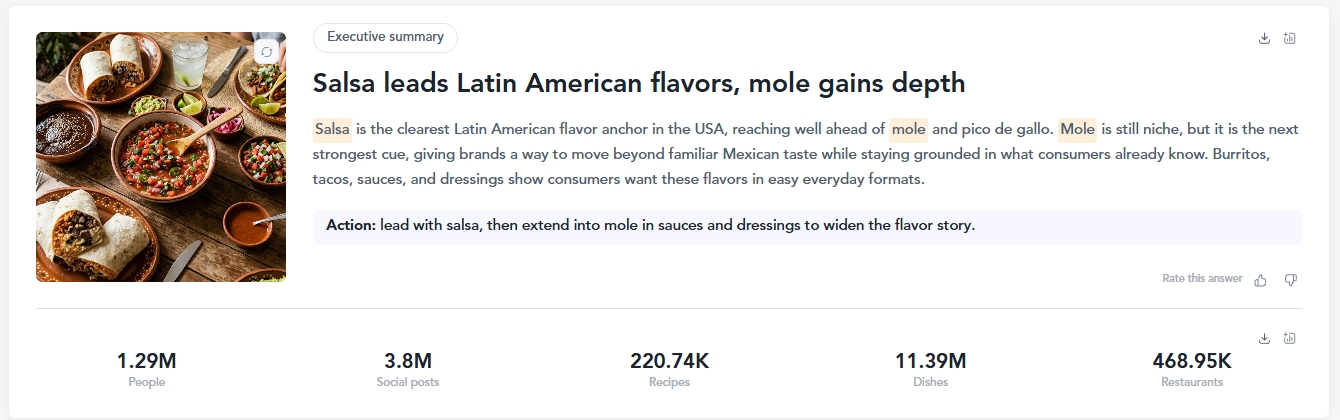
The latest flavor trends in Latin America for 2026 center on regional home cooking, bright seafood and chile-lime heat with a sweet edge. In Tastewise US data, Puerto Rican sazón, sancocho and Mexican aguachile sit among the fastest-rising terms, while broad Tex Mex staples cool.
Staples like nachos, guacamole and tortillas all sit in the declining stage of the Tastewise lifecycle model.
The rise of hyper-regional ingredients and smoky fusions
Caribbean home cooking leads. Sazón, the seasoning blend behind Puerto Rican rice and stews, ranks in the top 1% for growth. Sofrito sits in the top 6%. Pernil and coquito, the roast pork and coconut eggnog of a Puerto Rican holiday table, both rank in the top 3%. Sancocho, the root vegetable stew cooked across Colombia, Panama and the Caribbean, sits in the top 2%.
Mexico’s momentum has moved to the coast and the griddle. Aguachile, shrimp cured in lime and chile, ranks in the top 2%. Milanesa sits in the top 2% as well, and Oaxaca cheese ranks in the top 4%. South America brings the grill: churrasco lands in the top 5%, picanha in the top 7% and chimichurri in the top 9%.
On technique, buzz tagged charred rose 14% while smoky held flat, so char is the cue to lean on. Some famous names are cooling. Mole and açaí both sit below the median for growth. Treat them as familiar anchors and pair them with a rising partner flavor.
Leveraging Tastewise AI data for flavor discovery
Tastewise reads US social posts, home recipes and restaurant menus together. It then assigns every food term a lifecycle stage, from early and emerging through trending, mature and declining. That separates a lasting shift from a spike.
Birria shows how it works. It still carries more volume than most Latin American dishes, yet it now sits in the declining stage. Aguachile shows the opposite pattern, a mature dish that is still gaining ground. AI agents can run the same check on any flavor before a line review.
What spices and ingredients are trending in Latin American cuisine?

Chile-lime seasoning like Tajín, guava, hibiscus and guajillo chile lead the rising spice and ingredient set, alongside sazón and sofrito. US consumers want heat balanced by fruit, acid or a touch of sweetness.
Across Tastewise US social and menu data, Tajín ranks in the top 12% for growth. Guava sits in the top 17%, hibiscus in the top 20% and guajillo in the top quarter. Passion fruit sits in the bottom quarter, chamoy in the bottom third and dulce de leche in the bottom 5%.
The claims around the food explain the pattern. Buzz tagged fresh rose 23% and intense flavor rose 15%. Traditional rose 8%, family rose 9% and celebration rose 10%. People want bold, fresh and rooted food to share.
Deconstructing the sweltering heat and sweet balance need state
Straight heat is cooling and partner flavors are doing the work. Salty rose 10% and savory rose 7%, while tangy dipped 9% and sour dipped 5%. Salt is pulling ahead of sourness as the balance for chile.
The drinks tell the same story. Michelada ranks in the top 4% for growth, aguas frescas in the top 5% and mangonada in the top 6%. Spirit-forward drinks are cooling, with mezcal and the pisco sour both in the bottom 3%.
Wingstop turned this need state into a national LTO. Its Sweet Heat Chamoy featuring Tajín launched nationwide on June 30, 2026. It pairs a chamoy dry rub with a Tajín Chamoy drizzle and adds a Chamoy Ranch dip. The flavor runs across wings, tenders, fries and corn.
Why is understanding flavor trends important for the food industry?
Understanding flavor trends helps food companies pick the right flavor, format and timing before competitors move. It helps shorten R&D cycles and gives sales teams evidence that buyers trust.
The payoff shows up in LTO performance. In coverage of Chipotle’s 2026 menu, the chain said Chicken al Pastor drew more than twice as many return requests on social media as any other limited-time item in its history. It also found that guests who buy an LTO tend to spend more over the year.
How can companies adapt to changing consumer flavor preferences?
For CPG teams, move chile-lime seasoning onto new carriers. The growth behind Tajín supports rim salts, popcorn, fruit cups and seasoned nuts. Guava and hibiscus fit sparkling water, yogurt and frozen bars, where fruit carries a gentle heat.
For foodservice operators, aguachile is a ready summer LTO for seafood and fast casual menus. Pernil sandwiches and coquito fit the holiday window. Plan spring menus early, since buzz tagged Cinco de Mayo rose 23%. The summer food trends report maps seasonal timing in more detail.
For marketing teams, lead with the region and the freshness, naming the island, country or city on the pack. Consumer segments then narrow the story to the shoppers most likely to try it.
Before you commit, ask five questions:
- Which region does this flavor come from, and can we name it?
- Is the ingredient rising or declining in its lifecycle stage?
- Which partner flavor balances the heat: fruit, salt or lime?
- Does it travel across more than one menu item or SKU?
- Which season or occasion gives it the strongest launch window?
What innovative products are being launched based on Latin American flavors?
Chipotle brought back Chicken al Pastor in February 2026, built on adobo, morita peppers, achiote and pineapple. It also debuted in a High Protein Cup. Wingstop’s Chamoy Ranch shows how a familiar dip can carry a new flavor.
Hot sauces can build on guajillo and chile-lime blends. Savory RTD cocktails fit the michelada and paloma, both sessionable and salt-led. Infused dairy can lean on Oaxaca cheese and chamoy-style drizzles. Snack bars and fruit snacks can pair guava with a light chile finish. Product innovation teams can test each idea against live demand first.
How CPG, foodservice and marketing teams can use Latin American flavor trends
The scenarios below show how a team could act on consumer flavor trends in Latin America. They are illustrative, not case studies of named clients, and every figure comes from the Tastewise US data in this guide.
For CPG innovation teams: building on chile-lime momentum
You need to pick one Latin American flavor to take to a category buyer, and buyers are wary of trend-led pitches. The data narrows the choice. Tajín ranks in the top 12% for growth across Tastewise US social and menu data, while chamoy sits in the bottom third. Chile-lime seasoning is the flavor with momentum, not the sauce format around it.
Move chile-lime onto carriers your range does not cover yet: rim salts, seasoned popcorn, fruit cups and seasoned nuts. For a fruit-led line, guava ranks in the top 17% and hibiscus in the top 20%, which suits sparkling water, yogurt and frozen bars with a gentle heat. You walk into the line review with a ranked flavor choice and a sell-in story for retailers built on demand, not a hunch.
For foodservice operators: timing a Latin American LTO
Your LTO slots are fixed, and a flavor without momentum wastes one. Aguachile ranks in the top 2% for growth while ceviche sits in the bottom quarter, so chile-lime seafood is gaining on the classic. Pernil and coquito both rank in the top 3%, and buzz tagged Cinco de Mayo rose 23%.
Slot aguachile as a summer LTO on seafood or fast casual menus. Hold pernil sandwiches and coquito for the holiday window, and plan spring menus early around Cinco de Mayo. An LTO calendar helps you line each flavor up with its window. The precedent is strong: Chipotle said Chicken al Pastor drew more than twice as many return requests on social media as any other limited-time item in its history.
For marketing and brand teams: naming the region
A generic “Latin” or “Mexican-style” label no longer sets a product apart. Buzz tagged Tex Mex fell 21% while authentic rose 15%. Panamanian food grew 27%, Argentinian 15% and Puerto Rican 14%, while Mexican held flat.
Name the island, country or city on pack and in your brand campaign planning. Lead with freshness, tradition and sharing rather than health, since fresh rose 23% while healthy and vegan each fell 29%. Tie the story to an occasion, such as a holiday table or a summer gathering. Your message then matches what people already value in this cuisine, and the region does the differentiating.
Next steps for Latin American flavor trends

The opportunity in 2026 sits in named regions, bright acid and balanced heat. Start with one rising ingredient, pair it with a familiar format and time it to a real occasion. The 2027 food trends forecast shows where these signals head next.
Which Latin American flavor is your team testing this year?
FAQs about consumer flavor trends in Latin America
US eaters are moving from generic Tex Mex toward named regions and home-style dishes. Across Tastewise US social, recipe and menu data for the past 12 months, buzz tagged Tex Mex fell 21% while buzz tagged authentic rose 15%.
The claims rising alongside it show what people value now: fresh rose 23%, intense flavor 15%, family 9% and traditional 8%. Staples like nachos, guacamole and tortillas sit in the declining lifecycle stage, while Puerto Rican sazón, sancocho and Mexican aguachile rank among the fastest-rising terms.
Panamanian food leads, with buzz up 27% over the past 12 months. Argentinian grew 15% and Puerto Rican 14%, while Mexican held flat.
At ingredient level, Caribbean home cooking leads. Sazón ranks in the top 1% for growth, sancocho in the top 2%, and pernil and coquito in the top 3%. South America brings the grill, with churrasco in the top 5% and picanha in the top 7%.
Tastewise is the proactive AI food and beverage intelligence system that delivers before you ask. For this guide, it read US social posts, home recipes and restaurant menus together, then assigned every food term a lifecycle stage: early, emerging, trending, mature or declining.
Lifecycle stage separates a lasting shift from a short spike. Growth figures track online buzz over the past 12 months, a leading signal of interest rather than a measure of sales. Rankings such as “top 2% for growth” place a term among the roughly 600 most-discussed Latin American food and drink terms in Tastewise US data.
Both are raw seafood cured in acid. Ceviche is fish or seafood marinated in citrus juice, usually with onion, chile and cilantro, and is most closely tied to Peru. Aguachile comes from Sinaloa in northwest Mexico. It is shrimp cured in lime and chile, served soon after mixing in a bright, spicy liquid.
In Tastewise US data, aguachile ranks in the top 2% for growth while ceviche sits in the bottom quarter. Growth rank measures momentum, not which dish is bigger today. Aguachile is a mature dish that is still gaining ground, so chile-lime seafood is pulling ahead of the classic.
Chile-lime seasoning, guava, hibiscus and guajillo chile carry the most momentum. Tajín ranks in the top 12% for growth, guava in the top 17%, hibiscus in the top 20% and guajillo in the top quarter.
Chile-lime suits rim salts, popcorn, fruit cups and seasoned nuts. Guava and hibiscus suit sparkling water, yogurt and frozen bars with a gentle heat. Be more cautious with passion fruit, chamoy and dulce de leche, which sit in the bottom quarter, bottom third and bottom 5% for growth.
Buzz tagged healthy and vegan each fell 29% over the past 12 months, and plant based fell 33%. The data shows the shift, not a single cause.
What rises in their place is telling. Fresh rose 23%, intense flavor 15%, celebration 10%, family 9% and traditional 8%. For this cuisine, people want bold, fresh and rooted food to share, so region and tradition give your product more pull than a health claim.
Sources cited in this article
- coverage of Chipotle’s 2026 menu newsweek.com
Cite this article
Reinoso, K. L. (2026). Navigating Consumer Flavor Trends in Latin America for 2026. Tastewise. https://tastewise.io/blog/consumer-flavor-trends-in-latin-america. Updated 9 Nov 2026