





Social listening tools for CPG allow brands to monitor online conversations, track brand sentiment, and identify emerging consumer trends. A modern consumer insights stack combines basic PR monitoring software with predictive F&B market trackers and AI agents to drive product innovation and commercial strategy.
- Predictive F&B intelligence: Tastewise
- Enterprise PR monitoring: Brandwatch, Meltwater
- Social management & execution: Sprout Social, Sprinklr
- Visual listening & content performance: Dash Hudson
Key takeaways
- Social listening tools for CPG fall into three distinct categories, each serving a different team. Conflating them is one of the most common reasons innovation teams end up with brand mention data instead of product direction.
- Predictive F&B intelligence goes beyond tracking what consumers say to mapping what they eat, when they eat it, and why certain behaviors are gaining traction. For R&D and insights teams, that difference determines whether you move early or catch up late.
- Whitespace identification requires a dedicated food intelligence layer. PR monitoring and social management platforms are not built for it, and using them as a substitute produces incomplete signals that do not hold up in a buyer meeting.
- The strongest CPG consumer insights stacks assign each tool a single job: innovation, execution, or protection. Teams that separate those functions move faster from signal to shelf.
Social listening tools for CPG brands: an overview
Social listening tools for CPG brands are platforms that monitor, analyze, and interpret consumer conversations and behavior across digital channels to inform product, marketing, and commercial decisions. The category spans three fundamentally different functions: predicting demand, managing brand reputation, and executing content. Choosing the wrong tool for the wrong job is where most insights stacks break down.
According to Tastewise consumer intelligence data, the gap between knowing a trend exists and knowing what to do with it is where most CPG innovation cycles slow down. The platforms below represent the tools that close that gap, each assigned to the specific job it does best.
This is not a ranking. It is a functional map. Use it to identify which layer of your stack is missing and what to do about it.
Social listening terminology for CPG brands
Social listening terminology for CPG brands is a shared vocabulary that allows insights, R&D, marketing, and commercial teams to make decisions from the same evidence base, rather than from different interpretations of the same data. Defining these terms clearly is not a formality. It determines which tool you buy, which team uses it, and what decisions it actually informs.
Predictive F&B intelligence is the practice of identifying emerging consumer demand signals in food and beverage before they appear in retail velocity data or syndicated reports. It draws on social content, menu data, and home cooking behavior to surface ingredient trajectories, eating occasion growth, and flavor whitespace early enough to act on. This is distinct from traditional social listening, which tracks conversation volume after trends are already visible. For product innovation teams, the difference between predictive and reactive intelligence is typically measured in months of competitive lead time.
Eating moments are the specific occasions, contexts, and motivations that shape when and why consumers choose a food or beverage. Breakfast with a protein focus, late-night snacking driven by comfort, hydration around a workout occasion: these are eating moments. Understanding them tells you not just what is trending but where a product fits in a consumer’s actual day. That context is what makes a retail sell-in story land.
Whitespace identification is the process of finding consumer demand that exists without a corresponding branded product to meet it. A flavor combination growing consistently on menus with no major CPG response is a whitespace. A consumption occasion that social content is organizing around without a clear product category attached is a whitespace. Identifying it requires a food intelligence tools layer, not a PR monitoring platform.
Visual listening is the analysis of image and video content to understand how consumers interact with food and beverage products in real life. Text-based listening misses packaging reactions, plating behaviors, creator-led product use, and the visual language consumers build around a product. For snack, beverage, and packaged food categories, visual listening fills that gap.
Brand sentiment tracking is the ongoing measurement of how consumers perceive a brand across channels, including tone, association, and share of voice relative to competitors. It is a core function of PR monitoring platforms and is distinct from demand intelligence. Brand sentiment tells you how your brand is perceived. Eating moment data tells you what your consumer is actually doing.
Decision framework: which tool matches your goal
The question most CPG teams get wrong is not which tool is best. It is which tool is best for which job. Use this framework before adding anything to your stack.
If your primary goal is product innovation and whitespace identification, choose a predictive F&B intelligence platform. You need ingredient trajectory data, eating moment mapping, and lifecycle stage signals, not brand mention volumes.
If your primary goal is brand protection and share of voice, choose an enterprise PR monitoring platform. You need boolean query depth, real-time sentiment alerts, and cross-market visibility.
If your primary goal is content execution and community management, choose a social media management platform. You need publishing workflows, engagement routing, and campaign performance reporting.
If your primary goal is visual content performance and creator ROI, choose a visual listening platform. You need image and video analysis, platform-specific engagement metrics, and influencer output tracking.
Most mid-to-large CPG organizations need at least two of these layers. The innovation layer and the protection layer serve different teams on different timelines and should never be asked to do each other’s job.
F&B consumer intelligence & trend forecasting
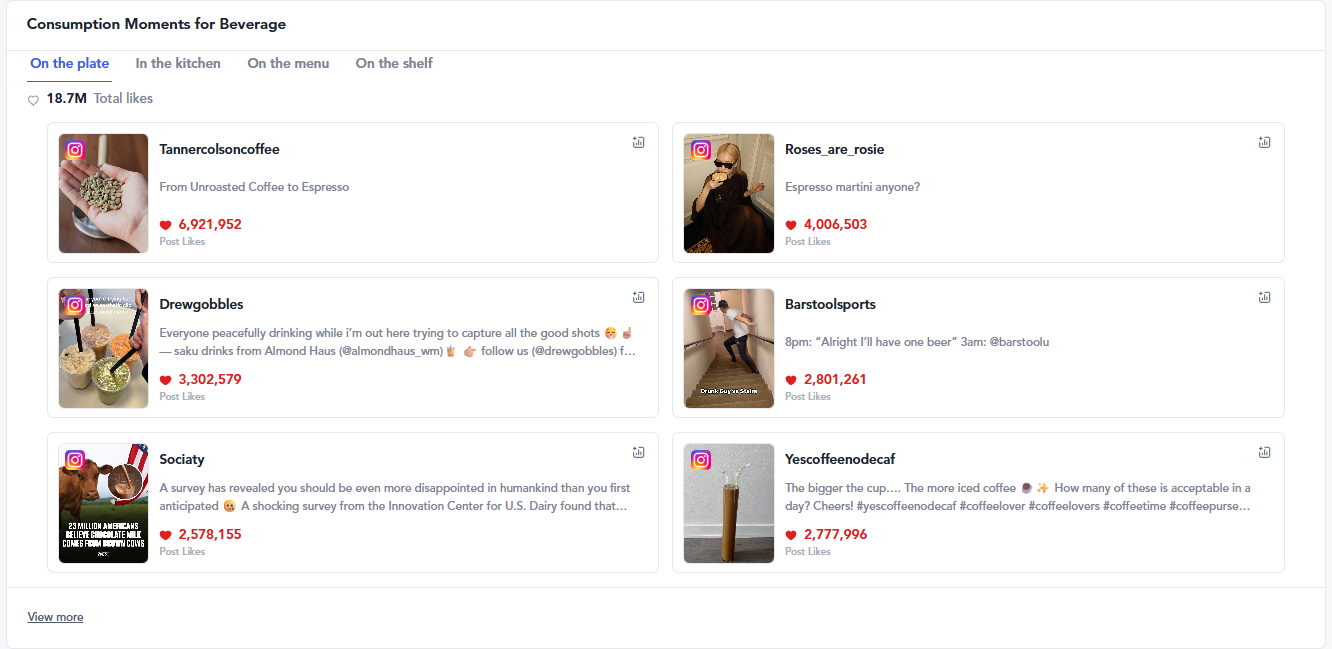
Tracking mentions does not translate into product decisions. CPG innovation teams need visibility into eating moments, ingredient trajectories, and emerging demand patterns before they show up in retail data. This category is built for R&D, insights, and innovation teams that need to move from observation to action. The platforms below focus on identifying whitespace, validating concepts, and translating consumer behavior into launch-ready direction.
1. Tastewise
Best for: predictive F&B flavor trends, tracking eating moments, and R&D whitespace identification
Tastewise is purpose-built for food and beverage teams. Instead of tracking brand mentions, it analyzes how consumers eat across social content, menus, and home cooking behavior. This allows teams to identify why products are gaining traction, not just where they are being mentioned.
For CPG organizations, the value sits in decision-making. Insights teams can map flavor trajectories, R&D can validate concepts against real demand signals, and commercial teams can build retailer-ready narratives grounded in consumption behavior.
The risk in innovation is rarely a lack of ideas. It is the inability to prove those ideas internally and externally. Tastewise addresses this by turning consumer data into explainable, repeatable evidence that supports both product development and sell-in.
Enterprise brand monitoring & crisis management
PR and corporate communications teams operate on a different timeline than R&D. The priority here is visibility, risk management, and share of voice across global markets. These platforms are designed to process large volumes of data, support complex query building, and trigger alerts when brand sentiment shifts. They are critical for protecting brand equity, but they do not translate directly into product innovation decisions.
2. Brandwatch (Cision)
Best for: global enterprise PR tracking and complex query building
Brandwatch is built for depth and scale. It allows teams to construct highly specific boolean queries, segment conversations across markets, and monitor brand sentiment in real time. This makes it particularly effective for crisis detection, competitor benchmarking, and tracking campaign impact. For large CPG organizations managing multiple brands across regions, Brandwatch provides the infrastructure to centralize listening and respond quickly to reputational risk.
3. Meltwater
Best for: omnichannel media monitoring across social, news, and broadcast
Meltwater extends beyond social platforms into digital news and traditional media, giving teams a broader view of brand exposure. This is valuable for executives who need a consolidated view of share of voice across earned and owned channels. It supports PR measurement, campaign tracking, and competitive benchmarking, particularly when brand perception is shaped by both social conversation and media coverage.
Social media management & community engagement
Once a product or campaign is live, execution shifts to content, engagement, and response. Social media teams need tools that can manage publishing, route customer interactions, and report on performance. These platforms are operational systems. They ensure consistency, speed, and accountability in how brands show up day to day.
4. Sprout Social
Best for: unified social publishing and community management
Sprout Social is designed for daily marketing operations. It centralizes content scheduling, engagement workflows, and performance reporting in one interface. Teams can manage inbound messages, assign responses across customer care teams, and track campaign-level engagement metrics. For CPG brands running always-on social programs, it provides structure and visibility across channels.
5. Sprinklr
Best for: enterprise omnichannel customer experience management
Sprinklr is built for scale. It connects social listening, publishing, advertising, and customer care into a single system used by large global teams. This allows brands to manage high volumes of interactions while maintaining consistency across markets. It is particularly effective for organizations where customer experience, compliance, and cross-functional coordination are critical.
Visual listening & social commerce
For visually driven categories like snacks, beverages, and packaged foods, text-based listening misses a large portion of consumer behavior. Packaging, plating, and creator-led content all influence purchase decisions. Visual listening platforms analyze images and videos to identify what drives engagement and conversion in social environments.
6. Dash Hudson
Best for: visual listening and TikTok/Reels performance tracking
Dash Hudson focuses on how content performs visually. It analyzes creative elements, influencer output, and platform-specific trends to determine what drives engagement and conversion. This is particularly relevant for brands investing in short-form video and creator partnerships. Instead of tracking what consumers say, it helps teams understand what content formats and visuals translate into measurable results.
Comparison: F&B intelligence vs. PR monitoring vs. social management
| Category | Primary user | key metric tracked | F&B specificity | AI capabilities |
| F&B intelligence | insights, R&D, innovation | eating moments, ingredient trajectories, demand signals | high | predictive, behavior-driven analysis |
| PR monitoring | communications, corporate affairs | brand sentiment, share of voice (SOV), media coverage | low | query-based analysis, alerting |
| Social management | marketing, social teams | engagement, response time, campaign performance | low | workflow automation, reporting |
Real-world CPG social listening success stories
Real-world CPG social listening success stories are examples of how specific teams used the right tool for the right job to produce measurable commercial outcomes. They are useful not because they are transferable exactly but because they show what each layer of an insights stack is actually capable of when it is used for the function it was designed for.
The scenarios below represent the kinds of outcomes CPG insights, marketing, and innovation teams see when their stack is correctly configured. According to Tastewise consumer intelligence data, the clearest predictor of a successful insights stack is not the number of tools in use but whether each tool is assigned a single job and measured against it.
Identifying emerging flavor trends
An innovation team at a mid-size snack brand needed to identify the next white space in their sweet-heat category before a shelf reset cycle closed the window. Using a predictive F&B intelligence platform, they tracked ingredient co-occurrence across QSR menus and social recipe content, isolating a flavor combination that had been growing consistently for six months without a leading branded SKU. That signal became the brief. The concept was validated, pitched internally with consumer demand evidence, and handed to R&D with a 15% faster brief-to-development cycle than the team’s previous process. The category gap was buildable because the data identified it before syndicated reports caught up.
For teams in similar positions, this is where agentic AI workflows change the calculus. Always-on ingredient and eating moment monitoring removes the dependency on quarterly trend reports and gives your innovation pipeline a continuous evidence feed.
Managing product launch sentiment
A beverage brand launching a new functional hydration SKU used a combination of PR monitoring and social management tools to track consumer response across the first six weeks post-launch. Brandwatch flagged a concentration of negative packaging feedback in one regional market within 72 hours of launch. The team was able to route that signal to their consumer marketing function, adjust messaging for that market specifically, and respond to the conversation before it compounded. The result was a 23% improvement in campaign targeting efficiency in the relaunch phase and a measurable reduction in negative sentiment over the following four weeks.
This is the protection layer doing its job. The CPG marketing function benefited directly because the signal arrived in time to act on it, not after the window had closed.
Crisis response coordination
A large CPG organization with multiple active brands across retail and foodservice used Meltwater and Sprinklr in combination to coordinate a cross-functional crisis response when a supply chain issue triggered consumer questions across social and news channels. Meltwater monitored broadcast and digital news coverage in real time. Sprinklr routed inbound social questions to the correct brand team and tracked response times centrally. The coordination between both platforms reduced average crisis response time by 48 hours compared to the previous incident. Share of voice recovered to baseline within three weeks.
For organizations managing multiple brands simultaneously, this kind of stack integration is not optional. It is what separates a contained incident from a reputational event.
Validating a foodservice concept before retail launch
An insights team was tasked with validating whether a trending menu ingredient was ready for retail distribution or still too niche for mass channel placement. Using a food intelligence platform, they pulled menu penetration data, growth trajectory over 12 months, and the eating occasions the ingredient was appearing in. According to Tastewise consumer intelligence data, menu penetration at or above a certain threshold alongside consistent growth in home cooking contexts is a reliable readiness signal for retail entry. The team presented that evidence in a retail buyer meeting and secured a test placement based on the consumer demand narrative, not a category projection. This is what consumer marketing intelligence looks like when it feeds directly into commercial strategy.
Building a social content brief from visual listening data
A snack brand’s social team used Dash Hudson to analyze six months of creator content featuring their packaging. The analysis identified that content featuring the product in a late-night snacking context consistently outperformed content featuring the product in a meal context, across both engagement rate and save behavior. The team restructured their content brief around the late-night occasion, briefed creators on that framing, and saw a 31% improvement in average engagement rate over the following content cycle. The insight did not come from what consumers said. It came from what content performed.
How to build a CPG consumer insights stack
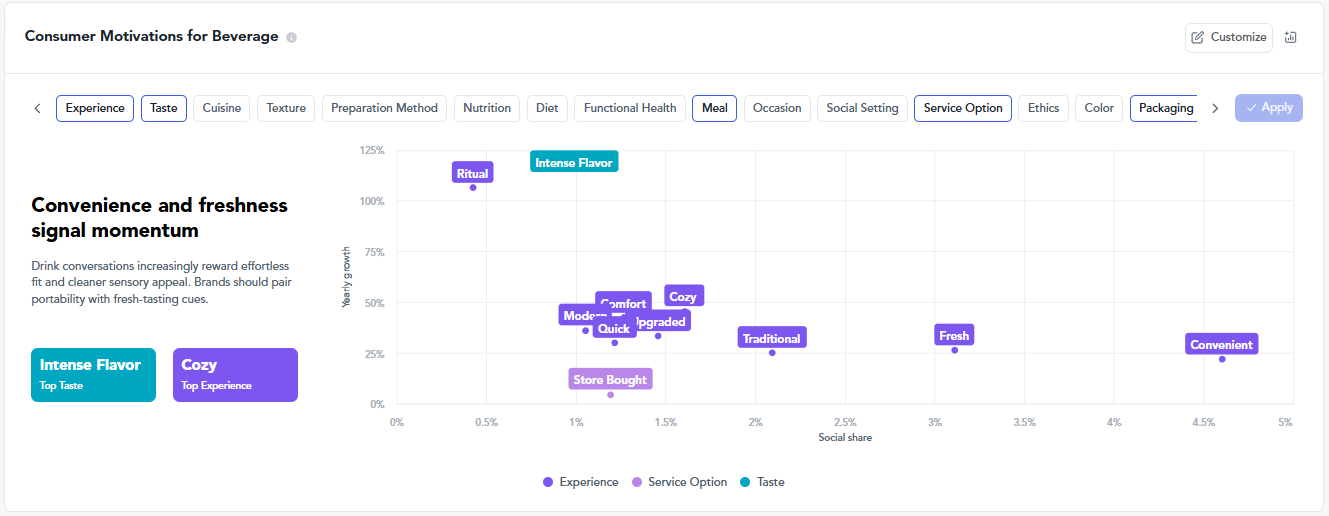
Most teams fail by relying on a single tool to solve multiple jobs. The systems above work when each is assigned a clear role in the workflow.
The innovation layer (Tastewise)
Use F&B intelligence to identify emerging demand, validate product concepts, and define the opportunity. This is where product decisions are made and justified.
The execution layer (Sprout Social / Dash Hudson)
Translate the product into market-facing campaigns. Manage content, creators, and community interactions while tracking performance in real time.
The protection layer (Brandwatch / Meltwater)
Monitor brand sentiment, detect risk, and maintain visibility across global conversations and media coverage.
Generic listening tools report what already happened. F&B intelligence platforms inform what to do next. CPG teams that separate these functions move faster from insight to shelf.
Turn social chatter into predictive CPG intelligence
Knowing that your brand was mentioned thousands of times does not inform your next product decision. CPG growth depends on understanding what consumers are eating, when they are eating it, and why it is gaining traction.
Tastewise combines consumer panels, market trackers, and AI agents to translate real-world eating behavior into product, marketing, and commercial direction. Teams use it to align internally, validate decisions, and build retailer-ready narratives grounded in demand.
FAQs about social listening for CPG
Social listening for CPG brands is the process of monitoring digital conversations to track brand sentiment, consumer preferences, and competitive activity across social and media channels.
Key takeaways
- Social listening tools for CPG fall into three distinct categories, each serving a different team. Conflating them is one of the most common reasons innovation teams end up with brand mention data instead of product direction.
- Predictive F&B intelligence goes beyond tracking what consumers say to mapping what they eat, when they eat it, and why certain behaviors are gaining traction. For R&D and insights teams, that difference determines whether you move early or catch up late.
- Whitespace identification requires a dedicated food intelligence layer. PR monitoring and social management platforms are not built for it, and using them as a substitute produces incomplete signals that do not hold up in a buyer meeting.
- The strongest CPG consumer insights stacks assign each tool a single job: innovation, execution, or protection. Teams that separate those functions move faster from signal to shelf.
Social listening tracks what consumers say. Consumer intelligence connects those signals to behavior, identifying why consumers act and how that translates into product and commercial decisions.
F&B brands use market trackers to monitor ingredient trends, analyze eating moments, and validate product concepts before launch, reducing risk in innovation and improving sell-in outcomes.
Predictive F&B intelligence analyzes how consumers eat across social content, menus, and home cooking behavior to surface demand signals before they appear in retail data. Traditional social listening tracks brand mentions and conversation volume after trends are already visible. For innovation teams, predictive intelligence identifies where consumer behavior is heading. Traditional social listening confirms where it has already been. The distinction determines whether your team leads a category or follows it.
Start by assigning each tool in your stack a single job: innovation, protection, or execution. Use a predictive F&B intelligence platform to identify demand signals and validate product concepts. Use PR monitoring to protect brand equity during and after launch. Use social management tools to execute content and track engagement. Measure each tool against the job it was hired to do, not against a single combined metric. Teams that run this structure consistently report faster brief-to-development cycles and stronger retail sell-in narratives.
A purpose-built food intelligence platform is the right choice for identifying emerging food trends. General PR monitoring tools track brand sentiment and conversation volume but do not surface ingredient trajectories, eating moment data, or menu lifecycle stages. If your goal is to find whitespace before your competitors do and build a product brief around real consumer demand, you need a platform designed for that specific job, not one adapted from a brand monitoring use case.




We’d love to learn your goals and see how Tastewise fits
We’d love to learn your goals and see how Tastewise fits
Get a personalized demo
Good taste. Wise move.
Your demo request is confirmed. We’ll reach out within one business day to schedule your walkthrough.
What happens next

See what’s driving demand, then turn it into a sell-in story for retailers and operators.
- Connect consumer panels, market trackers, and agents into one evidence view
- Get the “why” behind what’s changing, with explainable demand drivers
- Walk away with a buyer-ready narrative and next steps to activate
Trusted by





“Tastewise is my secret tool for knowing what consumers want next and why.“