






Most GPT tools feel strong in a demo environment. They respond quickly, structure ideas clearly, and handle a wide range of prompts. But that’s not the same as those GPT tools for food & beverage teams built specifically to answer questions and provide insight into the industry.
When applied to real business questions in food and beverage, gaps show up quickly:
- outputs lack connection to real market signals
- category nuance is missing across ingredients and formats
- answers require interpretation before they can be used
Food and beverage teams operate in a decision environment. Innovation, renovation, pricing, and sell-in depend on clarity and confidence. The role of GPT in this context is to support decisions that move forward.
What food and beverage teams need from a GPT
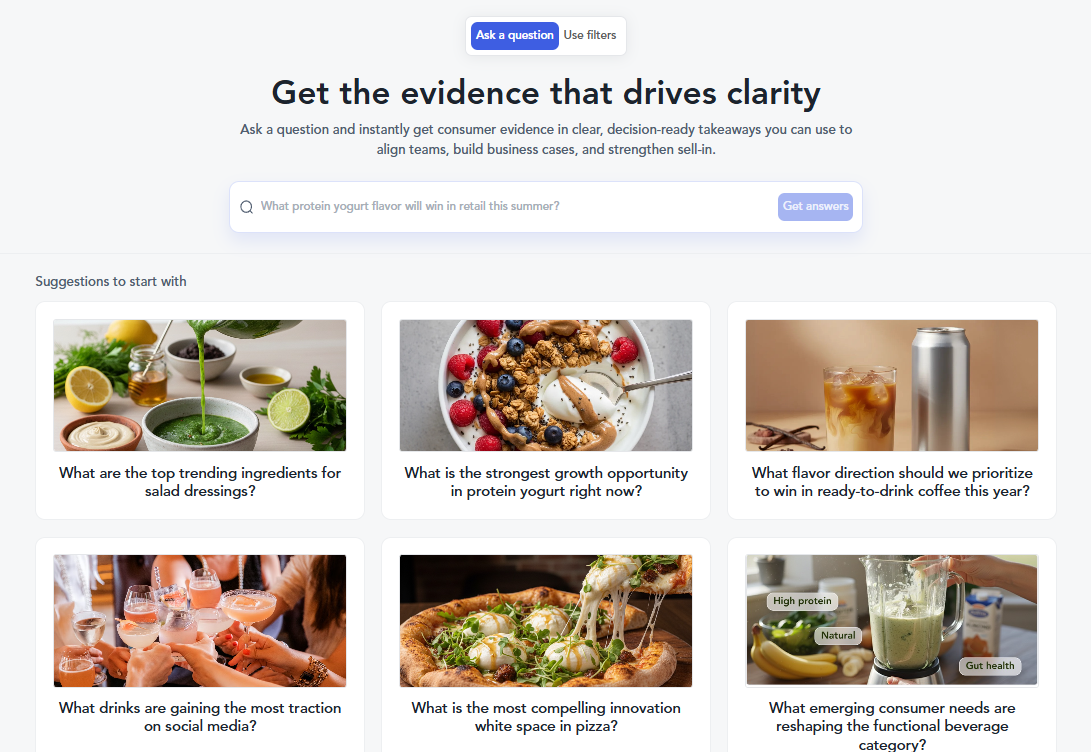
Evaluation starts with how well a system supports decisions under real conditions. A useful system understands how ingredients behave across formats, how claims connect to occasions, and how trends move between foodservice, retail, and home consumption. This determines whether outputs can be used without translation.
Relevance to current market activity shapes whether answers reflect demand or general knowledge. Teams need visibility into what is happening across products, menus, and consumer behavior at the same time.
Outputs need to guide action. Clear direction on what to test, what to prioritize, and how to position it allows teams to move without additional synthesis.
Speed matters because decisions are time-bound. Insight that fits into the workflow supports momentum and alignment across teams.
Types of GPT tools used by F&B teams
General-purpose GPT tools can handle food and beverage prompts. However, turning those outputs into decisions still requires category context and market grounding.
General-purpose GPT tools
Tools like ChatGPT and Claude perform consistently in writing, summarization, and early-stage ideation. Their strength comes from flexibility and speed.
In food and beverage use cases, outputs reflect generalized knowledge. Ingredient suggestions, concept ideas, and category descriptions are clearly structured, though they are not tied to current market activity.
Teams use these tools to frame thinking, generate options, and organize ideas. Additional steps are usually required before outputs can be used in decision-making.
Custom GPT builders
Tools like OpenAI’s GPT builder allow teams to define instructions, upload internal materials, and shape responses.
The effectiveness of this approach depends on how structured and up-to-date the inputs are. Many food and beverage teams operate with data spread across multiple functions, which requires time and coordination to organize.
As categories evolve, systems require updates to remain relevant. Outputs reflect the structure and completeness of what is provided.
Custom GPTs for food and beverage give teams more control over outputs, though they depend on how well internal data is structured and maintained.
Domain-specific GPTs built for food and beverage
These systems are designed around how the category operates. They incorporate ingredient relationships, format dynamics, and market behavior into how responses are generated. Questions are interpreted within context, allowing outputs to reflect how trends develop and move across channels. TasteGPT supports food and beverage teams with decision-ready answers grounded in category context, helping reduce the time between question and action.
Responses are structured around prioritization and relevance. This allows teams to move from question to direction with fewer intermediate steps.
Comparison: which tools support decisions
| Capability | General GPT | Custom-built GPT | TasteGPT |
| Understands F&B categories | ❌ | ⚠️ depends on setup | ✅ |
| Uses real-world signals | ❌ | ⚠️ depends on inputs | ✅ |
| Setup required | none | high | none |
| Speed to insight | fast | slower due to setup | instant |
| Decision-ready answers | ❌ | variable | ✅ |
The difference across these tools shows up in how directly outputs can be used in a decision.
Real examples of how outputs differ in practice
Food and beverage teams ask questions tied to active workstreams. A beverage team working on a functional hydration line asks:
“What ingredients should we prioritize for a Q3 launch?” A typical response returns a list of familiar ingredients such as electrolytes, vitamins, and adaptogens, often with short descriptions.
A more decision-oriented response ranks ingredients based on current momentum, identifies where saturation is already high, and highlights combinations appearing in new product formats. The output supports selection and narrows the field of options.
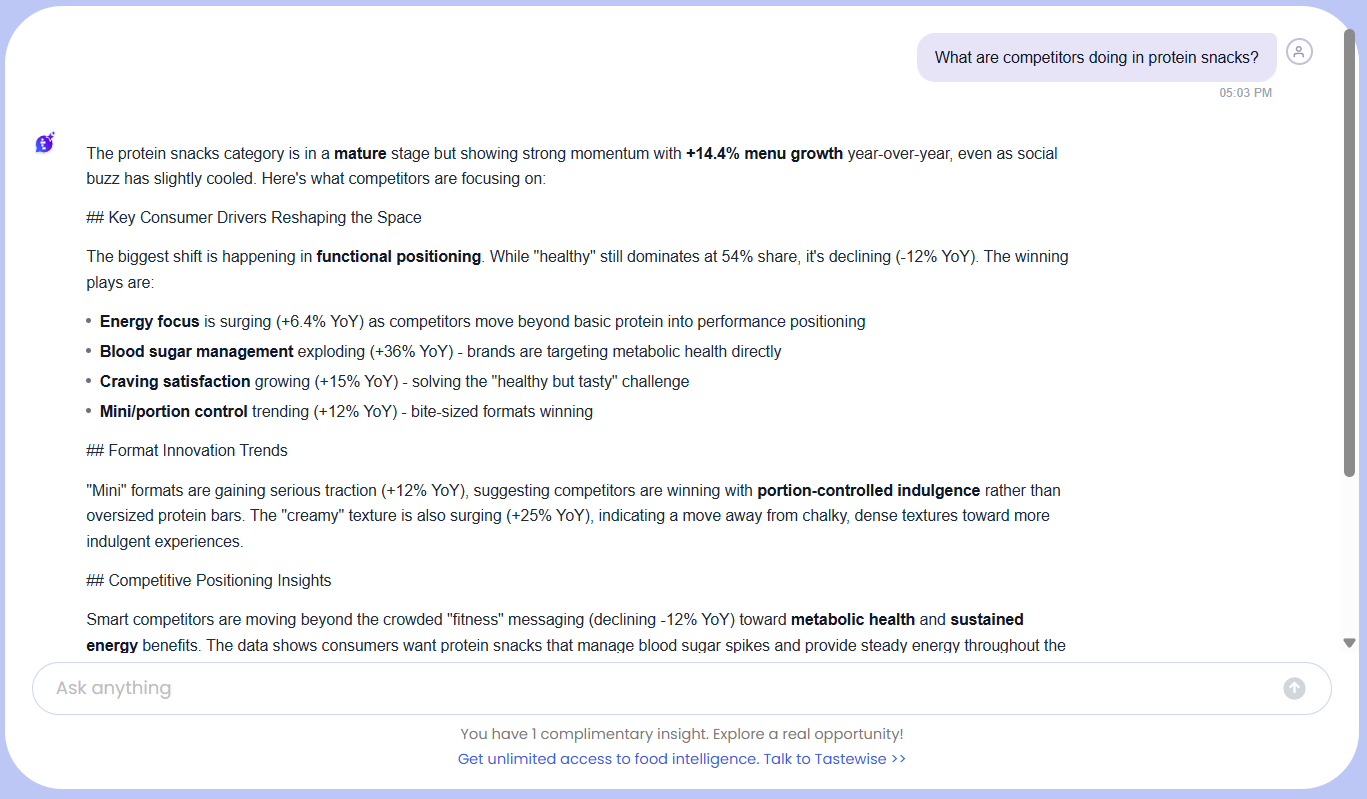
A snacks team evaluating protein expansion asks:
“What are competitors doing in protein snacks?” A standard response outlines existing formats such as bars, chips, and shakes, along with known brands.
A more useful response maps how the category is evolving. It highlights emerging formats, tracks shifts in protein sources, and shows how claims are changing across segments. The output supports positioning and portfolio decisions.
A commercial team preparing for a retailer conversation asks:
“What concept should we pitch for a seasonal LTO?” A general response generates flavor ideas tied to the season.
A more applicable response connects a concept to a specific occasion, defines the target consumer, and clarifies how it fits within an existing shelf or menu. The output can be used directly in a sell-in discussion.
What actually works
Teams benefit from reducing the distance between a question and a clear direction. Systems that perform well interpret questions within category context, organize outputs around prioritization, and present answers in a format that can be used immediately.
This reduces the need for additional steps such as narrowing options, validating relevance, or restructuring outputs for internal discussions.
The impact shows up in execution. Product teams move from exploration to concept selection with fewer iterations. Marketing teams translate insights into messaging without rebuilding the narrative. Commercial teams approach buyer conversations with defined concepts and rationale.
Outputs that can be used immediately create consistency across teams and shorten the path to execution.
Try it on a real business question
Take a question your team is actively working on. A launch decision, a renovation, a category expansion, or a pricing move.
Run it through a general GPT. Then run it through a system trained on food and beverage like TasteGPT. Compare how each response handles prioritization, relevance, and next steps. The difference shows up in how quickly a team can align and move forward. Ask your category question and see what comes back.
FAQs about the best GPT tools for food & beverage teams
GPT tools for food and beverage are AI systems designed to answer category-specific questions related to products, ingredients, trends, and market activity.
GPT tools for food and beverage help teams move from questions to clear direction by structuring outputs around prioritization, relevance, and next steps.
GPT tools for food and beverage support innovation by identifying emerging ingredients, formats, and concepts that align with current category dynamics
GPT tools for food and beverage should provide category understanding, reflect real market activity, and deliver outputs that can be used directly in decisions.
Some GPT tools for food and beverage require structured inputs and ongoing updates, while others are designed to deliver outputs without additional setup.

Read more from Kelia Losa Reinoso

We’d love to learn your goals and see how Tastewise fits
We’d love to learn your goals and see how Tastewise fits
Get a personalized demo
Good taste. Wise move.
Your demo request is confirmed. We’ll reach out within one business day to schedule your walkthrough.
What happens next

See what’s driving demand, then turn it into a sell-in story for retailers and operators.
- Connect consumer panels, market trackers, and agents into one evidence view
- Get the “why” behind what’s changing, with explainable demand drivers
- Walk away with a buyer-ready narrative and next steps to activate
Trusted by





“Tastewise is my secret tool for knowing what consumers want next and why.“