





Most teams don’t struggle to find information. They struggle to get clear answers. One team sees a trend worth acting on, another calls it noise, and a third asks for more validation. The delay is not caused by lack of data. It is caused by the absence of a clear, defensible answer. That is the gap a custom GPT for food & beverage is expected to solve, but most implementations don’t actually change how decisions get made.
The problem with generic GPT
Generic systems answer questions without resolving decisions. Teams experimenting with GPT tools or reviewing GPT examples often get outputs that sound credible but don’t hold up in internal discussions. These models are trained broadly, which means they flatten the signals that matter in food and beverage. They don’t capture how menu exposure drives retail demand, how formats behave differently within the same category, or how quickly ingredients move. The result is an answer that informs, but doesn’t create confidence.
What “custom GPT” actually means in F&B
A custom GPT for food & beverage is not defined by how to create a GPT or how to make your own GPT. It is defined by what sits behind it. The system needs to be grounded in real category inputs: consumer behavior, foodservice activity, retail signals, and ingredient-level context. Without that, even a well-built private GPT produces outputs that are disconnected from actual demand.
Why food & beverage specificity decides outcomes
In food and beverage, detail determines performance. “Protein snacks” is not one category, and “plant-based” does not behave the same across dairy, bakery, and prepared foods. Ingredients rise and fall based on exposure across menus, social content, and retail adoption. Generic systems average these signals, which slows decision-making. A custom GPT for food & beverage isolates them, which enables faster and more accurate calls. This difference directly impacts what gets launched, what gets listed, and what gets deprioritized.
What you can actually ask
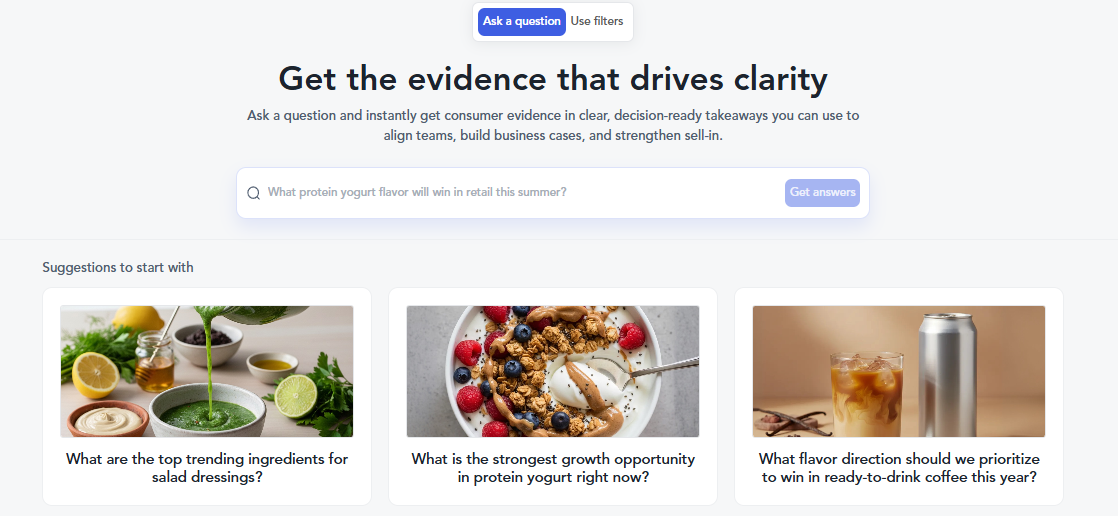
When the system is category-trained, the interaction changes. Instead of searching across multiple sources, teams can ask direct questions and get answers tied to real signals. Questions about ingredient growth in iced coffee, flavor momentum in desserts, menu concepts gaining share, or whitespace in functional snacks become immediate decision inputs. This is where chat CPG workflows shift from analysis-heavy processes to answer-driven execution.
From question to decision
The traditional workflow of research, analysis, discussion and decision creates friction because each step introduces interpretation. A custom GPT for food & beverage compresses that flow into question, answer, decision. The goal is not perfection. It is speed with enough evidence to act. The real failure point is not finding the right idea but being unable to articulate and sell it internally and externally. The system works when it removes that friction.
Where most “custom GPT” efforts fail
Most teams focused on how to create custom GPT systems underestimate what makes them work. The common gaps are predictable: lack of real-time data, no category depth, limited updates, and no connection to commercial workflows. Whether the effort is framed as how to make a custom GPT or create your own GPT, the outcome is the same. The tool generates answers but fails to support decisions, which leads to low adoption.
How TasteGPT turns category questions into answers you can act on
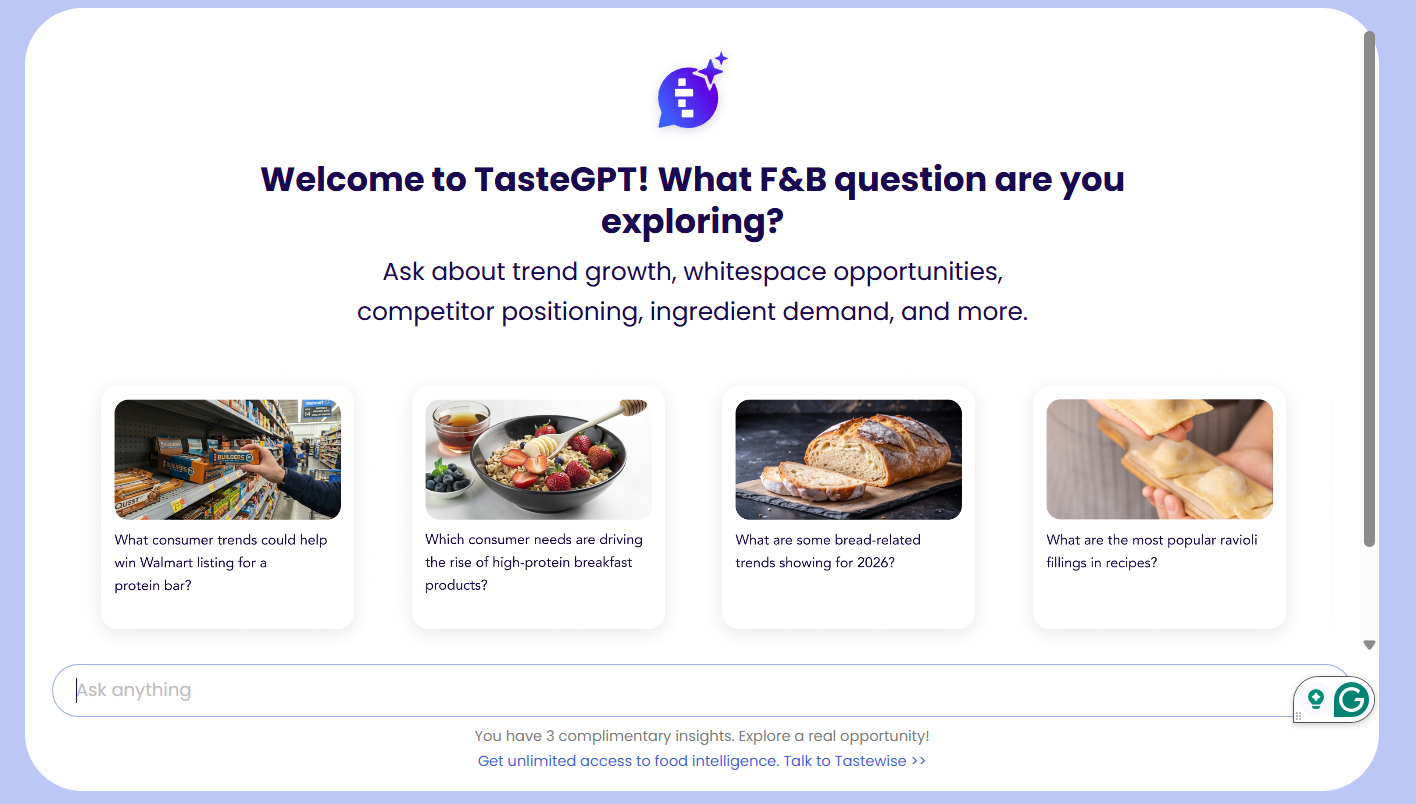
Instead of building from scratch, teams are adopting a custom GPT for food & beverage already trained on category-specific datasets, including the Social F&B panel, Foodservice signals, Home cooking panel, Surveys or synthetic data, and Internal studio outputs. This is where category-specific GPTs outperform generic tools, because the answers reflect what is actually happening in the market. Tastewise has introduced TasteGPT, the upgrade that turns real-time signals into actionable answers teams can use immediately.
Should you use TasteGPT or build internally?
The choice is not between AI and no AI. It is between generic outputs and category-specific answers. Building only works if there is access to structured, continuously updated data and the ability to operationalize it. Most teams need speed, alignment, and defensible answers. That is what a custom GPT for food & beverage delivers.
Retailers don’t buy trends. They buy proof. Internal teams don’t align around data. They align around decisions they can defend. A custom GPT for food & beverage closes that gap by turning signals into answers that can be used immediately.
Ask the question. Get the answer. Move.
FAQs about custom GPT for food & beverage
GPT stands for Generative Pre-trained Transformer. In food and beverage, the term matters less than how it’s applied. A generic GPT generates broad answers, while a custom GPT for food & beverage is trained on category-specific data, allowing it to return answers tied to real consumer demand, menu activity, and retail signals.
A custom GPT for food & beverage is an AI system trained specifically on food and beverage datasets such as consumer behavior, foodservice trends, and retail performance. Unlike general tools, it provides answers grounded in category reality, not generalized knowledge.
Generic GPT tools provide broad, context-light responses. A custom GPT for food & beverage uses structured category data and real-time signals to produce answers that support decisions, not just exploration. The difference is not output quality alone, but whether the answer can be used in a commercial context.
Most guides on how to create a GPT focus on prompts and configuration. That approach is incomplete for food and beverage. A usable system requires continuous data inputs, category context, and validation layers. Without those, even well-built tools fail to produce actionable answers.
To create a system that performs, teams need access to real-time category data, including sources like Social F&B panel, Foodservice, and Home cooking panel. They also need workflows that connect outputs to decisions. This is why many internal builds fall short, hey solve interface, not data.
Without proprietary data, most teams cannot build a reliable system. The alternative is to use a custom GPT for food & beverage that is already trained on category datasets and continuously updated. This allows teams to access decision-ready answers without maintaining the infrastructure themselves.
A private GPT is a closed system trained on internal or restricted data. For food and beverage brands, this only works if internal datasets are rich, structured, and continuously updated. In most cases, combining internal knowledge with a custom GPT for food & beverage trained on external category signals delivers stronger results.
The most effective GPT tools are those trained specifically on food and beverage data. Generic platforms support exploration, but category-trained systems support execution. The difference is whether the tool can connect signals to launch, pricing, or positioning decisions.
Yes, but success depends on data quality and maintenance. Teams exploring how to make your own GPT or create your own GPT often underestimate the need for real-time updates and category depth. Without those, outputs become outdated or too generic to use.
Teams should use a custom GPT for food & beverage when speed, alignment, and decision confidence are priorities. Building is only viable when there is access to structured, continuously updated data and the ability to operationalize outputs across teams.

Read more from Kelia Losa Reinoso

We’d love to learn your goals and see how Tastewise fits
We’d love to learn your goals and see how Tastewise fits
Get a personalized demo
Good taste. Wise move.
Your demo request is confirmed. We’ll reach out within one business day to schedule your walkthrough.
What happens next

See what’s driving demand, then turn it into a sell-in story for retailers and operators.
- Connect consumer panels, market trackers, and agents into one evidence view
- Get the “why” behind what’s changing, with explainable demand drivers
- Walk away with a buyer-ready narrative and next steps to activate
Trusted by





“Tastewise is my secret tool for knowing what consumers want next and why.“