





What if your next best-seller is already trending, and you’re just not seeing it fast enough? Functional food trends aren’t bubbling under the surface anymore, they’re shaping mainstream consumer behavior, product expectations, and retail strategies in real time. According to global market reports, the functional food category was valued at $337.85 billion in 2024 and is expected to reach $359.81 billion by 2025. Some forecasts predict a rise to over $793 billion by 2032, growing at more than 10% annually. The U.S. alone could reach $117 billion in that time. Functional nutrition is no longer niche, it’s rewriting the rules of what sells, how fast, and why.
Shoppers today want much more than standard nutrition. Many rely on items geared toward Gut health food trends, cognitive function ingredients, and hormone balance nutrition. They also show interest in fungi-based products, with a notable focus on Lion’s Mane mushroom benefits. In parallel, producers are modernizing their processes by using AI in functional food development. That shift helps them track real-time consumer signals, predict demand, and launch new items with less guesswork.
What Tastewise data reveals about consumer demand for functional ingredients
Functional food trends aren’t just about buzzwords anymore. Consumers are actively seeking ingredients that do something, support their focus, digestion, or hormonal health. While the category is wide, certain foods are leading the conversation across social, recipes, and menus.
Let’s look at three demand areas defining Functional nutrition right now—cognitive support, gut health, and hormone balance, and what Tastewise data tells us about where the market is headed.
1. What are the fastest-growing functional ingredients for cognitive health?
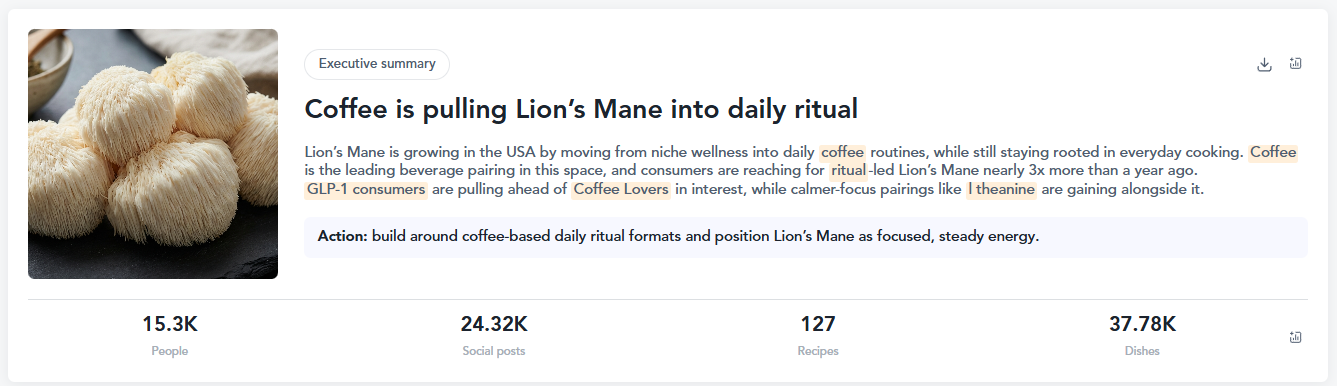
Lion’s Mane mushroom showing 127% growth, followed by adaptogenic herbs.
Consumers searching for focus and mental performance are gravitating toward natural ingredients like Lion’s Mane mushrooms, matcha, and dark chocolate. These are showing up most often in drinks, snacks, and café items.
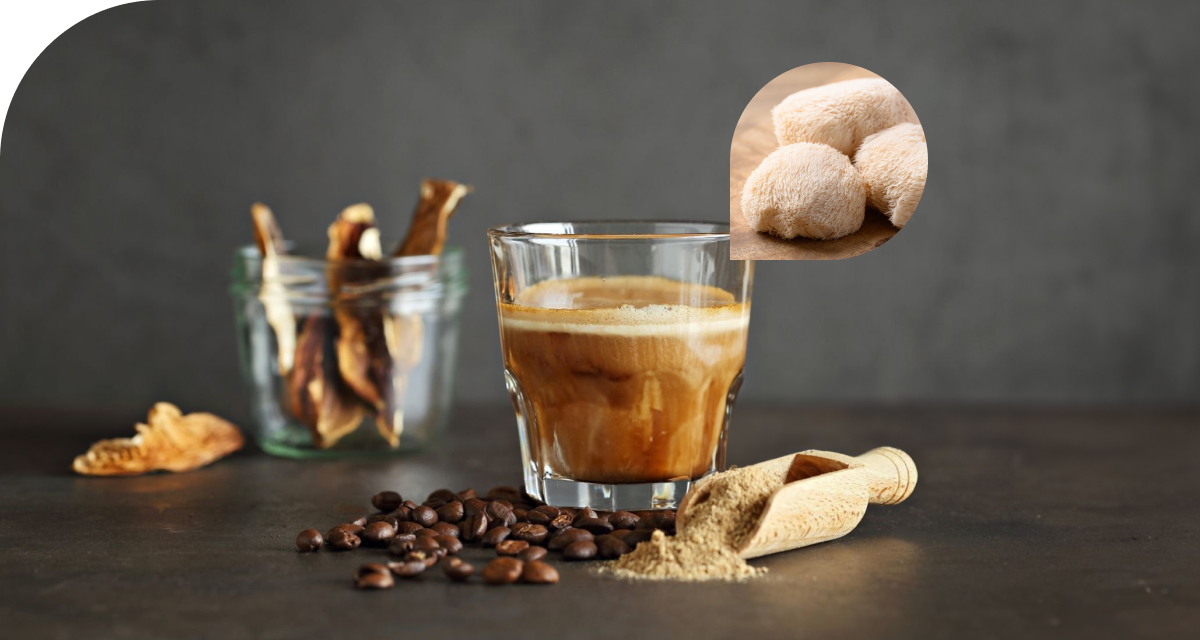
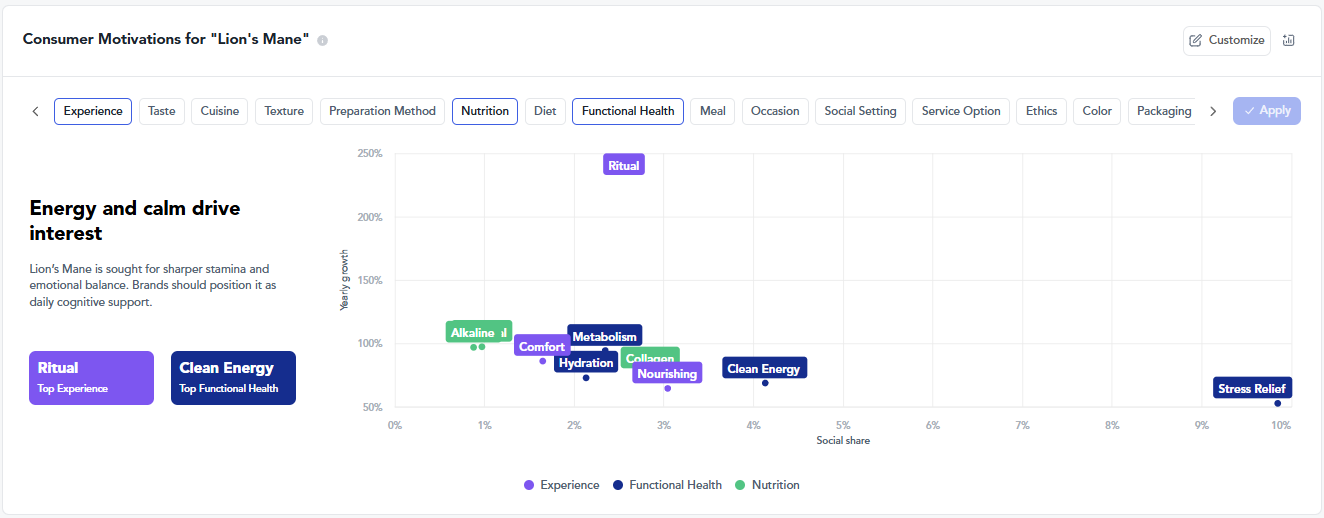
According to Tastewise data, Lion’s Mane mushroom benefits dominate conversations in the functional mushroom space. Consumers talk about mushroom coffee, mushroom juices, and “steak-style” vegan dishes made from Lion’s Mane. The social share for mushroom coffee alone is 7.8%, and it’s 469x more likely to appear with other functional dishes. Menu data confirms the rise, with mushroom coffee listed in nearly 9% of menu items tracked, often alongside Reishi and Chaga.
Matcha, another cognitive function ingredient, is also on fire. Matcha latte is one of the fastest-growing menu items year-over-year, up +4953%. The L-theanine + caffeine combo in matcha appeals to consumers seeking calm focus, without the crash. In social content, it often shows up in conversations tied to alertness, “clean energy,” and better workflow.
The takeaway? Products that promise sharpness and sustained energy, especially in drinkable formats, are driving consumer curiosity and menu adoption.
2. How do consumers prioritize gut health ingredients in 2025?
Prebiotics and fermented foods are leading purchase decisions.
Gut health has become one of the most discussed drivers in functional eating. Consumers aren’t just buying into vague claims, they’re engaging with specific, probiotic-rich foods like kefir, kombucha, kimchi, and sauerkraut.
Kefir in particular is gaining momentum. Tastewise data shows a 17.26% YoY growth in social share and strong correlations with other fermented wellness products. The top consumer needs driving conversation around kefir include “healthy” (44%), “gut health” (33%), and “probiotics” (32%). Dishes like kombucha, sauerkraut, and infused waters are frequently mentioned alongside kefir, indicating a broader shift toward fermented ecosystems.
Kefir’s restaurant presence is also growing. On menus, it appears most often in smoothies, soups, and specialty drinks. Water kefir is 4659x more likely to appear with other gut-focused items, suggesting that both consumers and chefs are seeing it as a foundational wellness ingredient.
If you’re developing for gut health, this isn’t the time to play it safe. The market is primed for bold fermentation-forward launches with clear digestive claims.
3. Hormone balance nutrition
Adaptogens like ashwagandha are driving beverage innovation
The rise of adaptogens reflects a deeper consumer desire for hormone and energy regulation—without synthetic solutions. Ashwagandha, in particular, is becoming a favorite in functional lattes, smoothies, and protein snacks.
Tastewise data shows that conversations about ashwagandha are up +20.65% year-over-year. The leading drivers? “Energy” (28%), “stress relief” (27%), and “adaptogens” (26%). Functional drinks are the most common application, with menu items like moon milk, golden milk, and smoothies showing strong correlations to ashwagandha-based products.
Moon milk, for example, is 771x more likely to appear on menus where ashwagandha is present. It’s a powerful signal: consumers aren’t just seeking single-ingredient fixes—they’re engaging with functional rituals that combine multiple benefits (stress relief, energy, mood) in one product.
Smoothies, protein shakes, and calming teas that support hormone balance nutrition are proving to be strong formats for adaptogen-based innovation. These drinks are also easy to extend into RTD, powder, or bar formats.
Which functional beverages are driving the nutrition revolution?
Kombucha and probiotic drinks capturing the market share. Tastewise’s Functional Nutrition in 2025 Survey reveals a powerful consumer shift: energy and focus are now the top drivers for choosing functional foods, with 61.6% of respondents seeking these benefits. Lion’s Mane tops the list of preferred functional ingredients, far outpacing others like ashwagandha. When it comes to trust, consumers overwhelmingly prioritize scientific backing (3.8x more than social media trends), and innovation is most welcomed in functional beverages, such as nootropic drinks and mushroom lattes.
Interestingly, while consumers value claims around immunity, digestion, and stress reduction, they most desire products that improve focus and cognition. Only 3.4% of respondents want functional nutrition integrated into foodservice, signaling a missed opportunity for that channel.
What functional nutrition trends should CPGs prioritize this year?
Not all functional foods are created equal, consumers today are shopping by outcome. Whether they want better focus, smoother digestion, or hormonal balance, they’re actively looking for ingredients that match those goals. Below is a breakdown of trending functional foods organized by health benefit, along with their primary appeal to consumers.
| Health Focus | Ingredient | Benefit to Consumers |
| Cognitive & Mood Support | Lion’s Mane Mushrooms | Memory, focus, mental clarity |
| Omega-3-rich fish (salmon, etc.) | Brain function, mood regulation | |
| Matcha | Calm alertness, steady energy | |
| Dark Chocolate (70%+) | Brain blood flow, mood support | |
| Energy & Performance | Beetroot juice/powder | Endurance, nitric oxide boost |
| Maca root | Stamina, energy balance | |
| Chia seeds | Long-lasting energy from fiber and omega-3s | |
| Quinoa | Complete plant-based protein and complex carbs | |
| Gut & Digestive Health | Kefir | Probiotics, digestive wellness |
| Kimchi / Sauerkraut | Fermented, gut microbiome support | |
| Prebiotic foods (garlic, banana) | Fuel for probiotics, gut diversity | |
| Bone broth | Gut lining repair, collagen support | |
| Immunity & Inflammation | Turmeric + black pepper | Anti-inflammatory curcumin |
| Ginger | Digestive support, immune boost | |
| Elderberry | Immune system defense | |
| Miso | Fermented, probiotic-rich | |
| Hormone Balance & Longevity | Flax seeds | Estrogen balance via lignans |
| Ashwagandha | Cortisol reduction, adaptogen for stress | |
| Green tea | EGCG antioxidants for cellular health | |
| Seaweed | Iodine for thyroid function |
What should CPGs should do with this info?
Consumers are telling you exactly what they want, CPGs just need to act on it faster.
- Create by benefit, not by format. Start with the outcome (focus, gut health, hormone support), then match ingredients and delivery systems. For example, don’t just make another bar, make a stress-support bar with ashwagandha and green tea extract.
- Label clearly and claim confidently. Shoppers are looking for callouts like “supports memory” or “boosts gut health.” These messages should be front and center on-pack and in digital channels.
- Pair ingredients with proven context. Matcha is booming in latte form. Kefir works well in smoothies. Ashwagandha thrives in evening drinks. Use consumption moments to shape innovation.
- Use this table to prioritize R&D. Not all ingredients are equally trendy. Use data to focus on fast-moving, high-engagement items like mushroom coffee (Lion’s Mane) or kefir-based beverages before your competitors do.
Need to validate which ingredient trends are growing fastest in your category? Platforms like Tastewise help you track ingredient-level demand in real time, so your functional product pipeline stays relevant.
Accelerating progress with AI in functional food development
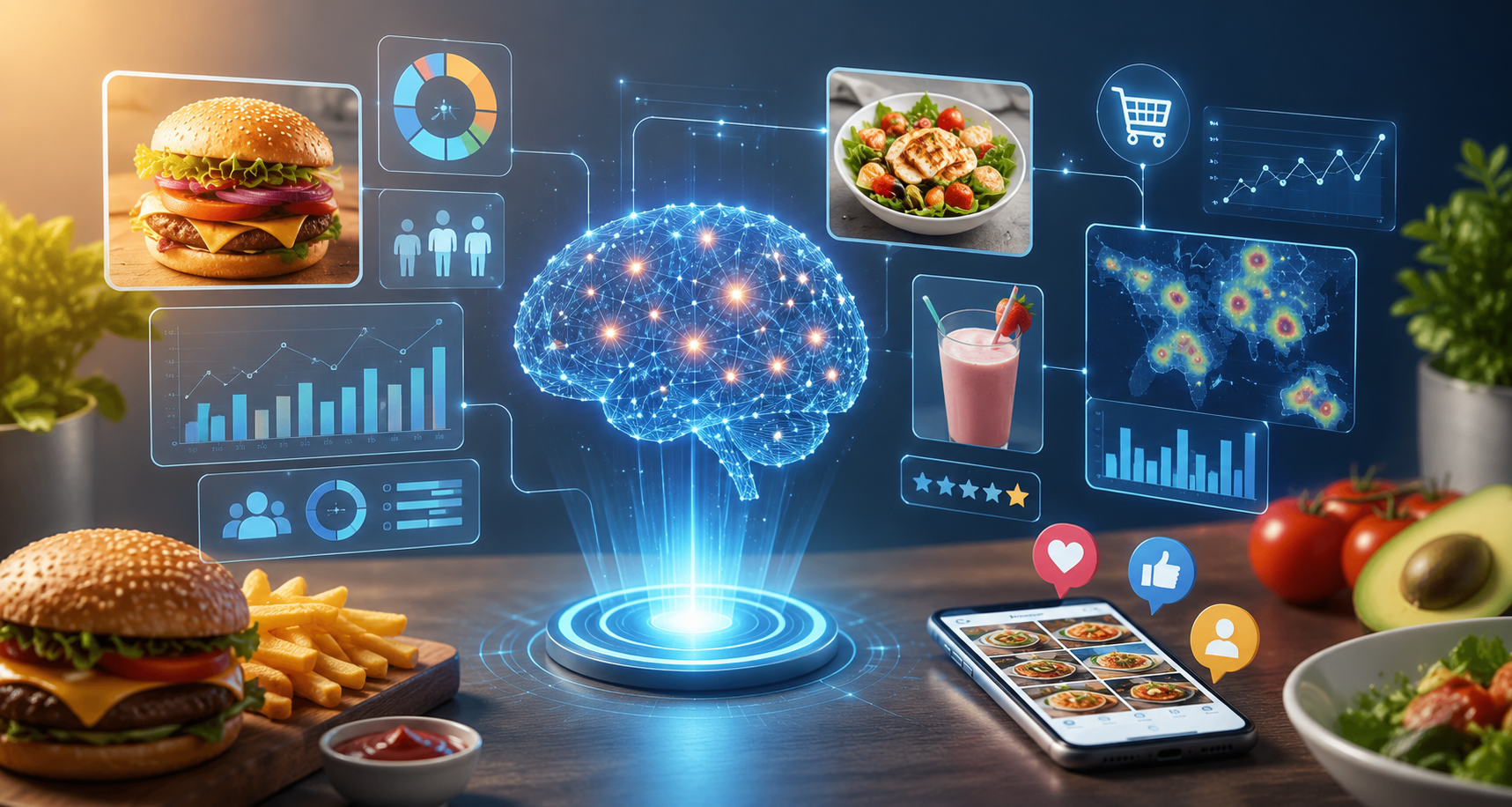
Keeping an eye on so many trending needs demands real-time insight. That’s where AI in functional food development helps. Modern platforms monitor online recipes, social posts, restaurant menus, and shopper feedback. This data reveals which benefits draw the most interest—whether it’s cognitive function ingredients, improved digestion, or specific claims around hormone support.
The same technology also streamlines product testing. Ideas that show strong social engagement can be tested in smaller markets. Teams gather feedback quickly, then refine recipes in short cycles rather than waiting months. Producers who rely on these insights can roll out items at the exact moment they pique consumer attention, avoiding delays that might cause missed opportunities.
Large food expos highlight these quick shifts. For instance, Expo West has showcased a surge in functional mushroom coffees and adaptogen-forward drinks. Many of these launches went from concept to shelf in record time because they were guided by data.
AI Tools for functional nutrition
Modern tools don’t just help track demand—they help bring it to life. AI now supports menu planning by identifying which functional ingredients pair well together, which dishes are gaining traction across channels, and how to position new formats based on what’s already working in-market.
Need to launch a gut-health product for busy professionals? AI can analyze social data and restaurant menus to recommend a kombucha smoothie with trending add-ins. Trying to turn an underused adaptogen into a hero? Recipe engines can pull in format inspiration from user behavior—like when to serve, how to flavor, and what other claims to include on-pack.
This Chia Almond Coconut Pudding was developed using real-time insights into trending formats and benefits. It’s plant-based, functional, and pairs chia’s energy and gut health benefits with consumer-loved flavors like coconut and almond.
For CPG teams, this isn’t just R&D support—it’s execution strategy. With the right AI tools, you can go from insight to product brief to shelf-ready format with speed and confidence.
Why it matters for CPG brands
The rise of Functional nutrition is not a single-item phenomenon. It spans mushrooms, fermented goods, adaptogenic herbs, and more. Shoppers pay close attention to label claims. They want to know if a coffee blend includes Lion’s Mane or if a bar has prebiotics for digestion. They want evidence-based solutions.
CPG brands and retailers gain an advantage by studying tastewise data or other real-time information channels. They see which dishes are gaining traction. They notice that “mushroom coffee” is on more menus or that kefir has a double-digit increase in social growth. They can act on these signals and focus on line extensions or brand-new launches.
This speed is vital. Trends shift in weeks rather than years. AI in functional food development offers a nimble approach, shining a spotlight on which benefits resonate right now. That knowledge turns into well-timed product releases.
Real-world success stories: how leading CPGs implement functional nutrition
Functional nutrition scales when the benefit is clear and the format is familiar. The brands winning in this space are not creating new behaviors. They are attaching functional claims to products consumers already use, then executing with clarity at shelf and in messaging.
Four Sigmatic functional coffee
Four Sigmatic expands coffee into functional territory by layering digestive and immune support into a familiar format. Its gut health ground coffee combines probiotics and functional mushrooms, positioning the product around digestion and daily wellness rather than just energy.
The execution stays simple. It keeps the coffee ritual intact while adding a clear, benefit-led claim that is easy to understand at shelf. That reduces the need for education and supports repeat purchase.
Olipop functional soda
Olipop entered a saturated soda category with a gut health proposition, using prebiotics and fiber to justify a premium position. Its classic root beer stays within traditional soda expectations, making it easy for consumers to switch without changing behavior.
By aligning with an existing consumption occasion, the brand replaced rather than reinvented, which accelerated adoption across retail channels.
BelliWelli functional gummies
BelliWelli extends its gut health positioning beyond bars into a more accessible format with its functional gummies, combining prebiotics and digestive support with a format typically associated with indulgence.
The advantage is lower friction. Gummies remove some of the barriers tied to traditional functional formats like powders or supplements. The benefit remains clear, but the experience feels lighter and easier to adopt.
Startup vs. enterprise functional nutrition strategies
Startups win on speed and focus. A plant-based startup launching adaptogenic beverages should prioritize one clear benefit, such as stress support, and pair it with a familiar format like RTD drinks. The goal is fast validation through early demand signals, then rapid iteration based on consumer response.
Enterprise brands operate differently. A major CPG reformulating existing products with functional ingredients needs to protect scale and distribution. Instead of launching something new, they layer functional claims into proven products. For example, adding probiotics to an existing yogurt line or fiber to a snack range. The advantage is immediate shelf presence, but execution depends on clear claims and minimal disruption to taste and price.
Foodservice sits between the two. A foodservice company developing gut-health menu items can test quickly through LTOs. Fermented ingredients or probiotic beverages can be introduced in specific locations, then scaled based on performance. This creates a low-risk testing environment before retail expansion.
The difference is not capability. It is timing and risk tolerance.
Common implementation pitfalls and how to avoid them
The most common failure is unclear benefit positioning. A plant-based startup launching adaptogenic beverages often combines too many claims, such as stress, energy, and immunity. This creates confusion and slows adoption. The fix is to anchor on one primary outcome and make it visible at shelf.
Large CPGs face a different issue. When reformulating with functional ingredients, they often overcomplicate the message or dilute the benefit. Adding a functional ingredient without clearly communicating its purpose leads to weak conversion. The solution is to tie every ingredient to a simple, front-of-pack claim.
In foodservice, the risk is lack of repeatability. Gut-health menu items may generate initial interest but fail to sustain demand if the benefit is not clear or the taste does not meet expectations. Testing through LTOs helps, but only if performance is measured and refined before scaling.
Across all three, the pattern is consistent. Products fail when the benefit is unclear or hard to act on. They scale when the value is immediate and easy to understand.
FAQs
AI empowers brands to track and respond to emerging consumer behaviors as they happen by analyzing data across social media, recipe platforms, menus, and digital shelves. This real-time analysis uncovers shifting preferences for ingredients, health claims, and product formats that traditional market research often misses. By giving brands instant visibility into what consumers want today—not weeks or months ago—AI enables faster reaction times, more relevant product launches, and smarter marketing strategies that reflect current demand.
AI is widely used to identify trending flavors, predict category growth, optimize packaging claims, and support new product development. Teams also rely on AI for dynamic pricing strategies, menu optimization, and retail shelf performance tracking. In innovation workflows, AI accelerates ideation and concept validation, helping brands prioritize what will resonate based on real consumer data rather than assumption. These use cases streamline decision-making and reduce time to market.
Combining real-time consumer insights with AI allows companies to create products that are both timely and aligned with actual demand. AI doesn’t just surface raw data—it contextualizes behavior by showing why certain trends matter and how they connect across platforms. When teams use these insights to inform product development, marketing messaging, and positioning, they reduce risk and improve launch success. The result is a more agile, data-informed process that scales from trend detection to execution.
ROI depends on timing against demand signals. According to Foodservice data, once an ingredient reaches 8–12% menu penetration, retail traction can follow within 3–6 months.
Delays usually come from internal hesitation, not market readiness. Signals already exist in the Social F&B panel and Home cooking panel before most teams act.
Brands that move early focus on validated formats and clear benefit claims. This reduces failed launches and speeds up revenue impact.
Cost efficiency comes from adoption, not just price. Ingredients like matcha, turmeric, ginger, and chia scale faster because they are recognizable and require less education. The Home cooking panel shows higher repeat usage for these, which lowers marketing costs.
Emerging ingredients can work, but only if supported by strong demand signals. Start with what already converts, then expand.
Energy, focus, and gut health lead across channels. According to the Social F&B panel, these benefits show consistent growth in engagement and repeat behavior. Foodservice data confirms higher menu penetration for these use cases.
Benefits with clear consumer understanding scale faster. Niche benefits grow slower due to lower awareness.
Price works when the benefit is clear. Survey data shows functional products can hold a 15–30% premium when the claim is easy to understand and tied to a known ingredient.
Velocity drops when consumers do not understand the value. Anchor pricing to familiar categories and validate through repeat purchase behavior.
Startups compete by acting earlier on emerging demand. Large brands tend to wait for full validation across channels. Startups can move when signals are already consistent but not yet saturated. That is where competition is still low and differentiation is easier to establish.
The advantage comes from focus and speed. A single clear benefit, paired with a format consumers already understand, reduces friction at launch. From there, fast iteration based on real consumer response allows startups to adjust before larger players enter the space.
Winning is less about scale and more about timing and clarity. Brands that enter early with a strong, easy-to-understand proposition are better positioned to capture demand before it becomes crowded.

We’d love to learn your goals and see how Tastewise fits
We’d love to learn your goals and see how Tastewise fits
Get a personalized demo
Good taste. Wise move.
Your demo request is confirmed. We’ll reach out within one business day to schedule your walkthrough.
What happens next

See what’s driving demand, then turn it into a sell-in story for retailers and operators.
- Connect consumer panels, market trackers, and agents into one evidence view
- Get the “why” behind what’s changing, with explainable demand drivers
- Walk away with a buyer-ready narrative and next steps to activate
Trusted by





“Tastewise is my secret tool for knowing what consumers want next and why.“