






Across Tastewise datasets, mango milkshake demand continues to surface in social and foodservice, but its primary reference point, mango lassi, is no longer doing the same growth work it once did. The result is a format caught between familiarity and saturation, even as adjacent mango desserts accelerate.
Mango Milkshake Overview
- +21.4% YoY social growth, low overall share
- Strongest tie to mango lassi (5663x correlation)
- Lassi growth slowing, price largely capped
- Mango falooda up +24.8% YoY, avg price $10.19
- Higher performance when used inside desserts
The problem: mango milkshake is tied to a slowing anchor
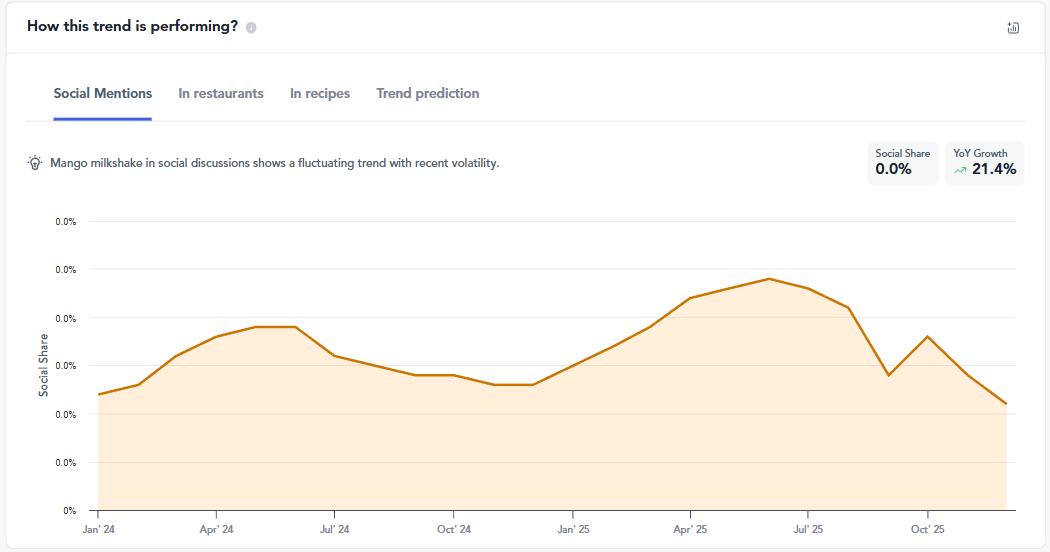
According to the Social F&B panel, general mango milkshake social mentions are up +21.4% YoY. However, engagement spikes are short-lived and heavily dependent on cuisine-led context rather than broad dessert appeal.
At the same time, mango lassi, the category mango milkshake most strongly correlates with, shows modest growth with visible deceleration. Operator menu share rises incrementally (+6.3% YoY), but social growth has flattened, and menu expansion lacks momentum.
This creates a structural constraint. Mango milkshake continues to inherit the expectations, pricing logic, and menu role of lassi, without benefiting from the growth curve that once justified that position
Price pressure without a growth story
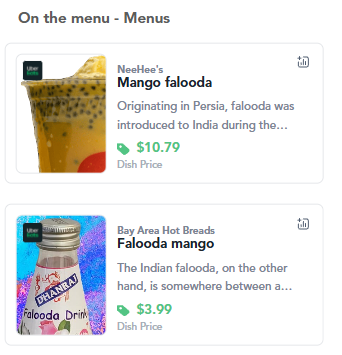
Menu data reinforces the tension. Mango lassi pricing holds steady in the $6–$8 range across operators, with limited upward movement. In contrast, mango milkshake falooda formats show a different trajectory. Average menu price now sits at $10.19, up +15.9% YoY, alongside rising menu item counts (+24.8% YoY).
Price increases without demand loss signal something lassi no longer provides: competitive energy. Falooda is earning space through differentiation, not legacy.
The competitive set is changing under the surface
Mango milkshake remains tightly clustered around lassi, but consumer behavior is already stretching outward. Falooda content shows sustained menu stability over 24 months and stronger YoY growth (+39.6%), even as traditional milkshake and smoothie adjacencies decline.
This is not about novelty. Falooda works because it solves a menu problem mango lassi no longer does: it delivers mango indulgence with visual density, layered texture, and dessert justification that supports premium pricing.
As a result, mango milkshake positioned as “another lassi variation” competes in a crowded, slowing lane. Mango milkshake positioned as a component inside a larger dessert construct enters a different competitive set entirely.
What falooda reveals about where mango milkshake still wins
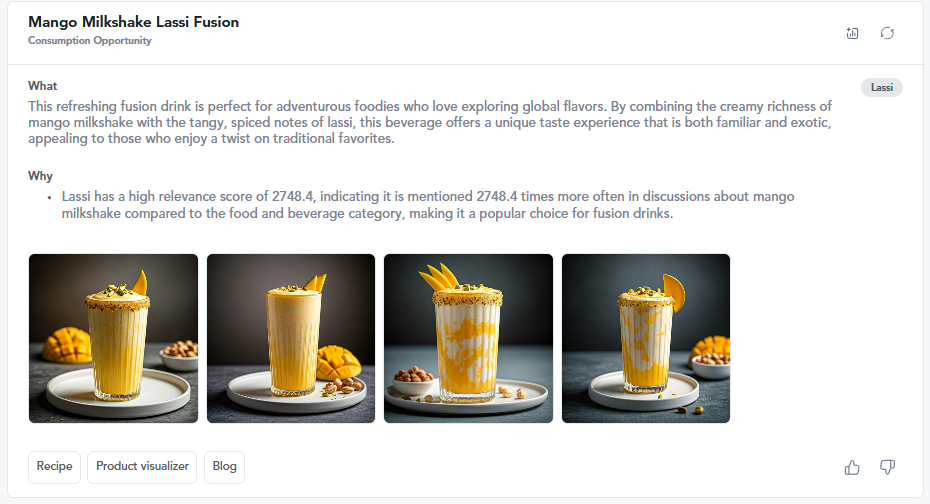
Falooda’s rise explains where mango milkshake trends still have leverage. Consumption moments show mango milkshake performing best when used as a base, not a standalone hero, layered with noodles, ice cream, seeds, or syrups, and framed as a plated or glass-built dessert. This changes mango milkshake from beverage logic into dessert logic, where pricing elasticity and menu justification improve.
Mango milkshake performance now depends on how clearly its role can be explained. Buyers are deciding what the product replaces, how it earns its price, and whether it justifies space in a crowded set.
Our Tastewise guide on retail in 2026 breaks down how teams translate demand concentration, format logic, and pricing proof into shelf decisions buyers can stand behind.
How format context shapes mango milkshake performance
The data does not suggest mango milkshake is losing relevance. It suggests that performance varies meaningfully by how the product is framed on menus.
When mango milkshake is positioned primarily as a standalone drink, its performance tracks closely with mango lassi, which is a format showing continued presence but moderated growth. In contrast, formats where mango milkshake functions as a component within layered desserts, such as falooda, are showing stronger menu expansion and higher average pricing.
This difference appears to be less about the ingredient itself and more about the role it plays. Falooda’s continued menu growth and rising price point indicate that operators are finding more flexibility and competitive differentiation when mango milkshake supports a broader dessert build rather than carrying the entire proposition on its own.
Viewed through that lens, the recent volatility in mango milkshake trends reflects not declining interest, but sensitivity to format context. Where that context expands, performance follows.
FAQs about mango milkshake trends
Mango milkshake shows positive YoY growth in social mentions, but with low overall share and visible fluctuations. This pattern points to demand that is present but highly context-dependent rather than broadly scaled.
Mango lassi maintains steady menu presence with moderate growth, indicating maturity. Mango milkshake remains closely tied to lassi in consumer perception, which shapes expectations around pricing, format, and usage.
Menu data shows falooda expanding at a higher rate and supporting higher average prices. This suggests operators are finding more flexibility and differentiation in layered dessert formats than in standalone beverage offerings.
Falooda typically incorporates mango milkshake as part of a broader build. The relationship is additive rather than substitutive, with mango milkshake functioning as a base ingredient rather than a finished product.
Sustained price increases alongside menu growth suggest consumers accept premium pricing when mango-based offerings are framed as desserts rather than drinks.
When isolated from format and menu context, mango milkshake demand appears fragmented. When evaluated within the formats where it is being actively used, demand aligns more closely with stable menu growth and pricing power.

Read more from Kelia Losa Reinoso

We’d love to learn your goals and see how Tastewise fits
We’d love to learn your goals and see how Tastewise fits
Get a personalized demo
Good taste. Wise move.
Your demo request is confirmed. We’ll reach out within one business day to schedule your walkthrough.
What happens next

See what’s driving demand, then turn it into a sell-in story for retailers and operators.
- Connect consumer panels, market trackers, and agents into one evidence view
- Get the “why” behind what’s changing, with explainable demand drivers
- Walk away with a buyer-ready narrative and next steps to activate
Trusted by





“Tastewise is my secret tool for knowing what consumers want next and why.“