





Salad trends are no longer a question of flavor discovery. They are a question of format viability, channel fit, and occasion clarity. According to Tastewise data, demand has not disappeared, but it has moved, and brands that keep treating salads as a static category risk misallocating innovation and shelf space.
Salad trends are weakening as menu defaults, not as consumer behavior
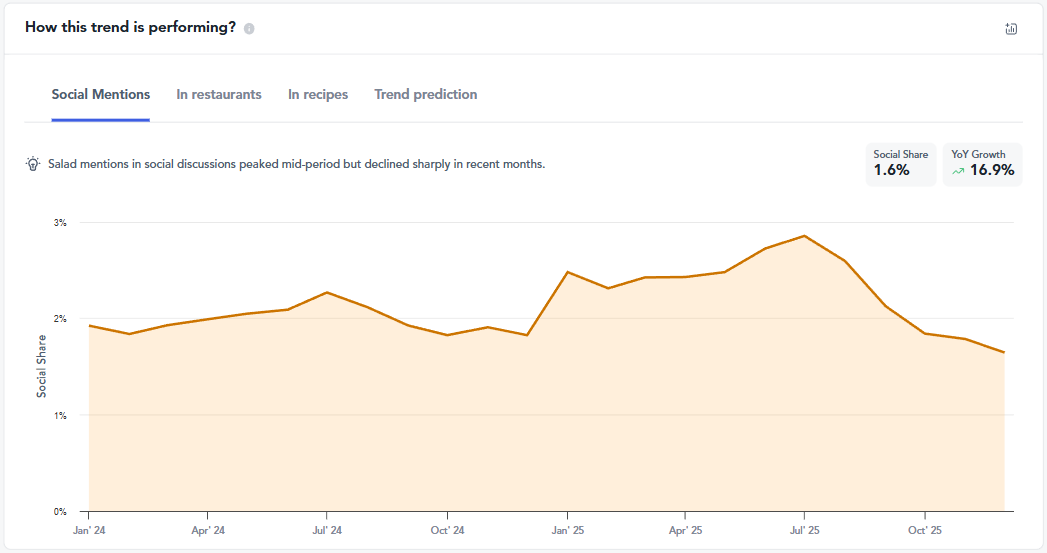
According to the Social F&B panel, salad mentions are up +16.9% YoY, yet recent months show a sharp decline in conversation velocity. At the same time, Foodservice data shows salad menu listings down -2.3% YoY over a 24-month period.
This split means salads still matter culturally, but not as automatic menu items. Operators are cutting low-performing SKUs while consumers continue to engage with salad-adjacent eating.
Brands should stop defending salads as core menu anchors and instead redeploy them into modular roles: add-ons, sides, bases, and bundled meals that earn their space.
Salad trend overview:
- Social conversations about salad are up +16.9% year-over-year
- 61.4% of U.S. restaurants currently offer salad dishes on their menus
- The top consumer needs driving salad consumption today are taste and freshness
- Vegan and plant-forward salads remain the most dominant dietary adaptation
Format, not health, is driving salad trends
In the Home cooking panel, “tasty” (24%) and “fresh” (17%) lead salad-related needs, while “healthy” trails at 13%. Texture and preparation cues like crispy, tangy, and cooked are over-indexing versus nutrition-led language.
This shifts salad trends away from functional health positioning and toward sensory payoff. The decision lens changes from “Is this good for you?” to “Is this worth eating?”
R&D teams should prioritize cooking methods and preparations, roasted vegetables, pickled components, crunchy toppings, before investing in incremental health claims.
Classic salads are declining while constructed salads hold demand
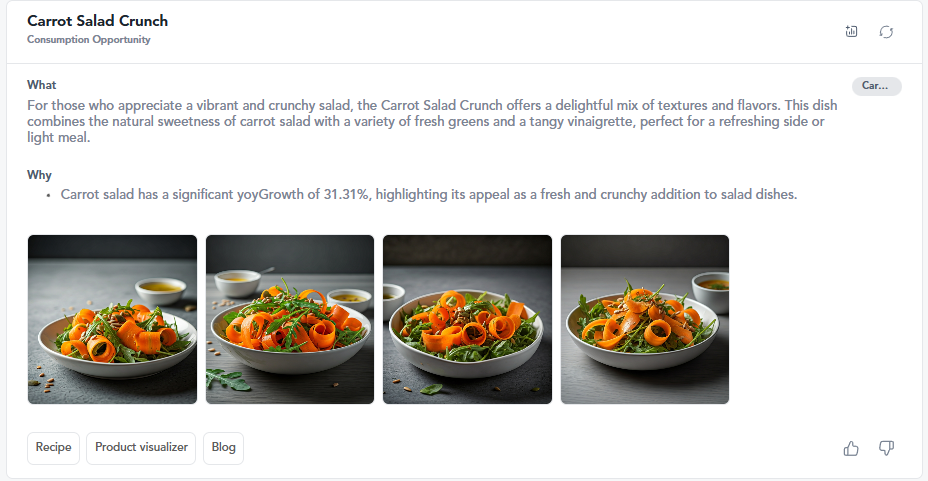
Recipe and menu data show steady decline in traditional salad formats, but growth in specific preparations such as carrot salad (+31% YoY), quinoa-based salads, and chickpea-forward builds.
That concentration indicates that repetition, not category fatigue, is the core issue. Consumers are opting into salads that behave like meals, not sides.
Brands should renovate existing lines around grain-based, legume-based, and warm-prep salads instead of launching entirely new salad SKUs that repeat legacy structures.
Salad trends are consolidating around lunch and dinner occasions
Tastewise category driver analysis shows salads over-indexing at lunch (15.2%) and dinner (18.5%), while snack, breakfast, and meal prep usage underperform compared to savory benchmarks.
This narrows the viable occasions where salads can win distribution. Expansion into all-day usage is not supported by demand.
Commercial teams should anchor salad innovation to core meal occasions and position products as replacements for sandwiches, bowls, or light entrées, not as flexible anytime options.
Channel strategy must change how salad trends are sold
Foodservice data indicates salads are losing space as standalone menu items, while Social F&B panel signals show strong engagement around wraps, bowls, and fusion formats that incorporate salad components without naming them directly.
Consumers are still eating salads. They are just not ordering “salads.”
Retailers and brands should migrate salad equity into adjacent formats, wraps, kits, bowls, then use repeatable Social and Foodservice evidence to defend those decisions internally and sell them externally.
What this means for decision-makers
Salad trends no longer justify broad innovation bets. They require selective deployment, format discipline, and clear channel logic.
Use Tastewise evidence to:
- Cut underperforming classic formats
- Reinvest in cooked, textured, and meal-forward preparations
- Align salads to lunch and dinner only
- Sell adjacency formats instead of standalone SKUs
The risk is not exiting salads. The risk is staying static while demand reorganizes.
FAQs about salad trends
Salad trends are declining as default menu items, not as consumer behavior. Foodservice data shows menu pullback, while Social F&B panel data confirms continued engagement through adjacent formats like bowls, wraps, and meal builds.
Grain-based, legume-based, and cooked-vegetable salads are holding demand. Formats such as quinoa salads, chickpea salads, and carrot salads outperform classic leafy builds because they deliver satiety and texture.
Foodservice data shows operators are cutting low-velocity SKUs. Traditional salads struggle to justify space compared to bowls, sandwiches, or warm dishes that deliver higher check value and repeat orders.
Lunch and dinner dominate salad usage. Tastewise occasion data shows weak performance in snack, breakfast, and meal-prep occasions, limiting viable expansion beyond core meals.
Health is no longer the primary driver. Home cooking panel data shows taste, freshness, and texture outperform health as decision factors, shifting salads into an experience-led choice.
Only if the format changes. Data supports renovating existing lines or migrating salad components into bowls, kits, or wraps rather than launching traditional standalone salads.



We’d love to learn your goals and see how Tastewise fits
We’d love to learn your goals and see how Tastewise fits
Get a personalized demo
Good taste. Wise move.
Your demo request is confirmed. We’ll reach out within one business day to schedule your walkthrough.
What happens next

See what’s driving demand, then turn it into a sell-in story for retailers and operators.
- Connect consumer panels, market trackers, and agents into one evidence view
- Get the “why” behind what’s changing, with explainable demand drivers
- Walk away with a buyer-ready narrative and next steps to activate
Trusted by





“Tastewise is my secret tool for knowing what consumers want next and why.“