





Gen Z eating habits are driven by comfort, flavor, and convenience, not rules. The data shows a generation optimizing food around taste, speed, and social validation, challenging the latest nutrition trends that rely on traditional structure or nutritional purity.
What are Gen Z’s eating habits in short?
Gen Z food choices prioritise comfort, flavour intensity, and convenience, with taste and speed outweighing health, freshness, or meal structure.
- 64.9% prefer comfort foods like pizza, pasta, and burgers
- Flavor influences choice 4.7× more than health
- 52% choose smoothies or drinks when eating on the go
- Sweet flavors outperform savory by 9.7×
- Convenience ranks higher than freshness, cravings, or satisfaction
What actually influences what Gen Z eats
According to the Tastewise Gen Z habits survey, flavor influences Gen Z food decisions 4.7× more than health and nutrition, with 61.5% selecting taste as their primary driver.
This explains why indulgent formats continue to scale even when “better-for-you” messaging increases. Health is framed as a lifestyle add-on, not a food-first discipline.
Price matters less than expected. Only 7.7% cite affordability as their main driver. That shifts value perception toward experience density rather than cost savings.
How social media shapes Gen Z food choices
Social platforms act as trial accelerators for the food trends taking over social media; while 16.3% cite social media as their main influence, consumer behavior shows an even deeper impact.
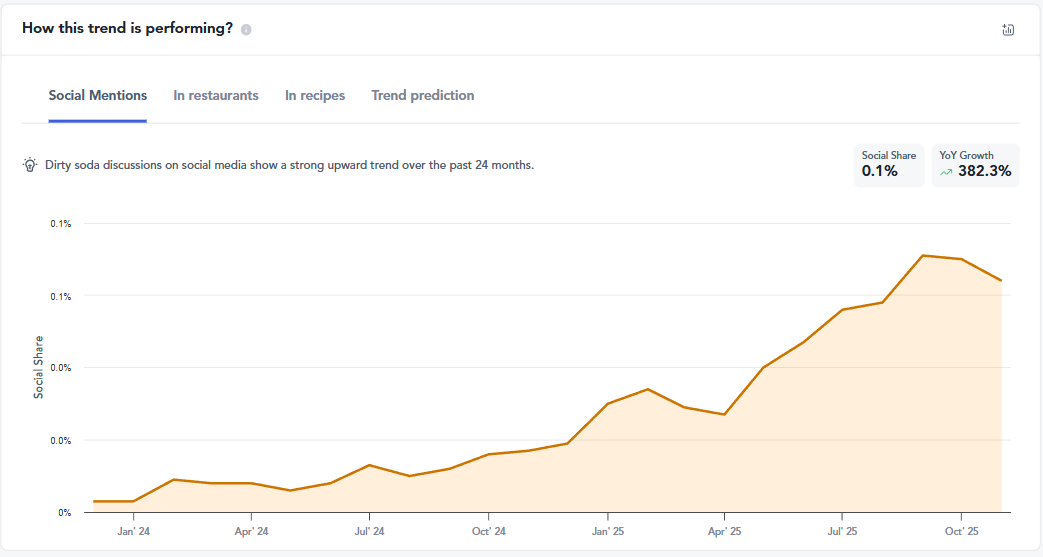
Up-and-coming dishes like Dubai chocolate (+689% YoY) and dirty soda (+382.3% YoY) are discovery-led, not menu-led. Exposure creates demand before availability.
For food marketing teams, this compresses innovation timelines. Products are judged in public before they are scaled.
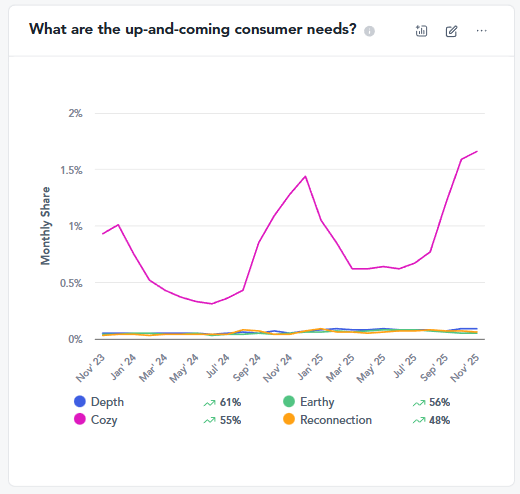
How emerging Gen Z habits and needs perform over time
Cozy is the only up-and-coming consumer need showing both growth and scale. It holds the highest monthly share across the full period and accelerates twice, with the strongest lift in late 2025.
This pattern reflects sustained demand for comfort, warmth, and familiar sensory cues. Earthy grows quickly at +56%, but from a low base, indicating rising acceptance rather than mainstream pull. It performs best when integrated into familiar formats instead of leading them.
Depth posts the fastest growth at +61%, yet remains constrained by limited share. The signal points to interest in richer, more layered flavor experiences once engagement already exists, not as a primary driver.
Reconnection grows +48% but stays the weakest by volume, suggesting conceptual appeal without consistent food-led behavior. To turn these insights into consumer data you can act on, look at the clear structure: Cozy serves as the main driver of demand, Earthy and Depth add necessary complexity, and Reconnection operates best as a supporting narrative layer.
Emerging eating habits for Gen Z for 2026
The insights below reflect observed Gen Z food behaviors based on Tastewise data. They show where familiarity holds, where experimentation happens, and what consistently drives choice.
Gen Z’s favorite snacks culture and flexible meal habits
Snacking replaces structured meals and on-the-go consumption is liquid-heavy.
- 52% prefer smoothies or drinks
- Snack packs rank second at 27.4%
- Finger foods barely register
This is not grazing. It is a functional intake with minimal friction. Beverage trends and snack trends are converging into hybrid formats.
Gen Z eating out, where and why they spend
Eating out is about familiarity with novelty layered on top.
Popular dishes remain stable:
- Coffee (8.9% social share)
- Cake
- Tea
- Chocolate
- Pizza
At the same time, emerging formats cluster around indulgent twists, not new categories. Smashburger tacos and protein lattes test format elasticity without asking consumers to relearn behavior.
This pattern matters for fast food trends and foodservice pricing strategies.
Why Gen Z loves bold flavours and global food
Sweet flavors dominate consumption intent at 68.4%. Spicy follows at 23.1%.
Global flavor interest exists, but it scales best when paired with sweetness or indulgence. Ube-based items outperform birria fusion by 3.6×.
This explains why Gen Z favorite snacks skew toward desserts and flavored drinks rather than savory street food.
Gen Z healthy eating, balance over perfection
Reflecting the shift in healthy food trends in 2026, Gen Z healthy eating is activity-linked, not meal-linked.
- 42.2% associate health with fitness routines
- Only 17% associate it with meal prep
Avoidance behavior supports this. Meat and animal products are avoided 1.1× more than allergens, but ultra-processed foods barely register. Health is selective. It does not override taste or convenience.
Food values, identity, and purpose matter to Gen Z
Ethics rank last in stated decision drivers at 1.6%. That does not mean values are irrelevant. It means values are expected as baseline. Brands do not win points for ethics alone. They lose points when values contradict experience. Food branding for Gen Z must align silently with identity, not announce it.
Based on trend velocity and consumption behavior:
- Liquid meals continue to outpace solid formats
- Sweet-forward flavor systems remain dominant, laying the perfect foundation for the swicy food trend to capture mainstream consumer interest
- Comfort foods stay central, with modular upgrades
- Beverage-led innovation outperforms traditional menu expansion
These Gen Z eating habits favor speed-to-market over long development cycles.
How Tastewise helps brands understand Gen Z eating habits
Tastewise connects Home and restaurant data across food and beverage consumption.
Teams use:
- Consumer Dashboard to track Gen Z preferences in real time
- Operator Dashboard to link social demand to menu performance
- Category Dashboard to identify emerging vs declining items
- Custom Trends and Strategic Dashboards to test concepts before launch
Accelerating reaction times across foodservice, retail, and CPG workflows is why brands choose Tastewise. Explore the Tastewise platform today to see exactly how our real-time Gen Z insights are generated.
What Gen Z eating habits mean for food brands and CPGs
- Build for taste first, then optimize nutrition
- Treat beverages as core meals, not add-ons
- Launch fast, iterate faster
- Use food trends and beverage trends as demand signals, not inspiration
- Align food marketing with behavior, not stated intent
Gen Z eating is pragmatic, not aspirational.
FAQs about Gen Z eating habits
No consistent dinner time dominates. Snacking and liquid meals replace fixed eating windows.
Comfort foods, sweet flavors, desserts, coffee-based drinks, and familiar formats with novelty.
Yes, but cereal trends skew toward dessert-style flavors and snack usage, meaning they don’t actually reflect the breakfast trends shaping 2026.
They are selective, not picky. Flavor and format matter more than category.
Items that combine comfort, sweetness, and portability outperform others.
Coffee drinks, desserts, pizza, chocolate, smoothies, and snackable indulgent formats.
Yes. To see how Tastewise tracks Gen Z behavior across social, menus, recipes, and consumption moments, request a Tastewise demo today.
With Tastewise pricing solutions, brands can accurately identify emerging items, test different formats, and perfectly align their pricing strategy with consumer demand before a full rollout.




We’d love to learn your goals and see how Tastewise fits
We’d love to learn your goals and see how Tastewise fits
Get a personalized demo
Good taste. Wise move.
Your demo request is confirmed. We’ll reach out within one business day to schedule your walkthrough.
What happens next

See what’s driving demand, then turn it into a sell-in story for retailers and operators.
- Connect consumer panels, market trackers, and agents into one evidence view
- Get the “why” behind what’s changing, with explainable demand drivers
- Walk away with a buyer-ready narrative and next steps to activate
Trusted by





“Tastewise is my secret tool for knowing what consumers want next and why.“