





Foodservice performance is being reshaped by how decisions translate into menu engineering, not just what trends are identified. QSR and FSR operators are managing tighter profit margins, higher expectations from Gen Z diners, and increasing pressure on back-of-house operations.
According to Foodservice data, the winning formats are already clear. The gap is execution and turning demand signals into menus that improve check size, throughput, and repeat purchase.
The signals covered here are part of a wider picture of how away-from-home dining behavior is changing in 2026. Consumers are recalculating the value of dining out, daypart patterns are fragmenting, and solo dining occasions are growing faster than most teams have planned for.
The Away From Home 2026 playbook is a data-backed framework for foodservice and CPG teams working through exactly these decisions, covering menu engineering, LTO strategy, and how to build a buyer case grounded in real consumer demand.
Premium is shifting toward familiarity with a crafted edge
Premium is no longer defined by rarity. It is defined by how easily consumers understand it and how efficiently it converts.
In the USA, consumers treat agave wine like a familiar wine occasion, with wine-led contexts appearing in roughly 1 in 5 mentions. At the same time, it is showing up in cocktail builds where tequila is a leading pairing, bridging familiarity with discovery.
According to the Social F&B panel, “real fruit” interest within this space is growing at nearly 2.5x year-over-year. Consumers are leaning into freshness cues and recognizable ingredients rather than abstract premium positioning.
Cocktail language is also shifting:
- Fruits remain dominant, anchoring familiarity
- Seasonings like herbs, spice, and savory accents, are increasing, creating more culinary-style drinks
This moves cocktails away from sweet simplicity toward layered, restaurant-quality builds that justify price.
Menus that treat premium as “crafted but familiar” are performing better than those relying on expensive or obscure ingredients.
A premium agave-wine spritz with lime and real-fruit variants fits directly into this behavior, especially when positioned toward specific audiences like dads, where occasion-based targeting increases conversion and check size.
Customization is expanding, but structure determines profitability
Customization is now expected, particularly among Gen Z diners, but unstructured flexibility creates operational drag.
According to Foodservice data, customizable formats continue to scale, with malatang over-indexing due to its fully build-your-own structure. At the same time, the most successful formats limit complexity through controlled systems.
The same pattern appears in emerging breakfast formats. In the USA, breakfast ramen is not positioned as novelty. It is built around a clear structure:
- Noodles lead the format
- Broth anchors the experience
- Pork is the most common add-on
Consumers are not asking for infinite choice. They are repeating structured builds that feel customizable within boundaries. Spicy variants are gaining traction, signaling demand for intensity in morning occasions.
Menus that translate customization into repeatable builds protect back-of-house efficiency while still increasing perceived value.
A breakfast ramen kit built around noodles and broth, with a pork add-on and optional spicy topper, aligns with both operational simplicity and consumer demand.
Real food is outperforming engineered positioning
The shift toward “real food” is showing up in both protein and plant-based categories.
According to the Home cooking panel, post-shopping behavior indicates a move toward recognizable ingredients and protein-forward meals. Foodservice data confirms meat is growing significantly faster than plant-based alternatives.
Within plant-based, the shift is not toward mimicry. It is toward whole foods. In the USA:
- Vegetables lead plant-based alternatives
- Lentils and chickpeas anchor protein-forward meals
- Chia is rising in snacks and beverages due to functional cues
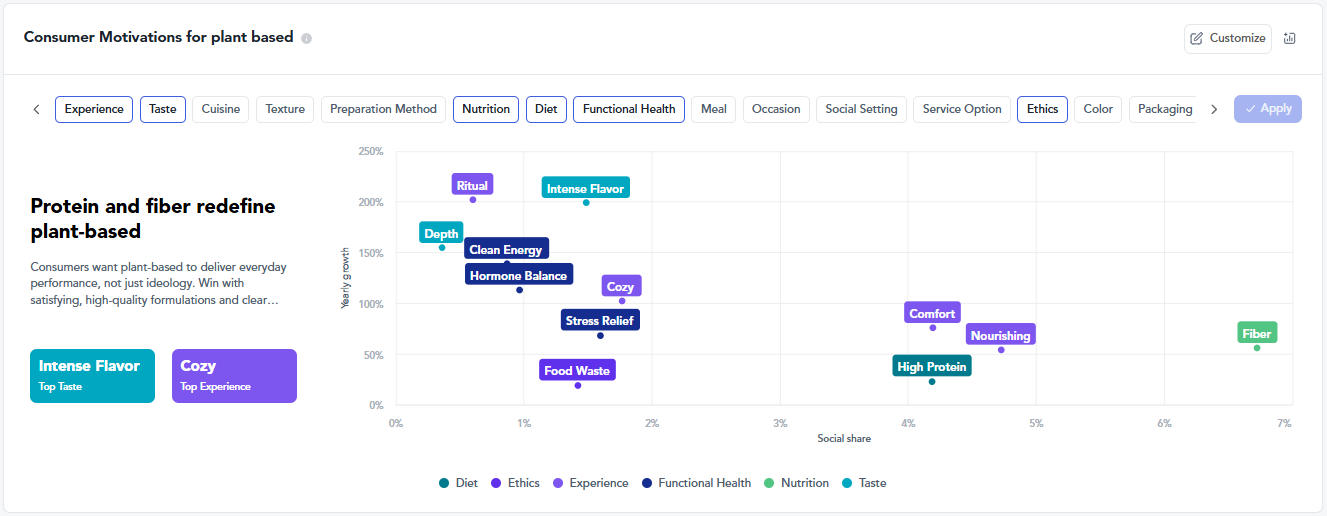
At the same time, demand for intense flavor in plant-based meals has grown roughly 3x year-over-year, indicating that satisfaction, not substitution, is driving choice.
Menus that rely on highly processed meat alternatives are losing relevance. Menus that focus on vegetables, legumes, and bold flavor profiles are maintaining demand.
Plant-based works when it delivers:
- Clear protein and fiber cues
- Recognizable ingredients
- Strong, differentiated flavor
This is a menu optimization challenge, not a positioning exercise.
Texture is becoming a primary driver of value perception
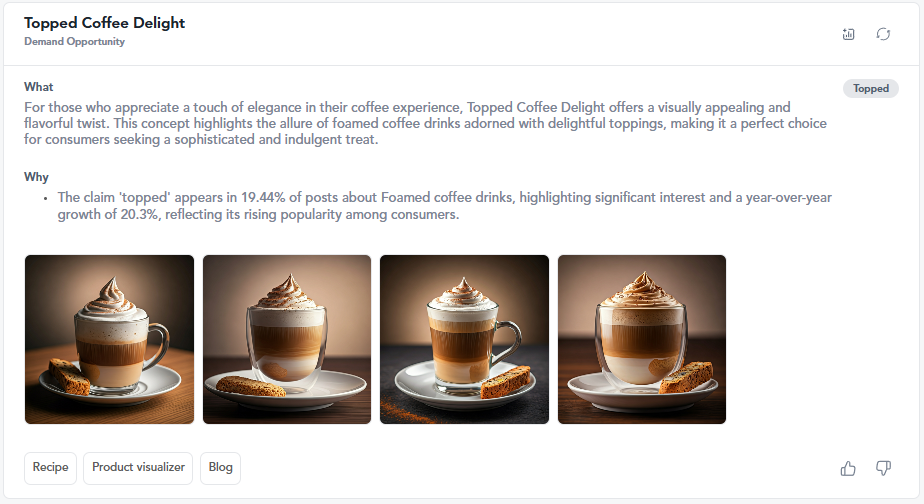
Texture is moving from secondary attribute to core decision driver. According to the Social F&B panel, texture-led formats are increasing across desserts and beverages, with layered and contrast-driven builds generating higher engagement.
In the USA, crunch-and-cream desserts are dominated by:
- Ice cream (present in over half of mentions)
- Cookie mix-ins as the leading crunchy component
Cookies and bars are being used to add structure, turning desserts into scoopable, layered formats. Nuts and seeds reinforce this shift, adding both texture and a “better-for-you” signal that increases permissibility.
Keto consumers are leading adoption in this space, ahead of Moms, indicating that indulgence formats are being reframed through functional positioning.
Texture changes the role of dessert:
It increases perceived complexity and value without increasing ingredient cost.
Menus that integrate crunch into creamy formats are seeing stronger repeat purchase and higher check size contribution.
The Foodservice Paradigm Shift: Past vs. 2026
| Outdated Approach | 2026 Trend |
|---|---|
| Generic premium ingredients | Familiar premium with fresh, real-fruit cues (e.g., agave wine spritz) |
| Open-ended customization | Structured, modular customization systems |
| Plant-based meat mimicry | Vegetable- and legume-led meals with bold flavor |
| Flavor-first innovation | Texture and sensory-led design (crunch + cream) |
| Static breakfast formats | Savory, structured formats like breakfast ramen |
| Menu expansion | Menu optimization and engineering |
| Trend-based decisions | Evidence-based conviction for sell-in |
The operational shift behind the trends
Foodservice teams are operating under tighter constraints while being asked to deliver higher relevance. Every menu decision must now hold up across:
- Profit margins
- Check size
- Back-of-house execution
- Repeat purchase
The breakdown is not in identifying opportunity. It is in aligning teams and translating signals into decisions that can be defended internally and sold externally. Tastewise’s approach centers on explainable, bespoke, and repeatable evidence, so teams can move from insight to execution without losing clarity or speed.
The operators gaining share are not reacting to trends. They are building menus that convert demand into performance, with systems that scale.
The shifts outlined here are already visible across menus, formats, and consumer demand. The gap is not awareness. It is execution.
The full Foodservice Forecast 2026 shows where demand is accelerating, which formats are scaling across QSR and FSR, and how to translate those signals into menu decisions that improve margin, check size, and operational performance.
FAQs about foodservice trends in 2026
Focus on trends that translate into measurable business impact. That means clear potential to increase check size, protect profit margins, or improve throughput. According to Foodservice data, formats that combine familiarity with operational simplicity scale faster across both QSR and FSR environments.
Customization needs to be engineered, not expanded. Limit choices to modular components that map directly to prep workflows. Structured builds increase perceived value for Gen Z diners while maintaining speed and consistency in the kitchen.
Retailers and operators expect proof, not positioning. Concepts need a clear demand signal, a defined target audience, and a strong operational fit. The most effective sell-in narratives connect consumer demand with menu role, pricing logic, and repeatability.
Menu optimization should prioritize performance over variety. Remove low-velocity items, double down on formats that drive repeat purchase, and ensure every item has a clear role in margin, traffic, or brand differentiation. Simpler menus with stronger signals outperform larger, unfocused ones.
The challenge is not insight, it is alignment. Teams need evidence that is easy to explain, tailored to their category, and consistent over time. Using explainable, bespoke, and repeatable evidence allows marketing, R&D, and commercial teams to move forward with decisions that are easy to defend and execute.


We’d love to learn your goals and see how Tastewise fits
We’d love to learn your goals and see how Tastewise fits
Get a personalized demo
Good taste. Wise move.
Your demo request is confirmed. We’ll reach out within one business day to schedule your walkthrough.
What happens next

See what’s driving demand, then turn it into a sell-in story for retailers and operators.
- Connect consumer panels, market trackers, and agents into one evidence view
- Get the “why” behind what’s changing, with explainable demand drivers
- Walk away with a buyer-ready narrative and next steps to activate
Trusted by





“Tastewise is my secret tool for knowing what consumers want next and why.“