





Cheese trends are scaling through repeatable meal usage across retail and foodservice. Demand is anchored in cooking methods and formats that deliver consistent performance and pricing power.
Cheese demand is scaling through repeat usage in core meals
According to the Social F&B panel, cheese holds 4.4% social share with +15.8% YoY growth, concentrated in pasta, sandwiches, salads, and pizza.
This establishes cheese as a high-frequency ingredient embedded in everyday meals. Brands should prioritize portfolio decisions that increase usage occasions per household through format optimization and pack architecture.
Social media shows cheese driving scale through visual payoff and repeatable formats
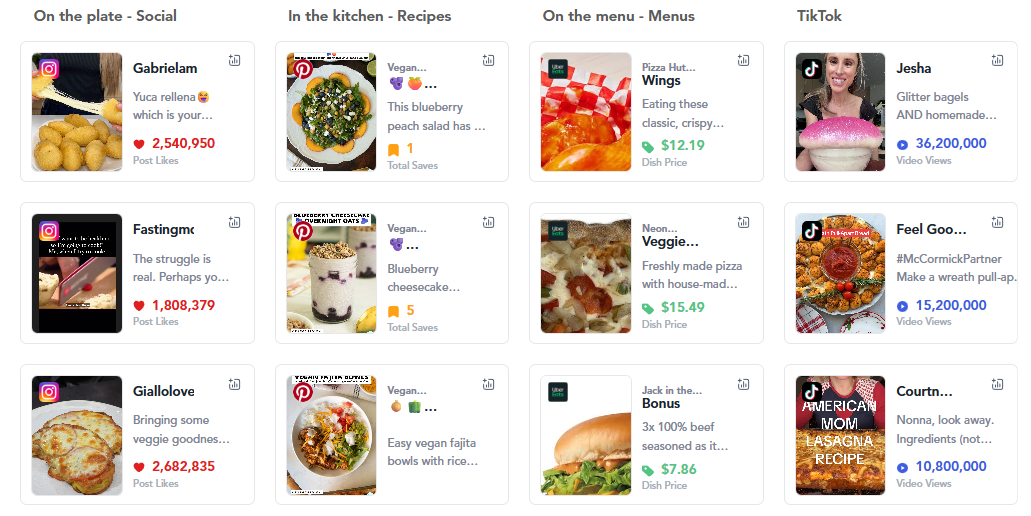
According to the Social F&B panel, cheese-led content generates outsized engagement when it delivers visible texture, melt, and portion satisfaction. High-performing posts cluster around fried fillings (yuca rellena), baked casseroles and lasagna, pull-apart breads, bagels with cream cheese, and mozzarella-forward dishes, with individual videos reaching 10M–36M+ views.
This establishes social as a proof layer for how consumers want to experience cheese: visually rich, comfort-led, and immediately replicable at home or on menu. Engagement concentrates around cheese that stretches, melts, or fills, rather than plated finesse.
Brands should use social performance to validate format and preparation decisions:
- Prioritize cheese formats that create pull, stretch, and melt moments on camera
- Anchor content around everyday builds (pasta bakes, stuffed items, sandwiches, breads) that translate directly to retail and foodservice
- Use high-engagement social dishes as sell-in proof, not inspiration, to support format selection and menu upgrades
Social media confirms that the cheese food trend scales when the product performs visually and functionally in real meals, making it a reliable signal for demand-backed activation across channels.
Melt-dependent cooking methods define where cheese performs best
Foodservice and Social F&B panel correlations show 24x index strength across grilled cheese, cheese pizza, mozzarella sticks, chili cheese fries, and cheese soups.
These dishes rely on heat, texture, and melt performance to deliver value.
Operators should focus menu development on baked, fried, and pan-melted preparations where cheese directly drives satisfaction and trade-up behaviour.
Meal-builder formats concentrate demand
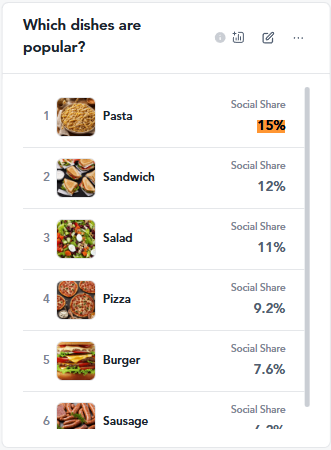
Dish performance shows pasta (15% social share), sandwiches (12%), salads (11%), and pizza (9.2%) as the primary carriers of cheese usage.
These formats position cheese as a structural component of meals rather than a secondary ingredient.
Retail teams should align merchandising and activation around meal-centric use cases, supporting cross-category basket building.
Core cheese types anchor repeatability
Ingredient performance data shows cheddar, mozzarella, cream cheese, Parmesan, and American cheese all indexing 24x in correlation.
These cheeses deliver versatility across multiple dishes and occasions.
R&D teams should protect and extend these core types through cut, shred, slice, and melt-performance innovation.
Consumer need-states reinforce taste-led positioning
Consumer needs associated with cheese are led by Tasty (21%) and American (15%), with consistent engagement across social and foodservice usage.
This clarifies how consumers evaluate cheese at the point of choice.
Marketing teams should anchor messaging in sensory payoff and familiarity, supported by visual proof of usage.
Foodservice validates scalable retail behaviour
Foodservice data shows cheese anchoring best-sellers and indulgent upgrades, while the Home cooking panel reflects strong post-shopping behavior tied to baked pastas, casseroles, and one-pan meals.
This creates a clear validation path from menu performance to at-home replication.
Commercial teams should use foodservice performance as demand proof in retail sell-in conversations.
FAQs about cheese trends
According to the Social F&B panel, cheese growth is concentrated in high-frequency meals such as pasta, sandwiches, salads, and pizza. Demand scales through repeat usage rather than single-occasion spikes, supporting long-term volume decisions.
Foodservice and social data show strongest performance in baked, fried, and pan-melted applications. These methods maximize texture, melt, and sensory payoff, which directly supports price justification and menu stickiness.
Shreds, slices, blocks, and melt-ready formats tied to full meals carry the highest repeat usage. These formats support both foodservice execution and home cooking replication, making them easier to scale across channels.
Cheddar, mozzarella, cream cheese, Parmesan, and American cheese show the highest correlation strength across dishes and occasions. Their versatility enables consistent performance across multiple menus and meal types.
Foodservice data validates cheese as a best-seller anchor and upgrade driver, while the Home cooking panel shows consumers replicating those meals at home. This creates a clear demand proof path for retail sell-in.
Cheese demand is primarily associated with taste and familiarity, led by “Tasty” and “American” need-states. These cues guide positioning, messaging, and visual execution at shelf and on menu.




We’d love to learn your goals and see how Tastewise fits
We’d love to learn your goals and see how Tastewise fits
Get a personalized demo
Good taste. Wise move.
Your demo request is confirmed. We’ll reach out within one business day to schedule your walkthrough.
What happens next

See what’s driving demand, then turn it into a sell-in story for retailers and operators.
- Connect consumer panels, market trackers, and agents into one evidence view
- Get the “why” behind what’s changing, with explainable demand drivers
- Walk away with a buyer-ready narrative and next steps to activate
Trusted by





“Tastewise is my secret tool for knowing what consumers want next and why.“