







Category management software helps FMCG brands optimize product assortment and space planning to maximize category profitability. A modern category management stack requires three layers: planogram visualization tools, historical retail scan data, and predictive consumer intelligence to build compelling growth stories.
- Planogram execution: Blue Yonder, DotActiv
- Historical data: NielsenIQ / Circana, retailer portals (dunnhumby, Walmart Luminate)
- Predictive growth layer: Tastewise
Shelf space is constrained by how defensible the category story is at line review.
Planogram & space planning software
Planogram & space planning software sits at the execution layer of category management. These tools translate assortment decisions into physical shelf layouts by allocating facings, optimizing shelf space, and improving SKU productivity. For FMCG teams searching for category management software, this is where space planning, planogram optimization, and retail assortment execution come together to influence shelf visibility and velocity.
1. Blue Yonder (formerly JDA)
Best for: Enterprise-grade space and floor planning
Blue Yonder remains the standard for large-scale planogram execution. It handles complex store clustering, 3D visualization, and macro-to-micro space allocation across regions and formats.
Category managers use it to:
- Allocate facings based on velocity targets
- Simulate shelf resets across store formats
- Align merchandising standards with retailer requirements
The limitation is not functionality. It assumes the assortment decision has already been made.
2. DotActiv
Best for: Data-driven planogram building and assortment planning
DotActiv connects POS data directly to shelf layouts, making it more accessible for mid-market CPG teams.
It is typically used to:
- Run SKU rationalization exercises
- Translate velocity into facings
- Build retailer-ready planograms faster
It improves execution speed. It does not determine which subcategories deserve expansion.
Historical scan data & retailer portals
3. NielsenIQ (NIQ) / Circana (IRI)
Best for: Syndicated historical POS data and market share reporting
These platforms define how categories performed.
They are used to:
- Track share vs. competitors
- Identify declining SKUs
- Benchmark pricing and promotion performance
They answer “what sold.” They do not justify “what should be added.”
4. Retailer-specific portals (dunnhumby, Walmart Luminate / Retail Link)
Best for: First-party shopper loyalty data and retailer-specific line reviews
Retailer portals are mandatory in line reviews.
They provide:
- Basket-level behavior
- Shopper segmentation within the retailer
- Category penetration and switching patterns
They strengthen the audit phase. They do not provide forward-looking category expansion logic.
Predictive category intelligence
5. Tastewise
Best for: Predictive category growth stories and identifying assortment whitespaces
The failure point in most line reviews is not execution. It is the inability to justify why the category should grow.
Early-stage demand signals consistently appear months before they are reflected in retail scan data. Foodservice data shows that LTO adoption often precedes retail distribution shifts.
This creates a structural gap:
- Scan data validates the past
- Retailers require proof of future demand
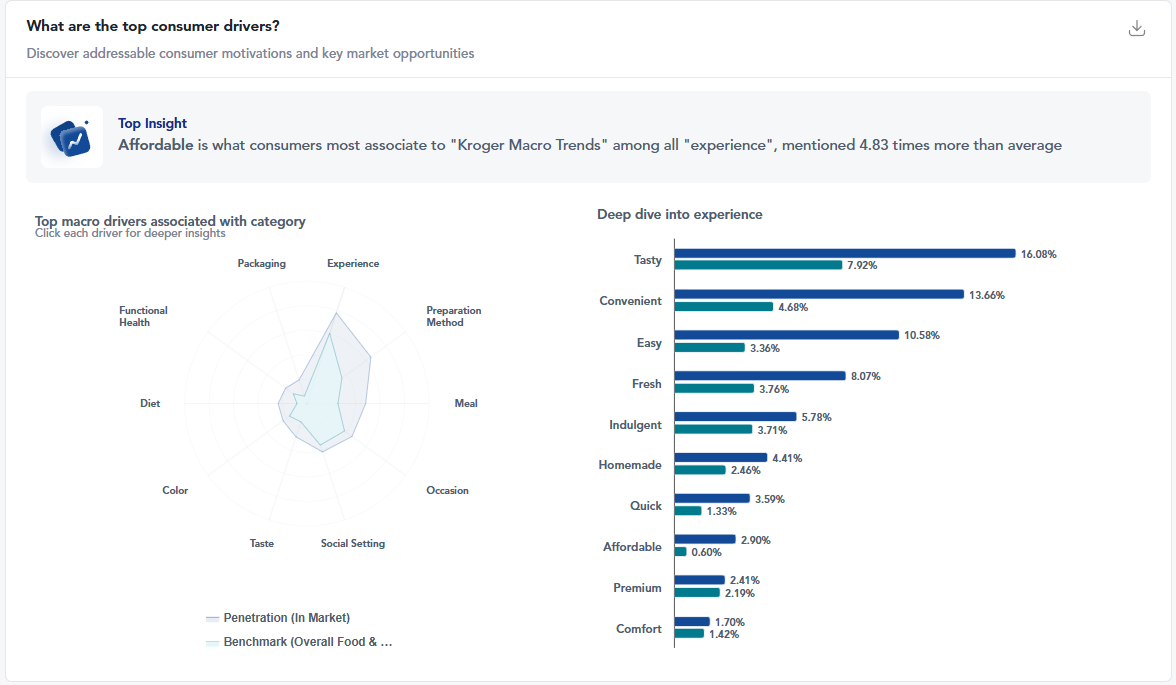
Tastewise closes that gap by identifying:
- Emerging subcategories with demand momentum
- Ingredient and format-level adoption patterns
- Audience-specific drivers of growth
[Insert Graphic: Tastewise Chart showing YoY consumer demand growth for “Functional Beverages” vs. actual shelf space availability]
That evidence becomes the core of the category growth story:
- What whitespace exists
- Why it matters to the retailer’s shopper base
- What assortment expansion delivers in revenue terms
This is the layer that converts a planogram into a sell-in argument.
How to build a modern category management tech stack
Most category plans fail at the line review because the story starts with shelf layout instead of demand justification.
Planogram tools focus on space optimization. Historical data focuses on past performance. Retail buyers evaluate future category growth and expected shopper demand. The disconnect happens when these inputs are not aligned into a single, defensible narrative.
A modern stack works when each layer answers a specific commercial question and feeds directly into the next decision.
Step 1: The vision (Tastewise)
Use predictive intelligence to identify a high-growth subcategory before it appears in syndicated data. Define the expansion opportunity and the shopper it serves.
Step 2: The audit (NielsenIQ + retailer portals
Validate which SKUs underperform. Quantify the space that can be reallocated. Align with retailer-specific shopper data.
Setp 3: The execution (Blue Yonder / DotActiv)
Translate the strategy into a planogram:
- Reallocate facings
- Introduce new SKUs
- Demonstrate shelf productivity improvements
This sequence aligns internal teams and produces a buyer-ready narrative grounded in evidence.
Build category growth stories that retail buyers can’t ignore
To become a category captain, you need to bring the retailer insights they don’t already have. Historical scan data only tells you what happened yesterday; you need to prove what shoppers will buy tomorrow.
Tastewise provides the industry’s most advanced predictive consumer panels and market trackers. Arm your category management team with localized, real-time demand data to optimize assortments, justify shelf space expansions, and win the line review.
FAQ about category management software
Use predictive data to define the growth hypothesis (which subcategory should expand), then use scan and loyalty data to validate where space can be reallocated. The combination creates both forward-looking justification and backward-looking credibility.
Predictive consumer panels and market trackers. Post-shopping behavior and usage patterns surface emerging demand earlier than retail sales data. This allows category managers to act before trends become saturated.
Planogram tools optimize space. They do not justify why the space should change. Retailers require a category growth story backed by evidence. Without predictive demand data, the planogram becomes an execution artifact rather than a commercial argument.





We’d love to learn your goals and see how Tastewise fits
We’d love to learn your goals and see how Tastewise fits
Get a personalized demo
Good taste. Wise move.
Your demo request is confirmed. We’ll reach out within one business day to schedule your walkthrough.
What happens next

See what’s driving demand, then turn it into a sell-in story for retailers and operators.
- Connect consumer panels, market trackers, and agents into one evidence view
- Get the “why” behind what’s changing, with explainable demand drivers
- Walk away with a buyer-ready narrative and next steps to activate
Trusted by





“Tastewise is my secret tool for knowing what consumers want next and why.“