






Key insights
Sprite Pie is a seemingly simple – if a bit unusual – dessert that has major implications for food and beverage brands around the world. The sprite pie food trend is more than a viral food trend. It’s tangible evidence of consumers’ growing interest in retro-novelty and beverage crossover products.
With data from the Tastewise social F&B panel indicating over 25% YoY growth in social media discussions about soda cakes and 15.3% YoY increase in discussions about water pie, Sprite Pie is a real-world example of a trend with measurable implications for the larger CPG and F&B industries. Brands looking to build greater internal and external conviction should consider both the impact of “shock value” products and marketing campaigns as well as the importance of rolling out CPG innovations with flexible, multipurpose applications.
What is Sprite Pie?
Sprite Pie is a unique dessert made by combining lemon-lime soda, sugar, butter and baking it in a pie crust. The recipe is a riff on a Depression-era dessert called “Water Pie” that offered the simplicity and cost-effectiveness families needed during a period marked by limited resources. Fast-forward to 2026, and Sprite Pie has emerged as a flavor-forward, modern take on this historic indulgence.
Even today, some consumers are drawn to Sprite Pie because of its relative simplicity and affordability. Other consumers are drawn to the novelty, with many sharing their attempts at beverage-infused desserts on social media platforms like TikTok. With all of these factors in mind, the Sprite Pie “trend” makes apparent that brands looking to increase conversions and foster ongoing engagement with their products should account for the actual consumer behaviors driving the market.
For example, evidence from Tastewise datasets confirms that consumers are increasingly engaging with soda-based desserts and actively seeking out additional beverage-infused applications in home cooking environments. Brands can (and should) treat this repeatable evidence as validation for R&D, marketing and retail strategies that embrace beverage innovation opportunities and lean into growing consumer curiosity in food.
The data behind the hype
Tastewise data reveal that Sprite Pie has benefitted from recent spikes in social attention and is beginning to show early signs of foodservice adoption. This statistical footprint emulates a classic pattern of micro-viral trends: Rather than demonstrating signs of sustained and steady growth, Sprite Pie social attention data reveals multiple significant spikes during specific seasons.
Based on synthetic data from Tastewise, however, what was once a fleeting viral moment is slated to stake out a more sustained presence in the coming months, with trend prediction forecasts suggesting as much as 39.3% YoY growth in social attention. Thus, the question becomes: How do brands transform a novelty, nostalgia-informed trend into a consistent source of consumer engagement?
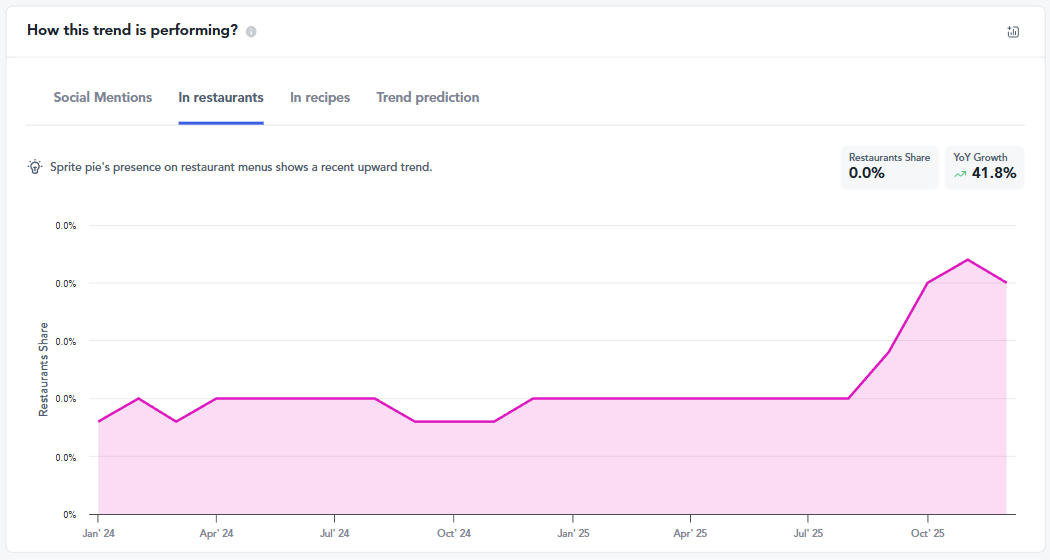
One way is by leaning into potential foodservice partnership opportunities, as current social F&B panel data suggests Sprite Pie has achieved over 41% YoY growth in restaurant menu mentions. This kind of bespoke evidence suggests that Sprite Pie and similar beverage crossover products are becoming more “mainstream” and may therefore achieve the widespread recognition and social acceptance necessary to increase conversions at the individual sales level.
All in all, data from the Social F&B panel combines quantitative and qualitative signals, including social discussion, recipe experimentation and viral trend analysis factors to provide brands with a comprehensive overview of the variables and behaviors fueling trend performance. In the case of Sprite Pie and soda-based desserts, this explainable evidence indicates:
- Viral spikes that suggest repeated windows of heightened consumer awareness
- Repeat cooking behaviors that provide actual merchandising opportunities
- Menu adoption increases that support commercialization potential
The data is clear: Sprite Pie is the kind of trend CPG brands can leverage to achieve internal and external buy-in for new products, innovations and applications. And they can do so without relying on guess-work or historical data alone.
R&D Perspective: Beverage-infused innovation
The key innovation signal here is not about Sprite specifically, but the application of beverages as functional ingredients in desserts. Foodservice signals show soda-based, nostalgic baking trends are increasingly appearing on restaurant menus and are popping up as both long-term and limited time offerings. Similarly, Tastewise’s home cooking panel confirms that consumers are engaging in repeated culinary experiments involving beverage crossover recipes. Both of these datasets suggest that beverage-infused desserts and other opportunities for beverage crossover applications are well-poised for more widespread retail adoption.
This growing consumer interest creates multiple scalable product opportunities for CPG brands because they leverage familiar ingredients in unfamiliar applications. This helps reduce formulation risk while fostering ongoing consumer interest and brand recognition. This provides R&D teams with ample opportunities to leverage consumer curiosity to expand their current offerings into new F&B categories. By leaning into the various applications for a product rather than limiting a brand to a single category, R&D teams can add new products to their rosters and leverage existing products for expanded growth.
Tastewise supports this kind of end-to-end execution, by making it easy for teams to devise data-backed flavor innovation strategies. For example, brands looking to build upon the success of the viral Sprite Pie can easily search the platform for similar beverage crossover opportunities (like Dr. Pepper glaze, for example) to more rapidly foster internal alignment and move towards developing a product with external sales potential.
Marketing lesson: The power of “shock value”
Sprite Pie would likely have fallen short of viral stardom had it not been for its curiosity-sparking novelty. Tastewise Social F&B panel sentiment data shows both curiosity and surprise reactions to the mere idea of a soda-based pie. This shock value generates attention in and of itself and encourages consumers to test out unexpected flavor and format combinations.
The “does Sprite Pie taste good” question alone has fueled thousands of consumers to turn this novelty dessert into the star of viral video content. The uncertainty and curiosity generated by applying a well-known product in a new way reactions drives higher engagement rates among consumers that far surpass standard engagement levels with conventional recipes.
CPG marketing teams can convert this curiosity-driven engagement into commercial impact through controlled activation strategies like:
- Limited-time experimental menu launches
- Social media recipe challenges
- Collaboration campaigns with established or up-and-coming beverage brands
- Seasonal or regional flavor experiments that align with demand spikes
Sprite Pie and other soda-based desserts require consumers to look at existing products in new ways. By using bespoke data to make evidence-backed decisions, marketing teams can validate consumer acceptance prior to launching new products and fully embrace the unexpected or even unusual nature of cross-category products with greater internal confidence.
Finding the next “Sprite Pie” (before your competitors do)
Predicting viral food innovation requires tracking multiple behavioral signals in real time. Tastewise integrates social, foodservice, home cooking and synthetic, survey-based datasets to help brands identify emerging applications early and respond more reflexively to spikes and shifts in consumer demands and preferences.
While many data-tracking initiatives focus only on consumer behaviors at the point of purchase, Tastewise takes the validation process a step further by tracking consumers’ home cooking behaviors to monitor repeat usage and purchase patterns.
This approach helps brands identify early adoption rather than passive engagement signals and makes it easier to validate perceived social growth, foodservice expansion and consumer sentiment and behaviors. By relying on repeatable evidence and data-driven performance projections, brands can engage in an ongoing process of validating, evaluating and re-evaluating growth opportunities in context rather than in a statistical vacuum.
Conclusion
Sprite Pie validates a broader consumer behavior shift: consumers are willing to experiment with beverage-infused desserts and other cross-category applications in pursuit of novelty, nostalgia and simplicity. Additionally, the trajectory of the Sprite Pie trend indicates that unexpected flavor and format combinations can convert viral engagement to sustained commercial adoption and expansion over time.
Tastewise provides the explainable, bespoke and repeatable evidence brands need to make decisions with more conviction before a product even hits the assembly line. By leveraging real-time social, foodservice, home cooking and consumer sentiment data, CPG teams can identify high-confidence innovation opportunities and validate them thoroughly before their competitors can move. Tastewise supports end-to-end execution and fosters internal and external confidence – even in the most surprising or unexpected products, innovations and concepts.
FAQs about sprite pie
Sprite Pie has a sweet, citrus-forward flavor with a custard-like texture. Some consumers report that the pie tastes more like vanilla than citrus and that the carbonation in the soda yields a smooth, dense texture after baking.
Sprite Pie is a social media novelty that has an actual, data-backed presence in home kitchens and on restaurant menus. While viral TikTok recipes and social media discussions about Sprite Pie have historically spiked in a specific seasonal pattern, Tastewise trend predictions suggest that the trend is headed for more sustained acceptance and integration in the months ahead.
Data related to the acceptance and adoption of Sprite Pie validates numerous opportunities for beverage-crossover products and innovations. Brands should look at the consumer behaviors driving recent application experimentation and tailor their R&D, marketing and distribution efforts with consumer curiosity in mind.




We’d love to learn your goals and see how Tastewise fits
We’d love to learn your goals and see how Tastewise fits
Get a personalized demo
Good taste. Wise move.
Your demo request is confirmed. We’ll reach out within one business day to schedule your walkthrough.
What happens next

See what’s driving demand, then turn it into a sell-in story for retailers and operators.
- Connect consumer panels, market trackers, and agents into one evidence view
- Get the “why” behind what’s changing, with explainable demand drivers
- Walk away with a buyer-ready narrative and next steps to activate
Trusted by





“Tastewise is my secret tool for knowing what consumers want next and why.“