





Beverage Trends 2026 are being shaped less by novelty and more by how consumers recalibrated daily habits over the past few years. Shifts in health priorities, work patterns, and social routines have narrowed what actually earns repeat consumption. As a result, beverage growth is concentrating around formats that deliver clear function, fit existing rituals, and can be defended at shelf, not broad ideas of innovation.
Key beverage innovation terms defined
Precision wellness
A beverage approach focused on a specific, measurable health outcome rather than a broad wellness claim. Examples include post-workout drinks with defined protein content, gut health sodas with prebiotic positioning, or sleep beverages formulated with melatonin or magnesium.
Routine-led formats
Beverage formats designed to fit into habits consumers already have instead of creating new occasions. Examples include protein coffee in the morning, prebiotic soda at lunch, or functional tea in an evening wind-down routine.
Functional beverages
Drinks positioned around a clear physiological benefit such as energy, hydration, gut health, focus, calm, or recovery. In beverage innovation trends, functional beverages scale best when the benefit is easy to understand and tied to a familiar format.
Enhanced beverages
Traditional beverage formats with one added benefit, ingredient, or claim. Examples include electrolyte water, vitamin-enhanced juice, or coffee with added adaptogens. The difference from fully functional beverages is that the enhancement supports the format rather than redefining it.
Stacked functional claims
The use of more than one benefit within the same product, such as energy plus gut health or hydration plus immunity. These products can work, but only when one benefit remains primary and the rest support it.
Clean label beverages
Drinks built around ingredient transparency, recognizable components, and fewer artificial additives. In functional drink development, clean label expectations increasingly sit alongside performance claims rather than replacing them.
Botanical beverages
Beverages using plant-based ingredients such as herbs, flowers, roots, or fruit botanicals for flavor, function, or both. These products perform best when the botanical ingredient contributes to taste as well as positioning.
Sustainable beverage packaging
Packaging designed to reduce waste, improve recyclability, lower material use, or create operational efficiency. This includes lightweight bottles, recyclable cans, refill systems, and formats designed for lower shipping or storage impact.
What is precision wellness in beverages?
Precision wellness in beverages refers to products designed to deliver a specific, measurable functional benefit within an existing consumption routine. Unlike general wellness drinks, precision wellness concentrates demand around outcomes such as energy, gut health, or recovery, rather than broad “better-for-you” positioning.
According to the Social F&B panel, beverages tied to a single, clear function are outperforming multi-claim wellness drinks. This is not expanding the category. It is concentrating repeat consumption around formats that already fit daily habits.
Here’s what this means for beverage brands:
- Products without a clear role in a routine are losing repeat purchase
- Demand is not growing evenly across wellness
- It is consolidating around defensible use cases
Traditional vs. Precision Wellness Beverages
| Traditional Wellness | Precision Wellness |
|---|---|
| “Supports overall health” positioning | Targets one clear outcome (e.g., gut health, energy) |
| Example: Vitaminwater | Example: OLIPOP (prebiotic soda) |
| Requires explanation | Immediately understood |
| Drives trial | Drives repeat purchase |
| Harder to defend at shelf | Easier to justify to buyers |
Which functional beverages are succeeding in 2026?
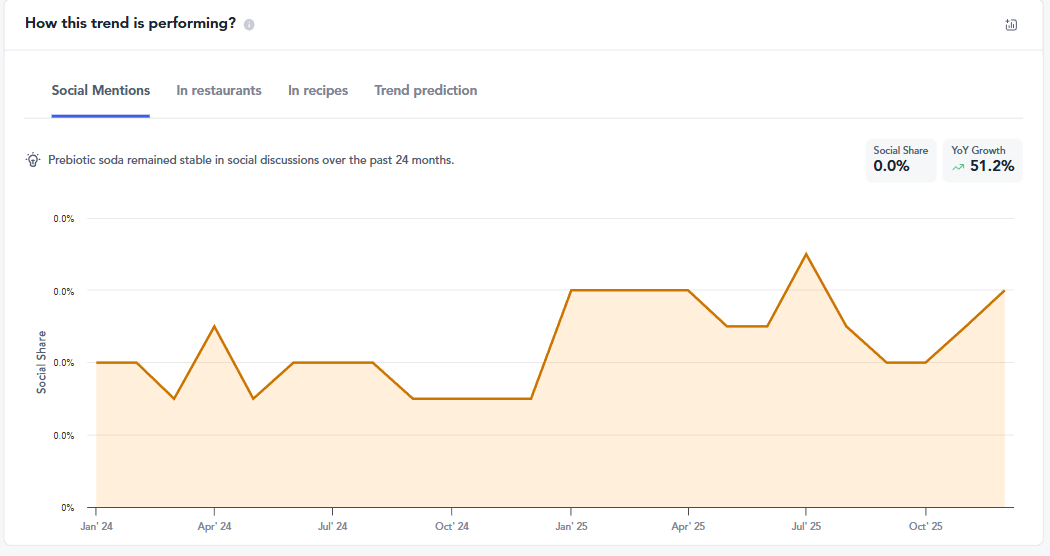
Functional beverages succeed when the benefit is explicit and embedded into a format consumers already use. For instance, when asking does Gen Z drink less coffee, the answer lies in how they drink it: according to the Social F&B panel, protein coffee increased 49.3% because it reframes a daily brew as both energy and nutrition. Similarly, prebiotic soda increased 51.2% by positioning gut health within a familiar refreshment occasion rather than a supplement.
The key difference is how demand is being captured. Growth is not coming from new beverage occasions, but from replacing existing ones with options that deliver more value per consumption moment. In both cases, the format does most of the work. Coffee and soda already have established frequency, so adding function increases relevance without introducing friction.
Here’s what this means for beverage brands: consumers are not looking to expand their beverage repertoire. They are upgrading what they already consume with products that deliver a clearer, more defensible benefit. The products that scale are behaviorally invisible upgrades, formats that require no new habit, no additional explanation, and no change in routine, but offer a stronger reason to purchase repeatedly. This is what makes them easier to justify internally and easier to sell into retail, where repeat velocity determines shelf space.
How do multiple wellness benefits scale without losing clarity?
Functional tea highlights how targeted wellness beverages can address more than one consumer need without diluting clarity. In the Social F&B panel, functional tea demand clusters around healthy (55%), gut health (28%), energy (25%), and antioxidant beverages (24%). This distribution suggests consumers are using functional tea as a daily wellness drink, not a situational intervention.
Supporting signals reinforce this shift. Mentions tied to stacked functional claims grew +299%, while clean label beverages increased +204%, indicating that consumers expect both transparency and performance from modern functional wellness drinks.
The key difference is that these benefits do not compete with each other because the format is already understood. Tea is a habitual, flexible beverage consumed across dayparts, which allows additional functional claims to layer without creating confusion.
Here’s what this means for beverage brands: adding more benefits does not automatically increase value. Benefits only scale when the product already has a clear role in a consumer’s routine. Without that anchor, additional claims create friction rather than differentiation.
How do routine-led formats differ from standalone wellness drinks?
Routine-led formats are beverages designed to fit into existing habits, while standalone wellness drinks require consumers to create new occasions. The difference between the two is adoption friction.
Routine-led formats such as protein coffee, prebiotic soda, and functional tea succeed because they align with moments that already exist, such as morning coffee, refreshment breaks, or evening wind-down. Standalone wellness drinks, including tonics or supplement-style beverages, often struggle because they require new behaviors that are harder to sustain.
The key difference is repeatability. Routine-led formats inherit frequency from the behavior they replace, while standalone drinks must build frequency from scratch.
Here’s what this means for beverage brands: the fastest path to scale is not introducing a new ritual, but embedding functionality into an existing one. Products that align with established consumption patterns are easier to adopt, easier to justify to buyers, and more likely to deliver consistent velocity at shelf.
Functional vs. Enhanced Beverages
| Enhanced Beverage | Functional Beverage |
|---|---|
| Adds a benefit to an existing drink | Built around a specific benefit |
| Example: Smartwater (Coca-Cola) – hydration + electrolytes | Example: Huel Ready-to-Drink – complete nutrition |
| Example: Vitaminwater (Coca-Cola) – vitamins added to water | Example: Premier Protein Shakes – protein for satiety/recovery |
| Function is secondary | Function is the reason to buy |
| Maintains the same use occasion | Defines the use occasion |
| Lower consumer commitment | Higher intent-driven consumption |
What sustainability innovations are consumers actually buying?
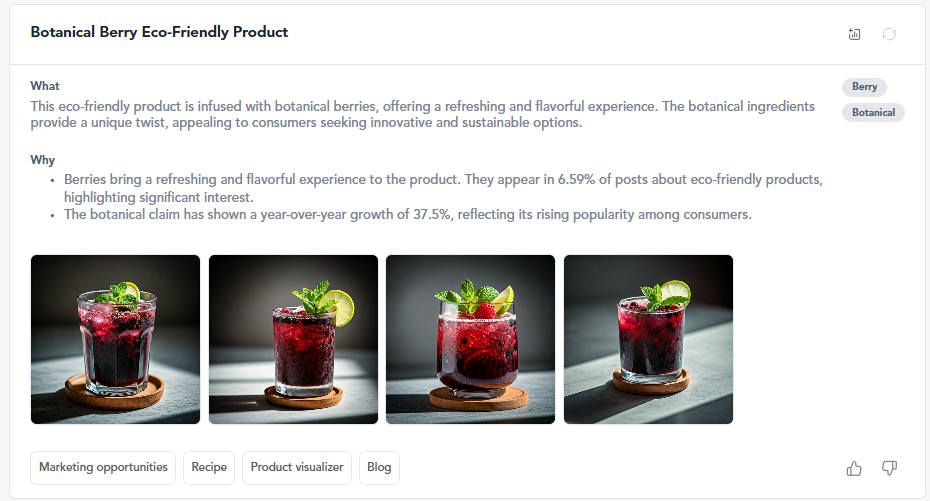
Sustainability innovations are gaining traction when they are specific, visible, and tied to a product’s role. According to the Social F&B panel, botanical-related sustainability signals increased 37.5%, with botanicals appearing in 6.6% of eco-conscious beverage discussions. These products perform when sustainability is integrated into flavor, ingredient familiarity, or refreshment, rather than positioned as a standalone benefit.
The key difference is how sustainability is experienced. Consumers respond to sustainability when it enhances something they already value, such as taste or ingredient quality, rather than asking them to prioritize environmental impact alone.
Here’s what this means for beverage brands: sustainability needs to be embedded into the product experience, not layered on top of it. When sustainability supports an existing purchase driver, it strengthens the proposition. When it stands alone, it struggles to convert.
How do eco-friendly ingredients attract attention?
Concepts that combine botanical ingredients with sustainability cues can generate early interest, particularly in social discovery. For example, a botanical berry beverage positioned around eco-friendly sourcing and natural ingredients reflects growing engagement with botanicals, which appear in 6.6% of social posts tied to eco-conscious products and show +37.5% YoY growth in botanical-related claims.
This type of positioning works best when the ingredient choice reinforces an existing consumption motivation, such as refreshment or flavor, rather than asking consumers to value sustainability as a standalone benefit.
Where do sustainability concepts fail to scale?
However, sustainability-led beverages struggle to scale when the claim remains abstract. Eco-friendly language that is not supported by tangible packaging choices, sourcing transparency, or functional relevance often fails to move beyond early engagement. Without a clear explanation of what makes the product more sustainable, and why that matters in daily use, interest remains surface-level and inconsistent.
This is where many sustainability concepts stall: the consumer understands the intent but cannot articulate the value, and buyers cannot defend the SKU decision. As a result, sustainability must be articulated in a way that connects directly to usage, cost, or operational benefit. Without that structure, even strong intent does not translate into repeat purchase or retail support.
Why is packaging innovation outperforming ingredient-led sustainability?
According to broader beverage innovation patterns, sustainable packaging solutions are outperforming ingredient-led sustainability narratives. Lightweight materials, recyclable formats, and packaging designs that reduce waste or improve storage efficiency are easier for retailers and operators to justify. These changes directly affect logistics, shelf efficiency, and operational cost, making sustainability actionable rather than aspirational.
When sustainability shows up through packaging decisions, it becomes easier to communicate internally, easier to sell externally, and easier for consumers to recognize at the point of purchase. Sustainability becomes commercially viable when it is built into the physical product experience. Packaging makes sustainability tangible, which makes it easier to communicate internally, easier to sell externally, and easier for consumers to recognize at shelf.
Sustainability Claims vs. Proven Eco-Benefits
| Sustainability Claim | Proven Eco-Benefit |
|---|---|
| Broad language (“eco-friendly”, “natural”) | Specific, visible change |
| Example: innocent Drinks – “natural, responsibly sourced” messaging | Example: Liquid Death – aluminum cans replacing plastic bottles |
| Example: Honest Tea (legacy positioning) – organic, ethical sourcing | Example: Boxed Water – carton-based packaging reducing plastic use |
| Ingredient-led messaging | Packaging or format-led proof |
| Requires belief | Easy to verify at shelf |
| Harder for buyers to quantify | Easier to defend in retail conversations |
How is flavor innovation contributing to beverage growth?
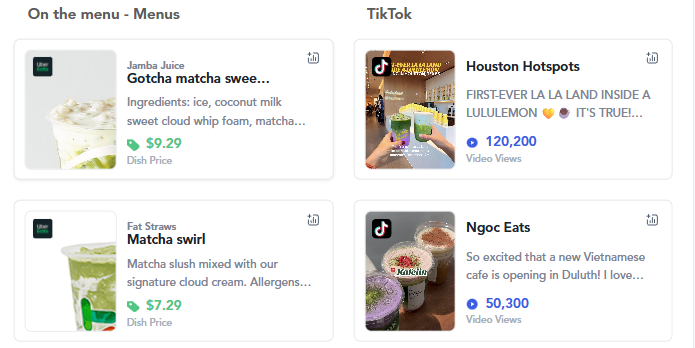
Flavor experimentation continues to play a role in beverage innovation heading into 2026, but adventurousness alone is not what’s driving adoption. The flavors gaining traction are those that enhance an existing benefit, improve sensory payoff, or fit cleanly into familiar beverage rituals. Novelty works when it is legible and purposeful, not when it asks consumers to relearn how or why they drink.
The concept of the matcha cloud illustrates how flavor exploration performs best when paired with a recognizable structure. According to recent matcha consumption data, while the format is still niche in total share, it boasts a +275.6% YoY growth in social discussions and a clear crossover into foodservice with more than 1,600 restaurant placements.The appeal is not matcha alone, but the combination of flavor, texture, and visual presentation within a latte-style format consumers already understand.
Flavor innovation succeeds when it clarifies the product’s purpose and improves drinkability. Formats that require explanation slow adoption, while those that align with existing expectations scale faster.
Intense flavor and real fruit are driving engagement without sacrificing clarity
Across functional beverages, flavor is becoming a differentiator again, but in a controlled way. According to the Social F&B panel, claims tied to intense flavor (+307% YoY) and real fruit (+270% YoY) are accelerating alongside functional benefits. This suggests consumers are no longer willing to trade taste for health, even in wellness-oriented drinks.
Flavor exploration here is additive, not distracting. It supports repeat consumption rather than positioning the beverage as a one-time experience.
Botanical ingredients are gaining traction when flavor does the work
Botanical ingredients continue to show momentum, particularly when they serve a clear sensory role. Botanical claims grew +37.5% YoY, and botanicals now appear in 6.6% of social posts tied to eco-friendly and wellness beverages. However, their performance improves when they are introduced as flavor-forward components, such as berry botanicals, rather than abstract health signals.
Integrating botanical flavors into refreshing, familiar profiles makes them easier to understand and scale, pointing directly to where cocktail culture is heading.
Bone broth drinks extend flavor exploration into savory formats
Flavor exploration in beverages is also moving beyond sweet and botanical profiles. Bone broth drinks show +34.1% YoY growth in social discussions, with recent upward momentum despite a small overall share. The format is gaining traction across home cooking and foodservice, supported by more than 26,000 posts and growing restaurant presence.
Savory flavor works here because the format signals purpose immediately. Bone broth is understood as warming, nourishing, and protein-forward, reducing friction around drinking something traditionally consumed as food. In this case, flavor exploration reinforces function rather than novelty, aligning with the broader shift toward beverages that fit clear routines and use cases.
What should beverage teams validate before launch?
Flavor exploration in 2026 is not about pushing boundaries for their own sake. It is about enhancing function, improving drinkability, and reinforcing format familiarity. Beverages that succeed are using flavor to:
- Strengthen an existing functional promise
- Improve sensory satisfaction without adding complexity
- Deliver novelty within recognizable consumption rituals
For brands, the opportunity lies in choosing flavors that clarify the product’s role rather than compete with it. Identifying the right beverage format is only part of the challenge. Winning retail placement depends on whether the decision can be explained clearly, defended with evidence, and translated into a buyer-ready story.
That’s where most beverage concepts stall. For teams looking to move from insight to shelf, the Winning the Shelf Playbook breaks down how to turn consumer demand signals into retailer-facing logic, what to lead with, what to validate, and how to frame your drink so buyers understand exactly why it deserves space.
A practical checklist for beverage brands entering the market
Before moving a beverage concept toward launch or retail conversations, teams should pressure-test a few fundamentals. These considerations separate ideas that travel from those that stall.
- Is the target consumer clearly defined?
Identify who this drink is for, when they consume it, and what it replaces in their routine. Formats like protein coffee, functional tea, or bone broth drinks work because the audience and moment are immediately legible. - Is the benefit specific and defensible?
Broad wellness positioning underperforms. Anchor the product around one primary need, energy, gut health, calm, recovery, and validate that demand with repeatable evidence. - Does the format align with the function?
Consumers adopt beverages faster when the format matches expectations. Familiar structures such as RTD coffee, soda alternatives, tea, or warm broths reduce friction and support repeat purchase. - Is sustainability tangible, not implied?
Sustainable ingredients or botanical sourcing should reinforce an existing product role. Packaging decisions that reduce waste, improve efficiency, or simplify logistics are easier to defend internally and to buyers. - Does flavor support repeat consumption?
Innovation should improve drinkability, not distract from it. Successful flavor exploration enhances function, reinforces format familiarity, and avoids novelty that limits frequency. - Can the decision be explained simply?
If the concept cannot be articulated clearly to marketing, commercial teams, and retailers, the insight will not travel, regardless of how strong the data looks.
Where Tastewise fits into beverage decisions heading into 2026
The beverage trends shaping 2026 point to a consistent reality: formats that align with clear needs, routines, and buyer logic are earning scale. Insight alone is not enough if teams cannot prove the decision, align internally, and translate demand into a shelf-ready story.
Tastewise helps beverage teams move from signals to conviction with explainable, bespoke, and repeatable evidence across social, foodservice, and at-home behavior.
FAQs about 2026 beverage trends
Beverage trends in 2026 are being shaped by drinks that align with clear functional needs and repeatable routines. Formats like protein coffee, functional tea, prebiotic soda, and bone broth drinks are gaining traction because they fit existing consumption habits while delivering specific benefits.
Functional beverages perform better when the benefit is specific and easy to understand. Consumers are more likely to adopt drinks positioned around energy, gut health, or recovery than beverages relying on broad wellness or “better-for-you” claims.
Formats that replace familiar drinks scale faster. Ready-to-drink coffee, soda alternatives, tea-based beverages, and warm savory drinks reduce friction for consumers and are easier for retailers to merchandise and justify on shelf.
Flavor innovation matters when it supports function and drinkability. Trends like matcha cloud and botanical-forward beverages show that consumers respond to flavor exploration when it enhances a familiar format rather than introducing novelty for its own sake..
Brands can validate beverage trends by combining social signals, foodservice adoption, and at-home consumption behavior. Using data to confirm who the drink is for, when it’s consumed, and what it replaces helps reduce risk before entering retail conversations.


We’d love to learn your goals and see how Tastewise fits
We’d love to learn your goals and see how Tastewise fits
Get a personalized demo
Good taste. Wise move.
Your demo request is confirmed. We’ll reach out within one business day to schedule your walkthrough.
What happens next

See what’s driving demand, then turn it into a sell-in story for retailers and operators.
- Connect consumer panels, market trackers, and agents into one evidence view
- Get the “why” behind what’s changing, with explainable demand drivers
- Walk away with a buyer-ready narrative and next steps to activate
Trusted by





“Tastewise is my secret tool for knowing what consumers want next and why.“