






The US restaurant menu is changing faster than most development calendars can keep up with. Consumers are pulling away from safe, softened formats and moving toward dishes with real flavor depth, global origin, and a clear identity. The 2026 menu trends USA data shows three movements happening at once: intense flavor is the fastest-growing consumer claim in foodservice, globally-inspired dishes are up 85% in tracked operator volume, and chicken is being stretched into new formats and cuisines faster than any other protein. Your menu team needs to know which of those signals has the longest runway, and which ones your competitors are already filling.
Key takeaways
- Intense flavor claims are up 47% in the past year within the poultry category alone, outpacing every other consumer motivation in the set. Menus that continue to soften global flavors for the mainstream are moving in the opposite direction from consumer demand.
- Asian cuisine signals now represent about 1 in 3 consumer food choices tracked across the Tastewise US panel, and Chinese cuisine claims are up 10% in the past 12 months. The consumer appetite for Asian formats at fast-casual price points has stopped being a trend and started being a baseline expectation.
- Chicken is at the center of every major menu shift in 2026. The chicken sandwich format is up 47% in the poultry category, pasta applications for chicken are up 46%, and the bao bun format has grown 188% in the past year. Where chicken goes, your menu brief should already be pointing.
- Traditional menu formats are holding a 27% consumer share in the foodservice panel while simultaneously declining 14%. Consumers still order the familiar, but they want it done with more care and with a reason to return. Upgraded and premium claims are both growing, signaling that quality-of-execution matters more than format novelty right now.
What is actually driving US menu trends in 2026
The headline finding from the current data is not one trend. It is a tension between two consumer pulls that your menu has to resolve. On one side, about 1 in 4 consumers are still choosing traditional menu formats, and comfort and authentic claims are both present and growing in the 2026 data. On the other side, intense flavor is up 47% in the past year, Southeast Asian flavors are up 41%, and the bao bun format has grown 188%. Consumers want something that feels familiar and something that tastes genuinely different. The menus winning in 2026 are the ones serving both at the same time.
Tastewise tracks this across 115 million menu items and 873,000 restaurants in the US. The platform connects what consumers are choosing to eat with what operators are actually putting on menus, and right now those two datasets are telling the same story from different angles: the floor for global flavor has been established in the mainstream, but most operators are still treating it as an occasional LTO rather than a menu architecture decision.
The opportunity is in the specifics. Not global flavor as a concept, but the exact dish formats, preparation signals, and daypart applications where consumer demand exists and operator menu supply is still thin. That is what the data below addresses.
Chicken is the sharpest lens on 2026 menu trends
No protein is being pulled in more directions by consumer demand right now than chicken. It is also where the clearest white space sits in the 2026 US menu data. Chicken’s overall consumer trajectory in the poultry category shows 594 tracked consumers and 722 posts, down 32% in the past year, but the breakdown by format tells the real story. The formats that are growing are growing fast.
The chicken sandwich is up 47% in tracked consumer posts within the poultry category. Pasta applications for chicken are up 46%. The bao bun format has grown 188% in the past 12 months. Grilled chicken is up 67% and tortilla-based formats are up 95%. The core chicken protein is not declining as a consumer choice. Consumers are declining specific preparations and actively choosing new ones. That is a format migration, not a category retreat.
For operators and menu developers, the restaurant chicken cost and menu pricing picture in 2026 adds a second dimension to this. Chicken remains the most cost-efficient protein for operators running tight margins on a fast-casual menu. The migration toward globally-inspired chicken formats, bao, pasta, tortilla wraps, stir-fry applications, means your team can build novelty and demand at a price point that does not erode margin. Intense flavor seasoning, glazed preparations, and stir-fried applications all index well in the claims data and all apply cleanly to chicken at QSR and fast-casual price tiers.
The three global cuisine signals shaping US restaurant menus
The food and beverage trend forecast for 2026 covers category-level shifts in detail. At the dish level, three specific global signals are showing the strongest combination of consumer reach and operator white space right now.
Asian and Chinese formats at mainstream scale.
Asian cuisine claims represent 33% of consumer choices tracked in the chicken and poultry category, with Chinese cuisine up 10% in the past year. This is not a specialty operator signal. Asian and Chinese formats are appearing in the claims data for broadly accessible US foodservice, which means the consumer who eats at a fast-casual chicken concept is already expecting at least one Asian application on the menu. If your menu does not have one, you are leaving a meaningful share of that consumer’s repeat visits on the table.
Southeast Asian at fast casual.
Southeast Asian claims are up 41% in the past year in the poultry and chicken category. Thai applications within that set are up 44%. The practical menu translation is straightforward: Thai basil chicken, lemongrass marinades, and wok-prepared preparations are all appearing in the operator data at price points between $14 and $21. These are not premium or experiential formats. They are fast-casual builds that the consumer is already choosing, and the operator data shows they are not yet saturating any segment outside of dedicated Thai and Southeast Asian concepts. That is the definition of white space.
French technique crossing into everyday formats.
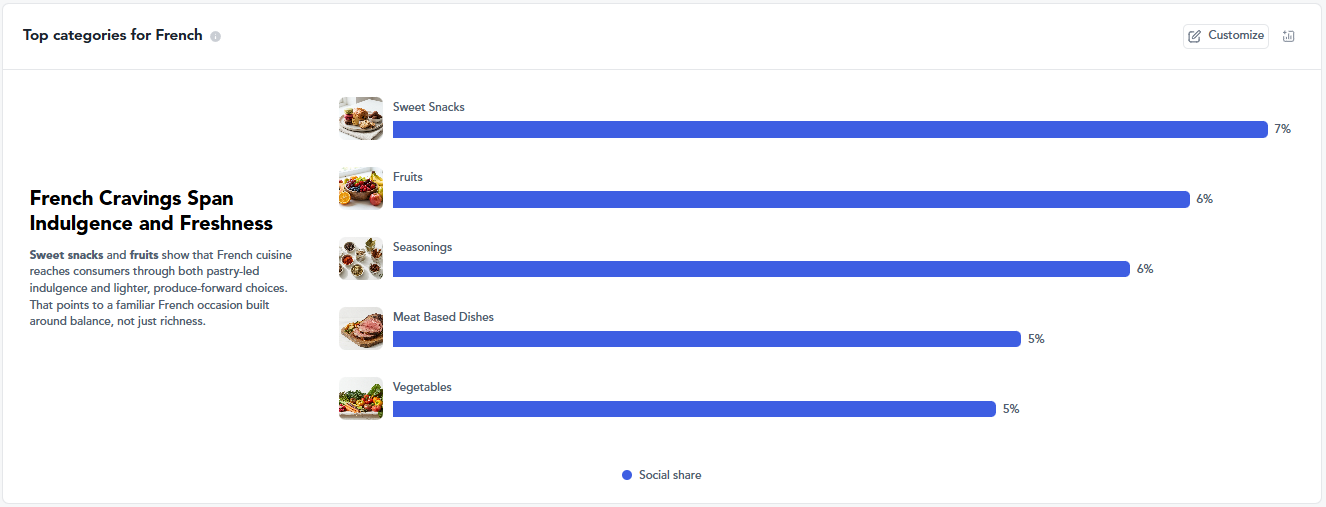
French cuisine claims in the chicken category are up 36% in the past year. That is a less expected signal than the Asian figures, but it is consistent with a broader consumer shift toward quality-of-execution signals: upgraded (up 16%), premium (up 27%), and roasted (up 12%) are all growing in the same category. Consumers are choosing French-influenced preparations, confit, braised, and cream-sauce applications, at accessible price points. This is a signal for menu developers building in the FSR and polished casual tiers more than in QSR, but it is worth tracking for any operator whose positioning relies on quality differentiation.
What traditional menu trends actually mean in 2026
One of the most misread signals in the current data is the traditional menu category. Traditional claims hold 27% consumer share in the foodservice panel, which is large. They are also down 14% in the past year. Some operators read this as a signal to move away from traditional formats entirely. That is the wrong interpretation.
The consumer is not abandoning traditional dishes. Comfort is up 50% in the same dataset. Authentic is holding steady. What the traditional claim decline actually signals is that consumers are becoming more selective about which traditional preparations they still find worth ordering. A burger that does not do anything interesting is losing ground. A burger that is smashed, seasoned with a distinct flavor profile, and upgraded in some specific way is not.
The upgraded (up 16%) and premium (up 27%) claim growth in the same dataset is the correction signal. Consumers want traditional formats with a reason to choose them over the option two doors down. Your menu brief for 2026 traditional formats should not ask which dishes to drop. It should ask what each traditional dish does that no competitor is doing yet.
The foodservice operator forecast covers how chain operators are responding to this shift across QSR, fast-casual, and full-service segments.
Your next menu cycle starts with the right data.
Catering menu trends and the daypart gap
The food trends catering menu picture in 2026 is being shaped by the same global flavor migration happening in the restaurant channel, but the daypart and format pressures are different. Catering operators and menu developers building for events, lunch programs, and corporate formats are facing a specific version of the same consumer challenge: the person eating at a catered event in 2026 has the same globally-informed palate as the person eating at a restaurant, but the formats they can accept are constrained by service logistics.
Event claims are up 56% in the chicken category. Celebration occasions are up 30%. Business setting claims are up 150% in the past year, from a small base, but the direction is clear. The catering and event occasion is becoming more demanding, not less. The consumer attending a catered event in 2026 is more likely to notice if the protein is tired and less likely to forgive a menu that looks identical to the one from three years ago.
The practical catering menu opportunity sits in globally-flavored proteins built for easy service: marinated and glazed preparations (marinated flat at 5% growth, glazed up 95%) that hold well, portion clearly, and carry a flavor story the guest can identify. Sesame (up 96%), sticky preparations (up 104%), and tandoori applications (up 24%) all appear in the operator data as viable catering formats that are underrepresented outside dedicated global cuisine caterers.
FAQs about menu trends USA
Three signals have the strongest combination of consumer reach and operator white space in the current data. The first is intense flavor in chicken formats: up 47% in the past year and appearing across globally-inspired applications that are not yet saturating the mainstream fast-casual menu. The second is Southeast Asian and Thai applications: up 41% and 44% respectively in the poultry category, present on menus but still concentrated in specialist operators. The third is the upgrade signal in traditional formats: upgraded claims are up 16%, premium up 27%, meaning consumers want familiar dishes executed with more intention rather than new dishes from scratch.
Chicken remains the most margin-friendly protein for operators navigating 2026 cost pressures. The consumer migration toward globally-inspired chicken formats, bao bun applications up 188%, pasta applications up 46%, and stir-fry preparations up 74%, means operators can build novelty and repeat-visit demand using a cost base they already control. Intense seasoning, glazed finishes, and globally-inspired sauces all add perceived value without adding significant ingredient cost. The pricing ceiling for globally-flavored chicken at fast-casual is already demonstrated in the operator data, with items like Thai basil chicken and Korean-influenced formats sitting comfortably at $14 to $21 in current menu surveys.
They are not in conflict. The consumer choosing a traditional format in 2026 is making a quality-of-execution choice, not a flavor-avoidance choice. Traditional claims hold 27% consumer share in the foodservice panel, but the same consumer panel shows comfort up 50%, authentic steady, and premium up 27% in the same set. The consumer wants a dish they recognize, prepared in a way that gives them a specific reason to choose it. Your brief for traditional formats in 2026 should focus on what makes each dish worth ordering over the competitive alternative, not on whether to keep it on the menu at all.



We’d love to learn your goals and see how Tastewise fits
We’d love to learn your goals and see how Tastewise fits
Get a personalized demo
Good taste. Wise move.
Your demo request is confirmed. We’ll reach out within one business day to schedule your walkthrough.
What happens next

See what’s driving demand, then turn it into a sell-in story for retailers and operators.
- Connect consumer panels, market trackers, and agents into one evidence view
- Get the “why” behind what’s changing, with explainable demand drivers
- Walk away with a buyer-ready narrative and next steps to activate
Trusted by





“Tastewise is my secret tool for knowing what consumers want next and why.“