






Cake trends in the US are holding steady. Across the Tastewise US consumer panel, cake moments held level with last year over the past 12 months, and cake dishes dipped 1.4%. Demand still clusters around occasions. Birthdays come up in nearly 1 in 6 US cake moments (16%), so volume rises and falls with the celebration calendar.
The cake data behind these figures covers 1,365,817 US consumers, 336,614 recipes, 3,657,424 dishes and 457,401 restaurants.
Key takeaways
- Cake moments in the US held level with last year, and cake demand follows the celebration calendar of birthdays, weddings and weekends.
- Birthdays come up in nearly 1 in 6 US cake moments (16%), and celebration is up 10% on last year.
- Chocolate and cheesecake still lead cake dishes, while cupcake (down 21%) and birthday cake (down 31%) are shrinking.
- Speculoos (up 36%), cookie butter (up 28%) and matcha (up 15%) are the fastest-growing cake flavours. Pistachio is down 9% and chocolate pistachio 12%.
- Japanese cheesecake (up 159%) and yogurt cake (up 49%) lead format growth, as last year’s crunchy kataifi and knafeh cool.
- In US cafés and coffee shops, speculoos, cookie butter and cinnamon buns lead dessert growth, with 62,106 dessert items tracked on café menus.
Market performance and demand signals for cake trends
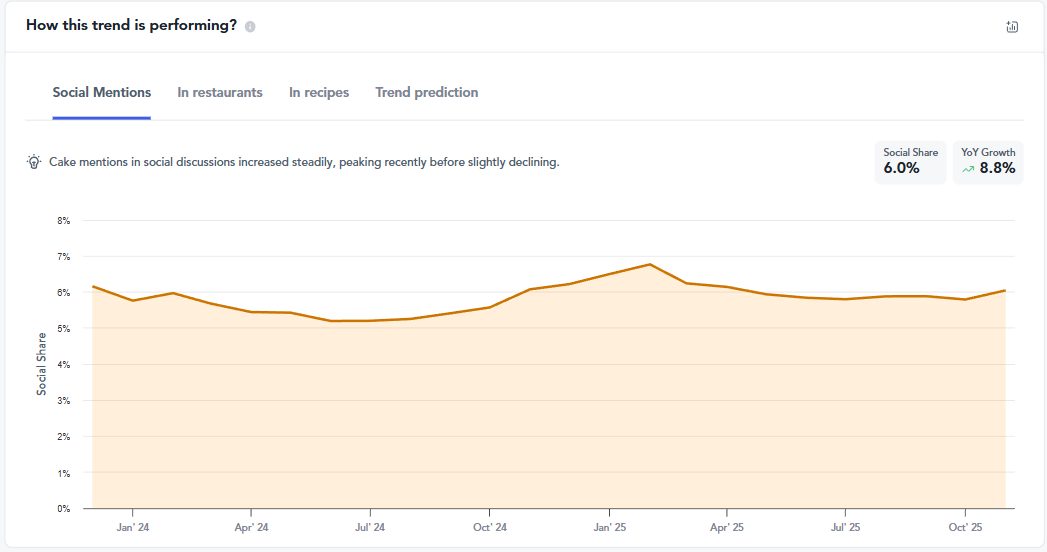
Cake is still a high-volume category, and its demand follows the calendar. Birthdays (16%), weekends (8%) and weddings (7%) shape when US cake moments peak, which ties cake trends to seasonal events and social moments.
For CPG and foodservice teams, that means forecasting around demand windows. Weekend cake moments are up 9% on last year and weekday moments 8%, so plan launches and LTO timing around the weekend peak.
What consumers want from cake right now
Tastewise consumer needs show cake demand is being shaped by sensory expectations and presentation.
Top needs in US cake moments:
- Birthday (16%)
- Tasty (12%)
- Baked (11%)
- Sweet (11%)
- Celebration (11%)
- Attractive (10%)
- Indulgent (10%)
“Birthday” now leads at 16%, ahead of “tasty” (12%). Among the top seven needs, only “celebration” (up 10%) and “attractive” (up 2%) grew on last year, while “tasty” fell 20%. Cake demand is leaning on the occasion and the look, which puts pressure on formats that photograph well and hold their structure.
Why “attractive” changes cake product design
“Attractive” demand pushes cake toward:
- higher contrast layers (dark + light)
- glossy finishes (frosting, glaze, sauce)
- toppings that read instantly on camera (berries, pistachio, chocolate shards)
That affects both menu builds and packaged innovation. A cake that travels poorly or loses definition loses social value.
Dish performance: the winners are classic, the growth is global
Across the Tastewise US consumer panel, cake moments are anchored in familiar products.
Most common cake-related dishes, by share of US cake moments:
- Chocolate (15%)
- Cheesecake (11%)
- Cookie (10%)
- Cupcake (10%)
- Birthday cake (8.6%)
- Muffin (5.4%)
- Chocolate cake (5.3%)
Chocolate and cheesecake lead because they are reliable, and they work as slices, mini portions, layered desserts and hybrid builds. Most of the top seven are shrinking. Cupcake is down 21% on last year and birthday cake 31%.
The up-and-coming list is where the cake trends are changing fastest:
- Japanese cheesecake (+159%)
- Yogurt cake (+49%)
- Speculoos (+36%)
- No-bake cheesecake (+29%)
- Cookie butter (+28%)
- Sourdough cookies (+25%)
Kataifi and knafeh, last year’s breakout textures, have cooled. Knafeh is down 42% on last year and kataifi 17%. The growth has moved to soft and tangy textures and to cookie flavours. Japanese cheesecake and yogurt cake trade on a light, airy crumb, and speculoos and cookie butter add a spiced biscuit layer to cheesecake and sponge.
What softer textures mean for foodservice
Japanese cheesecake, yogurt cake and Biscoff cheesecake (up 21%) work because they offer:
- a light texture that holds up as a single slice
- portion flexibility (slices, cups, mini rounds)
- a flavour cue consumers already know from coffee (speculoos)
Restaurants can adapt these into plated desserts or bakery cases without needing full cake decoration labour.
What softer textures mean for CPG
For retail, the same formats can translate into:
- chilled cheesecake cups and slices
- cookie butter or speculoos swirl cakes
- yogurt-based loaf cakes
The operational question is shelf life. Chilled cheesecake and yogurt formats need cold-chain space, so test them first where your chilled bakery distribution is already strong.
Dish lifecycle stages show where the next menu ideas are forming
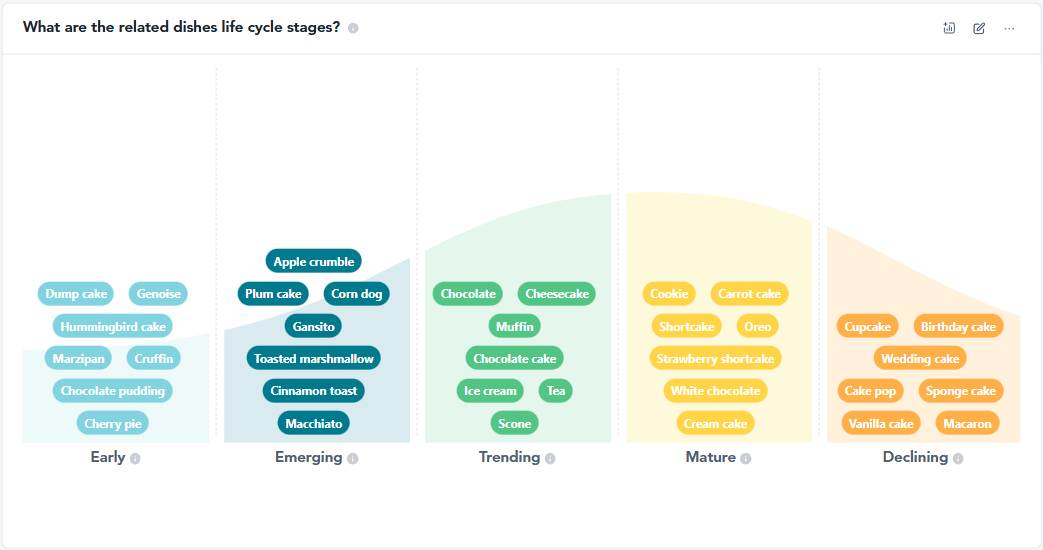
Tastewise lifecycle staging shows cake innovation isn’t coming from “new cake flavors” alone. It’s coming from new formats that change how cake is made, served, and sold.
Early-stage formats are built for speed and texture
Dump cake and cruffin point to two directions, and the data now splits them. Dump cake is down 10% on last year, while cruffin is up 14%.
Dump cake reflects demand for low-effort baking. It’s less about perfect decoration and more about an easy, reliable outcome. The low-effort need is still growing as dump cake fades. “Easy” is up 17% in US cake moments and no-bake cheesecake 29%, which keeps the case open for CPG-ready shortcuts (mix-ins, tray bakes, no-bake kits) and foodservice batch desserts that can be portioned fast.
Cruffins bring the opposite value. They’re a hybrid bakery format that feels premium because of texture and structure, not because of frosting work. This is a cleaner path to “special” without adding labour.
Emerging dishes push cake into snack and coffee occasions
Toasted marshmallow (up 21%), banana bread (up 20%) and cinnamon bun (up 14%) are growing in US cake moments, and coffee pairings are climbing with them. Latte is up 17% since last year and iced latte 25%.
These flavours and formats work because they’re familiar, warm, and easy to translate across channels:
- bake and spice cues (banana bread, cinnamon bun) fit snackable bakery items and seasonal retail runs
- toasted cues (toasted marshmallow) fit LTO toppings and fillings
- coffee-linked cues (latte, iced latte) expand cake into morning and afternoon occasions
For foodservice, this supports sliceable cakes, muffins, and coffee-pair desserts. For CPG, it supports portable formats and limited-time seasonal runs that don’t require consumers to learn a new product.
Ingredient performance for cake trends
Tastewise ingredient share shows the cake food trend is still powered by classic profiles:
Most common ingredients, by share of US cake moments:
- Chocolate (15%)
- Berry (13%)
- Strawberry (7%)
- Vanilla (5.8%)
- Frosting (4.9%)
- Sugar (4.7%)
- Buttercream (3.7%)
Chocolate holds the top spot in both dish share and ingredient share (15% each). That’s category stability. It also means new launches need to compete with a flavour consumers already treat as “default”.
The momentum is in modern pairings and premium cues.
Fastest-growing flavour ingredients, by growth in US cake moments over the past 12 months:
- Speculoos (+36%)
- Cookie butter (+28%)
- Greek yogurt (+21%)
- Matcha (+15%)
- Allulose (+15%)
- Brown butter (+12%)
Matcha is the green cue that held on. It is up 15% and sits in 1.3% of cake moments, a far bigger base than strawberry matcha (0.14%, up 8%). Pistachio has cooled, down 9% on last year, and chocolate pistachio is down 12%. Speculoos and cookie butter lead the growth, which points cake toward spiced, caramelised biscuit flavours.
Where allulose fits into cake innovation
Allulose is still small, in 0.02% of US cake moments, but it is up 15% on last year, and cake is not usually associated with sugar reduction.
- “lighter” cake positioning without removing indulgence cues
- better-for-you bakery lines
- protein-forward or functional bakery formats that still need sweetness
The aim is meeting the “tasty” expectation (12% of cake moments) while reducing the sugar load that can limit repeat purchase. “Protein” is moving the same way, up 11% on last year.
Consumption moments for cake trends
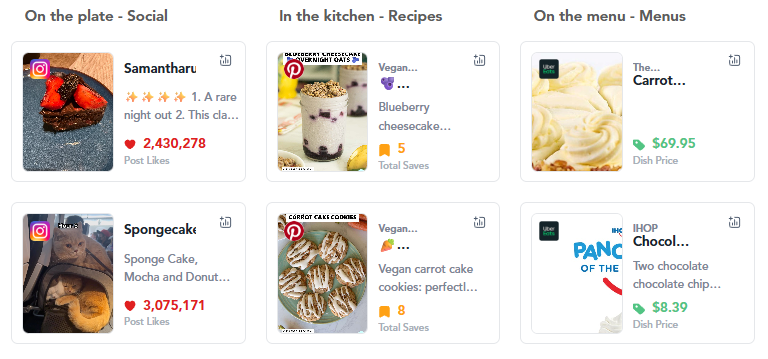
Tastewise consumption moments show cake is performing heavily “on the plate” through social engagement, and on TikTok through high-view formats.
TikTok performance examples:
- Custom handmade cake reveal: 68.6M views
- Sushi-style birthday cake: 20.2M views
- Three-layer Matilda chocolate cake recipe: 15.8M views
- Cinnamon roll wedding cake: 5.0M views
- Cinnamon roll cheesecake: 4.6M views
The top videos are built around a reveal: a one-of-a-kind custom cake, a cake made to look like sushi, cinnamon rolls stacked in place of a wedding cake. Even the recipe video in the top five sells a three-layer cross-section. A cake that creates a strong reveal moment is more likely to be shared.
What this means for product formats
The strongest social formats support:
- layered cakes with visible interiors
- stuffed centres and fillings
- strong colour contrast (matcha, strawberry, pistachio)
- sliceable products that hold shape
Those mechanics fit both bakery case and packaged dessert innovation.
Menu and retail translation: where the money is made
Tastewise menu snapshots show cake formats appearing across mainstream chains and dessert-led brands:
Examples:
- The Cheesecake Factory: Toasted Marshmallow Galore ($13.95)
- Nothing Bundt Cakes: Strawberries and cream Bundtlet ($7.19)
- McDonald’s: Hotcakes ($6.19)
- Metro Diner: Strawberry shortcake pancakes ($11.89)
- Mimi’s Cafe: Banana chocolate loaf ($6.92)
This matters because the cake trends aren’t limited to “cake slices.” It’s showing up in:
- breakfast formats (pancakes, hotcakes)
- single-serve formats (Bundtlets, slices)
- portable baked goods (banana loaf)
That’s where scale happens. Cakes become a flavour system and texture cue that can be applied across dayparts.
What to do with this as a foodservice team
Prioritise formats that:
- work in high-throughput kitchens
- deliver visual impact without complex decoration
- allow seasonal rotations (berry, strawberry, chocolate)
Cheesecake mousse-style toppings and layered builds are operationally simpler than full cakes, while still meeting “celebration” and “attractive” needs.
What to do with this as a CPG team
Build cake innovation around:
- flavour pairings with growth behind them (speculoos, cookie butter, matcha)
- texture formats (airy Japanese-style cheesecake, yogurt cake, biscuit crumb layers)
- sugar strategy options (allulose, up 15%, and protein, up 11%)
Classic chocolate still leads at 15% of cake moments, though it is down 15% on last year. The growth is in biscuit spice, matcha and soft, tangy textures.
Leveraging comprehensive cake datasets for data-driven innovation
Cake trends move through occasions, flavours and formats at different speeds, so a single sales report rarely tells you which change is worth a launch. Tastewise reads cake demand from three sources together: what US consumers eat and share, what home cooks bake, and what restaurants put on the menu. Its cake datasets include 3.19 million restaurant menu items across 446,441 US restaurants and 16,530 chains, read alongside the consumer and recipe data above.
Reading those sources together matters because they rarely move in step. Cake moments overall held level with last year, while the flavours inside them shifted sharply.
Data-driven flavour validation
Granular cake data lets your product developers check a flavour pairing before it reaches a concept brief. Pistachio is a useful test. It still sits in slightly more US cake moments than matcha (1.4% against 1.3%), but pistachio is down 9% on last year while matcha is up 15%. Chocolate pistachio, a breakout pairing a year ago, is now down 12%. Earl Grey (up 4%) and salted caramel (up 1%) are flat.
Formats show the same split. Basque cheesecake is up 9% and Japanese cheesecake has more than doubled (up 159%), while bento cake, the mini format behind many single-serve launches, is down 39%. “Mini” as a need is up 3%, so single-serve demand is holding as the bento look fades.
Market intelligence and CPG growth
Real-time cake data cuts R&D risk because it shows you where a flavour sits in its lifecycle. Tastewise classes each ingredient as early, emerging, trending, mature or declining. In cake, speculoos (up 36%) and cookie butter (up 28%) are trending, which gives a commercial bakery or retail brand time to develop a biscuit-spiced line before the flavour reaches peak saturation. Dubai chocolate shows the cost of arriving late. It is down 31% on last year in US cake moments.
Teams using Tastewise for product innovation run these checks against their own category, retailer and launch calendar. Consumer insights teams get the reason behind each shift, whether an occasion, a need or an audience, with every figure sourced.
FAQs about cake trends
Yes. Across the Tastewise US consumer panel, cake moments held level with last year over the past 12 months. Birthdays come up in nearly 1 in 6 cake moments (16%), and celebration is up 10%, so demand stays tied to occasions.
The most common cake-related dishes in US cake moments are chocolate (15%), cheesecake (11%), cookie (11%), cupcake (9.3%) and birthday cake (7.2%). These formats stay on top because they are familiar and easy to deliver across retail and foodservice, though cupcake and birthday cake are both down on last year.
Across the Tastewise US consumer panel, the top needs tied to cake are birthday (16%), tasty (12%), baked (11%) and sweet (11%). Celebration (11%) and attractive (10%) are the two top needs still growing, which links cake demand to social moments and visual presentation.
Chocolate is the top cake ingredient, in 15% of US cake moments, followed by berry (13%), strawberry (7.0%) and vanilla (5.8%). Finishing cues also show up strongly, including frosting (4.9%) and buttercream (3.7%), which support layered and decorated formats.
Speculoos (up 36%), cookie butter (up 28%) and matcha (up 15%) are the fastest-growing cake flavours across the Tastewise US consumer panel over the past 12 months. Last year’s breakout pairings have cooled. Chocolate pistachio is down 12%, and strawberry matcha is up only 8%.
Across US cafés and coffee shops, dessert growth comes from biscuit spice and soft, creamy textures. Over the past 12 months, cookie butter is up 26% in café dessert moments and speculoos 18%, and Japanese cheesecake has more than doubled from a small base (up 155%). Cinnamon buns (up 17%) and lemon bars (up 16%) lead the bakery-case formats.
Cupcakes (down 40%) and Dubai chocolate (down 34%) are falling fastest. On the menu side, Tastewise tracks 62,106 dessert items across 12,439 US café and coffee shop locations, led by Starbucks, Biggby Coffee and Peet’s Coffee.


We’d love to learn your goals and see how Tastewise fits
We’d love to learn your goals and see how Tastewise fits
Get a personalized demo
Good taste. Wise move.
Your demo request is confirmed. We’ll reach out within one business day to schedule your walkthrough.
What happens next

See what’s driving demand, then turn it into a sell-in story for retailers and operators.
- Connect consumer panels, market trackers, and agents into one evidence view
- Get the “why” behind what’s changing, with explainable demand drivers
- Walk away with a buyer-ready narrative and next steps to activate
Trusted by





“Tastewise is my secret tool for knowing what consumers want next and why.“