





Big Mac trends sit in a rare place: the conversation stays steady, but the use cases keep expanding. Tastewise Category Dashboard data shows 0.1% social share with +6.9% YoY growth, while mentions remain relatively stable with only minor fluctuations. That combination points to a dependable demand base that still leaves room for new formats and flavour-led innovation.
The data is pulled from 31,782 people, 43,235 posts, 981 recipes, 614,847 dishes, and 15,776 restaurants. That’s enough volume to separate real behaviour from a short-lived content spike.
Big Mac demand is stable, but the “how” is changing
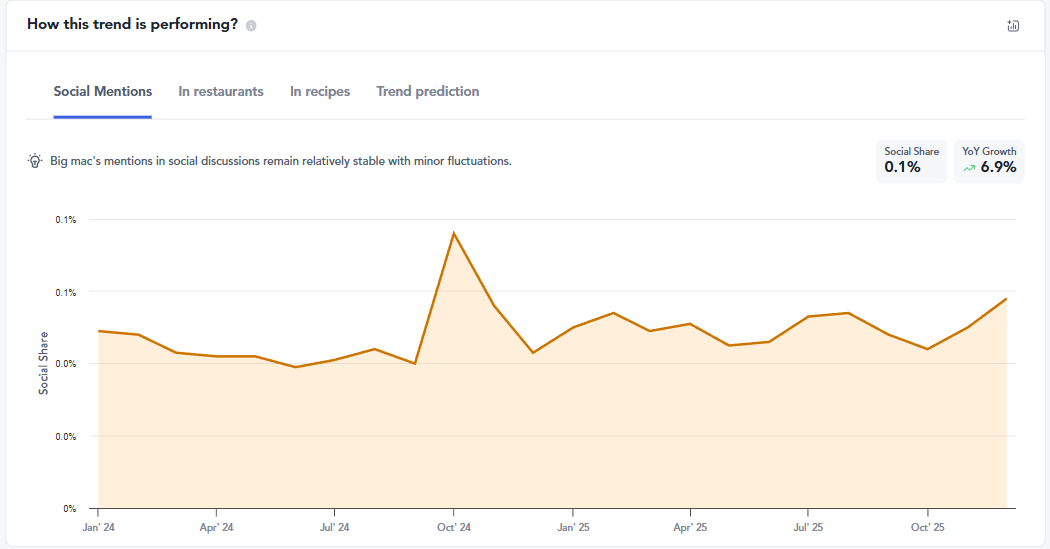
Big Mac conversations don’t move like a seasonal craze. They behave like a staple. That steadiness is useful for foodservice and CPG teams because it supports repeatable menu and retail decisions rather than one-off activations.
But stability doesn’t mean sameness. Tastewise dish insights show the Big Mac is in the “declining” lifecycle stage, even while burger culture stays dominant. That split matters: the product name may soften, but the Big Mac-style build keeps spreading into adjacent dishes and prep methods.
The consumer need is indulgence first, convenience second
Tastewise Consumer Needs data is blunt about what drives this trend:
- American (26%)
- Fried (15%)
- Tasty (14%)
- Mexican (9%)
- Cooked (9%)
- Convenient (9%)
- Healthy (7%)
This is not a “health-first” moment. “Healthy” sits at 7%, while fried + tasty combine to 29%. The practical takeaway: better-for-you versions work when they keep the same flavour architecture and mouthfeel. If the sensory hit disappears, the Big Mac association disappears too.
Big Mac formats are shifting toward wraps, bowls, and meal-prep builds
Big Mac trends are increasingly format-driven. Social content is packed with conversions that keep the flavour profile but change the structure:
- Big Mac Wrap (handheld, portable)
- Big Mac Salad (low-carb framing, meal-prep friendly)
- Burger burrito / taco mashups (Mexican need at 9% shows up here)
- “Double Big Mac” content (stacking as indulgence and value)
For foodservice, this supports two practical plays:
- Keep the core burger on menu for baseline demand.
- Use format changes as LTOs without retraining the kitchen on new flavour systems.
For CPG, it’s a kit and component opportunity. Consumers are already building the “Big Mac experience” at home. They just need the sauce, the pickle profile, and the right texture cues.
The Big Mac ecosystem is bigger than the burger
Tastewise dish popularity confirms the category gravity around this trend:
Top related dishes by social share:
- Burger (72%)
- Big Mac (67%)
- Pasta (19%)
- Mac and cheese (17%)
- Salad (12%)
- French fries (10%)
- Sandwich (9%)
That’s a wide footprint. Big Mac sits close to broader comfort staples like pasta and mac and cheese, which helps explain why the trend adapts so easily into “comfort mashups.”
The fastest-growing dishes connected to this ecosystem are not burger SKUs:
Up-and-coming dishes by YoY growth:
- Ragu (+307%)
- Mexican rice (+264%)
- Sweet tea (+249%)
- Steamed vegetables (+244%)
- Breadstick (+235%)
- Taco bowl (+219%)
- BBQ beef (+205%)
This points to bundling logic. The growth is in sides, bowls, and dinner-table anchors. For foodservice, that supports Big Mac-flavoured offers paired with rice bowls, BBQ builds, or drink-led value bundles. For retail, it supports cross-merchandising sauces with meal bases (rice, pasta, frozen sides).
Cooking methods: “fried + cooked” dominates, even in home versions
The needs mix includes fried (15%) and cooked (9%), which aligns with how people recreate the experience:
- Pan-seared or griddled patties for browning and fat carry
- Crisp lettuce + pickle crunch for contrast
- Sauce used as both topping and dressing (especially in salads)
Even the “healthier” remixes still lean on cooked proteins and rich sauce systems. That’s why the trend holds up in recipes as well as restaurant menus.
Ingredients show a protein-forward base with a pickle-led flavour hook
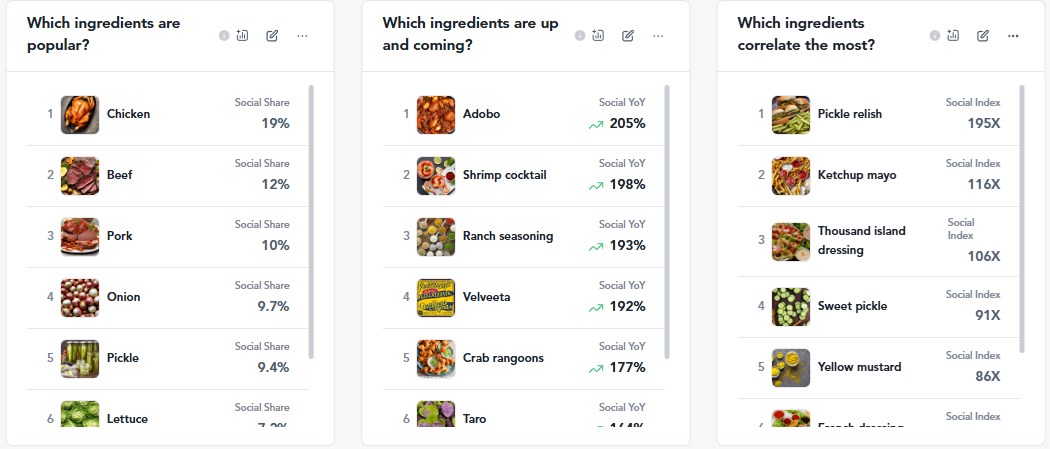
Tastewise ingredient popularity shows the core build is still anchored in everyday proteins and classic burger components:
Most popular ingredients by social share:
- Chicken (19%)
- Beef (12%)
- Pork (10%)
- Onion (9.7%)
- Pickle (9.4%)
- Lettuce (7.2%)
Chicken at 19% is notable. It suggests Big Mac flavour is traveling beyond beef. That supports menu extensions like chicken burgers, wraps, and bowls using the same sauce system.
Up-and-coming ingredients by YoY growth add more detail on what’s gaining momentum:
- Mixed vegetables (+377%)
- Adobo (+205%)
- Shrimp cocktail (+198%)
- Ranch seasoning (+193%)
- Velveeta (+192%)
- Crab rangoons (+177%)
- Lemon garlic (+171%)
Mixed vegetables at +377% pairs well with the rise of salad and bowl formats. Ranch seasoning at +193% suggests consumers are leaning into creamy, tangy flavour families that overlap with Big Mac sauce preferences.
The sauce is the real product identity
If you want the fastest route to “Big Mac” recognition, it’s not the bun or the patty. It’s the sauce + pickle system.
Tastewise ingredient correlations show what travels with Big Mac most often:
- Pickle relish (195X social index)
- Ketchup mayo (116X)
- Thousand island dressing (106X)
- Sweet pickle (91X)
- Yellow mustard (86X)
- French dressing (72X)
- Dill pickle (60X)
That’s a retail roadmap. CPG innovation can win by building “Big Mac-style” condiments, dipping sauces, and dressing hybrids that match this profile. Foodservice can win by turning the sauce into a platform: dip cups, drizzle finishes, or salad dressings that keep the same sweet-tang balance.
There’s also a warning in the data. Sriracha is declining with -40.42% YoY change, even though it still appears in the ingredient set. Heat isn’t the core driver here. Creamy, tangy, pickle-forward flavours are.
Big Mac trends are powered by McDonald’s adjacency, but the behaviour is remixing
Correlation data confirms the McDonald’s universe still anchors the conversation:
Top correlated dishes by social index:
- Big Mac (2183X)
- McNuggets (237X)
- Quarter pounder (219X)
- McFlurry (109X)
- Chicken burger (104X)
- Mac and cheese (81X)
- Buffalo chicken pasta (70X)
That 2183X index shows how central the Big Mac is to the cluster. But the surrounding items tell you what consumers pair it with: chicken formats, fries-adjacent behavior, and dessert add-ons.
For operators, this supports combo strategy. For CPG, it supports basket-building: sauces + pickles + frozen sides + meal bases.
What to do with this in CPG and foodservice
Big Mac trends are not asking for a new burger. They’re asking for the same flavour payoff in more formats.
Foodservice actions
- Use Big Mac-style sauce as a limited-time platform across wraps, bowls, and salads
- Pair with high-growth sides and meal anchors (Mexican rice, breadsticks, BBQ beef)
- Keep fried texture cues where possible to match the top need set (15% fried)
CPG actions
- Build sauces and dressings that match the correlation stack (relish + ketchup mayo + thousand island)
- Create meal solutions that support home remixing: wraps, chopped salad kits, burger bowl kits
- Extend beyond beef: chicken-based builds are already a top ingredient at 19% social share.
The data shows a clear pattern: the Big Mac name may cool, but the flavour system keeps spreading. That’s why Big Mac trends remain stable year over year, even while the usage moves into wraps, salads, and comfort-driven mashups.
FAQs about Big Mac trends
Big Mac trends are stable in social conversation with measurable growth. Tastewise Category Dashboard data shows 0.1% social share and +6.9% YoY growth, with mentions staying relatively steady. The shift is happening in formats, where Big Mac flavour cues are being reused in wraps, salads, and copycat builds.
Because the sauce is the strongest flavour identifier in the dataset. Tastewise ingredient correlations are led by pickle relish at 195X, followed by ketchup mayo at 116X and thousand island dressing at 106X. That correlation stack explains why consumers recreate the sauce first, then rebuild the rest of the meal around it.
The highest engagement examples in the data point to format conversions that keep the same taste profile but change how the meal is eaten. Big Mac Wrap and Big Mac Salad show up as repeatable templates, alongside mashups like burger tacos and burrito-style builds. These formats align with consumer needs around convenience at 9% and healthy at 7%, while still delivering the “fried” and “tasty” expectations that dominate the conversation.
Tastewise ingredient performance shows Big Mac-style eating is built on common burger ingredients, with a heavy emphasis on pickle-forward sauces. Chicken and pasta both sit at 19% social share in this dataset, while beef is at 12%, onion at 9.7%, pickle at 9.4%, and lettuce at 7.2%. The strongest flavour association comes from the sauce family, led by pickle relish and creamy dressing blends.
Yes, but it’s competing inside a much bigger burger ecosystem. Tastewise dish popularity shows Burger at 72% social share and Big Mac at 67%, so the core demand is still large. At the same time, Big Mac appears in the declining dish lifecycle stage, which supports the idea that the brand-specific item is cooling while the “Big Mac-style” build keeps travelling.
In this dataset, thousand island dressing is part of the same flavour family, but it’s not the strongest signature cue. Thousand island correlates at 106X, while pickle relish correlates at 195X and ketchup mayo at 116X. That points to a more relish-heavy, tangy-sweet blend than a standard thousand island profile on its own.

Read more from Kelia Losa Reinoso


We’d love to learn your goals and see how Tastewise fits
We’d love to learn your goals and see how Tastewise fits
Get a personalized demo
Good taste. Wise move.
Your demo request is confirmed. We’ll reach out within one business day to schedule your walkthrough.
What happens next

See what’s driving demand, then turn it into a sell-in story for retailers and operators.
- Connect consumer panels, market trackers, and agents into one evidence view
- Get the “why” behind what’s changing, with explainable demand drivers
- Walk away with a buyer-ready narrative and next steps to activate
Trusted by





“Tastewise is my secret tool for knowing what consumers want next and why.“