







Valentine’s day food trends are consolidating around higher pricing, fewer SKUs, and at-home occasions. According to Foodservice data, Valentine’s menu share is 0.65%, with menu items up 8.99% over the last 12 months, while average items per operator declined 4.45% in the same period. Operators are narrowing assortment while still expanding presence. The commercial move is SKU compression with a stronger margin architecture.
Average Valentine’s menu price reached $76.43, increasing 3.93% over the last 12 months. Consumers are accepting higher checks for the occasion. That supports bundled formats, premium ingredients, and finish-at-home executions rather than price-led promotions.
Valentine’s Day food trends overview:
- At-home dominates with 79% participation
- Menu penetration growing 9% year-over-year
- Average check reaches $76 per item
- Chocolate commands nearly half of menus
- Macarons outperform lava cake 3-to-1
Home is the dominant occasion
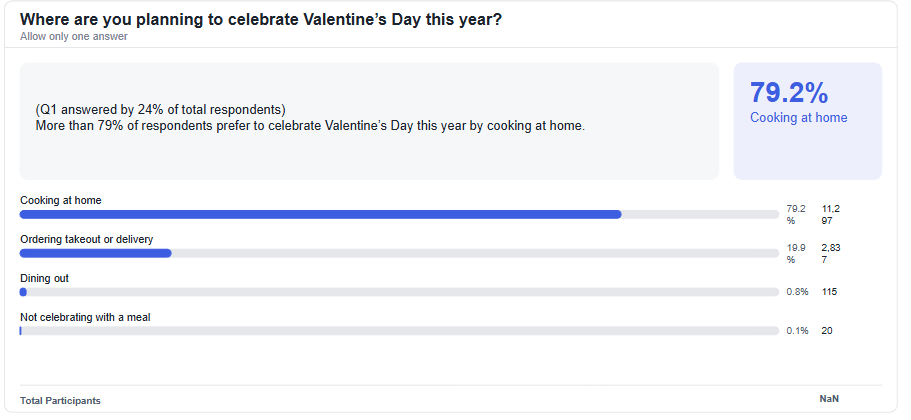
According to the Tastewise Valentine’s survey, 79.2% of consumers plan to cook at home, while 0.8% plan to dine out. Valentine’s day food trends are retail- and meal-kit-led, not restaurant-led.
Retail strategy should prioritize dessert kits, premium baking components, and plated-looking finishes such as fruit compote or pistachio cream. Foodservice should emphasize take-home bundles and ready-to-finish formats.
Beverage data reinforces this shift. 49% of respondents choose non-alcoholic beverages, compared to 30.4% choosing wine. That is nearly one in two consumers opting out of alcohol. Espresso, mocha, and cold-foam executions become relevant pairing tools for both operators and CPG.
Chocolate dominates, but format drives differentiation
Chocolate holds 46.48% menu share for Valentine’s. Cake sits at 28.59%, donuts at 26.25%, brownies at 25.13%. Chocolate presence is saturated. Incrementality must come from preparation and format.
Menu correlation data shows cake pops index 9.3X and mochi donuts 4.9X. Smaller, giftable formats outperform plated desserts. That aligns with at-home celebrations and shareable boxes.
The Tastewise Valentine’s survey shows 29.1% prefer macarons, compared to 8.3% for lava cake. Nearly one in three consumers select macarons. Valentine’s day food trends are shifting toward aesthetic, boxed, and portion-controlled desserts. Product development should focus on assortments, not single-plated items.
Emerging ingredients define premium signals
According to the Social F&B panel, cold foam grew by 134.56% over the last 12 months, pistachio by 93.48%, wagyu by 83.67%, lychee by 70.78%, fruit compote by 67.41%, and dragon fruit by 62.36%.
Texture layering and global fruit are gaining traction. Adding pistachio cream to chocolate SKUs or integrating fruit compote into cakes increases perceived innovation without operational complexity. Wagyu and prime rib, up 58.02% socially, introduce a premium savory tier for at-home kits.
Valentine’s day food trends are separating into two profitable lanes: premium savory kits and boxed dessert assortments.
Comfort and dietary identity shape preparation
48.8% of respondents describe their Valentine’s meal as comfort-driven and cozy. Cooking methods should reflect this: baked formats, slow-roasted proteins, layered desserts.
27.7% associate with vegan diets and 23.3% with gluten-free diets. Roughly one in four consumers choosing vegan creates a structural requirement for plant-based and gluten-free executions within seasonal assortments.
If your seasonal strategy requires tighter SKU selection, stronger price architecture, and formats aligned with at-home demand, the next step is execution planning. Get the structured framework that translates Social F&B panel signals, Foodservice performance, and the Tastewise Valentine’s survey into deployable menu builds, format guidance, and bundle strategy. Access the full Valentine’s Day menu ideas playbook to operationalize the data.
What a real Valentine’s LTO looks like in 2026
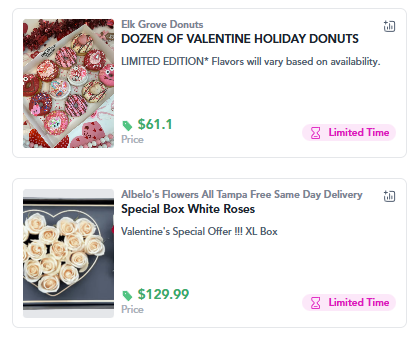
Foodservice data shows operators leaning into tightly scoped, premium-priced LTOs rather than expanding permanent Valentine’s menus. Elk Grove Donuts launched a “Valentine Holiday Donuts” limited-edition assortment priced at $61.10 per dozen . The execution is boxed, seasonal, and explicitly time-bound, built for gifting and margin density.
Acai Express and Creamery introduced a “Valentine Bowl LG” at $19, layering açaí with Nutella, strawberries, coconut oil, and granola. The build combines indulgent toppings with a health-forward base, aligning with 48.8% comfort-driven and 34% mostly healthy meal positioning in the Tastewise Valentine’s survey.
Both examples follow the same playbook: defined seasonal naming, premium price architecture, limited SKU scope, and format-led differentiation. The objective is short-window profitability, not long-term assortment expansion.
Channel performance defines deployment
According to the Social F&B panel, Valentine’s Day food trends account for 0.09% of social share, up 8.08% over the last 12 months. In Foodservice, menu share reaches 0.65%, growing 9.30% in the same period. Recipe share increased just 0.51%. Forward projections show total presence declining 9.36% compared to last year.
The signal is tight. Valentine’s is expanding on menus faster than it is expanding in consumer conversation or home recipe behavior. Operators are monetizing the occasion more efficiently than consumers are amplifying it.
This is not a broad demand surge. It is controlled menu growth inside a short commercial window. Deployment should prioritize high-margin LTOs with defined exit timing, validated in Foodservice first, then extended to retail only if velocity sustains.
Operator moves: who is activating and how
Foodservice data shows Valentine’s traction concentrated in dessert-led and limited-time executions across specific operators. Krispy Kreme and Dairy Queen Grill & Chill appear in whitespace analysis where Valentine’s mentions are growing but menu penetration remains low, indicating targeted seasonal activation rather than permanent SKU expansion.
Orwashers Bakery shows notable menu growth with moderate presence, reinforcing bakery as the most active category. At the item level, operators such as Elk Grove Donuts launched limited-edition Valentine assortments priced at $61.10 per dozen, while Acai Express introduced a $19 Valentine Bowl layering indulgent toppings like Nutella and strawberries over a health-forward base.
Across these examples, the pattern is consistent: boxed or bundled formats, premium price points, and tightly defined LTOs instead of broad seasonal menu rollouts.
FAQs about Valentine’s day food trends
Valentines Day food trends show moderate menu growth of 9.30% over the last 12 months, rising average prices at $76.43 per item, and strong at-home participation at 79.2% . Growth is concentrated in premium LTO formats rather than broad SKU expansion.
79.2% of consumers plan to cook at home, while only 0.8% plan to dine out . Valentines Day food trends are retail- and meal-kit-led, requiring boxed desserts, finish-at-home kits, and bundled offerings.
Chocolate leads with 46.48% menu share . Macarons are preferred by 29.1% of consumers, compared to 8.3% for lava cake . Small-format, giftable desserts such as cake pops and donut assortments are outperforming plated formats.
49% of consumers choose non-alcoholic beverages compared to 30.4% selecting wine . Espresso, mocha, and cold-foam formats align with this shift and create pairing opportunities for both Foodservice and retail.
Menu items increased 8.99% over the last 12 months, but average items per operator declined 4.45% . Valentines Day food trends point toward SKU compression and higher-margin LTO deployment rather than broad portfolio expansion.



We’d love to learn your goals and see how Tastewise fits
We’d love to learn your goals and see how Tastewise fits
Get a personalized demo
Good taste. Wise move.
Your demo request is confirmed. We’ll reach out within one business day to schedule your walkthrough.
What happens next

See what’s driving demand, then turn it into a sell-in story for retailers and operators.
- Connect consumer panels, market trackers, and agents into one evidence view
- Get the “why” behind what’s changing, with explainable demand drivers
- Walk away with a buyer-ready narrative and next steps to activate
Trusted by





“Tastewise is my secret tool for knowing what consumers want next and why.“