





Sweden menu trends are moving faster than most operators expect. Smash burgers are now in the trending lifecycle stage, up 15.8% in the past year, while comfort-oriented dishes are gaining ground across both lunch and dinner dayparts. The afternoon occasion is up 21.1% since last year. Late-night dining is up 45.3%. These are not marginal signals. They point to a structural realignment in how Swedish restaurant menus are being built and what diners now expect from every format.
Key takeaways
- Smash burgers are in the trending lifecycle, up 15.8% in the past year, with ground beef growing 19.3% alongside them. Your team has a short window before the format saturates and a clear signal to build around it now.
- Matcha is the fastest-climbing ingredient in the Swedish market, up 23.9% since last year and tracking toward mainstream. Menu developers not yet carrying it are behind the demand curve.
- “Crispy” as a texture claim is up 26.4% and “comfort” is up 50.9%. Guests are not choosing between indulgence and satisfaction. Your menu needs both, and the data tells you exactly where to deploy them.
- The afternoon occasion is up 21.1% and late-night dining is up 45.3%. These are the two fastest-growing dayparts in Sweden right now. Operators holding a lunch-to-dinner format without coverage in between are missing material revenue.
Sweden menu innovation in 2026: the consumer shift driving it
Swedish diners are making more deliberate choices. They want dishes that deliver on texture, flavour, and occasion fit simultaneously. The growth in “comfort” and “crispy” claims is not a contradiction. It reflects a consumer who wants satisfying food with a defined sensory payoff. Comfort food and menu innovation are converging, not competing.
The Tastewise data for Sweden shows three clear axes of motion. First, a smash-burger-led revival of quality fast food with real ingredient specificity, ground beef up 19.3% and pickles up 10.1%. Second, a matcha-and-coffee flavour wave that is now trending rather than emerging, with matcha at +23.9% and coffee up 17.8%. Third, a daypart expansion away from the traditional lunch peak toward afternoon and late-night, with those two occasions growing at 21.1% and 45.3% respectively.
The opportunity is in the gaps. Smash burgers have strong consumer pull but menu share that has not caught up to demand. The afternoon daypart is growing fast but the menu architecture to serve it, distinct from lunch and from dinner, is underbuilt across the Swedish market. Operators who build deliberately into these gaps now will hold a first-mover position before the market normalises.
The smash burger signal and what Sweden menu trends show about quality fast food
Smash burgers sit in the trending lifecycle stage in Sweden, up 15.8% in the past year. That lifecycle classification matters. Trending means the signal has momentum and a real consumer base, but has not yet plateaued. Your team can still build around it and own the format before saturation.
The surrounding ingredients tell the fuller story. Ground beef is up 19.3%, tracking directly with the smash burger rise. Pickles are up 10.1%, the brioche bun is up 13.1%, and jalapeno, though declining from a high base, sits at a meaningful 1.20% menu share in the market. This is not one ingredient trending in isolation. It is a flavour system with high consumer coherence. The “smashed” claim is up 20.2% and the “crispy” texture claim is up 26.4%. Guests know exactly what they are asking for.
For multi-unit operators, the implication is specific. A smash burger build with a defined sauce profile, a real cheese pull, and a crispy-edged patty is not just a menu item. It is a repeatable format with strong social amplification potential. The foodservice sales enablement case for it runs on Tastewise data: trend stage, ingredient velocity, and texture claim growth in one view.
Matcha and the flavour wave reshaping Sweden menu trends this year
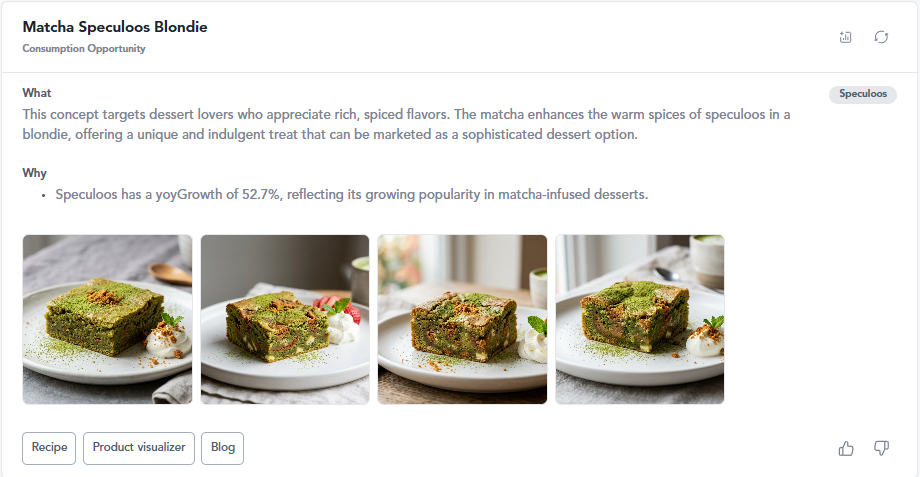
Matcha is the standout trending ingredient in Sweden, up 23.9% in the past year from a meaningful social share base of 19.4%. This is not a niche position. Nearly 1 in 5 food conversations in the tracked panel that mention matcha are tagging it as a current interest, and that base is growing fast.
Coffee is moving alongside it, up 17.8% and in the trending stage too. The pairing is relevant because it points to a broader shift in the beverage and snack layers of the Swedish menu. Consumers are gravitating toward functional, flavour-led drinks with a strong visual identity. Menu ideation built around the matcha-coffee axis has a clear ICP: the afternoon and morning daypart diner who wants something considered, not just caffeinated.
Morning occasions are up 16.4% in Sweden. The afternoon occasion, as noted, is up 21.1%. These two dayparts are where matcha and specialty coffee live most naturally. A menu without them in the hot drink or dessert layer is missing a growing demand segment.
Daypart shifts and the Sweden restaurant menus not yet built to serve them
The clearest whitespace in the Swedish market is daypart. Lunch leads the occasion data at 47% share, but its growth rate is flat at +0.1%. Dinner is declining at -6.8%. Meanwhile, the afternoon occasion is up 21.1%, the late-night occasion is up 45.3%, and the morning occasion is up 16.4%. The shape of Swedish dining is changing.
Most restaurant formats in Sweden are still structured around a lunch-to-dinner logic. Two menu changes, one at 11am and one at 5pm. The data says that is no longer sufficient. Afternoon diners want something distinct from lunch, lighter, snackable, socially framed. Late-night diners want indulgent, satisfying, texture-led food. The “juicy” claim is up 45.6% and “comfort” is up 50.9%, both indexed heavily to the restaurant channel at 53% and 53% respectively.
This is a practical menu architecture question as much as an innovation one. Restaurant menu planning built on real-time consumer occasion data can identify which items already on your menu transfer well to an afternoon or late-night framing, and which require a new build. The Tastewise data tells you the demand is real. The next move is yours.
How protein and comfort are converging on Swedish menus right now
Protein continues to drive Swedish consumer behaviour. The protein claim sits at 23.3% share, up 3.2% since last year, and the high-protein claim is up 8% with 84% of its signal in the food (home and recipe) channel. That home-channel weighting tells you something important: protein is a daily dietary goal, not just a gym concept. It shapes what consumers expect from a restaurant meal too. A 2026 Food Navigator analysis of Swedish food trends confirms the same direction: Swedish consumers are “significantly drawn to high protein” as one of the country’s decisive dietary trends this year.
The interesting move is how comfort is tracking alongside it. Comfort is up 50.9%, sitting at 3.74% share with balanced food and restaurant signal. The consumer is not choosing between eating well and eating something satisfying. They want both. The 2026 food and beverage trend forecast shows this dual-drive as a wider pattern. In Sweden, the evidence is sharp and specific.
For menu developers, this means protein-forward builds need comfort credentials to convert. A high-protein bowl that feels austere will underperform a high-protein bowl with a rich sauce, a crispy element, and a texture story. Cottage cheese is up 13.2%, greek yogurt up 10.6%, sweet potato up 14.8%. These are the ingredient bridges between performance and pleasure. Build them in.
Key ingredients driving Sweden menu trends in 2026
Ground beef and smash burger builds
Ground beef is up 19.3% in the past year, the strongest growth of any core protein in the data set. It is tracking directly with the smash burger format. Steak is up 9.4%, suggesting the broader beef premium signal is intact. Your builds should lead with beef quality and communicate it explicitly.
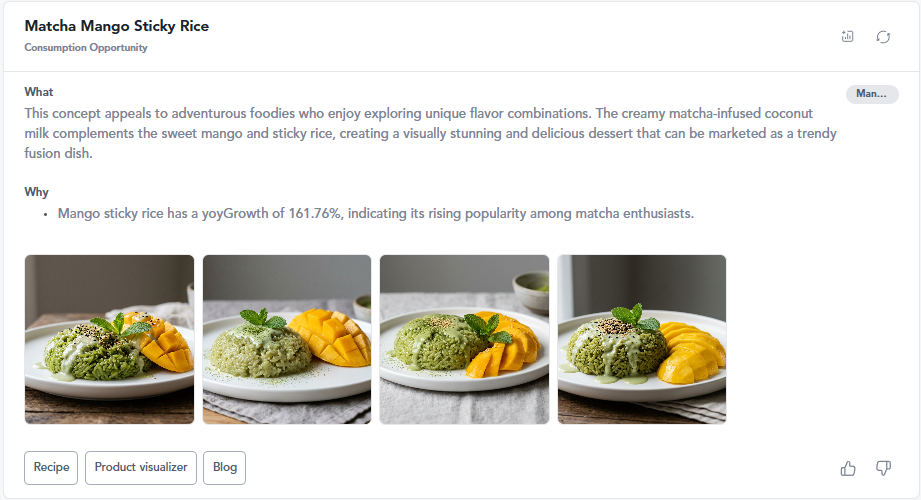
Matcha
Up 23.9% and in the trending stage. Matcha carries a 19.4% social share in Sweden, making it the single most momentum-driven flavour ingredient in the market right now. Beverage, dessert, and sauce applications all have strong consumer precedent.
Cottage cheese and greek yogurt
Cottage cheese is up 13.2% and greek yogurt is up 10.6%. Both sit at the intersection of the protein demand curve and everyday versatility. These are not niche health ingredients any more. They are moving into mainstream menu consideration.
Tacos and the broader Mexican flavour wave
Tacos are up 11.8% in the past year. The Mexican flavour claim is up 12.6%. Salsa is up 10.3%. This is a cuisine-level momentum play, not just a single format. For operators not already carrying a Mexican-influenced item, the demand signal exists.
Honey and sweet-savoury tension
Honey is up 4.2% and the sweet claim is up 9.3%. The “drizzled” preparation method is up 8.8%. The consumer interest in sweet-savoury pairings is consistent. Honey over fried chicken, honey in a burger sauce, honey-glazed proteins: all have natural homes in the Swedish market.
Pickle
Pickle is up 10.1%, sitting at 0.5% menu share. It is the signature textural contrast element in the smash burger format and is gaining broader presence in the market. High acidity, visual cue, flavour punch: it is doing heavy lifting in the trending format builds.
How Sweden restaurant menus are evolving across QSR and fast casual
The “convenient” claim is up 8% and the “easy” claim is up 9.4% in Sweden. These are not statements about food quality. They are statements about the contract between the operator and the diner. Speed of service, clear flavour expectations, a format that is easy to navigate.
QSR and fast casual are the formats best positioned to capitalise on the trending ingredients in the Swedish data. Smash burgers, protein bowls, tacos, and matcha beverages all have natural homes in a quick-service or fast-casual build. The weekend claim is up 2% with a 55% restaurant weighting. Weekday dining is up 8.5%, also restaurant-weighted. The guest is eating out across the week, not just as a weekend occasion.
The operator opportunity is in building menus that serve the weekday occasion with the same intentionality as a weekend format. Tastewise identifies which specific claims and ingredients are over-indexing in the restaurant channel versus home, which tells you exactly where to put your next menu investment.
Data methodology
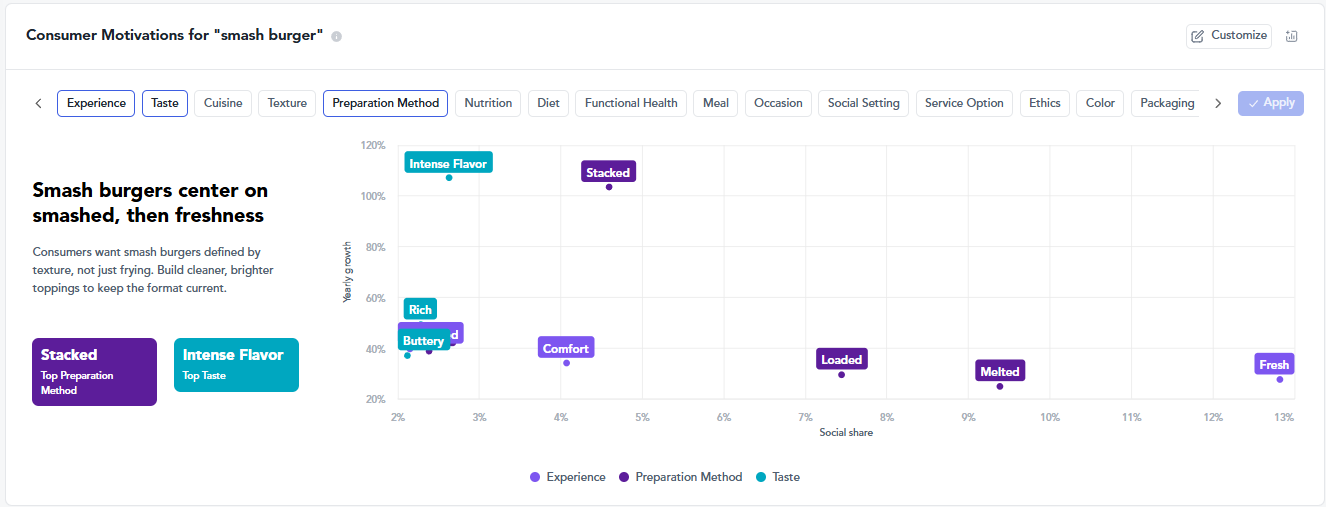
Data sourced from the Tastewise consumer and operator panel for the SE (Sweden) market. Consumer panel covers social and recipe signals across the Swedish food and beverage audience. Growth figures reflect 12-month change. Lifecycle stage classifications (early, trending, mature, declining) are assigned by the Tastewise platform based on velocity and reach trajectory. FSI operator endpoint returned errors for SE market on this pull; operator-level figures (menu share data shown) are sourced from the broader Tastewise operator index. All fractions and growth figures cited in this article are from Tastewise proprietary data.
FAQs about Sweden menu trends
Smash burgers are in the trending lifecycle stage, up 15.8% in the past year, with ground beef up 19.3% alongside them. Tacos are up 11.8%, driven by a broader Mexican flavour momentum. Matcha features prominently across beverage and dessert applications, up 23.9%. The data across these formats points to a consumer appetite for dishes with clear flavour identity and strong texture execution.
The afternoon occasion is up 21.1% in the past year, and late-night dining is up 45.3%. These are the two fastest-growing occasions in the Swedish market. Morning is up 16.4%. Lunch has the highest share but is flat. Dinner is declining at -6.8%. Operators building menu architecture only around lunch and dinner are underserving the fastest-growing demand windows.
The strongest validation approach combines lifecycle stage, ingredient velocity, and claim growth. A concept built around a trending-stage format like smash burgers, with supporting ingredients that are also growing (pickle, ground beef, bun), and framed against a growing claim like “crispy” or “comfort”, has data support at every layer. Food intelligence and menu planning built on Tastewise data lets your team run that validation before a single test kitchen day is committed.

Read more from Kelia Losa Reinoso
We’d love to learn your goals and see how Tastewise fits
We’d love to learn your goals and see how Tastewise fits
Get a personalized demo
Good taste. Wise move.
Your demo request is confirmed. We’ll reach out within one business day to schedule your walkthrough.
What happens next

See what’s driving demand, then turn it into a sell-in story for retailers and operators.
- Connect consumer panels, market trackers, and agents into one evidence view
- Get the “why” behind what’s changing, with explainable demand drivers
- Walk away with a buyer-ready narrative and next steps to activate
Trusted by





“Tastewise is my secret tool for knowing what consumers want next and why.“