






Ireland menu trends in 2026 are being shaped by a consumer who eats out less often but spends more deliberately when they do. According to industry analysis, Irish households still direct over ten billion euros a year to eating and drinking out, yet visit frequency is flat and operators are under real margin pressure. That tension is producing a clear menu response: fewer safe bets, more considered dishes, and a growing appetite for food that rewards the spend. If you develop menus or manage a foodservice portfolio in Ireland, the signals below tell you where consumers are pulling and where the whitespace still sits.
Key takeaways
- Brunch and morning occasions are driving disproportionate volume in the UK-Ireland market. Sourdough bread is growing 7.8% on the UK consumer panel and carries a 1.5% brunch menu share, signalling that premium baked formats are earning operator shelf space at breakfast and weekend dayparts. Build hero brunch items around fermented and premium-grain bases to match where consumer attention already sits.
- Matcha is the fastest-growing emerging ingredient in the brunch category, up 91.3% on the UK consumer panel over the past year from an early-stage lifecycle position. Irish food observers are already tracking its spread into coffee shops and patisseries. This is still an accessible build window; your team has room to lead rather than follow.
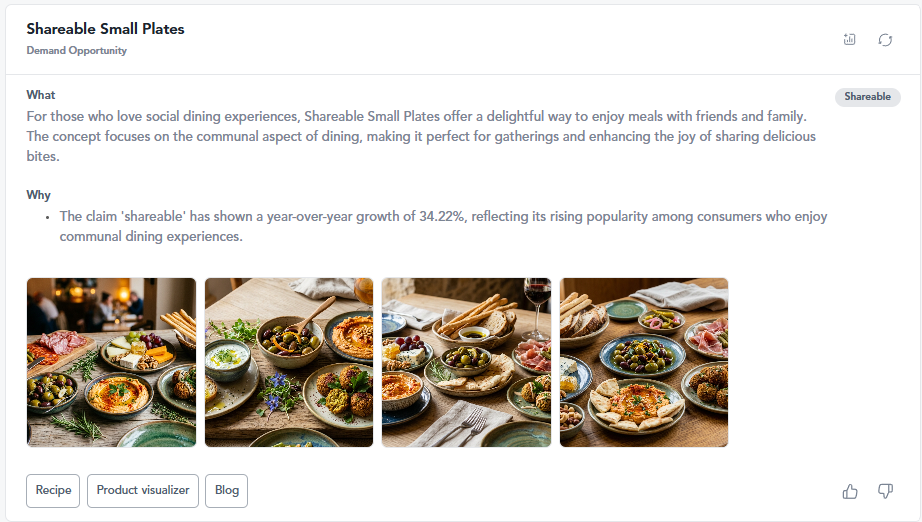
- Small plates and sharing formats show the “comfort” claim growing 109% and “intense flavor” up 141% in that context, reflecting consumers who are ordering fewer covers but wanting more experiential impact per dish. Operators who rethink portion architecture around bold, shareable flavors stand to capture the trade-down-but-trade-up diner.
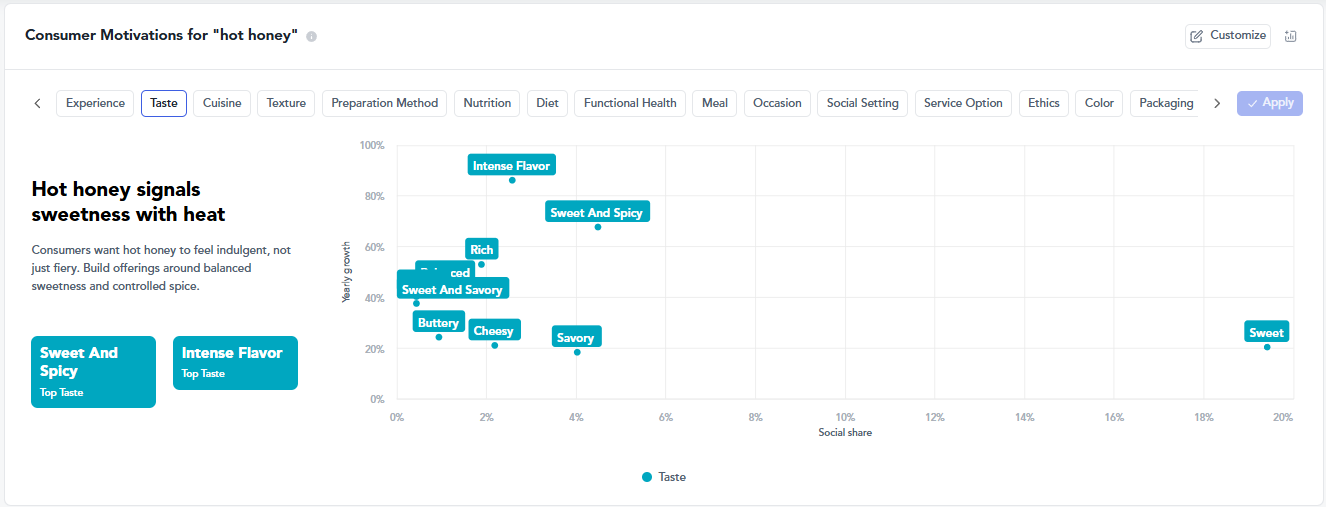
- Hot honey has crossed from a niche US import to a live UK menu signal, up 56.2% in the brunch panel and 34.3% in the small-plates context. In Ireland, the sweet-heat flavor arc is the next logical move for operators looking to give familiar dishes a credible point of difference.
Ireland menu trends in 2026: what is actually happening
Irish diners are not spending less because they care less. They are spending more selectively because they care more. The result is a clear trade-up dynamic: consumers are cutting the casual occasions but protecting the ones that feel worth it. That means the winning dish is no longer the safe one. It is the one that delivers a combination of recognisable comfort, bold flavor, and some form of craft or narrative. Traditional favorites are still on the table, but they are earning their place alongside global formats, fermented and premium-grain builds, and shared plates that invite a different kind of eating occasion.
Tastewise, the agentic food and beverage intelligence platform, surfaces these dynamics in real time across both consumer panels and operator menus. In the UK-Ireland market, sourdough bread holds a 1.5% brunch menu share while growing 7.8% on the consumer panel in the past year. Matcha has climbed 91.3% from an early lifecycle stage. Comfort as a dining motivation has grown 56.9% in the brunch context, and “crispy” as a texture claim is up 16.3%, reflecting consumer demand for dishes with physical presence. Small-plates occasions show intensity of flavor (+141% on the “intense flavor” claim) and social framing (“friends” reaches 15.9% share in that context) climbing in tandem.
The commercial opportunity for menu developers and multi-unit operators in Ireland is in recognising that consumer taste is not fragmenting randomly. It is consolidating around a coherent set of signals: morning and brunch dayparts as high-margin occasions, premium grain and fermented formats as trusted bases, sweet-heat and umami-forward flavor profiles as the differentiation layer, and sharing architecture as the table mechanic. Each of these is buildable. None of them requires reinventing the menu from scratch.
The product innovation solution at Tastewise maps exactly this kind of signal into concept direction, so your team can validate quickly against live data rather than guessing from trend reports.
Daypart shifts: why Ireland menu trends are being led by brunch and morning occasions
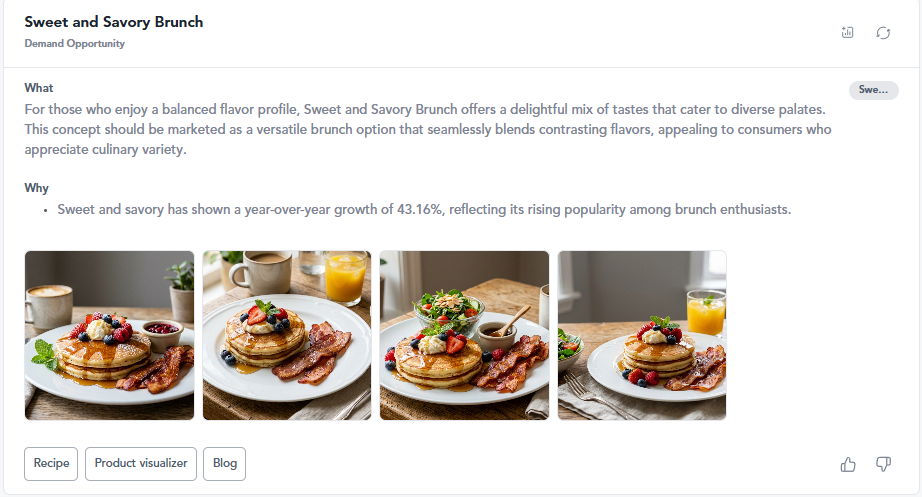
Brunch has moved from a weekend luxury to a structurally important daypart for Irish operators. Tastewise consumer panel data for the UK market shows breakfast and brunch occasions generating 30.7% claim share in the brunch context, with weekend occasions at 26.8%. The “morning” claim is up 17.5% over the past year, and “crispy” is up 16.3%, both pointing to consumers who want textural and sensory reward from their first eating occasion of the day.
The practical implication for menu developers is ingredient architecture. Sourdough bread sits at 8.1% consumer reach in brunch occasions with 7.8% growth in the past 12 months and a 1.5% operator menu share. Shakshouka carries a 2.5% consumer reach with 9.1% growth and a 1.5% menu share. Cilbir, the Turkish poached egg dish, has reached 1.49% consumer reach and is up 41.9% in the past year with a 0.4% menu share. Each of these has a higher menu-share-to-consumer-reach ratio than the brunch category average, meaning the operator build is already being validated. Your team is not pioneering; you are following proven demand.
The daypart gap is in the late-morning and weekday-brunch window. The “weekday” claim holds a 5.31% share in brunch occasions and is up 1.1%, while “evening” is growing at 16.3%. That suggests operators can stretch high-performing brunch formats into weekday lunch and early evening occasions with relatively low reformulation risk. A dish built for brunch that also sits credibly on a lunch menu is twice as efficient to develop and twice as easy to sell into a buyer.
For foodservice operators making the case for a brunch build, the data is already your sell-in story. Consumer reach, growth trajectory, and existing menu penetration are available at the ingredient level.
Key ingredients driving Ireland menu innovation right now
Not every ingredient trend in Ireland arrives with fanfare. Some of the strongest signals are quiet, growing steadily in consumer preference data without having fully resolved into operator menus yet. That gap between consumer reach and menu share is where the whitespace sits.
Matcha is the clearest example. It has a 1.77% consumer reach in the UK brunch panel and is up 91.3% in the past year from an early lifecycle position. Its menu share is effectively zero at this point, which means the consumer is pulling ahead of operators. Strawberry matcha, a specific application of the format, is growing at 140.9%, pointing to the flavor combination your team should be testing in drinks and dessert builds. In Ireland specifically, food commentators are already tracking matcha’s spread into patisseries and coffee-shop menus. The window to own this space at scale is now, not after it has resolved into every QSR in the country.
Hot honey is at a different lifecycle stage. It carries a 0.91% consumer reach in the brunch panel and is up 56.2% in the past 12 months. In small-plates and sharing contexts, it is up 34.3%. It appears at a 0% menu share in the brunch data, meaning consumer appetite is well ahead of operator response. The sweet-heat flavor arc maps directly onto the “spicy” claim (up 2% in brunch contexts) and the “smoky” claim (up 4.6%), suggesting consumers are comfortable with complexity in this part of the flavor space.
Other ingredients worth tracking: toasted sandwich as a format is up 54.8%, sitting at a 0% menu share that creates obvious build opportunity. Acai bowl is growing 60.5%. Banana bread is up 15.1% and is entering an emerging lifecycle stage. Dates have moved to a trending lifecycle position with 24.8% growth. Each of these is a proven consumer signal waiting for operator execution. The food intelligence and menu planning approach that Tastewise enables lets your team cut these signals by cuisine, daypart, and price tier before committing to development.
Ireland menu trends and the flavor architecture of the moment
The flavor story on Irish menus in 2026 is not about novelty for its own sake. It is about elevation. Consumers are applying the same trade-up logic they apply to the occasion itself to the flavor profile of the dish. They want familiar formats made more interesting. That is a commercially useful brief: it means your development team does not need entirely new concepts, just sharper flavor decisions on existing builds.
In sharing and small-plates occasions, the “comfort” claim has grown 109% over the past year, while “intense flavor” is up 141% and “rich” is up 24.5%. These three signals together describe a consumer who wants food that delivers emotionally, not just nutritionally. They also describe dishes that are easier to sell: comfort with a point of difference is a simpler pitch than a complicated global format with no recognisable anchor.
The sweet-heat combination is the most commercially available version of this in Ireland right now. Hot honey maps onto it. Harissa carries a 1.5% menu share and appears in both the brunch and small-plates datasets. Nduja is at 0.34% consumer reach with 5.9% growth and a positive trajectory in the sharing context. Chorizo is up 2.5% in the brunch panel and up 54.3% in the small-plates occasion. These are not aspirational ingredients. They are available, familiar to operators, and already moving in the direction the consumer is heading.
Texture is operating in parallel with flavor. “Crispy” is up 16.3% in brunch and 13.1% in small-plates occasions. “Fluffy” is up 28.3%. “Soft” is up 41.5%. “Whipped” is up 18%. These claims reflect a consumer who is paying attention to the physical experience of eating, not just the taste. Dishes that contrast texture intentionally, a crispy base with a whipped element for instance, are well-positioned to satisfy multiple preference signals at once.
According to Innova Market Insights’ 2026 food market analysis for Ireland, Irish consumers are actively seeking premium and authentic claims, preferring products that signal natural ingredients, no artificial additives, and traditional production methods. That aligns directly with what the Tastewise data shows on ingredient level: sourdough, fermented formats, and traceable protein are the trusted bases into which bold flavor is being introduced.
How Ireland menu trends show up across dining occasions
The dining occasion is doing more work in Ireland in 2026 than it has in recent years. When eating out is a rationed experience, the occasion itself has to earn its place. That is reflected in a clear split in the data between functional dayparts (weekday lunch, on-the-go morning) and considered occasions (weekend brunch, date night, celebration). The menu response to each is different, and operators who apply one strategy across both are leaving revenue on the table.
In functional dayparts, the “convenient” claim is up 6.6% in the brunch panel and carries a 74% at-home skew, meaning consumers in this space are also solving for speed and simplicity. Menu formats that translate well to takeout or counter service are favoured. The “on the go” claim is at 0.26% consumer reach in this context. The toasted sandwich format (up 54.8%) fits exactly here: familiar, fast, and credible as a premium build with the right ingredients.
In considered occasions, the “celebration” claim is up 20.2% in the brunch context, “indulgent” is up 6.7%, and “premium” is up 21.5%. Date-night and evening occasions are growing. “Relaxation” is up 38.7% in small-plates contexts. These consumers are not looking for shortcuts. They are looking for reasons to feel the occasion was worth the spend, which means presentation, sourcing narrative, and flavor complexity all matter more than price efficiency. Operators who invest in the considered occasion build will find the consumer is already there waiting.
For multi-unit operators and franchise groups in Ireland, the practical opportunity is in designing menu ranges that are occasion-segmented rather than uniform. A breakfast and brunch range built around sourdough, matcha, shakshouka, and hot honey speaks to the premium-morning consumer. A sharing and small-plates range built around bold flavor, smoked or cured elements, and textural contrast captures the trade-up evening diner. The best AI platforms for food innovation allow that kind of occasion-level segmentation without the traditional lag of annual menu review cycles.
Global influences on Ireland restaurant menus in 2026
Ireland’s food scene has absorbed global flavors faster than most of its European peers, and 2026 is no exception. The data reflects a consumer who is simultaneously pulling toward comfort and tradition and reaching for format diversity. That combination produces a clear commercial pattern: the most successful menu builds in Ireland are global formats made locally legible.
South Asian and Middle Eastern influence is the strongest international thread in the current UK-Ireland data. “Mediterranean” is up 8.9% in the brunch panel, “Middle Eastern” is up 3% in small-plates occasions, and “Indian” is up 24.6% in that context. Shakshouka, already identified as a brunch signal, is the most menu-penetrated example of Middle Eastern format adoption. Cilbir is at the same lifecycle stage shakshouka occupied two years ago. Mezze formats are up 362% in the small-plates panel, which sounds dramatic until you account for a small base, but the directional signal is confirmed across multiple sources.
Brazilian and South American cuisine is an emerging structural trend in Irish cities. Trend observers in the Irish food and restaurant sector have noted that açai, coxinha, and feijoada are moving from niche imports into visible restaurant formats in Dublin. The Tastewise consumer panel confirms the directional interest: açai bowl is up 60.5% in the brunch category. That is an early-stage signal with strong consumer pull and almost no operator saturation in Ireland yet.
The translation mechanic matters here. Consumers in Ireland are not looking for authenticity at the expense of accessibility. They want recognisable dishes elevated with credible global flavor logic. A smashed burger with nduja and honey is more commercially available than a full South American build. A weekend brunch with a shakshouka and a sourdough base is more scalable than a full Middle Eastern menu. The menu ideation frameworks that Tastewise supports are built precisely for this kind of cross-cultural translation work.
Strategic recommendations for Ireland menu developers and operators
The data from both the Tastewise consumer panel and the Irish foodservice market points to three practical moves your team can make now.
Build around the high-confidence brunch tier.
Sourdough, shakshouka, and cilbir are all validated by consumer panel growth and existing menu penetration. Hot honey and matcha are validated by growth with near-zero menu share, meaning the build window is open. A three to five item brunch range anchored in these ingredients has both the consumer pull and the operator proof points to support a buyer sell-in. The restaurant menu planning discipline that Tastewise supports gives your team a data layer under this build rather than relying on intuition.
Redesign the sharing range for intensity, not breadth.
Small-plates consumers in 2026 are choosing fewer items but want more from each one. “Intense flavor” up 141%, “comfort” up 109%, and “crispy” up 13% in that context describe a very specific brief: bold, texturally interesting, emotionally resonant. A four to six item sharing range built around sweet-heat, smoked or cured elements, and a whipped or creamy contrast component will outperform a wider, blander range at current consumer appetite levels.
Track the pre-resolution signals now.
Matcha (91.3% growth, 0% menu share), toasted sandwich (54.8% growth, 0% menu share), and acai bowl (60.5% growth, 0% menu share) are all in the pre-resolution window in Ireland. Moving on a pre-resolution signal takes six to twelve months to reach execution. Teams that start development now will arrive at launch point when the consumer signal has matured but the operator market is not yet saturated. The food and beverage trend forecast for 2026 maps this lifecycle logic across major categories, so your team has the full picture before committing to development.
Ireland’s menu moment in 2026 belongs to operators who can read the consumer fast enough to build ahead of saturation. The data is available. The signals are clear. Your team still has room to lead on matcha, hot honey, South American formats, and premium brunch architecture before those windows close.
FAQs about Ireland menu trends
The highest-confidence moves in 2026 are in the brunch and morning daypart, where sourdough, shakshouka, and hot honey all show strong consumer growth paired with existing menu penetration. Matcha and acai bowl are pre-resolution signals with high growth and near-zero menu share, giving operators a build window before the category fills. In shared plates and evening occasions, bold flavor combinations (sweet-heat, smoked, umami) are outperforming safe builds as consumers trade up within a tighter dining frequency.
Ireland shares much of the same consumer-panel direction as the UK, particularly around premium morning occasions, global flavor adoption, and sharing formats. The Irish market has some distinct characteristics: a faster absorption of South American cuisine in urban centres, a strong tradition of pub dining that creates specific occasion dynamics, and a market where menu inflation has run ahead of the European average, creating sharper consumer selectivity about which occasions earn the spend. Irish consumers also show higher-than-average alcohol purchase rates alongside growing moderation interest, which has implications for drinks menu architecture as well as food.
For limited-time offers, the highest-ROI ingredients are those in the emerging-to-trending lifecycle range with meaningful consumer growth but low operator penetration. Right now that means matcha (up 91.3% on the consumer panel, 0% menu share in the brunch category), hot honey (up 56.2% in brunch occasions, 0% menu share), toasted sandwich formats (up 54.8%, 0% menu share), and acai bowl (up 60.5%). Each of these has validated consumer pull without the saturation that comes from full operator adoption, meaning an LTO can generate standout rather than just parity. Pair any of these with a familiar, trusted base (sourdough, eggs, familiar protein) and the innovation risk drops significantly.



We’d love to learn your goals and see how Tastewise fits
We’d love to learn your goals and see how Tastewise fits
Get a personalized demo
Good taste. Wise move.
Your demo request is confirmed. We’ll reach out within one business day to schedule your walkthrough.
What happens next

See what’s driving demand, then turn it into a sell-in story for retailers and operators.
- Connect consumer panels, market trackers, and agents into one evidence view
- Get the “why” behind what’s changing, with explainable demand drivers
- Walk away with a buyer-ready narrative and next steps to activate
Trusted by





“Tastewise is my secret tool for knowing what consumers want next and why.“