





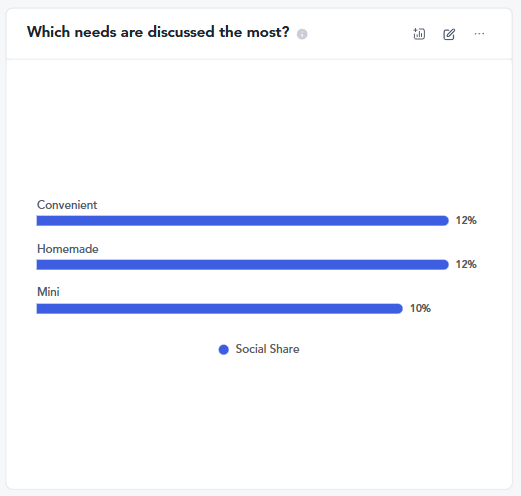
The chocolate chip food trend shows sustained demand growth across retail, foodservice, and social channels. Chocolate chip is maintaining momentum. This positions chocolate chip as a stable base flavor that continues to absorb new formats and usage behaviors.
Chocolate Chip trend overview
- Social conversations about Chocolate chip have increased by 17.3% year-over-year
- 16%+ (600K+) of U.S. restaurants offer Chocolate chip dishes on their menus
- The top consumer need driving Chocolate chip consumption today is snack
- Gluten-free Chocolate chip is the most dominant dietary adaptation
Chocolate chip sales statistics and market performance
Tastewise On the Shelf data from Walmart shows chocolate chip sales anchored in high-velocity baking chips, with dark and semi-sweet SKUs dominating shelf presence. Products span a wide price range, from single bags under $15 to $60–$80 bulk and multi-pack formats, supporting both routine replenishment and stock-up behavior.
Strong representation of gluten-free, vegan, keto, and protein-positioned products indicates that shelf growth is driven by dietary segmentation and pack-size strategy rather than new flavor introductions. For retailers, chocolate chip remains a low-risk category for premiumization and functional extensions.
Chocolate chip flavors driving engagement
Tastewise ingredient correlation data shows a resilient supporting ecosystem:
- Dark chocolate chips (244X correlation)
- Unsweetened cocoa (115X correlation)
Emerging pairings include:
- Pumpkin seed butter (+196% YoY)
- Maple cinnamon (+132% YoY)
These ingredients support both indulgent and better-for-you executions. Chocolate chip flavor performance remains strong because the base flavor allows adjustment without altering consumer expectations.
Chocolate chip popularity and consumer demand patterns
Tastewise Category Dashboard data shows chocolate chip maintaining broad cultural relevance. Cookies account for 66% of total social share, confirming the core format remains dominant. Demand growth, however, is driven by expansion beyond the classic cookie.
High correlation scores for:
- Chocolate chip brownies (239X)
- Chocolate chip muffins (238X)
indicate active consumer remixing. The chocolate chip food trend benefits from familiarity while supporting variation without reducing repeat behavior.
Chocolate chip formats reshaping usage
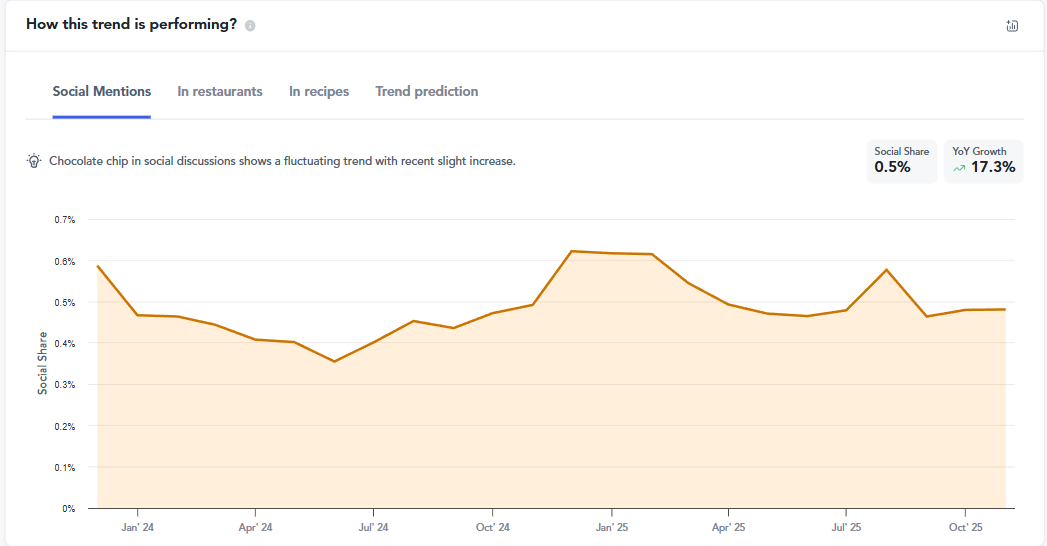
Tastewise consumer need data shows convenient and homemade at 12% both and mini (10%) as meaningful drivers of chocolate chip discussion. This points to controlled indulgence, where consumers want influence over ingredients, preparation, and portion size. Chocolate chip supports this behavior because it is familiar enough to handle substitutions and portioned formats without changing the core expectation.
Tastewise Menu Data also shows growth concentrated in reworked and hybrid formats, including:
- Brookies
- Cookie-brownie layers
- Muffin-cookie mashups
- Cookie fries
These formats outperform single-format baked goods in engagement. The chocolate chip food trend scales through structural variation rather than flavor novelty.
Chocolate chip menu usage across foodservice
Menu Data shows chocolate chip frequently used in:
- Limited-time dessert offers
- Bakery-style menu extensions
- Shareable and oversized dessert formats
Operators use chocolate chip as a dependable anchor for experimentation, reducing risk when testing new dessert formats or portion strategies.
Chocolate chip retail product evolution
Retail innovation centers on:
- Bulk baking chips
- Frozen and ready-to-bake formats
- Dietary-adapted products
Tastewise data shows chocolate chip retail product trends leaning toward flexibility in use case rather than indulgence escalation. Shelf expansion reflects how consumers want to use the product, not new flavor demand.
Chocolate chip social media behavior and cultural relevance
On TikTok, performance isn’t driven by the recipe alone but by visual reinvention:
- Cookie fries (4.8M views)
- Pine cone brownies (1.5M+ likes)
- Oversized shareable cookies
Mini formats represent 10% of consumer need-state mentions, tied to social sharing. The more recognizable the flavor, the more freedom creators take with form.
How Tastewise data is used to track chocolate chip demand
Menu Data is used to measure chocolate chip menu penetration and format adoption across desserts, baked goods, and limited-time offers.
Category Dashboard data is used to track ingredient-level correlation and year-over-year movement for chocolate chip and related components such as dark chocolate and cocoa.
On the Shelf data is used to analyze retail SKU distribution, pack-size availability, and price ranges for chocolate chip products across major retailers.
Consumer Surveys and Social Data are used to identify shifts in consumption occasions, preparation behavior, and dietary adaptations, including gluten-free usage.
Chocolate chip data is used as a baseline flavor signal to evaluate how changes in format, preparation, and dietary positioning affect demand without introducing flavor variability.
FAQs about chocolate chips
Tastewise data shows chocolate chip maintaining year-over-year growth and broad menu penetration, with demand supported by multiple formats rather than a single product type.
Growth is driven by snacking occasions, hybrid dessert formats, and convenience-led preparation rather than new flavor development.
Hybrid and reworked formats such as brownies, muffins, and cookie-based mashups show the strongest correlation and engagement growth.
Chocolate chip appears on more than 16% of U.S. restaurant menus, primarily in desserts, bakery items, and limited-time offers.
Yes. Consumer behavior shows increased use in quick-prep and single-serve recipes, along with higher adoption of dietary adaptations.
Gluten-free chocolate chip is the most dominant dietary adaptation across both menu and retail data.


We’d love to learn your goals and see how Tastewise fits
We’d love to learn your goals and see how Tastewise fits
Get a personalized demo
Good taste. Wise move.
Your demo request is confirmed. We’ll reach out within one business day to schedule your walkthrough.
What happens next

See what’s driving demand, then turn it into a sell-in story for retailers and operators.
- Connect consumer panels, market trackers, and agents into one evidence view
- Get the “why” behind what’s changing, with explainable demand drivers
- Walk away with a buyer-ready narrative and next steps to activate
Trusted by





“Tastewise is my secret tool for knowing what consumers want next and why.“