







The African cuisine trend in the US is holding steady. Across the Tastewise US consumer panel, African cuisine reaches 0.41% of food and beverage consumers, level with last year. Inside that flat total, consumers are moving between regions and reasons. West and East African cooking are gaining consumers while North African and Moroccan interest eases. Easy, everyday cooking is now the fastest-growing reason consumers give for choosing it.
For CPG teams, that points to a clear opening. Sauces, spice blends and staple bases that bring West and East African flavour into weeknight cooking match where demand is moving.
Key takeaways
- African cuisine reaches 0.41% of US food and beverage consumers on the Tastewise panel, with no change on last year.
- North African cooking still leads, named by nearly 2 in 5 African cuisine consumers (39%). Kenyan (up 12.5%) and Egyptian (up 7.3%) interest are growing while Moroccan eases.
- Convenience is the fastest-growing need. Among African cuisine consumers, easy is up 18.4% and everyday is up 15.3%.
- Last year’s breakout dishes have cooled. Peri peri chicken is down 26% and mezze is down 25% on last year.
- New growth sits in East and West African staples such as ugali (up 21.9%) and pounded yam (up 12.1%), each still under 0.3% of African cuisine consumers.
- Suya spice and palm oil are gaining consumers while berbere is down 26.3%, which favours West African pantry products.
African cuisine market performance across social, recipes, and restaurants
African cuisine is a stable, mid-sized cuisine in the US. It reaches 0.41% of food and beverage consumers on the Tastewise consumer panel, the same as a year ago. Consumer interest is holding, and the gains come from specific regions and uses.
The cuisine also has a real menu footprint. African dishes appear on 1.68% of US restaurant menus in Tastewise operator data. Fast casual and casual dining carry the most locations, followed by midscale and QSR.
A stable base with shifting demand inside it is easier to plan around than a spike. You can build a range for the regions and occasions that are growing, then use menu trends to time foodservice launches. LTO rotations give you a low-cost way to test a new flavour before a full launch. The live African food trend tracker follows the cuisine as new data comes in.
Consumer needs shaping African cuisine demand
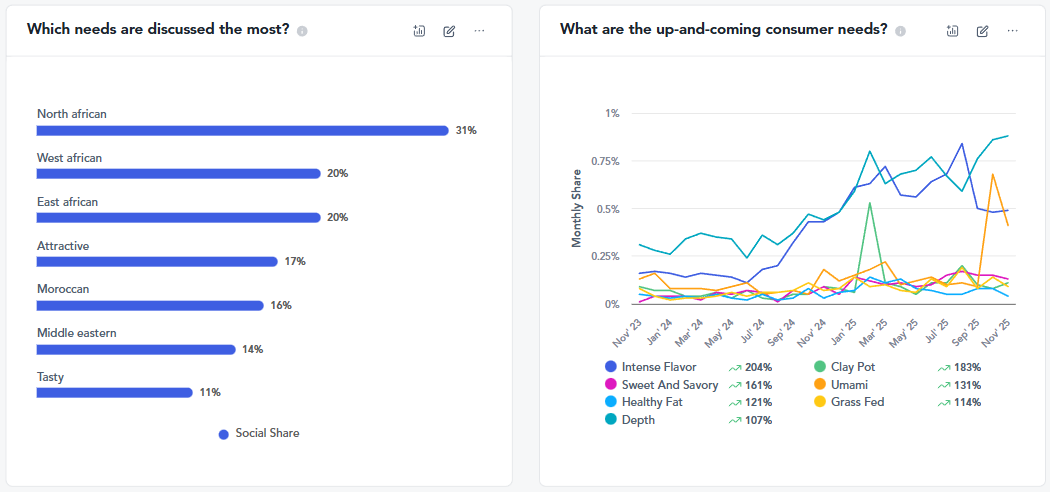
Consumers read African cuisine by region first. Across the Tastewise US consumer panel, North African cooking is the top need, named by nearly 2 in 5 African cuisine consumers (39%). Moroccan follows at about 1 in 4 (26%). East African reaches nearly 1 in 5 (18%) and West African nearly 1 in 6 (17%).
Which African regions are driving the most interest
North African cooking has the widest reach, but it is flat at 0.4% down on last year. Moroccan is down 3.7%. The regions gaining consumers are smaller:
- Kenyan cooking is up 12.5% and reaches 3.3% of African cuisine consumers.
- Egyptian is up 7.3% and reaches nearly 1 in 10 (9%).
- South African is up 6.2% and reaches 4.8%.
- West African is up 2.0% and East African is up 1.2%.
North African cues such as harissa and tagine spice still carry the widest recognition. West and East African cues give you more room to stand out while interest is still climbing. The West African food trend page tracks that region on its own.
How need clusters shape what consumers choose
The fastest-growing needs around African cuisine are practical ones. Among African cuisine consumers on the panel in the past 12 months:
- Easy is up 18.4% and reaches 4.0%.
- Everyday is up 15.3% and reaches 3.5%.
- Convenient is up 15.1% and reaches about 1 in 14 (7%).
- Quick is up 7.5% and reaches 3.3%.
Shared meals are growing too. Family is up 6.6% and celebration is up 5.5%, each reaching about 1 in 13 African cuisine consumers (8%).
That gives you a positioning formula. Name the region on pack, then make the route to dinner short. A jar of West African tomato stew base or a suya rub for sheet-pan chicken meets both needs.
Top African cuisine dishes and what’s growing fastest
Top African cuisine dishes and what’s growing fastest
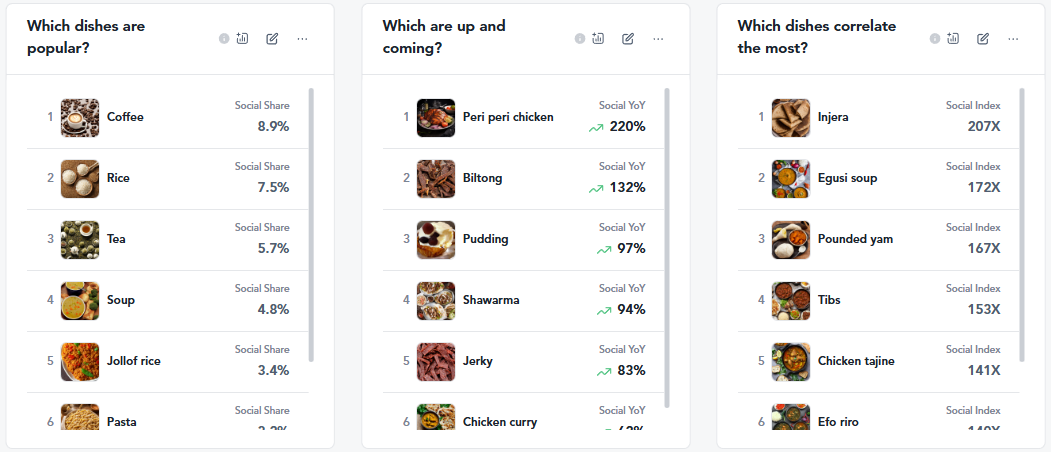
The dishes consumers link to African cuisine are mostly everyday staples. Most of last year’s breakout dishes have slowed, and the new growth sits in staple bases.
Most popular dishes among African cuisine consumers
Across the Tastewise US consumer panel, these are the dishes and drinks African cuisine consumers engage with most:
- Coffee, about 1 in 10 (10%), down 3.0%
- Rice, about 1 in 13 (8%), down 9.8%
- Tea, about 1 in 16 (6%), down 12.8%
- Soup, about 1 in 20 (5%), down 12.4%
- Tajine, 3.7%, down 21.0%
- Jollof rice, 3.1%, down 5.8%
- Pastilla, 2.9%, down 15.1%
Coffee and tea reach the most consumers, and African origin already shows up on US café menus. Peet’s Coffee lists an Ethiopian coffee and Cafe Landwer sells Moroccan mint tea.
Jollof rice is the strongest dish signal for CPG. It holds 3.1% of African cuisine consumers and is declining far more slowly than tajine or pastilla.
Dishes gaining consumers since last year
A small set of dishes is gaining consumers. Each still reaches under 0.3% of African cuisine consumers, so treat them as early signals:
- Rice bowl, up 34.6% (0.13%)
- Ugali, up 21.9% (0.24%)
- Msemen, up 19.9% (0.16%)
- Rice and beans, up 16.0% (0.15%)
- Pounded yam, up 12.1% (0.25%)
- Fried fish, up 9.5% (0.20%)
Most of these are staple bases from East and West Africa, the starch a meal is built around. Ugali lines up with the rise in Kenyan interest. Pounded yam and rice dishes line up with West African growth. Those bases suit flour, mix and frozen formats that a home cook can use on a weeknight.
Dishes that peaked last year
Several dishes that drove growth in early 2026 have reversed. Since last year:
- Peri peri chicken is down 26.0% (0.28%).
- Mezze is down 24.5% (0.18%).
- Biltong is down 11.2% (0.25%).
- Shawarma is down 10.5% (0.55%).
- Jerky is down 9.6% (0.31%).
If your pipeline holds peri peri or biltong concepts built on last year’s numbers, check the case again before launch. Peri peri keeps menu visibility through Nando’s PERi-PERi, but consumer growth has stopped.
Ingredient performance and flavor cues defining African cuisine
Familiar proteins and bases carry the reach in African cuisine. A handful of West African pantry items carry the growth.
Trending vs emerging ingredients in African cuisine
The highest-reach ingredients are familiar ones. Fish reaches nearly 1 in 10 African cuisine consumers (9%), chicken about 1 in 15 (7%) and date about 1 in 16 (6%). All three are down on last year, by 11.8%, 15.8% and 8.2%.
The ingredients gaining consumers are smaller and more specific:
- Sardine, up 15.6% (0.25%)
- Palm oil, up 7.3% (0.33%)
- Baobab, up 2.4% (0.60%)
- Suya spice, up 2.2% (0.13%)
- Pepper sauce, up 2.0% (0.18%)
Peri peri pepper, one of last year’s fastest growers, is now down 27.3%. Labneh is down 14.7%.
Baobab is worth a look for beverage and snack teams. It reaches 0.6% of African cuisine consumers, is still growing and works in drinks, bars and smoothie bowls.
Spice blends gaining and losing consumers
Spice blends are the easiest way to package African flavour, and the main blends are moving in different directions. Since last year:
- Berbere reaches 2.0% of African cuisine consumers and is down 26.3%.
- Ras el hanout is down 18.1% (0.20%).
- Chermoula is down 7.3% (0.14%).
- Harissa is down 2.3% (0.68%).
- Shito is down 1.4% (0.10%).
- Suya spice is up 2.2% (0.13%).
Berbere still reaches about 15 times as many consumers as suya spice. Suya is the blend gaining consumers, and that matches the rise in West African interest.
For product innovation teams, the credible build pairs a West African blend such as suya or shito with a base consumers already buy. Chicken, rice and tomato stew sauce all fit. Keep the format to a rub, a marinade or a cooking sauce.
Formats and occasions driving adoption in foodservice and retail
The formats gaining ground are weeknight home-cooking formats. Last year’s grab-and-go protein formats have slowed.
Weeknight meals, bowls and staple bases
Rice bowls are up 34.6% and rice and beans are up 16.0% among African cuisine consumers, both from small bases. In the same window, easy grew 18.4% and everyday grew 15.3% as reasons to choose African cuisine. Consumers are reaching for African flavour on ordinary nights at home.
For retail, that favours cooking sauces, spice rubs and quick-cook staples. Tastewise e-retail data already shows West African tomato stew sauces, suya seasonings and berbere blends sold online, so the shelf exists. The opening is a retail sell-in story that ties a product to growing West and East African demand.
Beverage and café adjacency (coffee and tea crossover)
Coffee and tea remain the widest entry points. Coffee reaches about 1 in 10 African cuisine consumers (10%) and tea about 1 in 16 (6%). Within coffee, black coffee is up 32.7% and roast coffee is up 11.2%, both from small bases under 0.2%.
On menus, African origin already sells coffee and tea. Peet’s Coffee lists an Ethiopian coffee, and Cafe Landwer and Horizon Shine Coffee sell Moroccan mint tea. Hibiscus drinks such as zobo are declining (down 19.1%), so origin-led coffee is the safer bet for beverage teams.
What African cuisine looks like on menus right now
African dishes on US menus split between café and fast casual items and full plates at independent restaurants. Tastewise operator data includes:
- Kenyan beignets at Griot Cafe, $3.25
- Moroccan lentil soup at Pret a Manger, $9.45
- Moroccan spiced chicken wrap at Proper Food, $16.85
- Moroccan chicken braise soup at Urban Plates, $17.69
- Fish dibi wrap at Bissap Baobab, $17.75
- Lamb tibs at Kategna Ethiopia Cuisine, $23
- Goat meat pepper soup at My Village Grill, $23.83
- Ugba at Tastee Afrikana, $24.99
Menu pricing signals from African cuisine dishes
Prices show two routes. Café and fast casual chains price Moroccan soups and wraps at roughly $9 to $18. Independent West and East African restaurants price full plates such as tibs, pepper soup and ugba at $23 to $25.
Fine dining over-indexes most for African cuisine relative to its size in Tastewise operator data. That supports premium positioning for authentic dishes at the top of the market.
For brands selling into foodservice, each route needs a different product. Chains need sauces and spice blends they can add to an existing soup or wrap. Independents need authentic staples and spice pastes for kitchens cooking full dishes.
Scalable menu builds (stews, sauces, spice-forward add-ons)
The sauce layer is the easiest place to start. A suya rub, a shito pepper sauce or a harissa paste lets an operator change an existing chicken, rice or wrap item without new equipment. Moroccan names already sit on chain menus, so a West African sauce on the same format is a low-risk test.
FAQs about African cuisine trend
The African cuisine trend is US consumer interest in African regional cooking, at home and in restaurants. Across the Tastewise US consumer panel, African cuisine reaches 0.41% of food and beverage consumers, level with last year. Growth is moving toward West and East African cooking and toward easy, everyday use.
Among named African dishes, tajine reaches 3.7% of African cuisine consumers, jollof rice 3.1% and pastilla 2.9%. Jollof rice is holding up best of the three. It is down 5.8% on last year, against 21.0% for tajine.
Suya spice is the blend gaining consumers, up 2.2% since last year. Berbere has the widest reach at 2.0% of African cuisine consumers but is down 26.3%. Suya, berbere, ras el hanout and harissa blends are all sold online in Tastewise e-retail data.
No. Peri peri chicken is down 26.0% on last year and reaches 0.28% of African cuisine consumers. Tastewise data published in January 2026 showed it more than tripling, and that growth has since reversed.
North African cooking has the bigger base, named by nearly 2 in 5 African cuisine consumers (39%), but it is flat. West African reaches nearly 1 in 6 (17%) and is up 2.0%. Staples such as pounded yam and pantry items such as suya spice and palm oil are growing with it.
Sauces and spice blends added to existing chicken, rice, soup and wrap items scale most easily, because operators need no new equipment. Rice bowls are also gaining consumers, up 34.6% from a small base of 0.13% of African cuisine consumers.




We’d love to learn your goals and see how Tastewise fits
We’d love to learn your goals and see how Tastewise fits
Get a personalized demo
Good taste. Wise move.
Your demo request is confirmed. We’ll reach out within one business day to schedule your walkthrough.
What happens next

See what’s driving demand, then turn it into a sell-in story for retailers and operators.
- Connect consumer panels, market trackers, and agents into one evidence view
- Get the “why” behind what’s changing, with explainable demand drivers
- Walk away with a buyer-ready narrative and next steps to activate
Trusted by





“Tastewise is my secret tool for knowing what consumers want next and why.“