





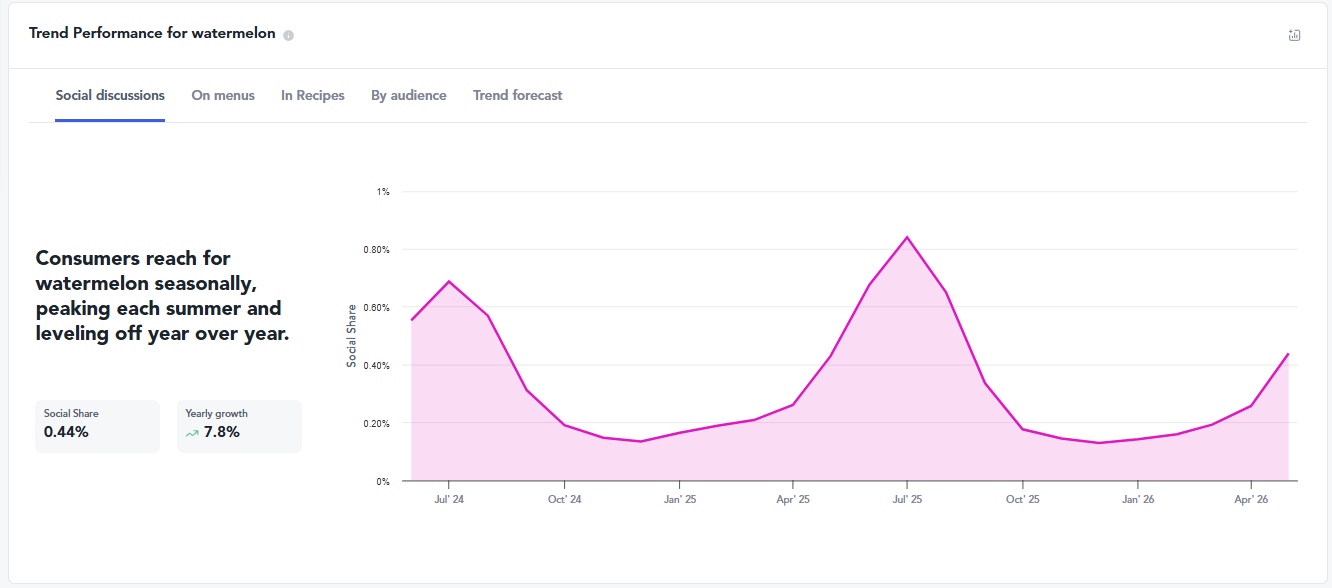
The watermelon trend in 2026 has moved well beyond summer salads and fruit platters. Consumer panel data from Tastewise shows watermelon reaching 176,574 consumers in the US with 7.8% growth in the past year, and the signal driving that growth is not flavor nostalgia. It is functional hydration. Electrolytes as a consumer need within the watermelon context are up 19.7%, lycopene appears in the functional ingredient data at nearly 25% menu share, and on-menu watermelon dishes grew 6.4% in the past year across 139,825 US restaurants. Your team has a window here, and it is not as wide as it looks.
Key takeaways
- Electrolytes within the watermelon context grew 19.7% in the past year with 1.59% consumer share. Gut health is up 7.7%. Consumers are already framing watermelon as a recovery and wellness ingredient, not just a seasonal snack. Your product innovation brief should reflect that shift before your competitors do.
- The watermelon-corn salad pairing generates 7.5 times more discussion in the watermelon context than the broader food and beverage category average, pointing to a fresh-produce occasion crossing from foodie circles into mainstream menus.
- Watermelon electrolyte and hydration products command retail prices from $22 to $55 per pack, with Prime Hydration, Liquid I.V., Celsius, and Cure Hydration all running watermelon SKUs. The retail whitespace is in clean-label, whole-fruit RTD positioning.
- Watermelon mint and watermelon lime are the two strongest flavour compound signals on menus, each holding over 6% menu share, growing 7.9% and 3.3% in the past year. These pairings are the fastest route to on-menu placement at juice bars, fast casual, and wellness-positioned chains.
What the watermelon trend looks like in 2026
Watermelon has always been a summer category anchor. What is different in 2026 is who is driving the demand and why. Consumers choosing watermelon today are increasingly doing so for functional reasons: natural electrolytes, lycopene content, hydration benefits, and low-calorie refreshment. The summer seasonal signal is still present at 19.7% consumer share, but “fresh” at 15.9% growth and “energy” at 18.5% growth are the claims gaining share. The consumer is reframing watermelon from a treat into a tool.
Across the Tastewise US consumer panel, the watermelon category generated over 278,000 posts in the past year with 7.8% growth. On the functional health side, electrolytes hold 1.59% consumer share with 19.7% growth. Lycopene appears at 24.9% menu share in the functional watermelon cluster. Coconut water as a companion ingredient grew 12.4%, reflecting the hydration-stacking behaviour where consumers combine watermelon with other electrolyte-rich bases. Protein is up 25.4% in the watermelon context and gut health claims grew 7.7%. At retail, watermelon electrolyte products from Prime Hydration, Liquid I.V., and Celsius are selling through at volume, validating consumer demand with real purchase data.
The opportunity sits at the intersection of two movements: the broader functional hydration trend and the consumer appetite for whole-food ingredients with a familiar flavor story. Watermelon is trusted, globally recognized, naturally sweet, and scientifically credible as a hydration base. Brands that build around that combination in product innovation have a genuine market position to occupy before the category gets crowded.
The consumption occasions driving watermelon demand
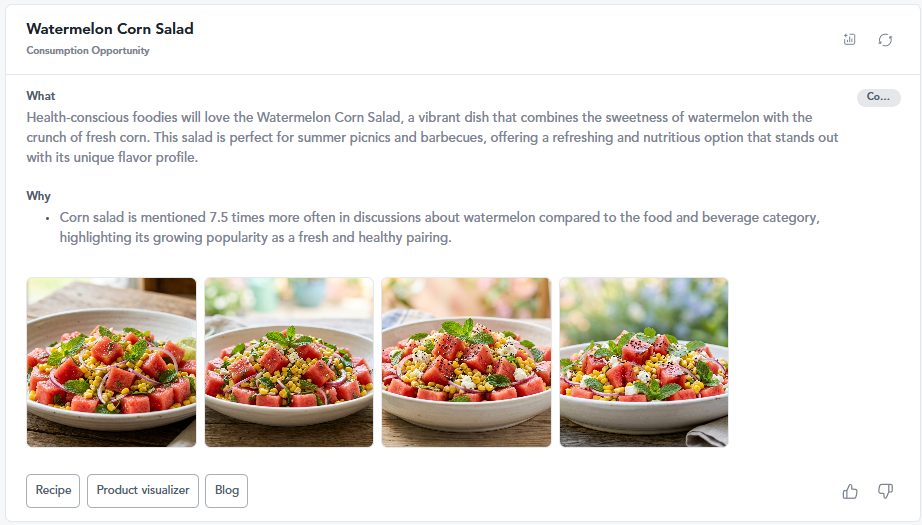
The watermelon-corn salad pairing shown above is more than a recipe trend. It is a signal about how consumers are building meals around watermelon in 2026. Corn grew 10.3% in the watermelon ingredient context this past year, sitting alongside feta (+6.2%), cucumber, and mint. These combinations point to a savoury-fresh occasion that extends watermelon well beyond its traditional role as a dessert or snack component.
The on-menu data confirms the shift. Across more than 139,000 US restaurants on the Tastewise platform, watermelon appears in hydration-specific contexts at juice bars including Juice Generation, Organic Krush, and Smoothie King. It features on wellness menus at Sunlife Organics, Le Botaniste, and Pressed. It appears in mocktail formats at fast-casual chains and in salad formats at build-your-own bowl concepts. Weekend occasions hold 9.3% consumer share with 6.2% growth. Snack occasions grew 9.8%. The ingredient is migrating across the daypart spectrum, and the consumer marketing opportunity is to own one of those moments before a competitor does.
Frozen formats are worth a close look. “Frozen” as a consumer claim in the watermelon context grew 14.9% in the past year. Popsicle formats appear consistently in the recipe data. Slushie formats hold 0.93% ingredient share with 11.5% growth. These are not niche signals. They represent a processing whitespace where watermelon’s natural hydration credentials can be preserved in a format that delivers on convenience and indulgence simultaneously.
The functional health signals making this more than a flavour trend
The trend performance chart above reveals something important beyond the 7.8% growth headline. Watermelon is not erasing its seasonality, but its off-peak floor is rising. Consumer engagement in the January-to-April window is higher in 2025-26 than in the equivalent 2024-25 period. That is the signature of a trend with a structural driver underneath the seasonal one, and the structural driver is functional hydration.
Electrolytes hit 24.3% consumer need share in the pure functional watermelon cluster, with 20.1% growth in the past year. Energy is at 22.6% share with 12.1% growth. Vitamin C grew 32.7%. Anti-inflammatory claims grew 18.7%. Gut health grew 17.1%. Protein within the watermelon context is up 26.1%. These are not marginal signals. They represent a consumer base that has absorbed the science on lycopene, L-citrulline, and natural potassium and is actively seeking watermelon as a delivery mechanism for those benefits.
At retail, the validation is clear. Prime Hydration’s strawberry watermelon SKU is among their highest-velocity products. Liquid I.V. runs watermelon as a year-round core SKU, not a seasonal variant. Celsius Sparkling Watermelon carries over 800 Amazon reviews at 4.6 stars. Cure Hydration, Ultima Replenisher, and REDMOND Re-Lyte all run watermelon electrolyte formats. The category has retail proof of concept. What it does not yet have is a clean-label, whole-fruit RTD format at scale. That is where the best AI platforms for food innovation are pointing teams right now.
What the electrolyte opportunity looks like on the ground
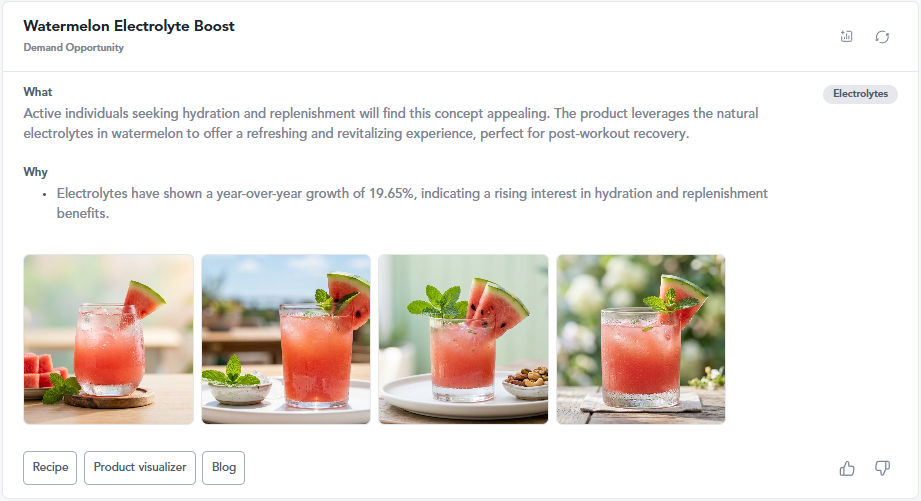
The Tastewise demand opportunity above captures the precise consumer profile driving the electrolyte signal: active individuals seeking hydration and replenishment, specifically framed around post-workout recovery. That is not a niche audience in 2026. Fitness holds 15.5% consumer need share in the functional watermelon cluster. Post-workout as an occasion is growing steadily. Clean energy grew 77.2%. Anti-bloat grew 67.5%. Blood sugar claims grew 43.3%.
The on-menu evidence supports the positioning. At Smoothie King, the hydration watermelon item sits at $4.60 to $8.55. At Le Botaniste, a coconut electrolyte watermelon drink runs at $6.05. At Pressed, the hydration watermelon fitness shot is $4. These price points span from accessible to premium and the format spectrum runs from shots to full beverages. The channel architecture for a watermelon functional product is already built. The foodservice sell-in story writes itself: natural electrolytes, zero added sugar, whole-fruit base, proven consumer demand signal.
What your team should do with the watermelon trend data
Three moves stand out from the consumer signal data. First, if your portfolio has a hydration or sports nutrition line, watermelon is the flavour priority for the next 12 months. The consumer need data, the retail sales data, and the on-menu placement data are all pointing in the same direction. A strawberry-watermelon or watermelon-lime format with clean electrolyte credentials and a whole-fruit story will land in a category that buyers already understand.
Second, the savoury occasion is genuinely underdeveloped. Watermelon-feta, watermelon-corn, and watermelon-basil pairings are generating strong consumer signals on menus and in recipe content, but retail shelf space in the prepared salad, dip, and snack categories has not caught up. A watermelon-based savoury snack or prepared salad kit occupies a cross-category whitespace that most CPG teams have not yet mapped. The CPG insights data on produce-adjacent snacking supports the move.
Third, the frozen and mocktail formats are the lowest-friction routes to trial. Watermelon popsicles, slushies, and mocktails sit in occasions where consumers are already comfortable with the ingredient and the format. Building a watermelon mocktail range or a premium frozen bar with functional claims gives your team a product that is visually compelling, functionally credible, and positioned against a trend the consumer is already demonstrating with their purchasing behavior.
FAQs about the next big watermelon trend
Watermelon retains a strong summer peak in the US consumer panel, with its highest social share appearing in June through August. However, the off-peak floor is rising. The January-to-April engagement window is measurably higher in 2025-26 than in the same period a year earlier. The driver is the functional hydration framing, which extends consumer interest in watermelon beyond its traditional summer occasion. Electrolyte products, frozen formats, and mocktail applications are all contributing to year-round shelf relevance. Brands positioning watermelon purely as a seasonal SKU are leaving revenue on the table in Q1 and Q4.
Watermelon mint and watermelon lime are the two highest-performing flavour compounds on menus, each holding over 6% menu share on the Tastewise platform, both growing in the past year. Watermelon cucumber is a strong pairing in the hydration and wellness context, particularly at juice bars and clean-eating chains. Watermelon feta is the leading savoury pairing and represents the clearest route into the prepared foods and premium snack category. For beverage innovation, watermelon strawberry is the most commercially validated retail combination, confirmed by Prime Hydration, Gatorade, and Liquid I.V. all running that pairing in active SKUs.
The strongest frame in 2026 is functional hydration with a whole-fruit story. Consumers responding to watermelon in the functional cluster are citing electrolytes, lycopene, natural potassium, and clean energy. They are not primarily motivated by flavour novelty. An R&D brief that leads with natural electrolyte content supported by real watermelon juice, positions against the post-workout and active lifestyle occasion, and uses clean-label claims including no added sugar and non-GMO will perform better than a flavour-led brief. The food and beverage marketing strategy that wins retail placement will frame watermelon as an ingredient with a science story, not just a flavour with a summer story.


We’d love to learn your goals and see how Tastewise fits
We’d love to learn your goals and see how Tastewise fits
Get a personalized demo
Good taste. Wise move.
Your demo request is confirmed. We’ll reach out within one business day to schedule your walkthrough.
What happens next

See what’s driving demand, then turn it into a sell-in story for retailers and operators.
- Connect consumer panels, market trackers, and agents into one evidence view
- Get the “why” behind what’s changing, with explainable demand drivers
- Walk away with a buyer-ready narrative and next steps to activate
Trusted by



“Tastewise is my secret tool for knowing what consumers want next and why.“