





Food and beverage brands spend millions on consumer research each year. The data quality is rarely the problem. What kills strategy is the gap between insight and execution: weeks of manual translation work between a raw data finding and the brief, claim, or sell-in narrative that a team can actually use. In a category where AI for food brands has moved from pilot to production, that lag is no longer acceptable. The brands closing that gap are not buying more data. They are changing how they act on it.
Key takeaways
- Teams using agentic AI workflows produce operator-ready narratives 10x faster than those relying on manual research translation. Every week saved is a week your team is in-market before a competitor.
- Brands using agentic AI report a 25% increase in sales conversion rates. The difference is that reps walk into buyer meetings with proof, not summaries.
- Research costs drop by 65% when human-and-agent workflows replace legacy manual analysis. That budget can move to activation, not just data collection.
- The insight-to-execution gap is not a data problem. It is a workflow problem. And it is solvable right now with the tools already available to large F&B teams.
- According to a PwC survey, 40% of consumers expect to use AI for comparison shopping by 2030, and the brands best positioned to meet that shift are the ones already building always-on intelligence into their workflows today.
Why the insight-to-execution gap is the real research failure
Consumer trends in food and beverage do not wait for quarterly review cycles. A flavor gaining traction in one region can be mainstream in another within weeks, and the brands that respond first earn the shelf space. Most teams already know this. The issue is that their research process was not designed for this speed. Data arrives in one format, strategy lives in another, and the translation between the two costs time that the market does not give back.
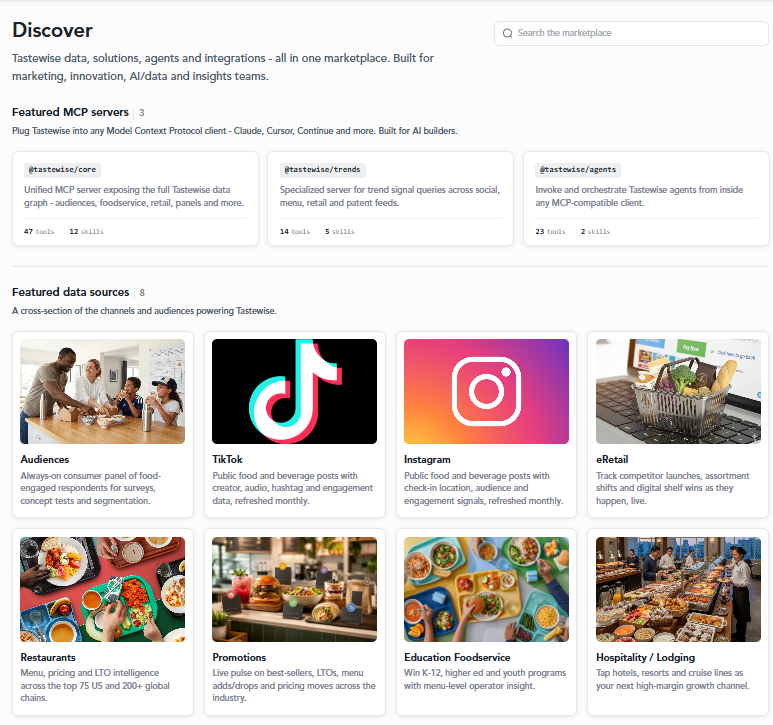
The Tastewise platform sits at the intersection of human food expertise, consumer data, and AI agents. It tracks consumer demand signals across retail and foodservice in real time, so the gap between what is happening and what your team should build narrows from weeks to hours. Brands trusted by 80% of the world’s leading F&B companies use it because speed of execution is now a commercial advantage, not just an operational preference.
The opportunity this creates is structural. When your team can move from a consumer signal to a production-ready brief in the same session, you stop leaving white space for competitors to fill. Your R&D pipeline responds to demand before it peaks. Your sales team walks into every buyer meeting with a story built on evidence, not instinct.
Shift to actionable AI intelligence over raw data
The most common version of research failure in F&B is not bad data. It is data that never becomes a decision. A team pulls a food and beverage trend report, identifies a rising consumer need, and then hands it to someone else to translate into a brief. That translation process, done manually, can take two to four weeks. By the time the brief is approved, the trend window has shifted.
Auditing your current research pipeline starts with one question: how long does it take from a confirmed consumer signal to a production-ready output your team can use in a buyer meeting or R&D brief? If the honest answer is weeks, the bottleneck is not the research. It is the workflow sitting between the data and the action.
Always-on AI in food industry applications replace the static report cycle with a continuous data stream. Instead of a point-in-time snapshot every quarter, your team gets a live view of what consumers are choosing, why they are choosing it, and where the unmet demand sits. The shift is not about having more data. It is about having data that arrives already connected to the decision it supports.
How to cut time-to-market by automating narratives with AI for food brands
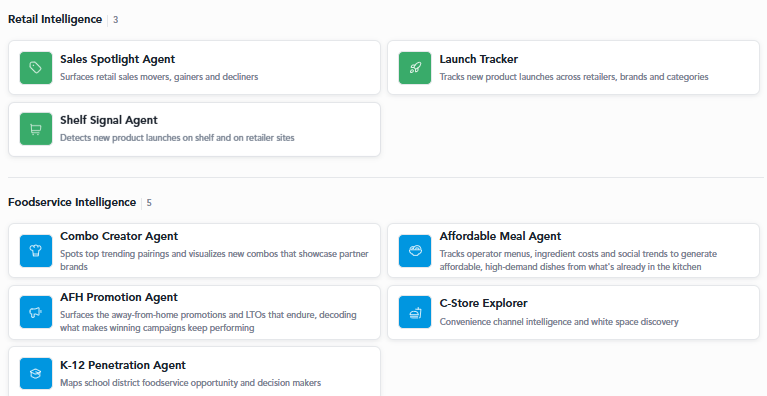
The 10x speed improvement in narrative production is not a theoretical ceiling. It reflects what happens when human-and-agent workflows take over the translation layer between data and output. An agent that understands your category, your audience, and your brand positioning does not need a brief to be written from scratch. It needs a confirmed signal and a destination format.
In practice, this means a brand manager working on a new sauce launch does not spend three weeks commissioning and waiting for research. They use an AI food prediction workflow to pull the relevant consumer demand signals, identify the flavour claims with the fastest growth in the category, and generate a sell-in narrative that speaks directly to the buyer’s priorities. The analyst’s job becomes reviewing and refining, not producing from scratch.
The output is not just faster. It is more defensible. When a retail buyer challenges the claim behind a new product, the response is not an internal estimate. It is a cited consumer signal with a clear growth trajectory. That is what drives the 25% increase in sales conversion. Buyers respond to proof, and proof is now available at the speed of the conversation.
Generate real-time flavors and recipes with AI for food brands
R&D teams have historically operated on a lag. Consumer preference data arrived after the innovation cycle had already committed to a direction. AI for CPG applications change that by feeding real-time demand signals directly into the concept stage. Your team no longer needs to extrapolate from last year’s survey data. It works from what consumers are choosing today.
The practical application is straightforward. If a flavour ingredient is growing quickly in a relevant adjacent category, your innovation pipeline can pick that signal up before it reaches peak mainstream adoption. That is the window where a first-mover brand captures the most shelf space and the clearest consumer story. The ingredient does not have to be entirely new. It has to be timed correctly.
According to the International Food Information Council, nearly 7 in 10 consumers say taste is their top food purchase driver, ahead of price and healthfulness. When your product innovation pipeline is connected to real-time flavour demand signals, you build products around what consumers are already choosing, not what you predict they might want.
How industry leaders protect research budgets
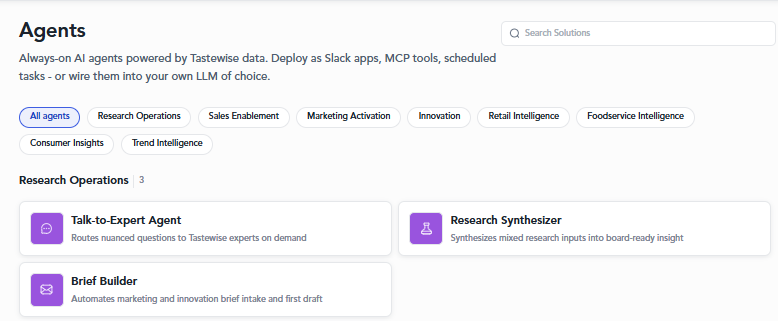
The 65% reduction in research costs that brands achieve through agentic AI does not come from cutting research. It comes from eliminating the non-research work that fills most of the research budget: the manual collation, the brief-writing, the translation from data format to narrative format. When agents handle that layer, human time concentrates on the decisions that actually require judgment.
Brands like PepsiCo, Kraft Heinz, and Nestle have moved toward human-and-agent workflows precisely because the alternative, committing large research budgets to processes that produce output too slowly to be useful, is a structural disadvantage. The retail sales enablement use case is the clearest example. A sales team with an always-on intelligence layer walks into every buyer meeting with a current proof deck, not a six-month-old report.
The broader principle applies across teams. When research output arrives at the speed of the business cycle rather than the speed of the analysis cycle, every downstream function, innovation, marketing, sales, and category management, gets a lift. The budget does not shrink. It goes further because the work it funds produces usable output faster.
FAQs about AI for Food Brands
Traditional research tools capture what happened in a defined period and require analysts to translate findings into usable outputs manually. Agentic AI connects consumer demand signals to production-ready outputs in real time. The translation layer, which is where most of the time and cost sits, becomes automated. Teams shift from waiting for insights to acting on them.
The timeline depends on how much of the current workflow is manual. Brands that have adopted human-and-agent platforms report moving from weeks to hours for standard brief and narrative production. The first gains tend to come in sales enablement, where the need for current, defensible proof points is most urgent.
Yes. The same demand signal infrastructure supports both channels. For retail teams, it accelerates sell-in narratives and buyer-ready proof decks. For foodservice teams, it surfaces menu whitespace and operator trends that support foodservice sales enablement conversations. The output format differs, but the underlying data layer is the same.

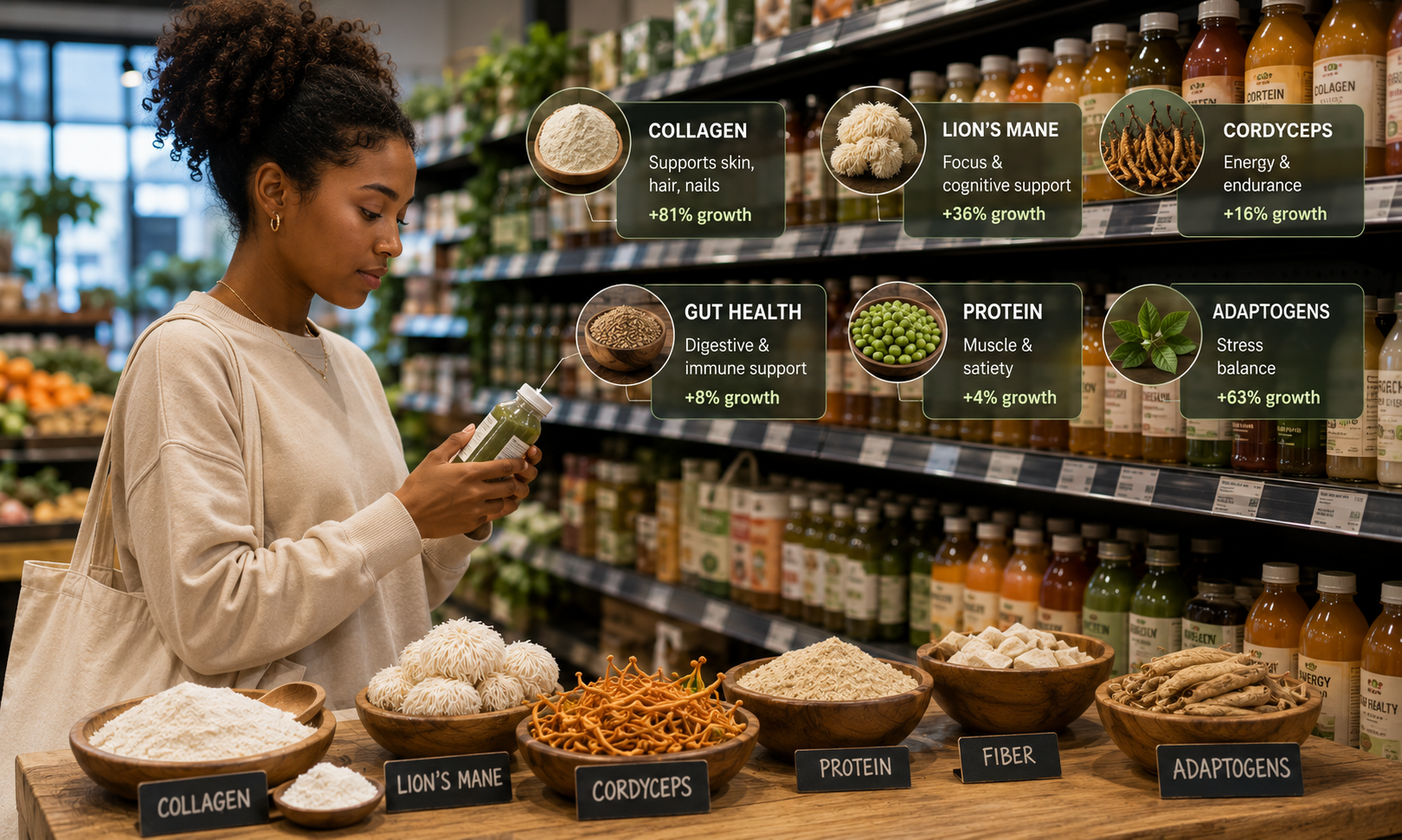
We’d love to learn your goals and see how Tastewise fits
We’d love to learn your goals and see how Tastewise fits
Get a personalized demo
Good taste. Wise move.
Your demo request is confirmed. We’ll reach out within one business day to schedule your walkthrough.
What happens next

See what’s driving demand, then turn it into a sell-in story for retailers and operators.
- Connect consumer panels, market trackers, and agents into one evidence view
- Get the “why” behind what’s changing, with explainable demand drivers
- Walk away with a buyer-ready narrative and next steps to activate
Trusted by



“Tastewise is my secret tool for knowing what consumers want next and why.“