





Beer trends in 2026 are telling a complicated story. The category is large, culturally embedded, and still the go-to drink for celebration and social occasions. But it is also under real pressure. Craft beer, once the undisputed growth engine, is now in a declining lifecycle stage. IPA volumes are contracting. Hard seltzer is losing share. If your team is working in the beer and cider category, you are navigating a market that rewards precision: knowing which sub-segments are growing, which occasions are gaining momentum, and which sensory profiles consumers are gravitating toward. The Tastewise consumer panel reveals the signals that separate the winners from the noise.
Key takeaways
- Celebration is growing at +7.7% in the beer category. Consumers are choosing beer for milestone moments, not just habit. Your team has a clear occasion peg to build sell-in narratives around.
- Guinness is up +16.9% and trending. In a category where most large brands are flat or declining, Guinness is the standout velocity signal. The smooth, premium stout positioning is resonating where generic craft is not.
- Smooth texture is now a top consumer driver. Across the Tastewise consumer panel, smooth leads texture preferences at nearly 1.4% share. Products that lead on mouthfeel are outperforming those that lead on bitterness or complexity alone.
- The craft beer segment is in structural decline at -23.7%. Volume is not gone, but growth is not coming from here. Innovation resources are better placed in premium lagers, artisan-positioned ales, and occasion-anchored formats.
What beer trends look like for consumers right now
Beer is a social category first. Tastewise data shows the top consumer occasions for beer in 2026 are weekends (12.45% share), friends occasions (7%), weekday occasions (6.89%), and celebration (5.08%). The mood is convivial, ritualistic, and increasingly tied to identity. Consumers are not just buying a beer. They are buying into a moment, a tribe, and an experience that matches their self-image. Celebration, specifically, is up nearly 8% since last year, which signals that beer is being chosen more deliberately for milestone occasions.
The Tastewise consumer panel also shows a divergence in ingredient and style signals worth paying close attention to. Craft beer holds the highest consumer share in the category at 18.08%, but it is declining at -23.7%. Ale is growing at +8.5% and holding a mature lifecycle stage. Guinness is in the trending stage at +16.9%. The beers and ciders category sits at around 4% consumer share overall but is losing volume against faster-growing adjacent categories like cocktails (+10.8%) and coffees (+4%). The opportunity is not about defending the whole category. It is about identifying the formats and positionings that have genuine velocity.
For your team, the implication is clear. Beer innovation in 2026 has to be built around specific occasions, specific sensory profiles, and specific audiences rather than the broad craft premise that drove growth a decade ago. Brands that anchor to celebration occasions, invest in smooth and premium sensory cues, and frame their beer through the lens of product innovation have the strongest path to shelf and menu presence.
Why the beer category is splitting in two
The headline story in beer trends right now is bifurcation. On one side, legacy craft formats are declining: IPA is down -17.7%, hazy IPA down -18.3%, double IPA down -22.5%, pale ale down -25.3%. These were the growth formats of the previous decade and they are now in structural contraction. On the other side, a smaller set of styles and brands is holding or trending upward. Ale is growing. Guinness is trending. Yuengling is in the trending stage at +23.5%. Peroni is trending at +16.4%. The food intelligence platform data suggests that consumers are rotating away from aggressive bitterness and complexity toward approachable, smooth, and character-led brands.
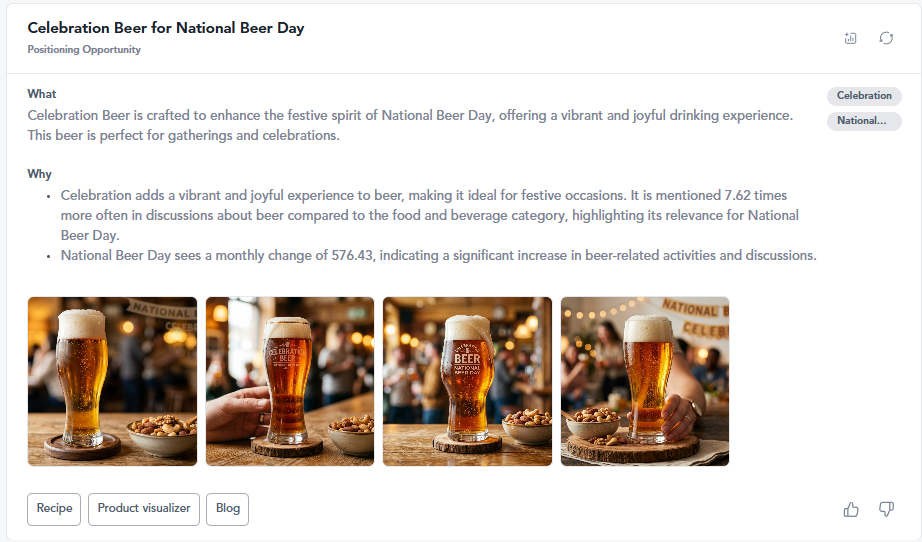
Tastewise platform data: Celebration Beer for National Beer Day. Positioning opportunity and consumer motivation signals.
National Beer Day is one of the clearest windows into this behaviour shift. According to Tastewise data, the celebration claim is up +7.7% in beer and National Beer Day shows a monthly change signal of 576.43, indicating a significant acceleration in beer-related engagement around that occasion. The data also shows that celebration adds a vibrant and joyful dimension to beer that is mentioned 7.62 times more often in beer-specific signals than in the broader food and beverage category. For your team, this is a sell-in story, a campaign peg, and an NPD brief all in one. The The National Beer Day report maps out the positioning opportunities in detail.
The split also shows up in consumer texture preferences. Smooth is the leading texture signal at 1.39% consumer share against a benchmark of 1.60% across all alcoholic beverages. Juicy sits at 1.14% and soft at 1.04%. Sparkling, interestingly, indexes below benchmark at 0.70% for beer versus 1.64% for the alcoholic beverages category overall. Consumers are telling you exactly what they want from a beer in 2026: something smooth, satisfying, and that does not fight for attention.
Beer trends data: the signals your team should be tracking
Beers and ciders sit at approximately 4% consumer share in the overall beverages landscape. That is a meaningful base but the category is losing relative ground. The comparison is instructive: cocktails are growing at +10.8%, grains at +15%, and meat-based dishes at +15% as a pairing category. Beer is not disappearing but it is being actively repositioned in consumers’ minds relative to the alternatives.
Within beer itself, the clearest growth signals cluster around a few distinct areas. Ale is in a mature lifecycle but growing at +8.5%. Shandy is growing at +6.9%. Irish beer is growing at +5.1%. These are traditional, origin-rooted formats that carry authenticity and heritage cues consumers are gravitating toward. Smooth at +23.2% in consumer claim growth is one of the most significant signals in the entire category. Premium is growing at +15.9%. Convenient is growing at +24.2%.
The foods pairing signal matters here too. Wings are in the trending stage within the beer category at +33%, sausage at +20.3%, and hot dog at +22%. Beer is consolidating around communal, comfort-forward food occasions. That is not a shrinking position. It is a deeply defensible one if your consumer marketing strategy is built around it rather than chasing the fading craft narrative.
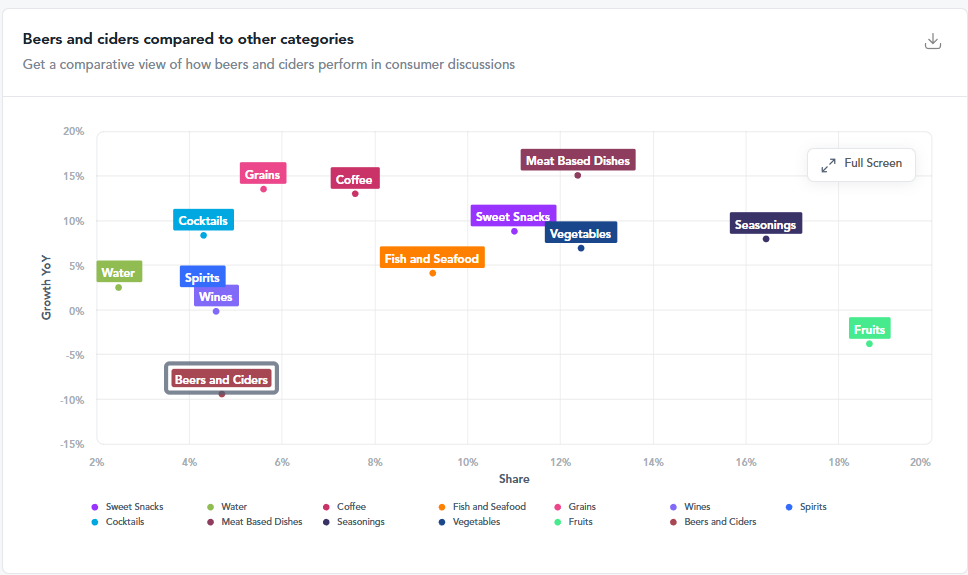
Tastewise platform data: beers and ciders compared to other beverage categories by consumer share and growth.
The texture and sensory opportunity in beer trends
Consumer texture preferences in beer are sharply defined in the Tastewise data. Smooth leads the category at 1.39% share. Juicy sits at 1.14%, soft at 1.04%, and creamy at 0.78%. Crispy at 0.78% over-indexes on the food pairing side. What is notable is what is not leading: sparkling and thick both sit below benchmark. Consumers who are committed beer drinkers in 2026 are choosing based on a mouthfeel that feels refined and effortless rather than bold or effervescent.
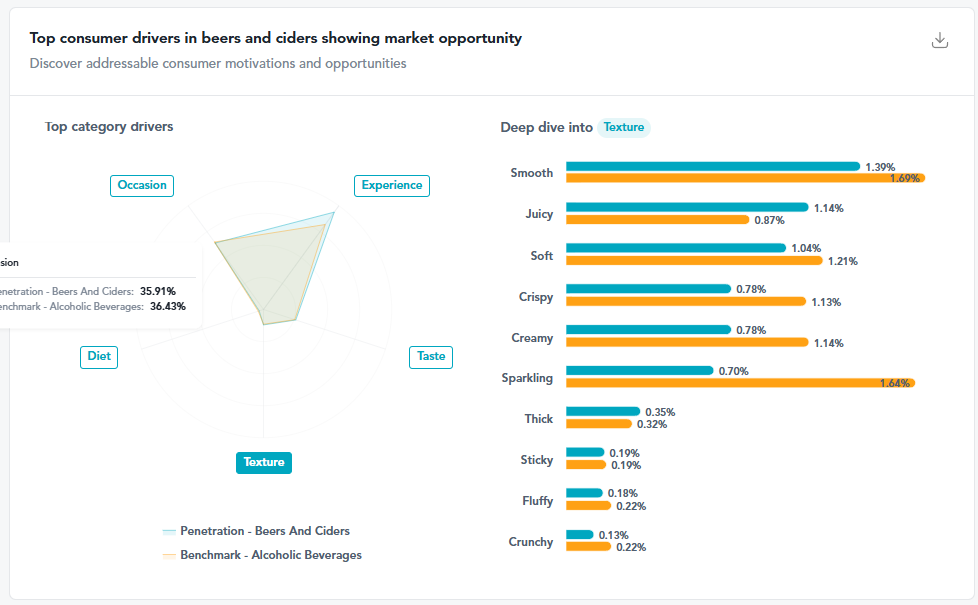
Tastewise platform data: top consumer texture drivers in beers and ciders with benchmark comparison against alcoholic beverages.
This has direct implications for how brands should be formulating, framing, and marketing. A beer that leads with smooth on pack and in advertising is aligned with where the data says consumers already are. A beer that leads with hazy, complex, or bitter is fighting the current. According to a 2024 analysis by the Brewers Association, the craft segment saw volume decline for the first time in years, which the Tastewise consumer data corroborates through the -23.7% lifecycle decline in craft beer specifically.
The energy signal in beer is also worth tracking closely. The energy claim in beer is growing at +77.1% in the past 12 months. This does not mean beer is becoming an energy drink. It means consumers are choosing beers for settings that carry an active, social energy: sporting events, evenings out with friends, post-activity occasions. Sports game occasions are stable at +1.4% and the after-work occasion is up +18%. These are the positioning territories with genuine runway for the next 12 months.
How your team can act on 2026 beer trends
The Tastewise data points to three high-confidence areas for your team to prioritise. The first is occasion-anchored positioning. Celebration (+7.7%), weekend (+flat but dominant volume), and evening (+3.3%) are the strongest occasion signals in beer. Products framed around these moments, in pack design, retail placement, foodservice menu strategy, or campaign creative, are aligned with where beer demand is most stable and most socially embedded.
The second is sensory leadership. Smooth, premium, and convenient are all growing in the beer claim space. A product that can credibly own smooth on the label and in the tasting notes has a competitive advantage over the field of craft-complexity messaging that the market is currently walking away from. The artisan claim still holds the highest share in beer at 19.29%, which suggests heritage and craft still matter as quality signals, but divorced from the IPA-centric positioning that drove the first craft wave.
The third is occasion specificity at retail and on-premise. The retail sales strategy for beer in 2026 should be built on specific calendar moments and pairing stories. Wings, sausage, and hot dog are the top trending food pairings in the beer category. Building those stories into buyer presentations, in-store activation, and digital content gives your team a proof point that goes beyond category data into genuine consumer behavior.
FAQs about beer trends
The most material beer trends in 2026 are the decline of craft formats (especially IPAs), the growth of smooth and premium-positioned ales, the rise of occasion-led demand around celebration and evening, and the emergence of sensory cues like smooth and soft as dominant purchase drivers. Brands like Guinness and Yuengling are trending while legacy craft SKUs are in structural decline.
Tastewise consumer data shows craft beer at -23.7% in the past year, moving into a declining lifecycle stage. The driving factors include category saturation, palate fatigue with bitter and complex profiles, and increased competition from adjacent categories like cocktails and premium lagers. Consumers are still interested in quality and provenance, but smooth and approachable have replaced complex and hoppy as the leading sensory preference.
Weekend and friends occasions remain the dominant volume drivers in beer. Celebration is the fastest-growing occasion at +7.7%, making it the highest-priority territory for NPD and marketing strategy. Evening (+3.3%), after-work (+18%), and sports game occasions are all tracking positive. National Beer Day is a significant acceleration point, with the Tastewise platform showing a monthly signal change of 576.43 around the occasion.



We’d love to learn your goals and see how Tastewise fits
We’d love to learn your goals and see how Tastewise fits
Get a personalized demo
Good taste. Wise move.
Your demo request is confirmed. We’ll reach out within one business day to schedule your walkthrough.
What happens next

See what’s driving demand, then turn it into a sell-in story for retailers and operators.
- Connect consumer panels, market trackers, and agents into one evidence view
- Get the “why” behind what’s changing, with explainable demand drivers
- Walk away with a buyer-ready narrative and next steps to activate
Trusted by



“Tastewise is my secret tool for knowing what consumers want next and why.“